Wisconsin Health Insurance Marketplace 2026 Guide
The health insurance marketplace Wisconsin residents use operates through HealthCare.gov — the federally facilitated platform — rather than a state-based exchange. For 2026, twelve carriers offer individual and family plans to Wisconsin residents, down from fourteen in 2025 after Chorus Community Health Plans exited entirely and multiple carriers pulled out of specific counties. The weighted average rate increase across the Wisconsin health insurance marketplace reached 22.8 percent for 2026, the largest single-year jump in several years, driven by the expiration of enhanced federal premium tax credits, post-pandemic utilization trends, and cost-sharing reduction funding uncertainty. Wisconsin’s Healthcare Stability Plan reinsurance program — in effect since 2019 — continues to keep underlying premiums lower than they would otherwise be, but the 2026 increase still produced meaningful sticker-shock for enrollees near or above the subsidy threshold. About 270,000 Wisconsin residents enrolled in 2026 marketplace plans. This guide covers every dimension of the Wisconsin health insurance marketplace for 2026: how HealthCare.gov works for Wisconsin residents, which carriers participate and where they withdrew, the unique BadgerCare Plus coverage gap at 100-138 percent of FPL, subsidy eligibility, and step-by-step enrollment guidance.

What brings you here today?
How the Wisconsin Health Insurance Marketplace Works
The health insurance marketplace Wisconsin uses operates on HealthCare.gov, the federal platform used by 32 states that do not run their own exchanges. Wisconsin residents enroll, compare plans, apply for subsidies, and select coverage entirely through HealthCare.gov — there is no separate Wisconsin portal. The Wisconsin Office of the Commissioner of Insurance approves rate filings; WisCovered.com provides Wisconsin-specific navigation help.
Wisconsin has used the health insurance marketplace Wisconsin residents rely on since the ACA launched in 2014 and has not pursued a transition to a state-based exchange. The practical effect for Wisconsin residents is the same HealthCare.gov account system, subsidy application, and plan comparison interface that residents of Florida, Texas, and Georgia use. Wisconsin-specific resources — rate filings, consumer guides, and navigator contacts — are maintained by the Wisconsin OCI at oci.wi.gov and through the state’s consumer-facing site WisCovered.com.
One distinctive feature of the Wisconsin health insurance marketplace is the Wisconsin Healthcare Stability Plan — a state reinsurance program launched in 2019 under a federal Section 1332 waiver. Wisconsin’s reinsurance program keeps the health insurance marketplace Wisconsin premiums lower by reimbursing carriers for high-cost claims, reducing the amount carriers need to build into premiums to protect against catastrophic-cost members. According to the Wisconsin OCI, the Healthcare Stability Plan has reduced marketplace premiums by an estimated 10 to 20 percent compared to what they would be without the program. Without it, Wisconsin’s 22.8 percent 2026 rate increase would have been steeper still. Wisconsin’s reinsurance waiver is renewed periodically; its continuation in future years is not guaranteed.
2026 Wisconsin Marketplace Carriers: What Changed and Who Exited
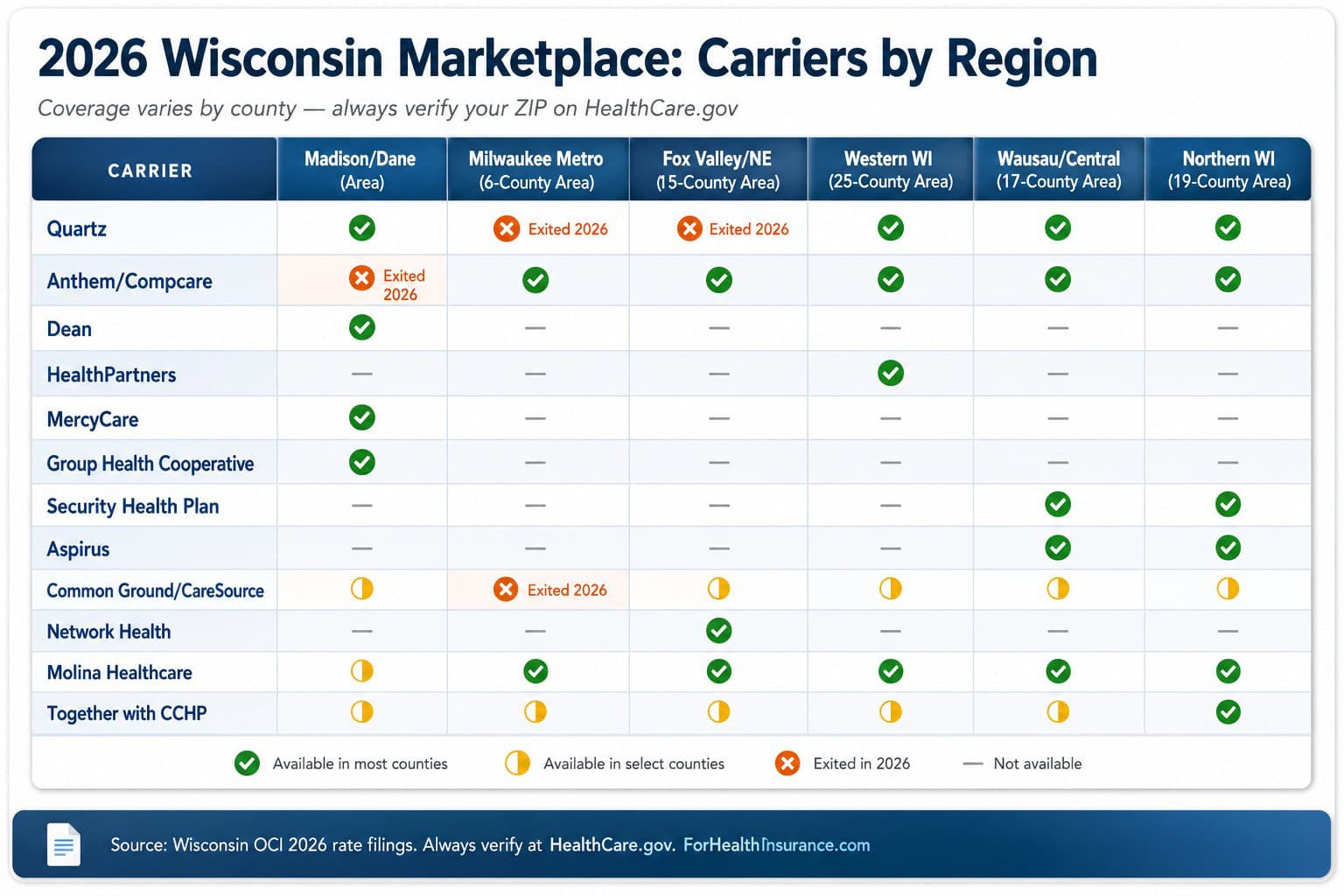
The 2026 health insurance marketplace Wisconsin operates lost two carriers entirely and saw major county-level exits from three more. Chorus Community Health Plans (Children’s Wisconsin) exited the marketplace, displacing approximately 11,000 eastern Wisconsin members. Anthem (Compcare) withdrew from 10 counties, Quartz withdrew from approximately 20 counties, and Common Ground Healthcare Cooperative (operated by CareSource) withdrew from 11 counties including Milwaukee, Racine, and Kenosha.
2026 health insurance marketplace Wisconsin county exits — verify your ZIP code
Anthem (Compcare) left: Columbia, Dane, Green, Iron, Langlade, Price, Rock, Taylor, Vilas, and Walworth counties. Quartz left: Adams, Brown, Calumet, Florence, Grant, Green Lake, Iowa, Jefferson, Juneau, Kenosha, Kewaunee, Lafayette, Manitowoc, Marinette, Marquette, Milwaukee, Oconto, Outagamie, and others. Common Ground (CareSource) left: Calumet, Dodge, Fond du Lac, Kenosha, Milwaukee, Outagamie, Racine, Sheboygan, Waupaca, Waushara, and Winnebago counties. Chorus Community Health Plans exited entirely — eastern Wisconsin enrollees needed to select a new carrier. Always filter HealthCare.gov plan results by your specific ZIP code before comparing premiums.
Quartz Health Benefit Plans
Quartz is a Madison-based, provider-sponsored health plan affiliated with UW Health and UnityPoint-Meriter. It remains the dominant marketplace carrier in Dane County and south-central Wisconsin. Quartz’s Quartz One network includes UW Health, UnityPoint-Meriter, Aurora Health Care (in eastern Wisconsin), and providers across Illinois, Iowa, and Minnesota. For 2026, Quartz withdrew from approximately 20 counties including Brown, Milwaukee, and Outagamie. The Quartz SimplyOne plan — built around Marshfield Clinic Health System — serves north-central Wisconsin counties.
- Dominant in Dane County / Madison
- UW Health + UnityPoint-Meriter network
- Withdrew from ~20 counties for 2026
- SimplyOne: Marshfield Clinic counties
Anthem Blue Cross Blue Shield (Compcare)
Anthem operates in Wisconsin as Compcare Health Services. Anthem received a 31.4 percent rate increase approval for 2026 — the largest of any Wisconsin carrier — and withdrew from 10 counties including Dane (Madison), Rock (Janesville), and Walworth. Outside those counties, Anthem offers POS and PPO-style plans with BlueCard national reciprocity across the Blue Cross Blue Shield Association. For Wisconsin residents who frequently travel or have providers out of state, Anthem’s BlueCard access is the most significant network differentiator among Wisconsin marketplace carriers.
- +31.4% rate increase for 2026
- Withdrew from Dane, Rock, Walworth + 7 others
- BlueCard national reciprocity
- POS and PPO plan designs
Dean Health Plan
Dean Health Plan is a south-central Wisconsin carrier built around the Dean Medical Group and SSM Health provider network, serving Madison and surrounding counties. Dean is SSM Health-affiliated and offers EPO plans with a tightly integrated physician and hospital network in Dane, Columbia, Rock, Jefferson, and adjacent counties. The 2026 Dean Health Plan rate increase was 13.14 percent — lower than Anthem and in line with Aspirus. Dean’s Silver EPO at $576 per month for a 40-year-old makes it one of the most price-competitive options in the Madison market.
- South-central WI (Madison-anchored)
- Dean Medical Group + SSM Health
- +13.14% rate increase for 2026
- Silver EPO: $576/mo for a 40-yr-old
Network Health
Network Health is a Wisconsin-based carrier headquartered in Menasha serving northeast Wisconsin — Appleton, Green Bay, Oshkosh, and the Fox Valley corridor. Network Health’s provider network includes Aurora Health Care, Bellin Health Systems, ThedaCare, Door County Medical Center, and Children’s Wisconsin for pediatric specialty care. The Chorus Community Health Plans exit for 2026 made Network Health the primary carrier for many former Chorus members in Calumet, Outagamie, and Winnebago counties, though Common Ground also withdrew from those counties, further concentrating the northeast Wisconsin market.
- Northeast WI (Fox Valley, Green Bay)
- Aurora, Bellin, ThedaCare networks
- Absorbed many former Chorus members
- Menasha-headquartered Wisconsin carrier
| 2026 Wisconsin Carrier | Primary Region | Network Anchor | 2026 Approved Rate Change |
|---|---|---|---|
| Anthem (Compcare) | Statewide minus 10 counties | BlueCard national | +31.4% |
| Quartz Health Benefit Plans | Madison + ~50 counties | UW Health, UnityPoint-Meriter | Variable by county |
| Dean Health Plan | South-central WI | Dean Medical, SSM Health | +13.14% |
| HealthPartners | Western + NW Wisconsin | HealthPartners, MN reciprocity | Variable |
| MercyCare | Southern Wisconsin | Mercy Health System | Variable |
| Group Health Cooperative | South-central WI (Madison) | GHC-SCW providers | Variable |
| Security Health Plan | Northern + central WI | Marshfield Clinic | Variable |
| Aspirus Arise Health Plan | North-central WI (Wausau) | Aspirus Health | +12.6% |
| Common Ground (CareSource) | Statewide minus 11 counties | CareSource-operated co-op | Variable |
| Network Health | Northeast WI (Fox Valley) | Aurora, Bellin, ThedaCare | Variable |
| Molina Healthcare | Southeast WI counties | Molina national network | Variable |
| Together with CCHP | Select counties | Children’s Community Health | Variable |
BadgerCare Plus vs the Wisconsin Marketplace: The 100-138% FPL Gap
Adults seeking the health insurance marketplace Wisconsin offers: Wisconsin covers adults under BadgerCare Plus up to 100 percent of the federal poverty level — approximately $15,650 for a single adult in 2026. Adults between 100 and 138 percent of FPL do not qualify for BadgerCare Plus, but qualify for heavily subsidized Wisconsin marketplace plans through HealthCare.gov. At 100 percent of FPL, premium tax credits and cost-sharing reductions typically bring Silver plan net premiums close to zero.
Wisconsin’s 100-138 percent FPL gap in the health insurance marketplace Wisconsin operates is the direct result of the state’s decision not to adopt full ACA Medicaid expansion. In the 40 states that fully expanded Medicaid, adults with income between 100 and 138 percent of FPL would qualify for Medicaid. In Wisconsin, they do not. They must use the HealthCare.gov marketplace, which does offer them substantial premium tax credits and cost-sharing reductions at this income level. A single adult in Madison earning $17,000 (about 108 percent of FPL) would not qualify for BadgerCare Plus but would qualify for a Silver plan with cost-sharing reductions that could bring their net monthly premium to $20 to $40 and their deductible to well under $1,000.
100-138% FPL marketplace eligibility in practice (2026)
A single adult earning $17,000/year (approximately 109% FPL) in Milwaukee: BadgerCare Plus — not eligible (above 100% FPL). HealthCare.gov marketplace — eligible for premium tax credits and Silver cost-sharing reductions. Estimated net Silver monthly premium after APTC: $20–$45/month. CSR Silver deductible: typically $150–$500 (vs. standard Silver ~$4,000+). A family of three earning $29,000/year (approximately 106% FPL) similarly finds the marketplace significantly more accessible than full-price coverage. The HealthCare.gov application screens for BadgerCare Plus eligibility automatically before showing marketplace plan options.
Get a 2026 Wisconsin Marketplace Quote
A licensed Wisconsin agent screens for BadgerCare Plus eligibility, calculates your exact 2026 subsidy across all 12 carriers, verifies your providers at UW Health, Aurora, Froedtert, Marshfield, or Bellin, and confirms coverage is available in your county before enrollment. Free, no obligation.
2026 Open Enrollment Dates and Special Enrollment Periods
Open enrollment for 2026 Wisconsin marketplace coverage ran November 1, 2025 through January 15, 2026 — that window is now closed. Open enrollment for 2027 plan coverage runs November 1 through December 15, 2026, under the federal rule shortening the window. Plans selected by December 15 take effect January 1. Outside open enrollment, Wisconsin residents enroll only through a Special Enrollment Period triggered by a qualifying life event.
The 2027 enrollment window (November 1 – December 15, 2026) is shorter than the window Wisconsin residents used for 2026 coverage, which ran through January 15. The Biden administration had extended the window to January 15 starting with the 2022 plan year; the federal rule change for 2027 returns it to December 15. Plans selected between December 16 and January 15 — which took effect February 1 under the extended window — are no longer available under the shortened schedule. Wisconsin residents who want January 1, 2027 effective dates must enroll by December 15, 2026.
Special Enrollment Periods (SEPs) are available year-round for Wisconsin residents who experience a qualifying life event. Common triggers include: loss of other coverage (job loss, COBRA expiration, aging off a parent’s plan at 26, loss of BadgerCare Plus eligibility), household changes (marriage, divorce, birth, adoption, death of a covered member), residence changes (move to a new Wisconsin ZIP code, move to Wisconsin from another state), and income changes that affect subsidy eligibility. SEPs typically run 60 days from the qualifying event date; documentation of the event must be uploaded to HealthCare.gov. Coverage under an SEP enrollment begins the first of the following month. BadgerCare Plus remains open year-round with no open enrollment requirement through ACCESS Wisconsin at access.wisconsin.gov.
Wisconsin Marketplace Subsidies in 2026
Health insurance marketplace Wisconsin subsidy eligibility runs from 100 to 400 percent of the federal poverty level — approximately $15,650 to $62,600 for a single adult in 2026. Advance Premium Tax Credits reduce monthly premiums; cost-sharing reductions on Silver plans reduce deductibles and out-of-pocket maximums for households between 100 and 250 percent of FPL. The 2025 expiration of enhanced premium tax credits returned the 400 percent subsidy cliff for 2026 Wisconsin enrollees.
The Advance Premium Tax Credit through the health insurance marketplace Wisconsin uses is calculated as the difference between the benchmark Silver plan premium in your rating area and a required contribution percentage of your household income — ranging from roughly 2 percent of income at 100 percent of FPL to 9.6 percent of income at 400 percent. Wisconsin’s benchmark Silver premiums vary by region and age: a 40-year-old in Madison has a lower benchmark than a 40-year-old in northern Wisconsin counties served by Security Health Plan or Aspirus. The KFF subsidy calculator provides state-specific estimates by age, income, and ZIP code. Actual subsidy amounts are determined when you file HealthCare.gov application — estimated amounts may differ from the calculator by a few dollars based on the most recent benchmark plan update.
Cost-sharing reductions are only available on Silver plans — they cannot be applied to Bronze, Gold, or Platinum tiers. A Wisconsin household between 100 and 150 percent of FPL on a CSR Silver plan may see deductibles as low as $150 to $300 and out-of-pocket maximums below $1,500, versus the standard Silver deductible of $4,000 to $5,500. For low-income Wisconsin Marketplace enrollees, the Silver plan with CSR is typically the highest-value option even if the net premium is slightly higher than a Bronze plan. For the full Wisconsin affordability analysis, see the affordable Wisconsin health insurance guide.
How to Enroll in the Wisconsin Health Insurance Marketplace
Enrolling in health insurance marketplace Wisconsin coverage takes five steps through HealthCare.gov: create or sign in to your account, complete the household and income application, review eligibility for BadgerCare Plus or premium tax credits, compare available plans filtered to your Wisconsin ZIP code with your subsidy applied, and select a plan. A licensed Wisconsin agent completes all five steps with you at no cost.
Step 1: Create or sign in to your HealthCare.gov account. Wisconsin residents who enrolled in 2025 or earlier have existing accounts; returning users can log in directly and begin the renewal or new plan selection. Step 2: Complete the household and income application — household size, tax-filing status, Wisconsin residency, modified adjusted gross income, and immigration status for all household members. HealthCare.gov auto-screens all applicants for BadgerCare Plus eligibility based on income before presenting marketplace plan options. Wisconsin residents below 100 percent of FPL are routed to BadgerCare Plus through the Wisconsin DHHR. Step 3: Review your eligibility determination — the platform calculates your Advance Premium Tax Credit amount and whether any household members qualify for cost-sharing reductions, BadgerCare Plus, or WCHIP separately.
Step 4: Compare available Wisconsin marketplace plans filtered to your ZIP code. This step is where most planning effort should focus: which carriers serve your county, which network covers your providers (verify UW Health, Aurora, Froedtert, Marshfield Clinic, Bellin, ThedaCare, or Aspirus affiliation specifically), and what the post-subsidy premium is for each metal tier. Step 5: Select a plan and confirm enrollment. Pay the first month’s premium to activate coverage — HealthCare.gov enrollment is not complete until the first premium is paid to the carrier. Coverage begins January 1 for open enrollment selections made by December 15, and the first of the following month for SEP enrollments. A licensed Wisconsin insurance agent or WisCovered.com navigator handles steps 1-5 at no charge — carrier compensation pays the broker, not the consumer.
Frequently Asked Questions
Common questions about the Wisconsin health insurance marketplace cover whether the state uses HealthCare.gov, which 12 carriers participate for 2026, when open enrollment runs, what the BadgerCare Plus income gap means for adults at 100-138 percent of FPL, and how to enroll through HealthCare.gov as a Wisconsin resident.
Does Wisconsin have its own health insurance marketplace or use HealthCare.gov?
Wisconsin uses HealthCare.gov — the federally facilitated marketplace platform — rather than operating its own state-based exchange. Wisconsin residents enroll, compare plans, apply for premium tax credits, and select coverage entirely through HealthCare.gov. There is no separate Wisconsin state portal. The Wisconsin Office of the Commissioner of Insurance approves carrier rate filings and oversees consumer protections, and WisCovered.com (operated by the OCI) provides Wisconsin-specific guidance and navigator resources. About 18 states plus DC operate state-based exchanges; Wisconsin has not pursued that transition.
Which carriers offer Wisconsin marketplace health insurance for 2026?
Twelve carriers offer 2026 Wisconsin marketplace plans through HealthCare.gov: Anthem Blue Cross Blue Shield (Compcare), Quartz Health Benefit Plans, Dean Health Plan, HealthPartners, MercyCare, Group Health Cooperative of South Central Wisconsin, Security Health Plan, Aspirus Arise Health Plan, Common Ground Healthcare Cooperative (operated by CareSource), Network Health, Molina Healthcare, and Together with CCHP. Two carriers exited for 2026: Chorus Community Health Plans (owned by Children’s Wisconsin), which displaced approximately 11,000 eastern Wisconsin members, and the combined county-level exits of Anthem, Quartz, and Common Ground from multiple Wisconsin counties.
When is open enrollment for the Wisconsin health insurance marketplace?
Open enrollment for 2026 Wisconsin coverage ran November 1, 2025 through January 15, 2026 — that window is now closed. Open enrollment for 2027 plan coverage is scheduled November 1, 2026 through December 15, 2026, under the federal rule change shortening the enrollment window. Plans selected by December 15 take effect January 1, 2027. Outside open enrollment, Wisconsin residents can enroll only through a Special Enrollment Period triggered by a qualifying life event such as job loss, marriage, birth, or move. BadgerCare Plus enrollment remains open year-round through ACCESS Wisconsin.
What is the Wisconsin BadgerCare Plus coverage gap at 100-138% FPL?
Wisconsin did not adopt full ACA Medicaid expansion to 138 percent of the federal poverty level. Instead, Wisconsin covers adults under BadgerCare Plus through a federal waiver up to 100 percent of FPL. Adults with household income between 100 and 138 percent of FPL — approximately $15,651 to $21,597 for a single adult in 2026 — do not qualify for BadgerCare Plus but can enroll in heavily subsidized marketplace plans through HealthCare.gov. At 100 percent of FPL, federal premium tax credits are available and often bring Silver plan net premiums close to zero after cost-sharing reductions are factored in. This 100-138 percent FPL band must use the marketplace; Wisconsin has no Medicaid safety net for these adults.
How do I enroll in Wisconsin marketplace health insurance?
Enroll in Wisconsin marketplace health insurance through HealthCare.gov. Create or sign in to a HealthCare.gov account, complete the household and income application, review your eligibility result for BadgerCare Plus or premium tax credits, compare available plans filtered to your Wisconsin ZIP code with your subsidy applied, and select a plan. Coverage begins the first of the month following enrollment for Special Enrollment Period enrollments, or January 1 for plans selected during open enrollment by December 15. A licensed Wisconsin insurance agent or certified navigator can complete the enrollment process with you at no cost — broker compensation is paid by the carrier.
Compare 2026 Wisconsin Marketplace Plans
A licensed Wisconsin agent screens for BadgerCare Plus eligibility, calculates your exact subsidy across all 12 Wisconsin health insurance marketplace carriers, verifies your providers before enrollment, and confirms your county has coverage. Free, no obligation for Wisconsin residents.
Free health insurance marketplace Wisconsin comparison — BadgerCare Plus, subsidies, and all 12 carriers in one call.
More on Wisconsin Health Insurance
State pillar — all coverage paths, BadgerCare Plus, ETF group plans, and carriers.
Wisconsin Individual & Family PlansIndividual marketplace plans, self-employed strategies, and family coverage in Wisconsin.
Affordable Wisconsin Health InsuranceBadgerCare Plus gap, subsidy math, CSR Silver, and 2026 cost benchmarks.
Wisconsin Small Business Health InsuranceGroup plans, ICHRA, QSEHRA, SHOP tax credit for Wisconsin employers.
Best Health Insurance in WisconsinCarrier-by-carrier comparison, PPO options, and network analysis for 2026.
PPO Health Insurance PlansNational PPO options for Wisconsin residents who need out-of-state provider access.
HealthCare.gov (Official)The federal marketplace enrollment portal used by Wisconsin residents.
Wisconsin Short-Term Health InsuranceLimited-duration plans for coverage gaps — when short-term makes sense vs a marketplace SEP.
Broker Disclosure
ForHealthInsurance.com is an independent health insurance agency serving Wisconsin residents. We are not affiliated with any carrier or government agency. We help you compare plans and enroll in coverage that meets your needs at no extra cost to you.