Affordable Health Insurance Wisconsin 2026 Guide
Affordable health insurance Wisconsin residents can access in 2026 is shaped by a coverage structure unlike most states. BadgerCare Plus covers adults only to 100 percent of the federal poverty level — approximately $15,650 for a single adult — rather than the 138 percent used in full ACA Medicaid expansion states. This creates a distinctive 100-138 percent FPL gap where adults earn too much for BadgerCare Plus but qualify for heavily subsidized marketplace coverage through HealthCare.gov, often at near-zero net premiums with Silver cost-sharing reductions. Above 138 percent of FPL and up to 400 percent, federal premium tax credits scale the cost of marketplace plans with income; Wisconsin’s subsidies are meaningful because the 2026 Wisconsin Healthcare Stability Plan reinsurance program has kept underlying premiums lower than they would otherwise be despite the 22.8 percent weighted average rate increase. Above 400 percent of FPL, the 2025 expiration of enhanced premium tax credits returned the subsidy cliff — full-price Wisconsin marketplace premiums apply. Children in Wisconsin qualify for BadgerCare Plus up to approximately 300 percent of FPL. Wisconsin also has no state individual mandate penalty, meaning the decision to enroll is driven by financial protection, not tax compliance. This guide maps every affordable health insurance Wisconsin path for 2026 with real income examples for Madison, Milwaukee, Green Bay, and rural Wisconsin households.

What brings you here today?
Do I qualify for BadgerCare Plus?
Wisconsin’s 100% FPL limit and the 100-138% gap
Check eligibility ↓Affordable Health Insurance Wisconsin: The Income Path Map
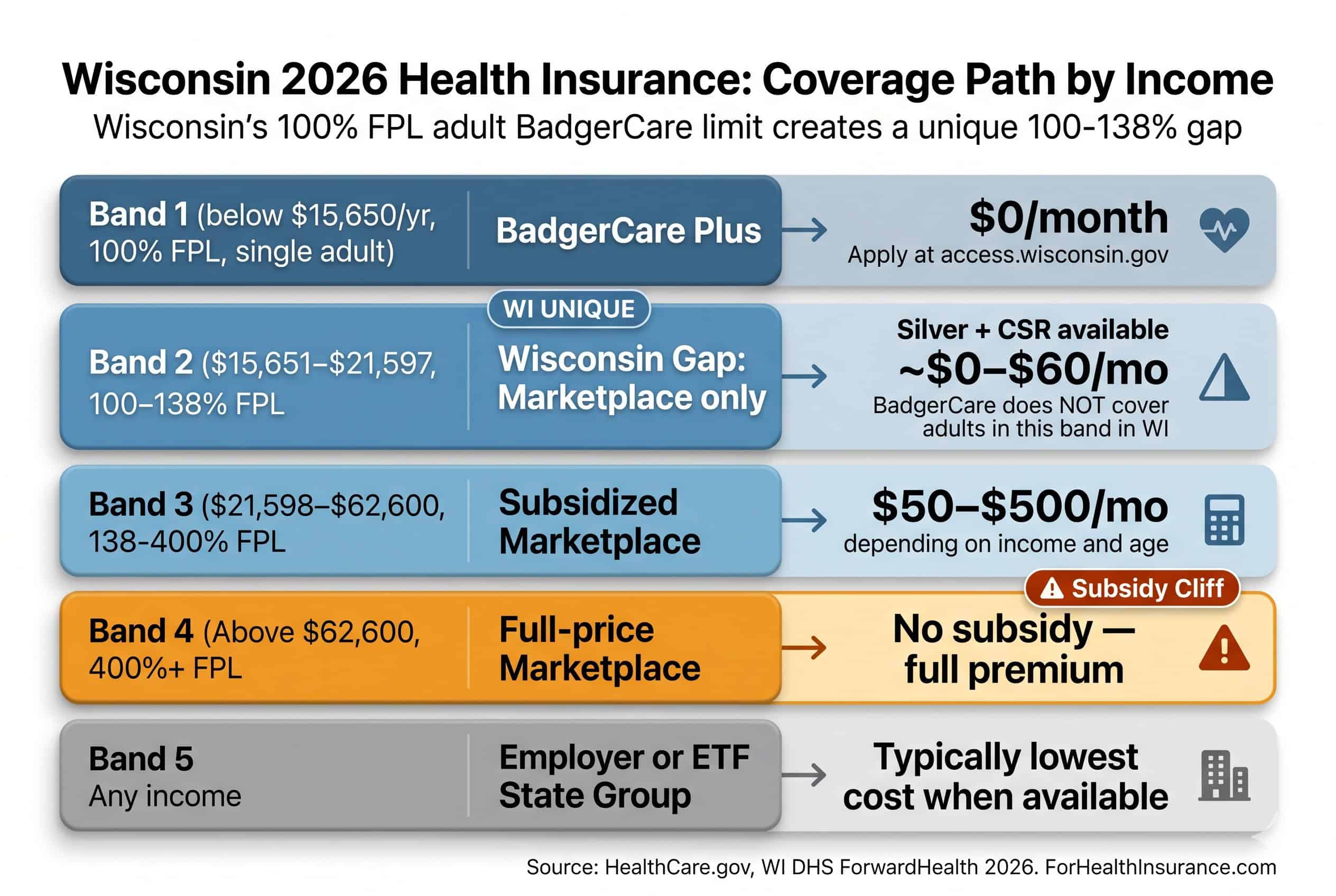
Affordable health insurance Wisconsin residents can access follows income. Below 100 percent of FPL, BadgerCare Plus is free. Between 100 and 138 percent of FPL — Wisconsin’s unique gap — only the marketplace is available, but heavily subsidized Silver plans typically cost $0 to $60 per month. Between 138 and 400 percent of FPL, marketplace premium tax credits scale costs down. Above 400 percent of FPL, the 2026 subsidy cliff returns full-price premiums.
Wisconsin’s income path for affordable health insurance is shaped by the state’s decision not to adopt full ACA Medicaid expansion to 138 percent of FPL. Most states that expanded Medicaid route adults between 100 and 138 percent of FPL into Medicaid at no cost. Wisconsin routes them to the HealthCare.gov marketplace, where they qualify for premium tax credits and Silver cost-sharing reductions that bring costs very close to zero — but where they must actively enroll and maintain coverage. The Wisconsin Department of Health Services BadgerCare Plus program at dhs.wisconsin.gov is the starting point for income verification; HealthCare.gov screens all applicants for BadgerCare Plus before showing marketplace options. Wisconsin has no state individual mandate penalty — the coverage decision is economic, not legal.
BadgerCare Plus: Free Wisconsin Medicaid at 100% FPL
BadgerCare Plus covers adults earning up to 100 percent of FPL — approximately $15,650 for a single adult and $32,150 for a family of four in 2026 — at no cost. Children and pregnant women qualify up to approximately 300 percent of FPL. BadgerCare Plus is administered through the ForwardHealth system and enrolls through ACCESS Wisconsin year-round. Most members receive care through BadgerCare Plus managed care organizations including UnitedHealthcare Community Plan, Anthem Blue Cross Blue Shield, and others.
BadgerCare Plus is the most affordable health insurance Wisconsin residents below 100 percent of FPL can access — it is free, covers preventive care, prescription drugs, mental health, maternity, and emergency services, and has no open enrollment restriction. Adults who qualify should apply rather than purchasing marketplace coverage, as marketplace plans impose premiums and cost-sharing that BadgerCare Plus does not. Applications are processed through ACCESS Wisconsin at access.wisconsin.gov, by calling the statewide enrollment number at 1-800-362-3002, or in person at local county or tribal Income Maintenance agencies across Wisconsin. Coverage is typically retroactive up to three months for documented medical needs.
2026 BadgerCare Plus income limits
Single adult: up to $15,650/year ($1,304/month). Household of 2: up to $21,150/year. Household of 3: up to $26,650/year. Family of 4: up to $32,150/year. Children and pregnant women: up to ~300% FPL ($96,450 for family of 4). Income uses MAGI (Modified Adjusted Gross Income) methodology. Apply at access.wisconsin.gov or 1-800-362-3002. ForwardHealth ID cards are mailed after enrollment approval.
The 100-138% FPL gap: marketplace only
Adults earning $15,651 to $21,597 (single) in 2026 fall into Wisconsin’s unique gap. BadgerCare Plus doesn’t cover them; HealthCare.gov marketplace does — with strong subsidies. A single adult at 110% FPL ($17,215) typically pays $0 to $40/month for a Silver plan after APTC and cost-sharing reductions bring the deductible to $150-$500. This is distinctly better than in non-expansion states with a true coverage gap, but requires active HealthCare.gov enrollment.
WCHIP: children up to ~300% FPL
WCHIP (Wisconsin’s Children’s Health Insurance Program, integrated into BadgerCare Plus since 2021) covers uninsured children in families earning too much for traditional Medicaid but unable to afford private coverage — up to approximately 300% FPL ($96,450 for a family of four). WCHIP coverage for children costs $0 to $35 per month depending on income. Children enrolled in WCHIP receive the same benefits as BadgerCare Plus Medicaid including dental, vision, and behavioral health. Apply through the same ACCESS Wisconsin portal.
BadgerCare Plus managed care organizations
Most BadgerCare Plus members in Wisconsin receive care through managed care health plans — MCOs that contract with the state to coordinate Medicaid benefits. 2026 Wisconsin BadgerCare Plus MCOs vary by region and include UnitedHealthcare Community Plan, Anthem Blue Cross Blue Shield, Children’s Community Health Plan, MercyCare Health Plans, Molina Healthcare, Network Health, Security Health Plan, and Trilogy Health Solutions. Members choose an MCO at enrollment; the ForwardHealth system guides the selection based on available providers in the member’s county.
Wisconsin Marketplace Subsidies: How Much Can You Save in 2026?
Wisconsin marketplace Advance Premium Tax Credits run from 100 to 400 percent of FPL — approximately $15,650 to $62,600 for a single adult in 2026. Cost-sharing reductions on Silver plans further reduce deductibles and out-of-pocket costs for households between 100 and 250 percent of FPL. Wisconsin’s reinsurance program keeps benchmark premiums lower, which means smaller APTC amounts than states with higher benchmark premiums — but also lower full-price premiums for enrollees above the cliff.
| Wisconsin Household Scenario (2026) | Full-Price Silver/mo | Est. APTC/mo | Net Monthly Cost |
|---|---|---|---|
| Single adult, 30, $17,000/yr (~109% FPL), Milwaukee | ~$430 | ~$400 | ~$0–$30 (+ CSR) |
| Single adult, 40, $28,000/yr (~179% FPL), Madison | ~$547 | ~$440 | ~$107 |
| Single adult, 40, $40,000/yr (~256% FPL), Green Bay | ~$547 | ~$280 | ~$267 |
| Single adult, 55, $50,000/yr (~320% FPL), Wausau | ~$900 | ~$580 | ~$320 |
| Couple (45/47), $65,000/yr (~280% FPL), Eau Claire | ~$1,300 | ~$920 | ~$380 |
| Family of 4, $55,000/yr (~172% FPL), Appleton | ~$1,600 | ~$1,440 | ~$160 (+ CSR) |
| Single adult, 40, $65,000/yr (~416% FPL) — above cliff | ~$547 | $0 | ~$547 full price |
Cost-sharing reductions (CSRs) are only available on Silver plans for Wisconsin enrollees between 100 and 250 percent of FPL. At 100 to 150 percent of FPL, CSR Silver plans can bring deductibles as low as $150 and out-of-pocket maximums below $1,500 — transforming a standard Silver plan ($3,000-$5,000 deductible) into near-Medicaid coverage levels at near-zero monthly cost. For a Milwaukee single adult at 120 percent of FPL (about $18,780 per year), the combination of APTC and CSR on a MercyCare or Dean Health Plan Silver makes affordable health insurance Wisconsin residents at that income level a practical reality rather than an aspirational one. According to KFF marketplace enrollment data, Wisconsin enrollees below 250 percent of FPL who select Silver plans with CSR access the most cost-effective coverage available on the private market.
Find Affordable Health Insurance in Wisconsin
A licensed Wisconsin agent screens for BadgerCare Plus eligibility, calculates your exact 2026 subsidy and CSR benefits, and compares affordable health insurance Wisconsin plans across all 12 carriers — including MercyCare at $547, Dean at $576, and HealthPartners PPO at $619. Free, no obligation.
The 2026 Wisconsin Subsidy Cliff and Who It Hits
The 2026 Wisconsin subsidy cliff cuts off Advance Premium Tax Credits at 400 percent of FPL — approximately $62,600 for a single adult and $129,200 for a family of four. At 401 percent, full marketplace premiums apply. The cliff returned in 2026 after enhanced credits expired at the end of 2025. Wisconsin’s reinsurance program moderates the severity compared to high-premium states, but affected households still face thousands of dollars of annual exposure.
Who the 2026 Wisconsin subsidy cliff hits hardest
Pre-retirement adults aged 55-64 in Wisconsin whose income falls just above 400 percent of FPL are the most exposed. A single 58-year-old in Madison earning $65,000 faces a full-price MercyCare Silver HMO at approximately $1,100 per month — roughly $13,200 per year — with no subsidy offset. The same individual at $62,000 (just below the cliff) pays approximately 9.6 percent of income — about $496 per month — after APTC. The $3,000 income difference produces $7,000 in annual premium savings. Self-employed Wisconsin residents who can control their net Schedule C income should model subsidy optimization carefully around the 400 percent FPL boundary. Early retirees in Wisconsin drawing from retirement accounts before Medicare eligibility at 65 face similar planning considerations for Roth conversions and capital gains timing.
Every Wisconsin Coverage Path: 2026 Monthly Cost Comparison
Every affordable health insurance Wisconsin path carries a different monthly cost by income. BadgerCare Plus is free below 100 percent of FPL. The 100-138 percent FPL gap band uses marketplace Silver with CSR at near-zero net cost. Subsidized marketplace coverage scales from $0-$100 at 138-200 percent to $200-$500 at 300-400 percent of FPL. Full-price marketplace coverage applies above 400 percent FPL.
| Coverage Path | Who Qualifies | Typical Monthly Cost (2026) | Key Feature |
|---|---|---|---|
| BadgerCare Plus (Medicaid) | Adults ≤100% FPL; children/pregnant ≤~300% FPL | $0 | Free, year-round enrollment |
| WCHIP (children) | Children, family income ≤~300% FPL | $0–$35/mo | Dental + vision included |
| Marketplace Silver + CSR (WI gap band) | 100%–150% FPL adults | $0–$60/mo after APTC + CSR | Deductible $150–$500 |
| Marketplace Silver subsidized | 150%–400% FPL | $50–$500/mo after APTC | ACA essential benefits |
| Marketplace Bronze subsidized | 100%–400% FPL | $0–$200/mo after APTC | Lowest premium, high deductible |
| Marketplace full price (Silver) | Above 400% FPL, no APTC | $547–$766/mo (40-yr-old) | No subsidy offset after cliff |
| ETF State Group (WI employees) | State, UW, local gov employees | $50–$430/mo (employee share) | Public employer benefit |
| Employer-sponsored (private) | W-2 employees with offer | $100–$300/mo (employee share) | Pre-tax payroll deduction |
Wisconsin residents who fall just above the subsidy cliff at 400 percent of FPL and cannot access employer coverage have a limited set of options for affordable health insurance in Wisconsin. Off-exchange coverage — purchased directly from a carrier rather than through HealthCare.gov — is available at the same full-price premium without a premium tax credit. An HSA-eligible Bronze plan paired with a Health Savings Account provides some tax mitigation: HSA contributions of up to $4,300 (single) or $8,550 (family) in 2026 are tax-deductible, reducing effective premium costs for those in higher tax brackets. Self-employed Wisconsin residents near the cliff should model whether reducing net Schedule C income through retirement contributions (SEP-IRA, solo 401(k)) or timing business deductions can move MAGI below 400 percent of FPL and restore APTC eligibility.
Frequently Asked Questions
Common questions about affordable health insurance Wisconsin residents ask cover how to get free BadgerCare Plus coverage, what the 100-138 percent FPL gap means in practice, what the cheapest Wisconsin marketplace option costs, whether Wisconsin has a coverage penalty, and how the 2026 subsidy cliff affects Wisconsin households near 400 percent of FPL.
How do I get free health insurance in Wisconsin?
Free health insurance in Wisconsin is available through BadgerCare Plus — the state’s Medicaid program administered through the ForwardHealth system — for adults earning up to 100 percent of the federal poverty level (approximately $15,650 for a single adult in 2026). Children and pregnant women qualify up to approximately 300 percent of FPL. Apply through ACCESS Wisconsin at access.wisconsin.gov or call 1-800-362-3002. BadgerCare Plus enrollment is year-round with no open enrollment window. Adults between 100 and 138 percent of FPL do not qualify for BadgerCare Plus but can access heavily subsidized marketplace plans on HealthCare.gov — often at $0 to $60 per month after premium tax credits and Silver cost-sharing reductions.
What is the Wisconsin 100-138% FPL coverage gap?
Wisconsin’s 100-138 percent FPL coverage gap is the income band where adults earn too much for BadgerCare Plus (which stops at 100 percent FPL for adults) but qualify for heavily subsidized marketplace coverage on HealthCare.gov. In 2026, this band runs from approximately $15,651 to $21,597 for a single adult. In states that fully expanded Medicaid to 138 percent of FPL, adults in this income range would qualify for Medicaid. In Wisconsin, they do not — but they qualify for strong premium tax credits and Silver cost-sharing reductions on HealthCare.gov, typically bringing net Silver premiums to $0 to $60 per month with deductibles as low as $150 to $500.
What is the cheapest health insurance in Wisconsin?
The cheapest health insurance in Wisconsin depends on income. BadgerCare Plus is free for adults earning below 100 percent of FPL. For Wisconsin adults above 100 percent of FPL who qualify for marketplace subsidies, a subsidized Bronze plan is typically the lowest monthly premium option — often $0 to $80 per month for enrollees between 100 and 250 percent of FPL. A subsidized Silver plan with cost-sharing reductions is often the best overall value for enrollees at 100 to 250 percent of FPL, with net premiums of $20 to $150 and deductibles as low as $150. At full price without subsidies, MercyCare’s Silver HMO at $547 per month for a 40-year-old is the lowest among Wisconsin marketplace carriers.
Does Wisconsin have a penalty for not having health insurance?
No. Wisconsin does not have a state individual mandate penalty for going uninsured. The federal individual mandate penalty has been $0 since 2019. Wisconsin residents who go without qualifying health insurance face no tax penalty at the state or federal level. Wisconsin is among the majority of states that have not enacted their own coverage requirement, unlike California, Massachusetts, New Jersey, Rhode Island, Vermont, and Washington DC. However, uninsured Wisconsin residents remain fully liable for any medical costs incurred while uninsured — a single emergency hospitalization at UW Health, Aurora, Froedtert, or Aspirus can result in bills of $20,000 to $100,000 or more.
How does the 2026 Wisconsin subsidy cliff affect coverage costs?
The 2026 Wisconsin subsidy cliff occurs at 400 percent of the federal poverty level — approximately $62,600 for a single adult and $129,200 for a family of four. At or below 400 percent of FPL, Advance Premium Tax Credits are available and scale with income. At 401 percent of FPL, no APTC is available and the full marketplace premium applies. The cliff sharpened in 2026 after enhanced premium tax credits that had temporarily eliminated it expired at the end of 2025. A single 55-year-old in Madison earning $65,000 pays the full $1,100-plus monthly Silver premium with no subsidy, while the same person earning $62,000 (just under the cliff) pays roughly 9.6 percent of income — about $496 per month — after APTC.
Get Affordable Health Insurance in Wisconsin
A licensed Wisconsin agent screens for BadgerCare Plus eligibility, calculates your exact subsidy and CSR benefits, and compares affordable health insurance Wisconsin plans across all 12 carriers. Free, no obligation for Wisconsin residents.
Free Wisconsin coverage comparison — BadgerCare Plus, WCHIP, subsidized marketplace, and every affordable path in one call.
More on Wisconsin Health Insurance
All Wisconsin coverage paths — BadgerCare Plus, marketplace, ETF group, and Medicare.
Wisconsin Marketplace GuideHealthCare.gov enrollment, 12 carriers, 2026 county exits, and open enrollment dates.
Wisconsin Individual Health InsuranceIndividual and self-employed plans, family coverage, and metal tier comparison.
Best Health Insurance in WisconsinCarrier-by-carrier comparison and PPO options for Wisconsin residents in 2026.
Wisconsin Small Business Health InsuranceGroup plans, ICHRA, SHOP tax credit, and carrier options for WI employers.
Wisconsin Short-Term Health InsuranceGap coverage options and when short-term makes sense vs a marketplace SEP.
HealthCare.gov (Official)Enroll in Wisconsin marketplace coverage or check BadgerCare Plus eligibility.
PPO Health Insurance PlansNational PPO options for Wisconsin residents who need out-of-state provider access.
Broker Disclosure
ForHealthInsurance.com is an independent health insurance agency serving Wisconsin residents. We are not affiliated with any carrier or government agency. We help you compare plans and enroll in coverage that meets your needs at no extra cost to you.