The Self-Employed Health Insurance Deduction: 2026 Guide

The self employed health insurance deduction is one of the most valuable tax breaks available to people who work for themselves — yet it’s also one of the most misunderstood. If you’re self-employed and pay for your own coverage, you may be able to deduct 100% of your premiums, lowering your income tax without ever itemizing. This guide explains exactly how the deduction works in 2026, who qualifies, what counts, the limits that trip people up, and how to claim it correctly.
Is Health Insurance Tax-Deductible for the Self-Employed?
Yes. If you’re self-employed and show a net profit, you can generally deduct 100% of the premiums you pay for medical, dental, vision, and qualified long-term care insurance — for yourself, your spouse, your dependents, and children under 27. It’s an above-the-line deduction, so you get the benefit even if you don’t itemize.
This is a genuinely powerful benefit. Most taxpayers can only deduct medical costs if they itemize and their expenses exceed 7.5% of their income, a threshold set out in IRS Publication 502. The self-employed health insurance deduction skips both hurdles: it’s taken “above the line,” directly reducing your adjusted gross income (AGI). A lower AGI can also ripple into other tax benefits that phase out at higher income levels.
What Is the Self-Employed Health Insurance Deduction?
The self-employed health insurance deduction lets self-employed individuals subtract the health premiums they pay from their taxable income on Schedule 1 (Form 1040), line 17. Unlike the itemized medical deduction, it reduces adjusted gross income directly and doesn’t require you to itemize or clear any percentage-of-income threshold.
In plain terms: the government recognizes that self-employed people don’t have an employer covering part of their premiums, so it lets you deduct what you pay as an adjustment to income. The deduction applies to premiums for you and your family, and it covers more than just medical insurance — dental, vision, and qualified long-term care coverage count too.
Who Qualifies for the Deduction?
You qualify if you have net profit from self-employment reported on Schedule C or F, are a partner with self-employment earnings, or are a more-than-2% S-corporation shareholder with premiums reported on your W-2. You must not have been eligible for employer-subsidized coverage through your own or a spouse’s job during the months you’re claiming.
Specifically, one of these must be true:
- You were self-employed with a net profit reported on Schedule C or Schedule F.
- You were a partner with net self-employment earnings reported on Schedule K-1.
- You were a more-than-2% shareholder in an S-corporation and had your premiums paid or reimbursed by the S-corp and reported on your W-2.
The plan generally must be established under your business (or considered to be). If you’re an S-corp shareholder, the premiums need to be included in your W-2 wages for the deduction to apply.
Need a Plan You Can Deduct?
The deduction only helps if you’re paying for your own coverage. Compare self-employed health plans available in your area, check that your doctors are in network, and get free help finding a plan that fits your budget and qualifies for the premium deduction — at no cost to you.
What Premiums Can You Deduct?
You can deduct premiums for medical, dental, and vision insurance, plus qualified long-term care insurance (subject to age-based dollar caps). The coverage can be for you, your spouse, your dependents, and any child who was under age 27 at the end of the year — even if that child isn’t claimed as your dependent.
Qualifying premiums include:
- Medical/health insurance premiums (including marketplace and off-exchange plans)
- Dental insurance premiums
- Vision insurance premiums
- Qualified long-term care insurance premiums, up to the age-based caps below
Long-term care premiums are limited by age. For 2025, the annual caps are:
| Age at year-end | 2025 LTC premium cap |
|---|---|
| 40 or younger | $480 |
| 41–50 | $900 |
| 51–60 | $1,800 |
| 61–70 | $4,810 |
| 71 or older | $6,020 |
The Limits That Trip People Up
Two limits on the self employed health insurance deduction catch most people: first, the deduction can’t exceed your net profit from self-employment, so a business loss means no deduction that year. Second, you can’t claim it for any month you were eligible for an employer-subsidized plan through your own or your spouse’s job — even if you didn’t enroll in that plan.
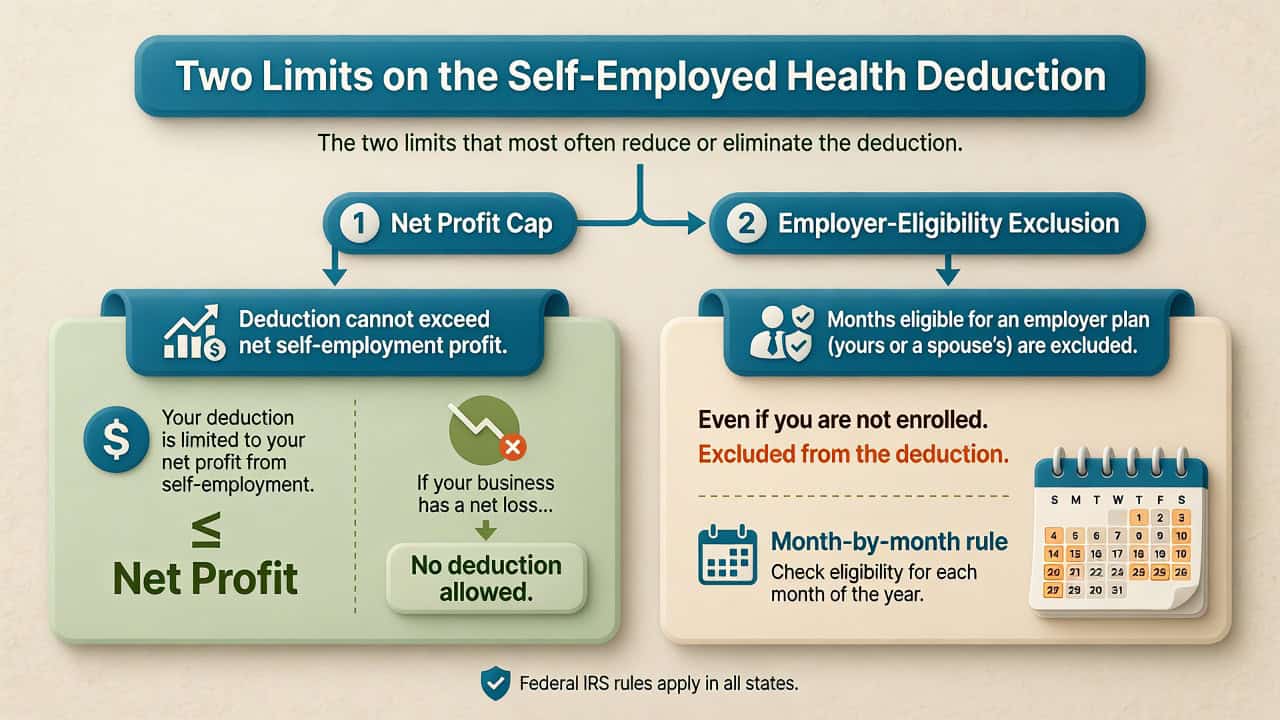
Here’s how each limit works:
- Net-profit cap. Your deduction can’t be more than your net earnings from the business under which the plan is established. If your business had a loss for the year, you can’t take the deduction at all. This prevents the deduction from creating or deepening a business loss.
- Employer-eligibility exclusion. For any month you (or your spouse) were eligible to participate in an employer-subsidized health plan, you can’t count that month’s premiums — whether or not you actually enrolled. The deduction is figured month by month.
Worked example: a consultant deducts a full year of premiums
Devi is a self-employed consultant who reports a net profit of $70,000 on Schedule C and pays $6,600 in medical and dental premiums for the year. Because she wasn’t eligible for any employer plan and her premiums ($6,600) are well under her net profit ($70,000), she can deduct the full 100% above the line on Schedule 1, line 17 — lowering her adjusted gross income by $6,600 without itemizing. Note the deduction cuts her income tax only; her self-employment tax on Schedule SE is figured separately and is unaffected.
How to Claim It: Form 7206 and Schedule 1
Starting with recent tax years, you calculate the deduction on Form 7206 and report the result on Schedule 1 (Form 1040), line 17. Form 7206 replaced the old worksheet in IRS Publication 535. If you have more than one business or other complicating factors, Form 7206 walks through the calculation step by step.
The basic flow:
- Total your qualifying premiums for the year (medical, dental, vision, and any eligible long-term care within the age caps).
- Apply the month-by-month employer-eligibility exclusion.
- Use Form 7206 to compute the allowable amount, capped at your net self-employment profit.
- Report the result on Schedule 1 (Form 1040), line 17.
You cannot deduct the same premiums twice — if you claim them here, you can’t also include them as itemized medical expenses on Schedule A. Because tax situations vary, it’s wise to confirm your specific numbers with a tax professional. For every way to enroll, see the health insurance options for the self-employed.
Frequently Asked Questions
Is health insurance tax-deductible for the self-employed?
Yes. If you’re self-employed with a net profit, you can generally deduct 100% of the premiums you pay for medical, dental, vision, and qualified long-term care insurance for yourself, your spouse, and your dependents. It’s an above-the-line deduction claimed on Schedule 1, so you don’t have to itemize.
What is the self-employed health insurance deduction?
The self employed health insurance deduction is a tax break that lets self-employed people subtract the health insurance premiums they pay from their taxable income. Unlike the medical expense itemized deduction, it’s taken above the line on Schedule 1, line 17, lowering your adjusted gross income directly.
How much of my health insurance can I deduct if self-employed?
You can generally deduct 100% of qualifying premiums, but the deduction can’t exceed your net profit from self-employment. If your business had a loss, you can’t take the deduction that year. Long-term care premiums are also subject to age-based dollar caps.
Does the self-employed health insurance deduction lower self-employment tax?
No. The deduction reduces your income tax by lowering your adjusted gross income, but it does not reduce your self-employment tax. Your Schedule SE calculation is figured separately and isn’t affected by this deduction.
Can I take the deduction if I was eligible for an employer plan?
No. You can’t take the deduction for any month you were eligible to participate in an employer-subsidized health plan through your own job or your spouse’s employer, even if you chose not to enroll. The deduction is figured month by month.
What form do I use to claim the self-employed health insurance deduction?
You use Form 7206 to calculate the deduction, then report the result on Schedule 1 (Form 1040), line 17. Form 7206 replaced the old worksheet that used to appear in IRS Publication 535.
Related Self-Employed Health Insurance Resources
The deduction is one piece of the tax picture. Explore the rest of the self-employed cluster — the main guide, the HSA that stacks a second tax break on top, what coverage costs, and how to choose the best plan.
The complete guide to plans, costs, and coverage options.
HSA for the Self-EmployedA second tax break that stacks on top of your premium deduction.
Self-Employed Health Insurance CostWhat coverage really costs in 2026 and how to lower it.
Best Health Insurance for the Self-EmployedHow to choose the plan that fits your doctors and budget.
Get Coverage You Can Deduct
An off-exchange plan qualifies for the self-employed deduction just like any marketplace plan. Compare your options, get expert help confirming eligibility, and find a plan that fits how you actually use coverage — all at no cost to you, so the deduction works as hard as it can.
Broker Disclosure
ForHealthInsurance.com is an independent health insurance agency serving residents nationwide. We are not affiliated with any carrier or government agency. We help you compare plans and enroll in coverage that meets your needs at no extra cost to you.