HSA for the Self-Employed: The Complete 2026 Guide

A health savings account for self employed workers is one of the most tax-efficient tools available: if you work for yourself, you shoulder the full cost of your health coverage — but you also get access to one of the most tax-efficient tools in the entire tax code: the health savings account. This guide walks through exactly how a self-employed HSA works in 2026, who qualifies, how to open one without an employer, the current contribution limits, and how the deduction lowers your tax bill. HSAs pair with high-deductible health plans, and choosing the right qualifying plan is where a licensed advisor can help.
What Is an HSA and How Does It Work?
A health savings account is a tax-advantaged account you can open only if you’re enrolled in a qualifying high-deductible health plan. Money goes in pre-tax or tax-deductible, grows tax-free, and comes out tax-free for qualified medical expenses. Unlike an FSA, the balance rolls over every year and stays with you for life.
Think of an HSA as a personal savings account with three tax perks stacked on top. You contribute money you haven’t paid income tax on, that money can be invested and grow without being taxed, and when you spend it on qualified medical costs, you pay no tax on the withdrawal. That combination — often called the “triple tax advantage” — is unusually generous, and it’s especially valuable for self-employed people who don’t have an employer subsidizing their premiums.
The account is yours, not tied to any job or employer. You own it, you control it, and it follows you through career changes, retirement, and beyond. For someone who is self-employed, that portability is a natural fit — there’s no HR department in the picture to begin with.
Can a Self-Employed Person Have an HSA? (Eligibility)
Yes — a health savings account for self employed individuals is fully allowed. The requirement isn’t about employment status; it’s about your health plan. As long as you’re covered by an HSA-eligible high-deductible health plan and don’t have disqualifying coverage like Medicare or a general-purpose FSA, you qualify to open and fund an HSA on your own.
To be HSA-eligible in 2026, your health plan must meet the IRS definition of a high-deductible health plan (HDHP), spelled out in IRS Publication 969:
- Minimum deductible: at least $1,700 for self-only coverage, or $3,400 for family coverage.
- Out-of-pocket maximum: no higher than $8,500 for self-only coverage, or $17,000 for family coverage.
You also cannot have other “first-dollar” coverage that disqualifies you. The most common disqualifiers are being enrolled in Medicare, being claimed as a dependent on someone else’s tax return, or having a general-purpose health FSA. If none of those apply and you have a qualifying HDHP, you’re eligible — no employer required.
Not Sure If Your Plan Is HSA-Eligible?
A licensed advisor can compare HSA-qualified high-deductible health plans available in your area and confirm a plan meets the IRS eligibility rules before you open an account, so you don’t lose the tax advantage on a technicality. Enrollment help is available at no cost to you.
How to Open an HSA Without an Employer
You can open your own HSA without an employer in three steps: enroll in an HSA-eligible high-deductible health plan, choose an HSA provider (a bank, credit union, or dedicated HSA custodian), and fund the account up to the annual limit. Because HSAs are individually owned, the process is as straightforward as opening a personal savings account.
Here’s the process for the self-employed, step by step:
- Get an HSA-eligible HDHP. This is the gatekeeper step. You can’t open or contribute to an HSA without qualifying coverage first. If you don’t already have a high-deductible plan, this is where a licensed advisor can help you find one that qualifies.
- Choose an HSA provider. Many banks, credit unions, and specialized HSA custodians offer accounts. Compare monthly fees, interest rates, and — if you plan to invest the balance for the long term — the available investment options.
- Open and fund the account. Opening an HSA is similar to opening any deposit account. Once it’s open, you can contribute at any time during the year, up to the annual limit, either in a lump sum or in smaller deposits.
- Keep your receipts. Track qualified medical expenses so your withdrawals stay tax-free and you’re prepared if the IRS ever asks.
2026 HSA Contribution Limits for the Self-Employed
For 2026, self-employed individuals can contribute up to $4,400 to an HSA with self-only coverage, or $8,750 with family coverage. If you’re 55 or older and not enrolled in Medicare, you can add a $1,000 catch-up contribution. These limits apply whether your coverage comes through you personally or a self-employed household.
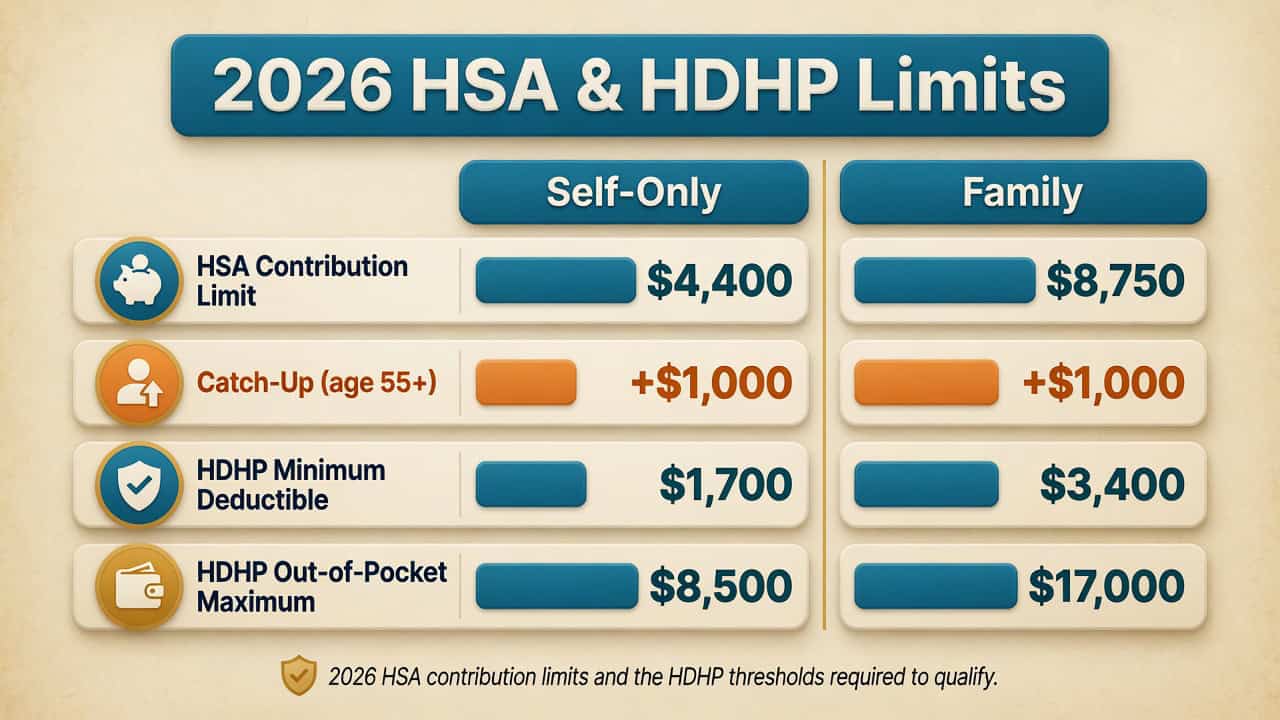
| 2026 Limit | Self-Only | Family |
|---|---|---|
| HSA contribution limit | $4,400 | $8,750 |
| Catch-up (age 55+) | +$1,000 | +$1,000 |
| HDHP minimum deductible | $1,700 | $3,400 |
| HDHP out-of-pocket maximum | $8,500 | $17,000 |
A few rules that matter for the self-employed: your contribution limit is generally prorated by the number of months you were HSA-eligible, unless you use the “last-month rule” and stay eligible through the following year. Looking ahead, the IRS has already set 2027 limits at $4,500 (self-only) and $9,000 (family), so the trend continues upward.
Worked example: a self-employed designer maxes out her 2026 HSA
Maya, a 40-year-old freelance designer with self-only HSA-eligible coverage, contributes the full 2026 limit of $4,400 to her HSA. Because HSA contributions are an above-the-line deduction, that $4,400 comes straight off her adjusted gross income — she deducts it whether or not she itemizes. In a 24% marginal bracket, the contribution lowers her federal tax bill by about $1,056 while the money stays hers, rolls over every year, and can be invested tax-free. If she were 55 or older, she could add the $1,000 catch-up and shelter $5,400.
The Self-Employed HSA Tax Deduction
HSA contributions you make on your own are an above-the-line tax deduction, claimed on Schedule 1 of Form 1040 using Form 8889. That means you can deduct them even if you don’t itemize, and the deduction reduces your adjusted gross income dollar-for-dollar — a direct, immediate tax benefit that’s separate from the self-employed health insurance premium deduction.
This is one of the biggest reasons HSAs are so powerful for the self-employed. Your contributions lower your taxable income right off the top. Combined with tax-free growth and tax-free withdrawals for medical costs, the account works hard for you at every stage.
Keep in mind the HSA deduction is separate from the self-employed health insurance deduction, which lets many self-employed people deduct their premiums. Learn more in the self-employed health insurance guide. You may be able to benefit from both — one for your premiums, one for your HSA contributions.
HSA vs. FSA vs. HRA for the Self-Employed
For most self-employed people, the HSA is the clear winner. A general-purpose FSA is employer-sponsored, so the self-employed usually can’t open one, and its funds are use-it-or-lose-it. HRAs are employer-funded and don’t allow personal contributions. The HSA is individually owned, rolls over every year, and is fully portable.
| Feature | HSA | FSA | HRA |
|---|---|---|---|
| Available to self-employed? | Yes | Rarely (employer-based) | No (employer-funded) |
| Funds roll over? | Yes, indefinitely | No (use-it-or-lose-it) | Varies by employer |
| You own the account? | Yes, for life | No | No |
| Requires HDHP? | Yes | No | No |
| Contributions tax-deductible? | Yes (above the line) | Pre-tax via employer | N/A |
The bottom line: if you’re self-employed and want a tax-advantaged way to cover medical costs, the HSA is almost always the right — and often the only — choice available to you.
What You Can Spend HSA Funds On
HSA funds can be used tax-free for a wide range of IRS-qualified medical expenses, including doctor visits, hospital stays, prescriptions, dental and vision care, and many medical supplies. Using funds for non-qualified expenses before age 65 triggers income tax plus a 20% penalty, so keeping good records matters.
Common qualified expenses include:
- Doctor visits, specialist care, and hospital stays
- Prescription medications
- Dental care and vision care, including glasses and contacts
- Medical equipment and supplies
- Preventive care services
After age 65, you can withdraw HSA funds for any purpose without the 20% penalty — you’ll just pay ordinary income tax on non-medical withdrawals, similar to a traditional IRA. This is why many people treat a well-funded HSA as a stealth retirement account. For the full, current list of qualified expenses, refer to IRS Publication 502.
Setting Up the Best HSA as a Self-Employed Person
The best health savings account for self employed setup starts with the right HDHP, then pairs it with a low-fee HSA provider that fits how you’ll use the account. If you’ll spend as you go, prioritize low fees and easy access. If you’ll invest for the long term, prioritize investment options and growth potential.
Because the HSA only works if you have a qualifying high-deductible plan, the coverage decision comes first — and it’s the part where getting it wrong costs you the whole tax advantage. A licensed advisor can confirm a plan is HSA-eligible before you commit, so you don’t accidentally enroll in a plan that disqualifies you. That’s exactly the kind of thing a licensed advisor helps self-employed clients get right. For a fuller picture of what coverage runs, see the self-employed health insurance cost guide.
Frequently Asked Questions
Can a self-employed person have an HSA?
Yes. Any self-employed person can open and fund a health savings account as long as they’re enrolled in an HSA-eligible high-deductible health plan and have no other disqualifying coverage such as Medicare or a general-purpose FSA. You don’t need an employer to have an HSA.
Can I open my own HSA without an employer?
Yes. HSAs are individually owned, so you can open one directly with a bank, credit union, or HSA provider without any employer involvement. The only requirement is that you’re covered by a qualifying HDHP. Self-employed individuals open their own HSAs the same way they open a personal bank account.
How much can a self-employed person contribute to an HSA in 2026?
For 2026, the HSA contribution limit is $4,400 for self-only coverage and $8,750 for family coverage. If you’re 55 or older and not enrolled in Medicare, you can add a $1,000 catch-up contribution on top of those limits.
Is a self-employed HSA contribution tax-deductible?
Yes. HSA contributions you make on your own are an above-the-line deduction, claimed on Schedule 1 of your Form 1040 via Form 8889. This means you can deduct them whether or not you itemize, lowering your adjusted gross income directly.
What is the difference between an HSA and an FSA for the self-employed?
A general-purpose health FSA is offered through an employer, so most self-employed people can’t open one. An HSA is individually owned, the funds roll over every year instead of being forfeited, and the account stays with you for life. For the self-employed, the HSA is almost always the better and more accessible option.
What kind of health plan do I need to qualify for an HSA?
You need an HSA-eligible high-deductible health plan. For 2026, that means a plan with a minimum deductible of $1,700 for self-only coverage or $3,400 for family coverage, and an out-of-pocket maximum no higher than $8,500 (self-only) or $17,000 (family).
Related Self-Employed Health Insurance Resources
An HSA works best as part of a wider coverage plan. Explore the rest of the self-employed cluster — the main guide, the plans that pair with an HSA, the premium deduction that stacks with it, and every way to enroll.
The complete guide to plans, costs, the deduction, and coverage options.
Best Health Insurance for the Self-EmployedHow to choose the plan that fits your doctors and budget — including HSA-eligible HDHPs.
Self-Employed Health Insurance DeductionDeduct 100% of your premiums — a separate benefit that stacks with the HSA deduction.
Health Insurance Options for the Self-EmployedEvery path to coverage and how to enroll.
Find an HSA-Eligible Plan That Fits
An HSA is only as good as the high-deductible plan behind it. Compare HSA-qualified plans available in your area and get expert help confirming eligibility, weighing deductibles, and matching a plan to how you’ll actually use the account — all at no cost to you.
Broker Disclosure
ForHealthInsurance.com is an independent health insurance agency serving residents nationwide. We are not affiliated with any carrier or government agency. We help you compare plans and enroll in coverage that meets your needs at no extra cost to you.