Best Health Insurance for the Self-Employed (2026)

Searching for the best health insurance for self employed workers usually surfaces lists of carrier names — but the truth is there’s no single “best” plan for everyone. The best plan for you depends on your doctors, your budget, how you use care, and how much flexibility you need. This guide walks through how to actually evaluate plans in 2026, why plan type often matters more than the carrier, and how self-employed buyers can find coverage that fits.
What Makes a Plan “Best” for the Self-Employed?
The best health insurance for self employed workers is the plan whose network includes your doctors, whose total yearly cost fits your income, and whose plan type matches how you use care. Because you pay the full premium with no employer subsidy, getting these three factors right matters more than chasing a brand name.
When you work for yourself, there’s no HR department narrowing the options or an employer covering part of the cost. That’s actually an advantage: you get to choose from the entire individual market rather than one company’s menu. The key is knowing what to weigh:
- Network fit — are your preferred doctors and hospitals in-network?
- Total cost — not just premium, but deductible, copays, and out-of-pocket maximum together
- Plan type — how it handles referrals, specialists, and out-of-network care
- Flexibility — whether you travel or work across state lines
Why Plan Type Often Matters More Than the Carrier
For the self-employed, the plan type (PPO, HMO, EPO, POS) often affects your experience and cost more than which carrier issues it. Plan type determines whether you need referrals, whether out-of-network care is covered, and how much freedom you have to choose providers — which for many independent workers is the deciding factor.
Here’s how the main plan types compare for someone working independently:
| Plan type | Network flexibility | Referrals? | Out-of-network? | Best for |
|---|---|---|---|---|
| PPO | Broadest | No | Covered (higher cost) | Travel, multiple states, keeping specific doctors |
| EPO | Moderate | No | Not covered | Lower cost, mostly local care |
| HMO | Local, narrow | Yes | Not covered | Lowest cost, care in one area |
| POS | Moderate | Yes | Covered (higher cost) | Mix of savings and some flexibility |
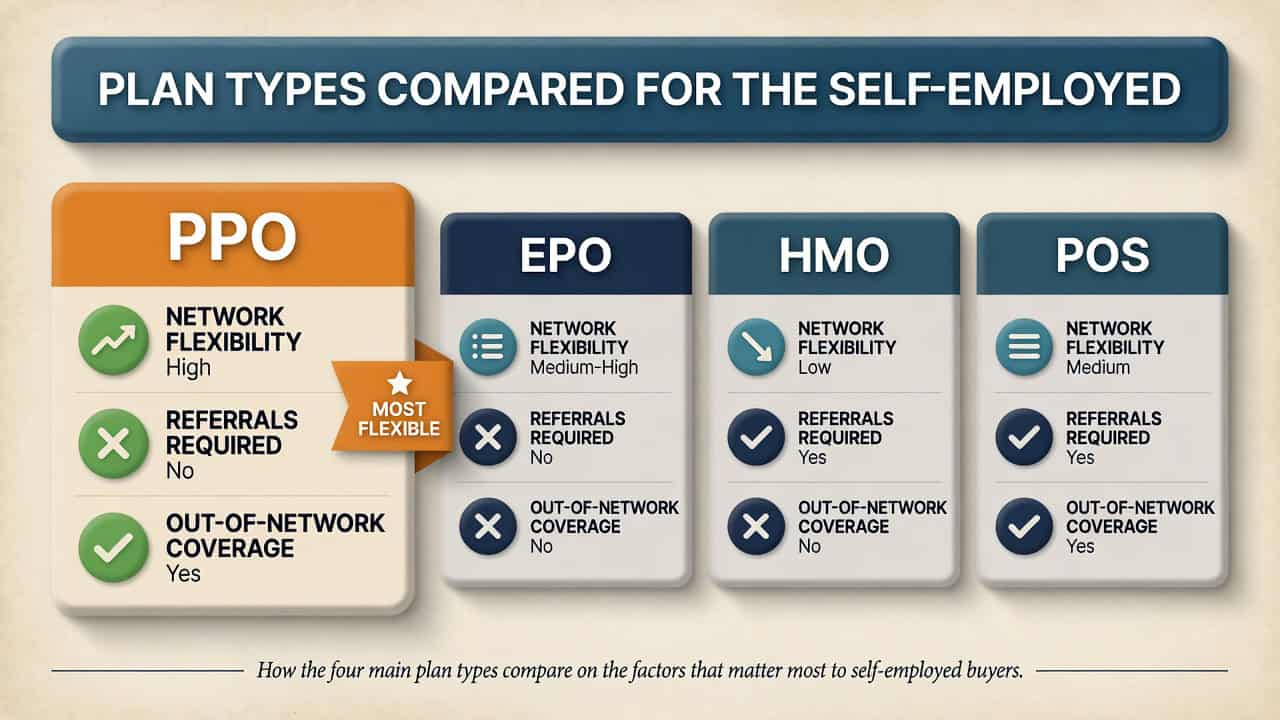
For self-employed people who travel, work in more than one place, or want to keep seeing specific specialists without referrals, the PPO’s flexibility is frequently worth the higher premium. To see a full breakdown of how these network types work, the PPO health insurance guide covers it in depth.
Compare the Best Plans for Your Situation
The fastest way to find your best plan is to compare real options in your ZIP code side by side. Check which networks include your doctors, weigh total yearly cost against premium alone, and get expert help at no cost to you.
PPO vs HMO for the Self-Employed
For many self-employed buyers, a PPO is the better fit because it offers broad networks, out-of-network coverage, and no referral requirements — flexibility that suits people who travel or want to keep specific doctors. An HMO costs less but restricts you to a local network and requires referrals, which works if your care stays in one area.
The trade-off comes down to flexibility versus cost. PPO networks travel well across state lines, which is a common fit for self-employed buyers who work in more than one place. HMOs keep premiums lower by concentrating care in a local network and routing specialist visits through a primary care doctor. Neither is universally “better” — it depends on whether you value freedom of choice or lower monthly cost more.
What the Best Self-Employed Plans Cost in 2026
Cost depends heavily on plan type, age, and location. Plan type is often the biggest single factor: a 2026 Silver PPO averages around $789 a month for a younger adult, versus roughly $676 for an EPO. Premium tax credits and the self-employed health insurance deduction can meaningfully lower what you actually pay.
Because you carry the full premium with no employer contribution, sticker prices look higher than a job-based plan — but two things soften the real cost:
- Premium tax credits can reduce your monthly cost if your income qualifies. Eligibility rules are explained at HealthCare.gov.
- The self-employed health insurance deduction lowers your taxable income on whatever you pay. See the deduction guide for details.
When comparing plans, always look at the total annual cost — premium plus expected out-of-pocket — rather than premium alone. A cheaper premium with a huge deductible can cost more if you actually use care.
Worked example: weighing a PPO against an EPO on total cost
Marcus is a self-employed videographer who shoots in three states and wants to keep his current specialist. Comparing 2026 averages, the Silver PPO runs about $789 a month and the EPO about $676 — a $113 monthly gap, or roughly $1,356 a year. For someone whose care stays local, the EPO is the better value. But Marcus travels: the EPO covers no out-of-network care, so a single out-of-area visit could erase that $1,356 saving and then some. Because his specialist is in the PPO network and his work crosses state lines, the higher premium buys coverage he will actually use.
Should You Buy On or Off the Marketplace?
If your income qualifies for premium tax credits, an on-marketplace plan may deliver the lowest net cost. If you don’t qualify for subsidies or want broader PPO networks, an off-exchange plan bought directly through a broker can offer more flexibility. The best choice depends on your income and how much you value network breadth.
Many self-employed people assume the marketplace is the only option. It isn’t. Off-exchange plans — bought directly or through a licensed agency — often provide stronger PPO networks and nationwide access. HealthCare.gov’s guidance for the self-employed outlines how marketplace coverage works for independent workers. If you earn too much for subsidies, off-exchange coverage is frequently the better value. A licensed advisor can compare both paths side by side so you see the real net cost of each.
How to Choose Your Best Plan
Start by listing your must-keep doctors, then filter to plans whose networks include them. Compare total yearly cost (not just premium), decide how much flexibility you need, and check HSA eligibility if you want that tax advantage. Comparing several plans side by side — ideally with expert help — is the fastest path to the right choice.
A simple decision process:
- List the doctors, specialists, and hospitals you want to keep.
- Filter to plans whose networks include them.
- Compare total annual cost: premium + deductible + expected out-of-pocket.
- Decide how much flexibility you need (travel, out-of-network, referrals).
- Confirm how and when you can enroll — see every health insurance option for the self-employed.
- If you want the triple tax advantage, check whether the plan is HSA-eligible.
Frequently Asked Questions
What is the best health insurance for self-employed people?
There’s no single best plan for everyone — the best health insurance for a self-employed person is the one whose network includes your doctors, whose costs fit your income, and whose plan type matches how you use care. For those who want flexibility and nationwide access, a PPO is often the strongest fit.
Is a PPO or HMO better for the self-employed?
It depends on how you use care. A PPO offers broader networks, out-of-network coverage, and no referrals — valuable if you travel, work across states, or want to keep specific doctors. An HMO usually costs less but locks you into a local network with referrals. Many self-employed people prioritize the PPO’s flexibility.
What should I look for in a self-employed health plan?
Focus on four things: whether your doctors are in-network, the total yearly cost (premium plus deductible and out-of-pocket max), the plan type and how it handles referrals and out-of-network care, and whether it’s HSA-eligible if you want that tax advantage.
Can self-employed people get good health insurance without an employer?
Yes. Self-employed individuals buy the same high-quality individual-market plans available to anyone, either on the marketplace or off-exchange directly through a broker. Off-exchange PPO plans in particular can offer strong networks and nationwide flexibility.
How much does the best self-employed health insurance cost in 2026?
Cost varies widely by plan type, age, and location. Plan type is often the biggest lever — a 2026 Silver PPO averages around $789 a month for a younger adult versus roughly $676 for an EPO. Premium tax credits and the self-employed health insurance deduction can lower the real cost.
Related Self-Employed Health Insurance Resources
Choosing a plan is one step. Explore the rest of the self-employed cluster — the main guide, what coverage costs, the premium deduction, and the HSA that pairs with a high-deductible plan.
The complete guide to plans, costs, the deduction, and coverage options.
Self-Employed Health Insurance CostWhat coverage really costs in 2026 and how to lower it.
Self-Employed Health Insurance DeductionDeduct 100% of your premiums and lower your taxable income.
HSA for the Self-EmployedThe triple tax advantage and how to open one without an employer.
Find Your Best Self-Employed Plan
Compare real plans available in your area and get free, expert help choosing the one that fits your doctors, your budget, and how you actually use care. A licensed advisor can check networks and compare on- and off-marketplace options — at no cost to you.
Broker Disclosure
ForHealthInsurance.com is an independent health insurance agency serving residents nationwide. We are not affiliated with any carrier or government agency. We help you compare plans and enroll in coverage that meets your needs at no extra cost to you.