Best Small Business Health Insurance: How to Compare Carriers
Searching for the best carrier produces a lot of confident rankings, and most of them are close to useless for a specific business. The carrier that serves a ten-person firm well in one metro area may not write coverage in the next state over, and the plan a competitor loves may exclude the hospital your employees actually use.
This page takes a different approach to finding the best small business health insurance. It covers the criteria that separate one carrier from another, who the major national writers are, why network breadth decides more cases than price, what a complete quote should contain, and how to compare offers so the differences are visible instead of buried.

What are you comparing?
What Separates One Carrier From Another
Five criteria account for nearly all meaningful difference: network breadth in the employees’ actual counties, plan designs offered at the group’s size, financial strength, quality accreditation, and renewal behavior. Price is the sixth, and it is the one most likely to change at the first renewal. The best small business health insurance is decided locally, not nationally.
Ranking the best small business health insurance nationally fails because the commercial market is not national in practice. The American Medical Association’s 2025 competition report found that 97 percent of metropolitan commercial insurance markets were highly concentrated in 2024, and that in 47 percent of metro areas a single insurer held at least half the market. A carrier that dominates one region may not file plans in the next.
Network breadth
Whether the employees’ current physicians and the nearest hospital system are contracted. Decides more satisfaction outcomes than any other factor.
Plan design range
How many designs the carrier offers at the group’s size, and whether an HSA-qualified option is available alongside a lower-deductible plan.
Financial strength
The carrier’s assessed ability to pay claims. A floor to clear rather than a differentiator, since most established writers rate well.
Renewal behavior
How aggressively the carrier prices year two and three. Invisible in a first-year quote and often the largest long-run cost difference.
The Major National Carriers Writing Small Group Coverage
By national commercial market share in 2024, UnitedHealth Group led at 16 percent, followed by Elevance Health and CVS Health’s Aetna at 12 percent each, Cigna at 9 percent, Health Care Service Corporation at 8 percent, and Kaiser Permanente at 6 percent. Blue Cross Blue Shield plans together reach roughly 43 percent.
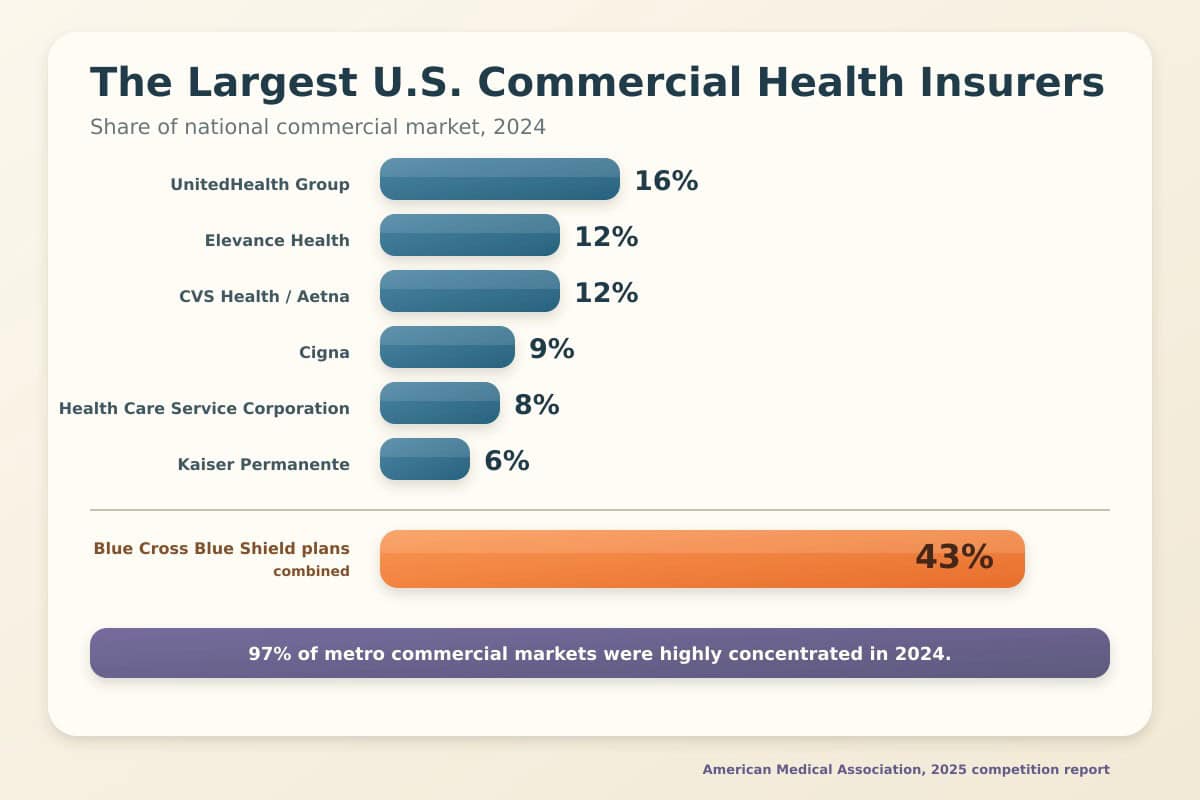
Market share is a measure of reach, not of quality, and it is a poor proxy for the best small business health insurance in any particular county. What the concentration figures do establish is that a business in most metro areas is choosing among a handful of realistic options rather than a broad field. The Peterson-KFF analysis of commercial market concentration tracks how that has tightened over time.
HealthCare.gov’s overview of health insurance for businesses notes that a group plan may be purchased through SHOP or directly from a private carrier. Regional carriers deserve a look alongside the national names. A Blue Cross plan operating in a single state frequently holds deeper contracts with the dominant local health system than a national carrier does, and Kaiser Permanente operates an integrated model in eight states and Washington, D.C. that behaves quite differently from a contracted network.
Network Breadth Decides More Cases Than Price
The single most reliable test of the best small business health insurance for a given company is whether the employees’ existing doctors are contracted. PPO designs covered 46 percent of workers with employer coverage in 2025, largely because they allow out-of-network care at higher cost sharing rather than excluding it outright.
The practical method for identifying the best small business health insurance is unglamorous and works: collect the names of the primary care physicians and any specialists employees currently see, then check each one against the provider directory for every plan under consideration before signing anything. A plan that saves $40 per employee per month and drops the pediatrician half the staff uses will generate more complaints than the savings are worth.
Plan type sets the rules for what happens when a provider is outside the network. HMO and EPO designs generally cover out-of-network care only in emergencies, while PPO plans pay a reduced share toward it. For a workforce spread across counties or working remotely in several states, that difference tends to matter more than the premium gap.
Directory accuracy is imperfect
Provider directories carry errors across the industry. For any physician an employee genuinely cannot lose, calling that office and asking which plans it currently accepts is more reliable than the directory listing.
Financial Strength and Quality Accreditation
AM Best ratings assess a carrier’s ability to pay claims and function as a floor to clear rather than a way to rank options, since most established small group writers rate well. NCQA accreditation scores health plans on clinical quality and member experience, and provides a comparison that is independent of the carrier’s own marketing.
Quality accreditation is the more useful of the two when narrowing toward the best small business health insurance for a particular workforce. NCQA evaluates plans on measures including preventive care delivery and member-reported experience, which maps more closely to what employees will actually notice than a solvency rating does.
State insurance departments publish complaint data that rarely appears in any carrier comparison and is worth ten minutes. The NAIC maintains the directory of state insurance departments, and most publish complaint ratios by carrier — a direct signal of how often members escalate a problem far enough to file formally.
Compare Carriers and Plans for Your Group
Enter the employee count to see which carriers write coverage in the area and what their plans cost, or talk the comparison through with a licensed agent.
What a Complete Quote Should Contain
A usable quote lists premium per enrolled employee by tier, the deductible and out-of-pocket maximum, the named network, the employer contribution percentage assumed, and the effective date. A single total monthly figure cannot be compared against another carrier, because the two quotes may assume different contributions and different tiers.
A 10-employee firm collects two quotes at a total premium of $9,000 a month each. Carrier A’s proposal assumes a 50 percent employer contribution and shows an employer cost of $4,500. Carrier B’s assumes 75 percent and shows $6,750. Carrier B looks $2,250 a month more expensive, but the plans are priced identically — the gap is entirely the assumption. Re-run at a matched 60 percent contribution and both land at $5,400, leaving network, deductible, and renewal history as the actual points of difference.
Renewal Behavior and Service
Renewal pricing is invisible in a first-year quote and frequently the largest long-run difference between carriers. Family premiums rose 6 percent in 2025 and 7 percent in each of the two prior years, and carriers filed double-digit small-group rate requests for 2026. A low opening quote followed by an aggressive renewal is a recognizable pattern.
Service quality is hard to assess before buying and easy to assess afterward, which is why it rarely features in any published ranking of the best small business health insurance. The questions worth asking a licensed agent are concrete: how long the carrier takes to issue ID cards, whether billing errors are common, and how member appeals tend to go. An agent who places groups with several carriers has seen all of it.
Switching carriers is not especially difficult once a plan is in place, which limits the damage of a wrong first choice. Deductibles generally reset with a mid-year change, though, so timing a switch to the plan anniversary avoids employees paying two deductibles in one calendar year.
A workable comparison sequence
The best small business health insurance emerges from a sequence, not a shortlist. Gather three to five quotes, normalize them to one contribution assumption, check each plan’s network against the employees’ actual physicians, confirm financial strength and accreditation, then look at the state complaint ratio. In markets where a single insurer holds half the share, the realistic field will be narrower than five.
Frequently Asked Questions About the Best Small Business Health Insurance
Which carrier is best for small business health insurance?
The best small business health insurance is not a single national carrier, because availability and network strength vary by county. The American Medical Association found that 97 percent of metropolitan commercial insurance markets were highly concentrated in 2024, so the strongest option in one metro is frequently unavailable in another.
Which health insurers are the largest in the United States?
By national commercial market share in 2024, UnitedHealth Group led at 16 percent, followed by Elevance Health and CVS Health’s Aetna at 12 percent each, Cigna at 9 percent, Health Care Service Corporation at 8 percent, and Kaiser Permanente at 6 percent. Blue Cross Blue Shield plans combined reach roughly 43 percent.
What should a small business health insurance quote include?
A complete quote lists the monthly premium per enrolled employee by tier, the deductible and out-of-pocket maximum, the network name, the employer contribution assumed, and the effective date. Quotes that show only a total monthly figure cannot be compared meaningfully against another carrier.
How important are carrier financial strength ratings?
They matter as a floor rather than a differentiator. AM Best ratings indicate a carrier’s ability to pay claims, and most established small group carriers rate well. A weak rating is a reason to look elsewhere, but a strong one does not indicate better networks or service.
Does a bigger carrier mean a better plan for a small group?
Not necessarily. National scale helps employees who travel or work remotely across states, but a regional carrier often holds deeper contracts with the dominant local hospital system. The relevant test is whether the employees’ actual doctors are in network.
How many carrier quotes should a business compare?
Three to five gives a realistic picture of the market without becoming unmanageable. Because 47 percent of metro areas have a single insurer holding at least half the market, some regions will have fewer genuine options than that.
Related Small Business Health Insurance Resources
The full employer guide to coverage, costs, eligibility, and enrollment.
What Coverage Costs Per Employee2026 premium benchmarks, the employer share, and what drives a quote.
Requirements and Employer Size RulesFTE counting, the 50-employee threshold, and who counts as an eligible employee.
Level-Funded vs. Fully InsuredHow the two funding models price, refund, and renew differently.
Contribution and Participation RequirementsCarrier minimums, how waivers are counted, and the year-end relaxed window.
Enrollment and Waiting PeriodsEffective dates, new hire waiting periods, and qualifying life events.
Find the Best Small Business Health Insurance for Your Group
Carrier availability and pricing depend on employee count, ages, and ZIP code. Run a quote to see the realistic field, or call to compare options with a licensed agent.
Broker Disclosure
ForHealthInsurance.com is an independent health insurance agency serving businesses. We are not affiliated with any carrier or government agency. We help you compare plans and enroll in coverage that meets your needs at no extra cost to you.