Self-Employed Health Insurance Cost: 2026 Price Guide

Understanding self employed health insurance cost is the first step to budgeting for coverage you buy on your own. Because you pay the entire premium with no employer chipping in, the sticker price can feel steep — but the number you actually pay is often much lower once tax credits and deductions are factored in. This guide breaks down what self-employed coverage really costs in 2026, what drives the price, and the levers that bring it down.
How Much Does Health Insurance Cost for the Self-Employed?
Self employed health insurance cost varies widely by plan type, age, and location, but plan type is often the biggest single factor. A 2026 Silver PPO averages around $789 a month for a younger adult, while an EPO runs roughly $676. Premium tax credits and the self-employed deduction can lower what you actually pay.
The averages give you a starting point, but your real number depends on your specific situation. Here’s a rough 2026 picture by plan type for a younger adult on a Silver plan:
| Plan type | Approx. 2026 monthly premium | Flexibility |
|---|---|---|
| PPO | ~$789 | Highest — out-of-network + no referrals |
| POS | ~$661 | Moderate — some out-of-network, referrals |
| EPO | ~$676 | Moderate — in-network only, no referrals |
| HMO | Often lowest | Local network, referrals required |
These are averages for full-price premiums before any tax credits. Your actual cost could be higher or lower depending on your age, ZIP code, and the specific plan.
Worked example: why the cheapest premium isn’t always the cheapest year
Consider two 2026 options for the same self-employed buyer. The Silver PPO runs about $789 a month — $9,468 for the year. A Bronze plan with a $9,000 deductible might run far less monthly, which looks like the obvious win. But if that buyer has one significant medical event, they pay the low premium plus most of that $9,000 deductible before coverage meaningfully kicks in. The Silver plan’s higher premium buys a lower deductible, so total yearly exposure can land below the “cheap” plan. Compare premium plus expected out-of-pocket, not premium alone.
Why Self-Employed Health Insurance Feels So Expensive
Self-employed people pay the full premium with no employer contribution, so the price looks higher than a job-based plan where an employer covers part of the cost. The plan itself isn’t necessarily more expensive — you’re simply seeing the entire cost rather than a subsidized share of it.
At a traditional job, an employer typically pays a large portion of the premium, so employees only see their smaller share deducted from a paycheck. When you’re self-employed, that employer contribution disappears and you cover 100% yourself. That’s why the same plan can feel dramatically more expensive — but two offsets exist specifically to help independent workers, both covered below.
What Drives Your Premium
Your self-employed health insurance premium is driven mainly by your age, location, plan type, and metal level, plus tobacco use and how many people you cover. Income doesn’t change the sticker premium, but it determines whether premium tax credits reduce your net cost — sometimes substantially.
The main factors, which follow the rating rules described at HealthCare.gov:
- Age — premiums rise with age within allowed limits.
- Location — your ZIP code and rating area affect pricing.
- Plan type — PPO, EPO, HMO, or POS (often the biggest lever).
- Metal level — Bronze, Silver, Gold, or Platinum, trading premium against out-of-pocket costs.
- Tobacco use — can increase premiums.
- Household size — covering a spouse or dependents raises the total.
- Where you buy — on- or off-marketplace changes what is available; see every health insurance option for the self-employed.
See Your Actual Cost in Your ZIP Code
Averages only go so far. Your age, ZIP code, and plan type can move the number hundreds of dollars either direction. Get a free quote to see the real plans and prices available where you live, with expert help at no cost to you.
How to Lower Your Self-Employed Health Insurance Cost
Three levers lower your real cost: qualify for premium tax credits if your income is eligible, claim the self-employed health insurance deduction on your premiums, and pick a plan type and metal level that match how you actually use care instead of over-buying. Together, these can dramatically reduce the price you feel.
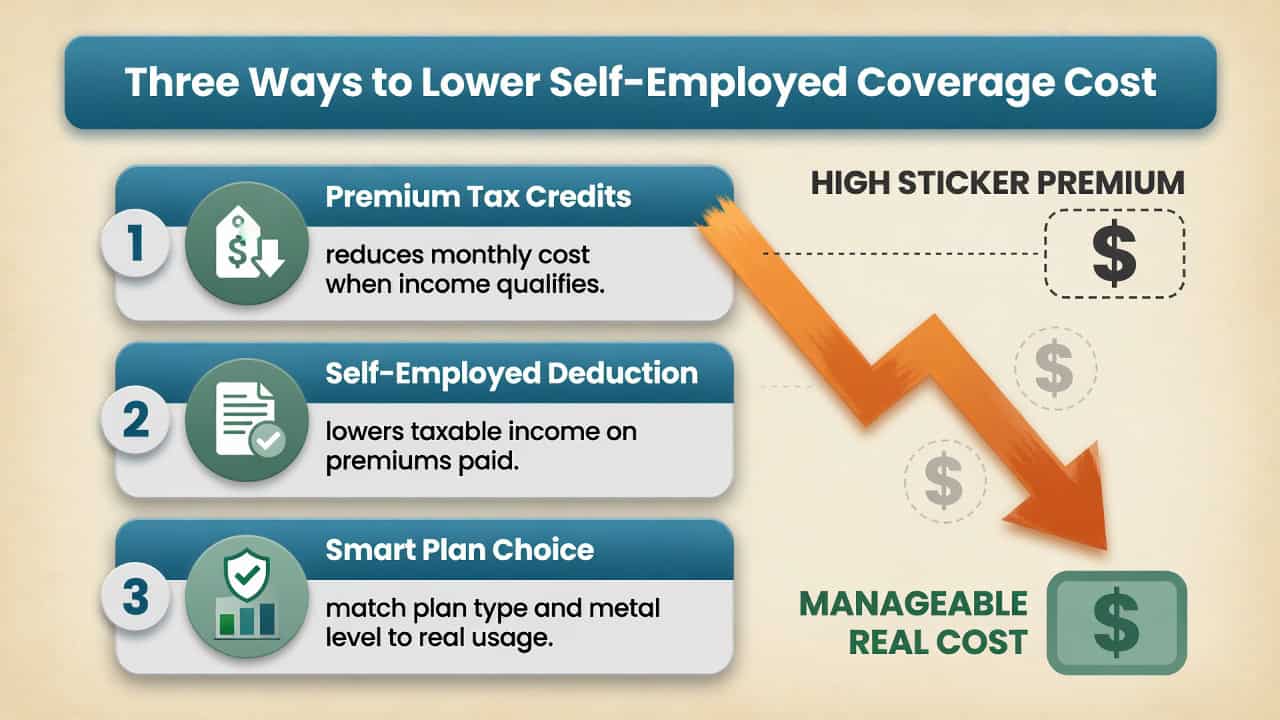
Here’s how each lever works:
- Premium tax credits. If your income falls in the eligible range, marketplace subsidies can cut your monthly premium — sometimes significantly. Eligibility is based on income relative to federal thresholds published at HealthCare.gov.
- The self-employed deduction. You can generally deduct 100% of your premiums, lowering your taxable income, as detailed in IRS Form 7206 instructions. See the deduction guide for the full rules.
- Smart plan choice. Match your plan type and metal level to how you actually use care. Over-buying coverage you never use is a common way self-employed people overpay.
Is Cheaper Always Better?
Not necessarily. A rock-bottom premium usually comes with a high deductible, so if you use care regularly, the cheapest plan can cost more overall once out-of-pocket spending is counted. The smarter measure is total yearly cost — premium plus expected out-of-pocket — not premium alone.
It’s tempting to grab the lowest monthly premium, but that number only tells part of the story. A Bronze plan with a low premium and a $9,000 deductible can leave you paying far more than a Silver plan if you have a medical event. Think about how much care you realistically expect to use, then compare plans on their total annual exposure. A licensed advisor can run those numbers with you so the “cheap” plan doesn’t turn into the expensive one.
Frequently Asked Questions
How much does health insurance cost for the self-employed in 2026?
It varies widely by plan type, age, and location, but plan type is often the biggest factor. A 2026 Silver PPO averages around $789 a month for a younger adult, while an EPO runs roughly $676. Premium tax credits and the self-employed health insurance deduction can lower what you actually pay.
Why is self-employed health insurance so expensive?
Self-employed people pay the entire premium with no employer contribution, so the sticker price looks higher than a job-based plan where the employer covers part of the cost. The plan itself isn’t necessarily pricier — you’re just seeing the full cost instead of a subsidized share.
How can I lower my self-employed health insurance cost?
Three main levers: qualify for premium tax credits if your income is eligible, claim the self-employed health insurance deduction on your premiums, and choose a plan type and metal level that match how you actually use care rather than over-buying coverage.
What affects the cost of self-employed health insurance?
Your premium is driven mainly by your age, location (ZIP code), plan type (PPO, EPO, HMO, POS), metal level (Bronze to Platinum), tobacco use, and how many people you’re covering. Income affects the net cost through premium tax credits.
Is cheaper health insurance worth it for the self-employed?
Not always. A low premium often comes with a high deductible, so if you use care regularly, a cheaper plan can cost more overall. Always compare the total yearly cost — premium plus expected out-of-pocket — rather than premium alone.
Related Self-Employed Health Insurance Resources
Cost is only one part of the decision. Explore the rest of the self-employed cluster — the main guide, how to pick the right plan, the premium deduction, and the HSA that adds a second tax break.
The complete guide to plans, costs, the deduction, and coverage options.
Best Health Insurance for the Self-EmployedHow to choose the plan that fits your doctors and budget.
Self-Employed Health Insurance DeductionDeduct 100% of your premiums and lower your taxable income.
HSA for the Self-EmployedThe triple tax advantage and how to open one without an employer.
Get a Real Price, Not an Average
Compare actual plans and prices available in your area and find the best value for how you use care. A licensed advisor can check whether you qualify for premium tax credits and weigh total yearly cost against premium alone — free, at no cost to you.
Broker Disclosure
ForHealthInsurance.com is an independent health insurance agency serving residents nationwide. We are not affiliated with any carrier or government agency. We help you compare plans and enroll in coverage that meets your needs at no extra cost to you.