Health Insurance Options for the Self-Employed (2026)

When you become self-employed, one of the first questions is where your health insurance will come from now that there’s no employer plan. The good news: you have several solid health insurance options for self employed work, and understanding all of them helps you find the best fit. This overview of health insurance options for self employed workers walks through every path to coverage in 2026 — the marketplace, off-exchange plans, a spouse’s plan, associations, and more — plus how to actually enroll.
How Do Self-Employed People Get Health Insurance?
Self-employed people get health insurance by buying an individual-market plan themselves — either on the ACA marketplace or off-exchange through a broker. Other paths include joining a spouse’s employer plan, a professional association plan, or Medicaid if income qualifies. Since there’s no employer to arrange coverage, you choose and enroll on your own.
Losing employer coverage feels daunting, but self-employment actually opens up the full individual market to you. Instead of one company’s plan menu, you can compare plans from multiple carriers and pick the network, plan type, and price that fit your life. The trick is simply knowing which paths exist — most people only know about the marketplace.
Your Main Health Insurance Options
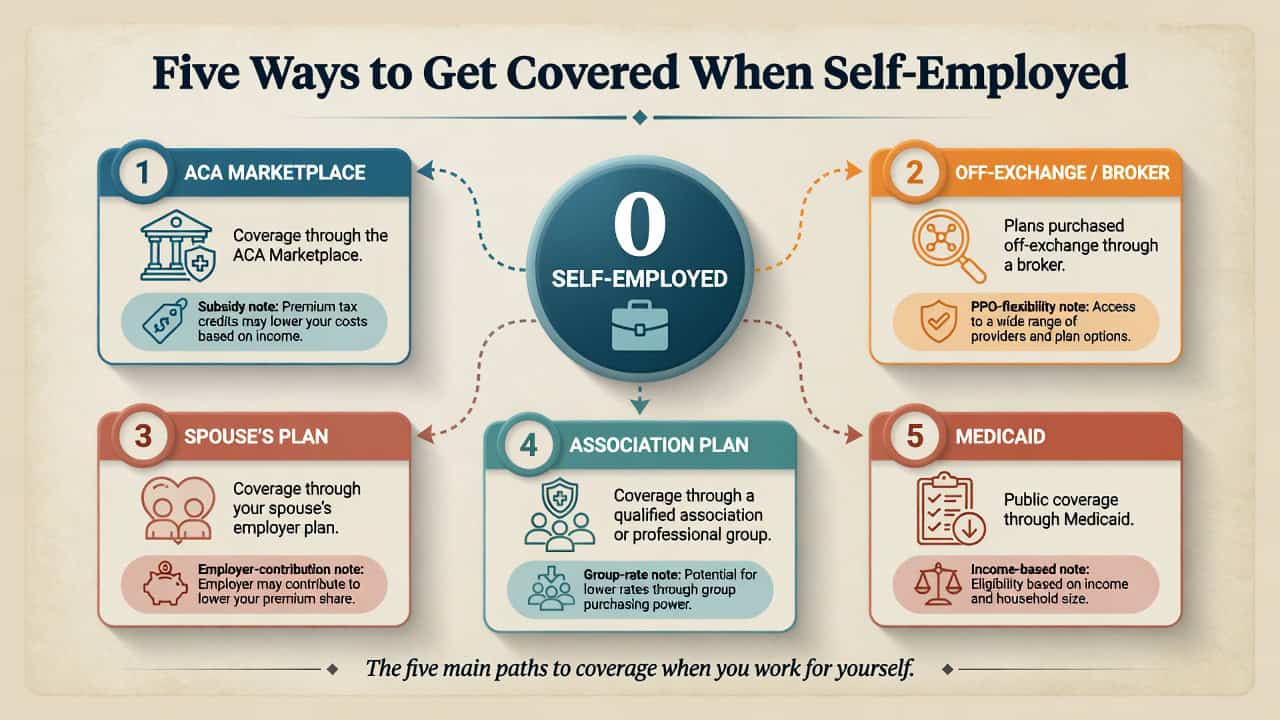
The main health insurance options for self employed workers are: ACA marketplace plans (with possible subsidies), off-exchange individual plans through a broker, a spouse’s employer plan, professional or trade association plans, and Medicaid if income qualifies. Off-exchange PPO plans are especially popular for their network flexibility and nationwide access.
| Option | Best for | Key benefit |
|---|---|---|
| ACA Marketplace | Those who qualify for subsidies | Premium tax credits can lower cost |
| Off-exchange (via broker) | Those wanting broader networks or no subsidy | PPO flexibility, nationwide access |
| Spouse’s employer plan | Those with an employed spouse | Employer contribution lowers cost |
| Association / trade group plan | Members of a qualifying group | Possible group rates |
| Medicaid | Those with low income | Low or no cost if eligible |
The Marketplace vs. Off-Exchange Plans
The ACA marketplace offers plans that may come with premium tax credits if your income qualifies. Off-exchange plans, bought directly or through a broker, don’t offer subsidies but often provide broader PPO networks and more flexibility. If you don’t qualify for subsidies, off-exchange coverage is frequently the better value.
Many self-employed people assume the marketplace is the only place to buy coverage. It isn’t. Here’s the practical difference: on-exchange plans are the only ones eligible for premium tax credits, so if your income qualifies, they can be very affordable. The IRS outlines self-employed coverage and deduction rules in its self-employed tax center. But if you earn too much for subsidies — or you want a broader network — off-exchange plans give you access to nationwide PPO options that travel well across state lines. A licensed advisor can compare both side by side so you see the real net cost of each path.
Not Sure Which Option Fits You?
Get a free quote and expert help comparing marketplace and off-exchange plans side by side. A licensed advisor can check whether your income qualifies for premium tax credits and show the real net cost of each path — at no cost to you.
How to Get Coverage: Step by Step
To weigh your health insurance options for self employed work and enroll: estimate your income to check subsidy eligibility, compare on-exchange and off-exchange plans, choose a plan type and network that fit your needs and doctors, then enroll during open enrollment or a special enrollment period. A licensed broker can guide each step at no cost to you.
Estimate your income
This determines whether you qualify for premium tax credits on the marketplace.
List your must-keep doctors
You’ll want plans whose networks include them.
Compare on- and off-exchange plans
Look at total yearly cost, not just premium, and weigh network flexibility.
Choose your plan type
Decide how much flexibility you need — PPO for broad access, HMO for lower cost. If you want the triple tax advantage, check whether the plan is HSA-eligible.
Enroll
Sign up during open enrollment or a qualifying special enrollment period.
When Can You Enroll?
You can enroll during the annual Open Enrollment Period, typically November 1 to January 15, or during a Special Enrollment Period triggered by a qualifying life event such as losing coverage, moving, marriage, or having a baby. Off-exchange plans sometimes offer more flexible enrollment timing than marketplace plans.
If you’re newly self-employed and just lost job-based coverage, that loss is itself a qualifying life event — so you don’t have to wait for open enrollment. You typically have a 60-day window to enroll in new coverage, one of the qualifying events listed at HealthCare.gov’s special enrollment page. Missing that window can mean waiting until the next open enrollment, so it’s worth acting promptly. For official enrollment dates and rules, see HealthCare.gov’s self-employed coverage page.
Worked example: a newly self-employed writer picks a path
Tomas leaves a salaried job in March to write full time. Losing that employer coverage is itself a qualifying life event, so he doesn’t wait for the November open enrollment — he has a 60-day special enrollment window. He estimates his first-year income, finds it low enough to qualify for premium tax credits, and compares an on-exchange Silver plan against an off-exchange PPO. The marketplace plan wins on net cost because the credit only applies on-exchange; had he earned too much to qualify, the off-exchange PPO’s broader network would likely have been the better value. The deciding factor was the income estimate, which is why it’s step one.
Frequently Asked Questions
How do self-employed people get health insurance?
Self-employed people get health insurance by buying an individual-market plan — either on the ACA marketplace or off-exchange directly through a broker. Other paths include joining a spouse’s employer plan, a professional association plan, or, if income qualifies, Medicaid. There’s no employer to arrange it, so you choose and enroll yourself.
What are the health insurance options for the self-employed?
The main options are: ACA marketplace plans (with possible subsidies), off-exchange individual plans through a broker, a spouse’s employer plan, professional or trade association plans, and Medicaid if your income qualifies. Off-exchange PPO plans are popular for their network flexibility.
How do I get health insurance when I’m self-employed with no employer?
You buy an individual health plan yourself. Determine whether you qualify for marketplace subsidies based on income, compare on-exchange and off-exchange plans, choose a plan type and network that fit your needs, and enroll during open enrollment or a special enrollment period. A licensed broker can guide the whole process at no cost to you.
When can self-employed people enroll in health insurance?
You can enroll during the annual Open Enrollment Period (typically November 1 to January 15), or during a Special Enrollment Period triggered by a qualifying life event such as losing coverage, moving, marriage, or having a baby. Off-exchange plans may have more flexible timing.
Do self-employed people have to use the marketplace?
No. The marketplace is one option, but self-employed people can also buy off-exchange plans directly or through a broker. If you don’t qualify for subsidies or want broader PPO networks, off-exchange coverage is often a better fit.
Related Self-Employed Health Insurance Resources
Once you know your options, the next questions are cost and fit. Explore the rest of the self-employed cluster — the main guide, how to choose the best plan, what coverage costs, and the premium deduction.
The complete guide to plans, costs, the deduction, and coverage options.
Best Health Insurance for the Self-EmployedHow to choose the plan that fits your doctors and budget.
Self-Employed Health Insurance CostWhat coverage really costs in 2026 and how to lower it.
Self-Employed Health Insurance DeductionDeduct 100% of your premiums and lower your taxable income.
Explore Your Coverage Options Today
Compare all your self-employed coverage paths in one place and get free, expert help finding the right fit. Whether you qualify for subsidies or need a broader network, an advisor can walk you through enrollment and deadlines — at no cost to you.
Broker Disclosure
ForHealthInsurance.com is an independent health insurance agency serving residents nationwide. We are not affiliated with any carrier or government agency. We help you compare plans and enroll in coverage that meets your needs at no extra cost to you.