Oklahoma Health Insurance 2026: SoonerCare, Marketplace & Carriers
Oklahoma health insurance in 2026 looks fundamentally different than it did five years ago. State Question 802 — the June 2020 ballot measure that put Medicaid expansion into the Oklahoma Constitution — added roughly 300,000 working-age Oklahomans to SoonerCare beginning July 1, 2021. The Oklahoma Health Care Authority (OHCA) reports that more than 1.2 million Oklahomans are now covered by SoonerCare following the SQ 802 expansion and the SoonerSelect managed-care rollout that began April 1, 2024. Oklahoma uses HealthCare.gov rather than a state-based exchange, and Blue Cross Blue Shield of Oklahoma (a division of HCSC) remains the dominant marketplace carrier. This Oklahoma health insurance guide covers SoonerCare under the constitutional expansion, marketplace plans through HealthCare.gov, what changed when enhanced premium tax credits expired at the end of 2025, tribal coverage and the Indian Health Service exemption, and how Oklahoma’s premium structure compares with neighboring Texas, Kansas, and Arkansas.

What brings you here today?
The Big Shift: How State Question 802 Changed Oklahoma Health Insurance
State Question 802 — Oklahoma’s June 2020 ballot measure — wrote Medicaid expansion into the Oklahoma Constitution, the only such constitutional amendment in the U.S. SoonerCare, administered by the Oklahoma Health Care Authority (OHCA), began enrolling expansion adults on July 1, 2021, adding roughly 300,000 working-age Oklahomans up to 138% of the federal poverty level. Oklahoma’s uninsured rate has since dropped from about 14.3% to roughly 11.2%.
The constitutional path mattered. SQ 802 passed with 50.5% voter approval in June 2020, and because expansion is in the Oklahoma Constitution rather than statute, the Oklahoma Legislature cannot repeal SoonerCare expansion through ordinary legislation — it would take another statewide vote. This makes Oklahoma’s expansion structurally more durable than expansions in states where coverage rests on legislative majorities. The Oklahoma Health Care Authority continues to administer SoonerCare for the expansion population alongside the traditional Medicaid population it has covered for decades. For 2026, the SoonerCare income threshold sits at about $21,597 for a single adult and $44,367 for a family of four.
The second major change came on April 1, 2024, when OHCA launched SoonerSelect — Oklahoma’s transition from fee-for-service Medicaid to managed care for most SoonerCare enrollees. Three contracted managed-care plans now serve SoonerSelect members: Aetna Better Health of Oklahoma, Humana Healthy Horizons in Oklahoma, and Oklahoma Complete Health (Centene). Members choose a plan or are auto-assigned, and each managed-care organization (MCO) builds its own provider network across the 77 Oklahoma counties. This is structurally different from neighboring Texas (which never expanded Medicaid) and from Kansas (which has not expanded as of 2026).
Where to enroll honestly in Oklahoma
Oklahomans can enroll in marketplace coverage through three legitimate channels: directly at HealthCare.gov (free, government-run), through a certified navigator (free, government-funded help), or through a licensed broker like ForHealthInsurance.com (free to you, paid by carriers regardless of channel). All three channels offer the same Oklahoma plans at the same prices — the difference is how much guidance and ongoing support you receive. SoonerCare enrollment is separate and handled directly by the Oklahoma Health Care Authority through mySoonerCare.org or by phone. Brokers typically help with provider verification, formulary checks, and post-enrollment claims questions; HealthCare.gov is self-service.
Oklahoma Health Insurance Carriers for 2026
Oklahoma’s 2026 marketplace is dominated by Blue Cross Blue Shield of Oklahoma — an HCSC subsidiary and the only carrier with a network presence in all 77 Oklahoma counties. Joining BCBS-OK on the 2026 HealthCare.gov marketplace are Medica, Aetna CVS Health, Ambetter from Oklahoma Complete Health, UnitedHealthcare, Community Care HMO of Oklahoma, and Taro Health. Carrier county availability varies sharply between the OKC and Tulsa metros and rural panhandle counties.
Blue Cross Blue Shield of Oklahoma
Oklahoma’s largest health-insurance carrier and a division of Health Care Service Corporation (HCSC). The only carrier with provider contracts in all 77 Oklahoma counties, including the panhandle. Strong inclusion of OU Health, INTEGRIS Health, and Saint Francis Health System.
- All 77 Oklahoma counties
- OU Health and INTEGRIS in network
- BlueCard national reciprocity
Medica
Minneapolis-headquartered nonprofit insurer that entered the Oklahoma marketplace in 2022 and expanded steadily. Particularly competitive Silver and Bronze pricing in the OKC and Tulsa metro areas, with selective rural Oklahoma county participation.
- Strong OKC and Tulsa pricing
- Nonprofit structure
- Selected rural counties
Aetna CVS Health
Aetna’s Oklahoma marketplace participation pairs ACA plans with the CVS MinuteClinic and HealthHUB primary-care footprint across the OKC and Tulsa metro areas. Notable in 2026 for an HMO-only Oklahoma offering structured around CVS-affiliated providers.
- HMO-structured 2026 plans
- CVS MinuteClinic integration
- OKC and Tulsa concentration
Ambetter from Oklahoma Complete Health
Centene’s Oklahoma marketplace carrier, branded as Ambetter from Oklahoma Complete Health. Also one of the three SoonerSelect managed-care plans, providing continuity for Oklahomans whose income moves above the SQ 802 SoonerCare threshold mid-year.
- Centene/Ambetter affiliated
- SoonerSelect managed-care plan
- Competitive Bronze pricing
Community Care HMO of Oklahoma
Oklahoma-headquartered nonprofit HMO with deep historical ties to the Saint Francis Health System in Tulsa. Service area concentrated in northeast Oklahoma counties around Tulsa, Creek, Rogers, and Wagoner — a regional alternative for Tulsa-metro shoppers.
- Oklahoma-headquartered (Tulsa)
- Saint Francis Health System
- Northeast Oklahoma focus
UnitedHealthcare and Taro Health
UnitedHealthcare returned to the Oklahoma marketplace in 2024 and offers select-county participation in 2026. Taro Health, a primary-care-first carrier, serves limited Oklahoma counties including Cleveland and Oklahoma counties with a direct-primary-care-style model.
- UHC select-county participation
- Taro Health primary-care-first
- OKC metro coverage
Carrier choice in Oklahoma comes down to four factors: which carriers serve your county, whether your existing primary care doctor and any specialists are in-network, how each carrier’s prescription formulary handles drugs you take regularly, and — for tribal members — which carriers integrate well with Indian Health Service or tribal-clinic referral patterns. Many rural panhandle counties (Cimarron, Texas, Beaver) have only one or two carrier options, while metro Oklahoma City and Tulsa typically offer four or more. The seven 2026 carriers cover all 77 Oklahoma counties with at least one carrier option in every county, though only Blue Cross Blue Shield of Oklahoma offers a true statewide footprint.
Coverage Paths for Working Oklahomans
Oklahoma health insurance shoppers fall into several distinct paths based on income relative to SoonerCare’s SQ 802 threshold, employment status, and tribal enrollment. The right channel depends on whether your household income qualifies for SoonerCare (138% of FPL), whether you’re a member of a federally recognized Tribe, whether Insure Oklahoma applies to you, and whether you have employer coverage. About 213,000 Oklahomans use HealthCare.gov; more than 1.2 million are covered by SoonerCare.
SoonerCare-eligible Oklahomans (post-SQ 802)
Single Oklahomans earning under $21,597 (138% of FPL) and families of four earning under $44,367 typically qualify for SoonerCare under the State Question 802 expansion. Apply through mySoonerCare.org or directly with the Oklahoma Health Care Authority — separate from HealthCare.gov.
Tribal members and IHS users
Oklahoma has the second-largest Native American population in the U.S. — roughly 332,000 enrolled tribal members. Federally recognized tribal members receive zero cost-sharing on Silver-tier marketplace plans regardless of income, and special monthly enrollment periods apply. Indian Health Service and tribal clinic care remains available alongside any marketplace coverage.
Self-employed and 1099 Oklahomans
Self-employed Oklahomans, ranchers, energy contractors, and 1099 workers should check Insure Oklahoma — a state premium-assistance program that subsidizes coverage for self-employed Oklahomans below 250% FPL who don’t qualify for SoonerCare. Schedule C net profit determines MAGI for marketplace subsidy calculations.
W-2 employees with employer coverage
If your Oklahoma employer offers a plan, federal “affordability rules” determine whether you can also receive marketplace subsidies. For 2026, employer self-only coverage is “affordable” if it costs under 8.39% of your household income — if so, you generally can’t receive HealthCare.gov subsidies even if you don’t enroll in the employer plan.
Recently between jobs
Job loss is a qualifying life event triggering a 60-day Special Enrollment Period in Oklahoma’s HealthCare.gov marketplace. Documentation: termination letter or final coverage date. After job loss, household income often drops below the SQ 802 threshold, which usually qualifies you for SoonerCare rather than a subsidized marketplace plan.
Above 400% FPL Oklahomans
Oklahomans with 2026 household income above 400% of FPL ($62,600 single, $128,600 family of four) no longer qualify for marketplace subsidies after enhanced premium tax credits expired at the end of 2025. Off-exchange PPO plans through national broker channels may be price-competitive and offer broader networks for Oklahomans who travel frequently.
How Much Does Oklahoma Health Insurance Cost in 2026?
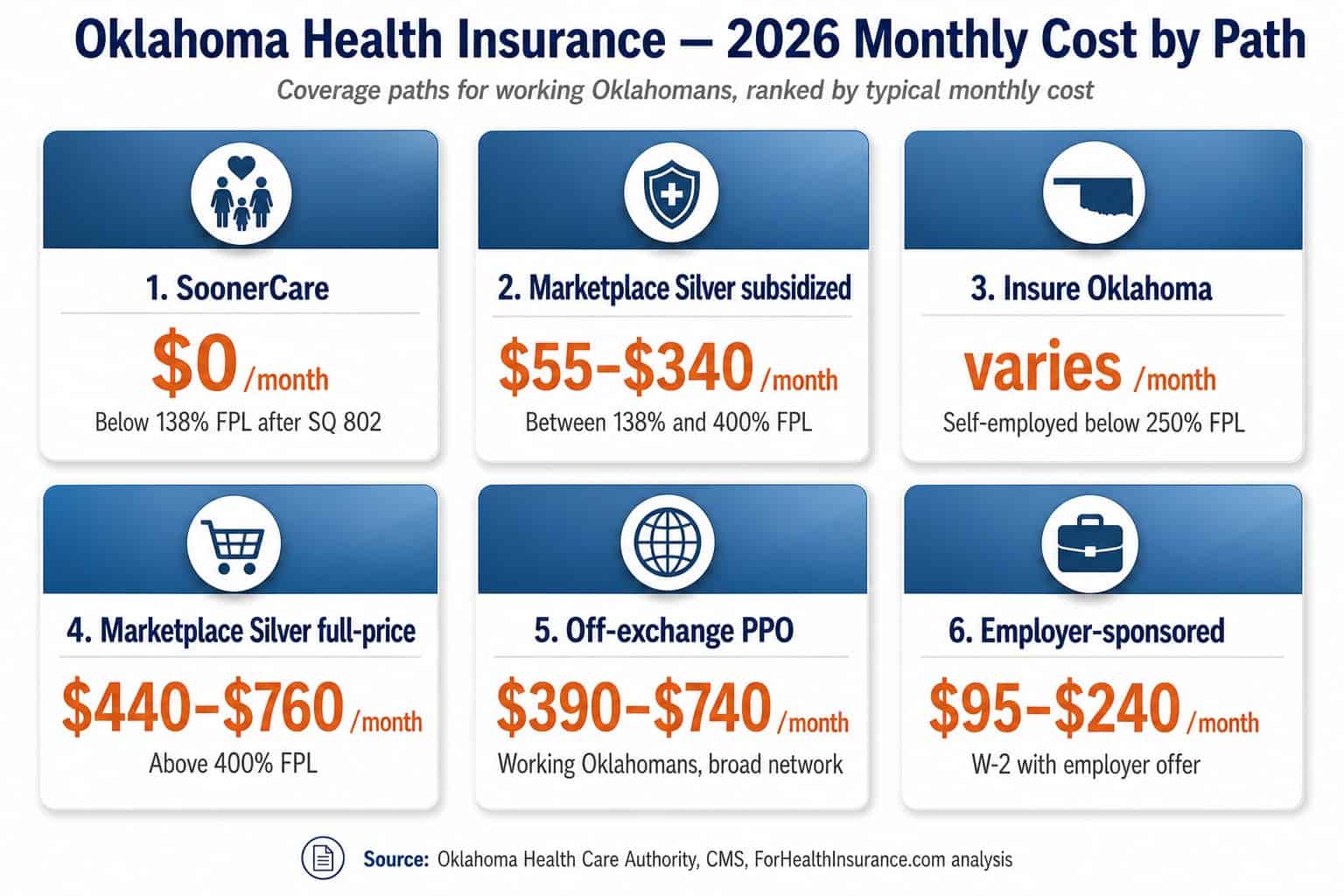
Oklahoma health insurance costs for 2026 vary based on subsidy eligibility, age, county, plan tier, and tobacco use. SoonerCare costs Oklahomans nothing or close to nothing for those who qualify under the SQ 802 threshold. For marketplace shoppers above that threshold, the 2025 average net premium for subsidy-eligible Oklahoma enrollees was about $73 per month. Without subsidies, full-price 2026 Silver-tier premiums in Oklahoma typically run $440 to $760 monthly for a 40-year-old.
Geography drives a large share of cost variation in Oklahoma. The OKC and Tulsa metros — Oklahoma County, Tulsa County, Cleveland County — have the most carrier competition and generally the lowest full-price benchmark Silver premiums. The Oklahoma panhandle (Cimarron, Texas, and Beaver counties) sits at the opposite end: fewer carriers, longer distances to in-network specialists, and noticeably higher full-price premiums. A 40-year-old in Cimarron County may pay $120 to $180 more per month than the same individual in Oklahoma County for an equivalent benchmark Silver plan. Counties along the Texas border (Choctaw, Bryan, Marshall, Love) sometimes see Oklahoma residents drive into north Texas for specialty care.
The age-rating curve is the single largest individual cost driver. Under federal ACA rules, the oldest applicants pay roughly 3× what the youngest adults pay for the same plan. A 21-year-old in Oklahoma City might pay $280 per month full-price for a benchmark Silver plan; a 64-year-old in the same county might pay $840 for the identical plan. This is why early retirees in Oklahoma benefit most from any subsidy that reduces premiums and why younger Oklahomans often prefer Bronze tiers that minimize monthly premium. Tobacco use can add up to 50% to premiums under federal ACA rules, though Oklahoma carriers typically apply smaller surcharges than the legal maximum.
| Oklahoma Coverage Path | Typical Monthly Cost (2026) | Best Fit For |
|---|---|---|
| SoonerCare (income-eligible under SQ 802) | $0 (most enrollees) | Below 138% FPL |
| Indian Health Service / tribal clinic | $0 (eligible tribal members) | Federally recognized tribal members |
| Marketplace Silver with CSR | $55–$210 (with subsidies) | 138%–250% FPL |
| Marketplace Silver subsidized | $80–$340 (with APTC) | 250%–400% FPL |
| Insure Oklahoma (self-employed) | Varies (state premium assist) | Self-employed below 250% FPL |
| Marketplace Bronze full-price | $330–$560 | Above 400% FPL, lower-cost option |
| Marketplace Silver full-price | $440–$760 | Above 400% FPL, balanced coverage |
| Off-exchange PPO (national) | $390–$740 | Working Oklahomans wanting nationwide network |
| Employer-sponsored (employee share) | $95–$240 | W-2 with employer offer |
Run an Instant Oklahoma Health Insurance Quote
Compare 2026 plans across Blue Cross Blue Shield of Oklahoma, Medica, Aetna CVS Health, Ambetter from Oklahoma Complete Health, and other Oklahoma marketplace carriers — by zip code, in 60 seconds. SoonerCare eligibility under SQ 802 is also screened automatically before any plan comparison runs.
Oklahoma Subsidies After 2025: What Changed
Oklahoma marketplace subsidies for 2026 changed materially when enhanced premium tax credits expired at the end of 2025. Before 2026, the American Rescue Plan and Inflation Reduction Act had eliminated the 400% federal poverty level cliff and capped premium contributions at 8.5% of income. For 2026, those enhancements expired. Oklahomans above 400% of FPL no longer receive a premium tax credit; those below 400% receive smaller subsidies than in 2025. SoonerCare under SQ 802 was unaffected.
The practical impact for Oklahoma marketplace shoppers has been steep. The 2025 average net premium for subsidy-eligible Oklahoma enrollees ran about $73 per month — partly because more than 90% of HealthCare.gov enrollees in Oklahoma received Advance Premium Tax Credits averaging roughly $520 per month. For 2026, with reduced subsidies, the average net premium has risen materially, contributing to the enrollment decline Oklahoma experienced going into the 2026 plan year. CMS data shows about 213,000 Oklahomans selected 2026 marketplace plans, down from approximately 254,000 for 2025.
The 2026 federal poverty level thresholds determine Oklahoma subsidy eligibility: a single Oklahoman earning under $15,650 may qualify for SoonerCare under SQ 802; between $15,650 and $62,600 (400% FPL) qualifies for HealthCare.gov subsidies; above $62,600 no longer qualifies for any premium tax credit. For a family of four, the corresponding thresholds are $32,150 (SoonerCare line) and $128,600 (subsidy ceiling). Oklahomans whose income falls between SoonerCare and the marketplace floor — historically called the “coverage gap” — was the population SQ 802 eliminated, since Oklahoma now covers adults up to 138% FPL through SoonerCare.
Repayment caps were eliminated for 2026
HR 1 (the One Big Beautiful Bill Act) eliminated the previous repayment cap on excess premium tax credits effective for the 2026 plan year. Before 2026, even substantial subsidy underestimates were capped at modest amounts at tax-time reconciliation — typically $300 to $2,800 depending on income and household size. For 2026 and beyond, the entire excess subsidy must be repaid if your projected income comes in too low compared to actual income. Oklahoma shoppers with variable income — self-employed ranchers, energy-sector contractors, gig workers, commission-based salespeople — should err toward overestimating slightly rather than under to avoid surprise tax-time bills.
Why Oklahoma Premiums Run Different Than Neighbor States
Oklahoma is one of about 30 states without an active 1332 reinsurance waiver — the federal authority that lets states fund a state-level reinsurance program to lower marketplace premiums. As a result, Oklahoma’s full-price marketplace premiums tend to run higher than premiums in neighboring states with reinsurance in place. Oklahoma’s regional risk pool also includes Tornado Alley emergency-room volume and high tobacco-use rates, both of which influence carrier rate filings.
Texas — Oklahoma’s southern neighbor — never expanded Medicaid, leaving roughly 1.7 million Texans in the coverage gap that SQ 802 eliminated for Oklahomans. Texas marketplace premiums tend to run 15–25% lower than Oklahoma’s at the unsubsidized level, partly because Texas has more carriers and a deeper risk pool. Kansas, also non-expansion as of 2026, shows a similar pattern. Arkansas, which uses a private-option Medicaid expansion structure, has full-price premiums broadly comparable to Oklahoma’s. Missouri, an expansion state since 2021, runs slightly lower than Oklahoma in most metro markets but higher than Oklahoma in rural counties bordering the Ozarks.
What Oklahoma does have: a competitive marketplace in OKC and Tulsa metros where multiple carriers serve the same counties, plus the SoonerCare expansion under SQ 802 that pulled the lowest-income working population out of the marketplace risk pool. The panhandle and southeastern Oklahoma counties remain price-sensitive — fewer carriers serve those counties, and rural network adequacy is thinner. Off-exchange PPO plans through national broker channels can offer better unsubsidized pricing in some Oklahoma markets, particularly for self-employed Oklahomans and 1099 contractors who don’t qualify for ACA subsidies but want comprehensive coverage with broader networks. Oklahoma shoppers can compare PPO options through the national PPO health insurance hub.
How to Enroll in Oklahoma Health Insurance
Enrolling in Oklahoma health insurance for 2026 takes five steps: estimate your projected 2026 modified adjusted gross income (MAGI), check whether your income qualifies for SoonerCare under SQ 802 through the Oklahoma Health Care Authority, run the HealthCare.gov prescreener for marketplace subsidies, compare plans across Oklahoma carriers in your county, and complete enrollment before the deadline. Self-employed Oklahomans below 250% FPL should also check Insure Oklahoma eligibility for additional state premium assistance.
For 2026 coverage, the open enrollment window ran November 1, 2025 through January 15, 2026. The next open enrollment period for 2027 coverage will be shorter due to a federal rule change — running November 1 through December 15, 2026 only — and all coverage will start January 1, 2027 regardless of when during open enrollment you enroll. Outside open enrollment, Oklahomans need a qualifying life event to enroll in marketplace coverage, such as marriage, divorce, birth, adoption, job loss, or a permanent move to a new area. SoonerCare enrollment is year-round through the Oklahoma Health Care Authority — there is no open enrollment window for Medicaid in Oklahoma. Federally recognized tribal members can change marketplace plans monthly, a special enrollment right that applies in Oklahoma’s marketplace because Oklahoma has the second-largest Native American population in the U.S.
The most expensive Oklahoma enrollment mistake is buying off-exchange directly from a carrier when you qualify for HealthCare.gov subsidies. The same plan from the same carrier never qualifies for premium tax credits when sold off-exchange. For the 90%+ of Oklahoma marketplace enrollees who received APTC, this single mistake costs an average of $520 per month — roughly $6,240 per year — for an identical plan. Always start with the on-exchange prescreener before considering an off-exchange option. The HealthCare.gov enrollment portal is the federally-run platform Oklahoma uses, the Oklahoma Insurance Department publishes carrier-specific rate filings, and the Oklahoma Health Care Authority handles SoonerCare enrollment under SQ 802.
Frequently Asked Questions
Common questions about Oklahoma health insurance cover SoonerCare under State Question 802, the federal exchange (HealthCare.gov), tribal coverage and Indian Health Service rules, what changed when enhanced subsidies expired, Insure Oklahoma for self-employed shoppers, and how Oklahoma compares to neighboring Texas, Kansas, and Arkansas. Answers below reflect 2026 plan year rules and current Oklahoma-specific guidance.
Does Oklahoma have its own health insurance exchange?
No. Oklahoma uses the federal HealthCare.gov platform rather than running a state-based exchange. Oklahoma shoppers compare and enroll directly through HealthCare.gov, while the Oklahoma Insurance Department regulates carriers and approves rate filings. SoonerCare is administered separately by the Oklahoma Health Care Authority. The federally facilitated structure means Oklahoma marketplace timelines and rules generally follow federal defaults rather than state-specific variations like those in California (Covered California) or Connecticut (Access Health CT).
How does SoonerCare eligibility work after State Question 802?
SQ 802 — the constitutional amendment Oklahoma voters approved in June 2020 — added Medicaid expansion to the Oklahoma Constitution, allowing adults at or below 138% of the federal poverty level to enroll in SoonerCare beginning July 1, 2021. For 2026, that threshold is about $21,597 for a single adult and $44,367 for a family of four. SoonerCare covers all ten essential health benefits, including hospital care, prescription drugs, mental health services, and preventive care. Enrollment is year-round through the Oklahoma Health Care Authority at mySoonerCare.org. Because expansion is in the Oklahoma Constitution, the legislature cannot repeal it through ordinary legislation.
What is SoonerSelect and how does it affect my coverage?
SoonerSelect is Oklahoma’s transition from fee-for-service Medicaid to managed care, launched April 1, 2024 by the Oklahoma Health Care Authority. Three managed-care plans serve SoonerSelect members: Aetna Better Health of Oklahoma, Humana Healthy Horizons in Oklahoma, and Oklahoma Complete Health (Centene). Members choose a plan or are auto-assigned, and each managed-care organization builds its own provider network. Most SoonerCare enrollees — including the SQ 802 expansion population — moved to SoonerSelect in 2024. Some populations (certain dual-eligibles, tribal members who opt out) remain in fee-for-service.
Why did my Oklahoma health insurance subsidy go down for 2026?
Enhanced premium tax credits enacted under the American Rescue Plan and Inflation Reduction Act expired at the end of 2025. Before 2026, these enhancements eliminated the 400% federal poverty level “subsidy cliff” and capped premium contributions at 8.5% of household income for higher earners. For 2026, those enhancements expired — Oklahomans above 400% FPL no longer qualify for any premium tax credit, and Oklahomans below 400% FPL receive smaller subsidies than in 2025. The result: average net premiums rose materially for Oklahoma enrollees, contributing to a marketplace enrollment drop from approximately 254,000 for 2025 to about 213,000 for 2026.
What’s the cheapest Oklahoma health insurance plan in 2026?
For Oklahomans below 138% of the federal poverty level (under $21,597 for a single adult), SoonerCare under SQ 802 is essentially free and covers all ten essential health benefits — there is no cheaper coverage in Oklahoma. For federally recognized tribal members at any income, Indian Health Service and tribal-clinic care is also $0 cost-sharing, and tribal members on Silver-tier marketplace plans receive zero cost-sharing regardless of income. For Oklahomans between 138% and 400% FPL, the cheapest marketplace option is typically a Bronze-tier plan after applying premium tax credits — often under $50 per month for younger Oklahomans with moderate incomes. For Oklahomans above 400% FPL, full-price Bronze ($330–$560 monthly) or off-exchange PPO plans through national broker channels are the practical options.
Which Oklahoma health insurance carriers are best?
“Best” depends on what matters to you. For statewide coverage including the panhandle: Blue Cross Blue Shield of Oklahoma is the only carrier with all 77 counties. For OU Health and INTEGRIS Health network access: BCBS-OK and Aetna CVS Health both contract with the major OKC academic systems. For Saint Francis Health System in Tulsa: Community Care HMO of Oklahoma has the deepest historical relationship. For lowest premium with subsidy: Ambetter from Oklahoma Complete Health and Medica typically file the most competitive Bronze and Silver pricing. For SoonerSelect-to-marketplace continuity if your income rises mid-year: Ambetter (also a SoonerSelect plan) provides the smoothest transition. The best carrier for any specific Oklahoman depends on which doctors they see, which prescriptions they take, and which county they live in.
How does tribal coverage and Indian Health Service work in Oklahoma?
Oklahoma is home to 39 federally recognized Tribes and roughly 332,000 enrolled tribal members — the second-largest Native American population in the U.S. Tribal members are eligible for care through Indian Health Service facilities and tribal-operated clinics at no cost-sharing. Beyond IHS, tribal members on Silver-tier HealthCare.gov plans receive zero cost-sharing regardless of income, and tribal members can change marketplace plans monthly (rather than only during open enrollment or with a qualifying life event). Many Oklahoma tribal members combine IHS or tribal-clinic primary care with a marketplace plan that covers specialty and emergency care outside the IHS system.
Compare 2026 Oklahoma Health Insurance Plans Now
A licensed Oklahoma agent can pull subsidy-aware quotes across Blue Cross Blue Shield of Oklahoma, Medica, Aetna CVS Health, Ambetter, and other Oklahoma marketplace carriers, plus off-exchange PPO alternatives, verify your doctors are in-network, screen for SoonerCare eligibility under SQ 802, and produce a side-by-side total annual cost comparison — at no cost and no obligation. The full review takes about 20 minutes by phone or video call.
Free Oklahoma health insurance comparison across all carriers — quote in 60 seconds.
Related Oklahoma Health Insurance Resources
Compare top Oklahoma carriers by network, customer satisfaction, and total cost.
Affordable Oklahoma Health InsuranceLower your monthly cost with SoonerCare, subsidies, and lowest-premium plan strategies.
Oklahoma Small Business Health InsuranceGroup plans, ICHRA, QSEHRA, and Insure Oklahoma options for Oklahoma employers.
Oklahoma Marketplace EnrollmentHow HealthCare.gov works for Oklahoma — SoonerCare vs marketplace enrollment.
Broker Disclosure
ForHealthInsurance.com is an independent health insurance agency serving Oklahoma residents. We are not affiliated with any carrier or government agency. We help you compare plans and enroll in coverage that meets your needs at no extra cost to you.