Affordable Health Insurance Oklahoma 2026: Costs & Options
Affordable health insurance Oklahoma in 2026 starts with a question most other states don’t have to ask first: do you qualify for SoonerCare? State Question 802 — the June 2020 constitutional amendment — extended SoonerCare to all Oklahomans at or below 138% of the federal poverty level beginning July 1, 2021, effectively making free or near-free coverage the starting point for roughly 1.2 million Oklahomans. For those above the SoonerCare threshold, the cheapest path depends on income, county, age, and whether you’re self-employed — Insure Oklahoma provides additional premium assistance for self-employed Oklahomans below 250% of FPL, and marketplace subsidies on HealthCare.gov can bring Silver-tier premiums to under $100 per month for eligible households. This guide maps every affordability lever available to Oklahoma shoppers in 2026, from free SoonerCare to low-cost Bronze plans and Tornado Alley emergency coverage strategies.

What’s your Oklahoma affordability situation?
Oklahoma’s Cheapest Coverage: SoonerCare and Insure Oklahoma
The cheapest health insurance in Oklahoma isn’t a marketplace plan — it’s SoonerCare. State Question 802 put Medicaid expansion in the Oklahoma Constitution, and since July 2021, Oklahomans at or below 138% of the federal poverty level ($21,597 single, $44,367 family of four for 2026) qualify for SoonerCare at $0 monthly premium. For self-employed Oklahomans and small employers just above that threshold, Insure Oklahoma provides state premium assistance that can reduce marketplace costs to under $75 per month.
SoonerCare (SQ 802 expansion)
Income at or below 138% of FPL. Administered by the Oklahoma Health Care Authority — apply at mySoonerCare.org year-round. Covers all 10 essential health benefits. Managed care through SoonerSelect MCOs since April 2024.
Insure Oklahoma (self-employed / small employer)
Oklahoma-only program subsidizing premiums for self-employed Oklahomans and small-employer groups earning below 250% of FPL. Combines with marketplace subsidies for maximum reduction. Check eligibility through the Oklahoma Insurance Department for affordable health insurance Oklahoma assistance.
Marketplace Silver with CSR (138%–250% FPL)
Silver plans with cost-sharing reductions lower deductibles from ~$4,800 to as little as $500 for Oklahomans between 138% and 250% of FPL. The best overall value in this income range — lower total annual cost than Bronze despite higher premium.
Marketplace Bronze subsidized (250%–400% FPL)
Bronze plans have the lowest monthly premium of any ACA-compliant tier. After Advance Premium Tax Credits for Oklahomans between 250% and 400% of FPL, Bronze plans are often under $100 per month — though higher deductibles mean more out-of-pocket when you use care.
Tribal members add a fourth free-or-near-free path that’s unique to Oklahoma: members of the state’s 39 federally recognized Tribes receive care through Indian Health Service and tribal-operated clinics at no cost-sharing. Beyond IHS, tribal members enrolled in Silver-tier marketplace plans receive zero cost-sharing — no deductible, no copays — regardless of their income level. Oklahoma has the second-largest Native American population in the U.S. with roughly 332,000 enrolled tribal members, meaning this is one of the most significant affordable health insurance Oklahoma options for tribal members.
Insure Oklahoma: the often-missed affordability tool
Insure Oklahoma is a state-funded premium assistance program that supplements marketplace coverage for self-employed Oklahomans and employees of small businesses below 250% of FPL. It’s separate from SoonerCare and separate from standard marketplace APTC — it layers on top. A self-employed Oklahoman earning $38,000 might qualify for both a federal premium tax credit and Insure Oklahoma assistance simultaneously, substantially reducing their monthly out-of-pocket premium. The program is administered through the Oklahoma Insurance Department and details on current SoonerCare thresholds are maintained by the Oklahoma Health Care Authority. Not all brokers routinely screen for Insure Oklahoma; ask specifically when comparing plans.
Oklahoma Health Insurance Cost by County: The Metro-to-Panhandle Gap
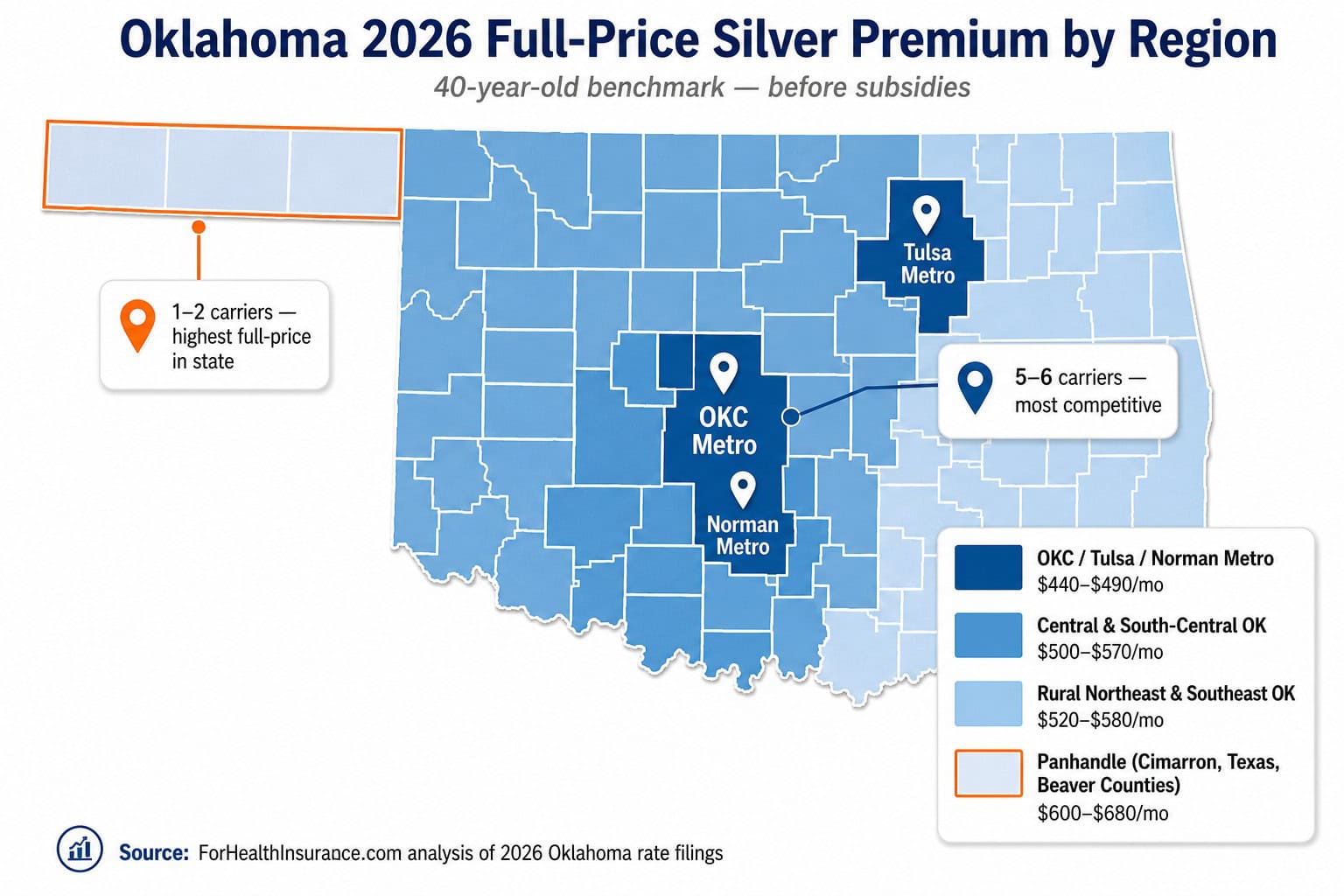
Full-price affordable health insurance Oklahoma premiums in 2026 vary widely by county — more so than in many states — because carrier competition drops sharply outside Oklahoma City, Tulsa, and Norman. A 40-year-old in Oklahoma County might pay $440–$480 per month for a benchmark Silver plan full-price; the same individual in Cimarron County in the panhandle may pay $600–$680 for equivalent coverage, a gap of $160–$200 per month driven by fewer carriers and higher claims costs in rural western Oklahoma.
| Oklahoma Region / County | Carriers Available (2026) | Est. Silver Benchmark (40-yr-old, full-price) | Key Driver |
|---|---|---|---|
| Oklahoma County (OKC metro) | 5–6 | $440–$480/mo | Most competitive market |
| Tulsa County (Tulsa metro) | 4–5 | $450–$490/mo | Strong carrier competition |
| Cleveland County (Norman) | 4–5 | $445–$485/mo | OU-adjacent market, competitive |
| Comanche County (Lawton) | 2–3 | $510–$560/mo | Mid-state, fewer options |
| Cherokee County (Tahlequah) | 2–3 | $520–$570/mo | Rural NE Oklahoma |
| Garfield County (Enid) | 2–3 | $530–$580/mo | North-central rural market |
| Cimarron / Texas / Beaver (panhandle) | 1–2 | $600–$680/mo | Fewest carriers; highest full-price |
The metro-to-panhandle premium gap matters most for Oklahomans above 400% of the federal poverty level, who no longer qualify for marketplace subsidies after enhanced premium tax credits expired at the end of 2025. Subsidy-eligible Oklahomans (below 400% FPL) are partially insulated — their subsidy is pegged to the benchmark Silver plan in their own county, so a higher benchmark in Cimarron County generates a larger subsidy to offset it. The gap also matters for Tornado Alley context: panhandle and western Oklahoma counties see higher emergency-room utilization costs from storm-related injuries, which feeds into carrier rate filings for those counties.
Find the Most Affordable Oklahoma Plan for Your Income
A licensed Oklahoma agent screens for SoonerCare under SQ 802, Insure Oklahoma eligibility, and marketplace APTC simultaneously — then compares subsidy-adjusted costs across all carriers in your county. Free, no obligation, takes about 20 minutes.
Bronze vs Silver vs Gold in Oklahoma 2026: Which Tier Is Cheapest?
The cheapest monthly premium in Oklahoma belongs to Bronze-tier plans, but Bronze is not always the cheapest total annual cost. For Oklahomans between 138% and 250% of FPL, Silver plans with cost-sharing reductions produce lower total annual costs because CSRs reduce deductibles from roughly $7,500 on a Bronze plan to as low as $500 on a CSR Silver. The right tier depends on income, expected healthcare use, and CSR eligibility.
Silver with CSR — best total value
CSRs reduce your Silver plan’s deductible to $500–$1,500 and lower copays and out-of-pocket maximums. Even though Silver’s monthly premium is higher than Bronze, the lower deductible saves most Oklahomans money on an annual basis if they use any healthcare. A Tulsa County resident at 180% FPL might pay $80/month for a Silver CSR plan with a $700 deductible — versus $45/month for a Bronze plan with a $7,500 deductible.
Bronze subsidized — lowest monthly cost
Above 250% FPL, CSRs phase out. At this income range, Bronze plans with APTC applied offer the lowest monthly premium — often $40–$175 per month in Oklahoma City or Tulsa metro counties. The trade-off: a $7,000–$9,000 deductible means Bronze works best for healthy Oklahomans who use minimal care and want catastrophic-level protection against a major event.
Full-price Silver or off-exchange PPO
Without subsidies, full-price Silver runs $440–$760 per month in Oklahoma depending on age and county. For working Oklahomans above 400% FPL — especially self-employed energy-sector or agricultural workers who travel — off-exchange PPO plans through national broker channels can offer broader networks and competitive unsubsidized pricing. Compare at the national PPO health insurance hub.
Tribal Silver — zero cost-sharing
For members of Oklahoma’s 39 federally recognized Tribes, a Silver-tier marketplace plan carries zero cost-sharing — no deductible, no copays, no out-of-pocket maximum — regardless of income. This makes Silver the unambiguous best-value tier for tribal members at any income level. Combined with Indian Health Service primary care, many tribal members achieve near-zero healthcare costs annually.
Why Oklahoma Health Insurance Costs Are Higher in 2026
Finding affordable health insurance in Oklahoma is harder in 2026 for two layered reasons: enhanced premium tax credits that kept net premiums low from 2021 through 2025 expired at year-end, and Oklahoma lacks a 1332 reinsurance waiver that would structurally reduce full-price premiums. Oklahoma shoppers above 400% of FPL now pay full freight, while those below 400% FPL saw subsidies shrink — average net premiums rose materially from the roughly $73 per month Oklahoma enrollees paid in 2025.
The enhanced premium tax credits — introduced under the American Rescue Plan in 2021 and extended through 2025 — had eliminated the 400% FPL subsidy cliff and capped premium contributions at 8.5% of income for all income levels. For 2026, neither protection applies. A single Oklahoman earning $70,000 (about 430% FPL) who paid roughly $420 per month for a Silver plan in 2025 after enhanced credits may now pay $560–$680 full-price in 2026, depending on county and carrier. The delta is especially visible in Tulsa County and Oklahoma County, where carrier competition had compressed prices during the enhanced-credit era.
Oklahoma’s Tornado Alley geography adds a structural cost layer that states without major weather-event risk don’t face. Emergency-room utilization spikes in the aftermath of tornado seasons — particularly in central and western Oklahoma counties — and those claims costs feed into annual carrier rate filings with the Oklahoma Insurance Department. This is part of why Oklahoma premiums run higher than neighboring Kansas even after controlling for carrier count and income demographics. Oklahomans with high deductibles or Bronze-tier plans in tornado-prone counties (Oklahoma County, Cleveland County, Grady County) should evaluate their cost-sharing exposure against the realistic likelihood of an ER visit from a weather event.
SoonerCare eligibility is unaffected by the 2026 subsidy changes
The expiration of enhanced premium tax credits and the HR 1 repayment rule changes apply only to HealthCare.gov marketplace coverage. SoonerCare under State Question 802 operates on a separate funding stream — joint federal-state Medicaid funds — and its eligibility threshold, $0 premium structure, and year-round enrollment remain unchanged for 2026. If your income dropped below 138% of FPL due to the economic impact of 2026’s subsidy changes on your household, you may now qualify for SoonerCare even if you previously used the marketplace. Apply year-round at mySoonerCare.org.
Frequently Asked Questions
Common questions about affordable health insurance in Oklahoma cover SoonerCare eligibility under SQ 802, Insure Oklahoma for self-employed shoppers, how cost-sharing reductions work on Silver plans, why premiums are higher in the panhandle than in OKC, and what changed in 2026 when enhanced subsidies expired. Answers reflect 2026 plan year rules and Oklahoma-specific program details.
What is the cheapest affordable health insurance Oklahoma plan in 2026?
The cheapest affordable health insurance Oklahoma option is SoonerCare — free coverage for Oklahomans at or below 138% of the federal poverty level ($21,597 for a single adult) under the State Question 802 constitutional amendment. For tribal members at any income, Indian Health Service and Silver-tier marketplace plans with zero cost-sharing are also effectively free. For marketplace shoppers between 138% and 400% FPL, the cheapest monthly premium is typically a Bronze plan after applying Advance Premium Tax Credits — often $40–$175 per month in OKC and Tulsa metro counties. Above 400% FPL, full-price Bronze ($330–$560/month) or off-exchange PPO plans represent the lowest-cost ACA-compliant options.
What is Insure Oklahoma and who qualifies?
Insure Oklahoma is one route to affordable health insurance in Oklahoma for self-employed residents and employees of qualifying small businesses (typically under 25 employees) pay for health insurance. It is designed for households between 100% and 250% of the federal poverty level who don’t qualify for SoonerCare but need additional help beyond standard marketplace APTC. The program combines with federal premium tax credits and is administered through the Oklahoma Insurance Department. It’s an Oklahoma-only program with no equivalent in neighboring Texas or Kansas, and is frequently underutilized because shoppers don’t know to ask about it.
Why does affordable health insurance Oklahoma cost more in the panhandle?
Oklahoma panhandle counties — Cimarron, Texas, and Beaver — typically have only one or two carriers offering 2026 marketplace plans, compared to five or six in Oklahoma City and Tulsa metros. Less carrier competition means less price pressure on rate filings. Rural network costs are also higher: fewer providers means longer-distance care and higher per-claim costs. A 40-year-old in Cimarron County may pay $600–$680 per month full-price for a Silver plan, versus $440–$480 in Oklahoma County — a $160–$200 monthly gap. Subsidy-eligible Oklahomans seeking affordable health insurance in Oklahoma are partially cushioned because their subsidy is calculated against their county’s own benchmark Silver, not a statewide average.
Should I choose Bronze or Silver for affordable health insurance in Oklahoma?
For affordable health insurance in Oklahoma, the right tier depends on income. For Oklahomans between 138% and 250% of the federal poverty level, Silver plans with cost-sharing reductions are almost always the better total-cost choice — CSRs can reduce your Silver deductible to as low as $500, making Silver cheaper in total annual cost than a Bronze plan with a $7,500 deductible. Above 250% FPL where CSRs phase out, Bronze plans offer the lowest monthly premium and make sense for healthy Oklahomans who rarely use care and want protection only against major events. Above 400% FPL, compare affordable health insurance Oklahoma options — full-price Bronze, Silver, and off-exchange PPO — side-by-side before deciding.
How does SoonerSelect affect my SoonerCare coverage?
SoonerSelect affects affordable health insurance Oklahoma enrollees covered under SoonerCare, launched April 1, 2024 by the Oklahoma Health Care Authority. Most SoonerCare enrollees — including the SQ 802 expansion population — were transitioned from fee-for-service to SoonerSelect MCOs: Aetna Better Health of Oklahoma, Humana Healthy Horizons in Oklahoma, or Oklahoma Complete Health (Centene). You either chose a plan or were auto-assigned. SoonerSelect changes which specific provider network you use under SoonerCare, but not your eligibility or your $0 monthly premium — those remain the same. If you haven’t verified your SoonerSelect plan assignment, contact the Oklahoma Health Care Authority or check at mySoonerCare.org.
Find Affordable Oklahoma Health Insurance Now
A licensed Oklahoma agent screens SoonerCare eligibility under SQ 802, Insure Oklahoma qualification, and HealthCare.gov subsidies — then compares every available plan in your county by total annual cost, not just monthly premium. Free, no obligation.
Free affordable health insurance Oklahoma cost comparison — takes about 20 minutes by phone or online.
Related Oklahoma Health Insurance Resources
Complete 2026 overview — SoonerCare, marketplace, carriers, and costs.
Oklahoma Marketplace EnrollmentHow HealthCare.gov works for Oklahoma — SoonerCare vs marketplace enrollment.
Best Oklahoma Health Insurance PlansCompare top Oklahoma carriers by network, satisfaction, and total cost.
Oklahoma Small Business Health InsuranceGroup plans, ICHRA, QSEHRA, and Insure Oklahoma for Oklahoma employers.
Broker Disclosure
ForHealthInsurance.com is an independent health insurance agency serving Oklahoma residents. We are not affiliated with any carrier or government agency. We help you compare plans and enroll in coverage that meets your needs at no extra cost to you.