Small Business Health Insurance Oklahoma 2026 Guide
Small business health insurance Oklahoma in 2026 is shaped by one program most neighboring states don’t have: Insure Oklahoma, a state-funded premium assistance program that subsidizes health coverage for employees of qualifying small businesses and self-employed Oklahomans below 250% of the federal poverty level. Beyond Insure Oklahoma, Oklahoma small employers have four main routes — traditional group plans, ICHRA (Individual Coverage Health Reimbursement Arrangements), QSEHRA (Qualified Small Employer HRAs), and SHOP marketplace plans — each with a different cost structure, administrative burden, and employee experience. The right choice depends on business size, the income profile of employees, whether coverage is needed statewide or in one market, and what BCBS-OK versus competing carriers offer in the relevant Oklahoma counties. This guide covers all five options with Oklahoma-specific cost benchmarks and carrier context.
What’s your Oklahoma small business situation?
Insure Oklahoma: The State’s Small Business Premium Assistance Program
Insure Oklahoma is the key differentiator for small business health insurance in Oklahoma — a state-funded premium assistance program with no equivalent in neighboring Texas, Kansas, or Arkansas. For qualifying employers with 25 or fewer full-time employees and average wages below $50,000, Insure Oklahoma covers a portion of both employer and employee premiums, stacking on top of federal small business tax credits.
The program has two components. The employer-sponsored insurance (ESI) component assists employers who offer group health insurance to employees earning below 250% of the federal poverty level — Insure Oklahoma pays a share of the premium directly, reducing the employer’s cost to offer coverage and reducing the employee’s share. The individual plan assistance component helps self-employed Oklahomans and employees of very small businesses (often fewer than 5 employees) purchase individual marketplace coverage with state-funded assistance layered on top of federal Advance Premium Tax Credits. An oil-field services contractor with four employees in Garfield County evaluating small business health insurance Oklahoma options, or a Stillwater retail shop owner with eight employees, may qualify for Insure Oklahoma assistance that substantially changes the economics of offering health coverage.
Insure Oklahoma is administered through the Oklahoma Insurance Department. Eligibility is determined by business size, employee income levels, and the type of coverage being offered. The program is frequently underutilized because small business owners in Oklahoma don’t know to ask for it — most national broker platforms and online enrollment tools don’t screen for it automatically. A licensed Oklahoma broker familiar with the program can run the eligibility check as part of a standard small group consultation.
Insure Oklahoma + federal small business tax credit: double stacking
Oklahoma small employers with fewer than 25 full-time equivalent employees and average wages below $56,000 may qualify for the federal Small Business Health Care Tax Credit — up to 50% of premium contributions for two consecutive tax years when coverage is purchased through SHOP. Insure Oklahoma can layer on top of this credit for qualifying businesses, creating a double-stacking opportunity where both state and federal assistance reduce the employer’s net cost. A licensed broker or accountant can model the combined benefit for Oklahoma small businesses that meet both programs’ thresholds.
Oklahoma Small Business Health Insurance Options: Group Plan vs ICHRA vs QSEHRA vs SHOP
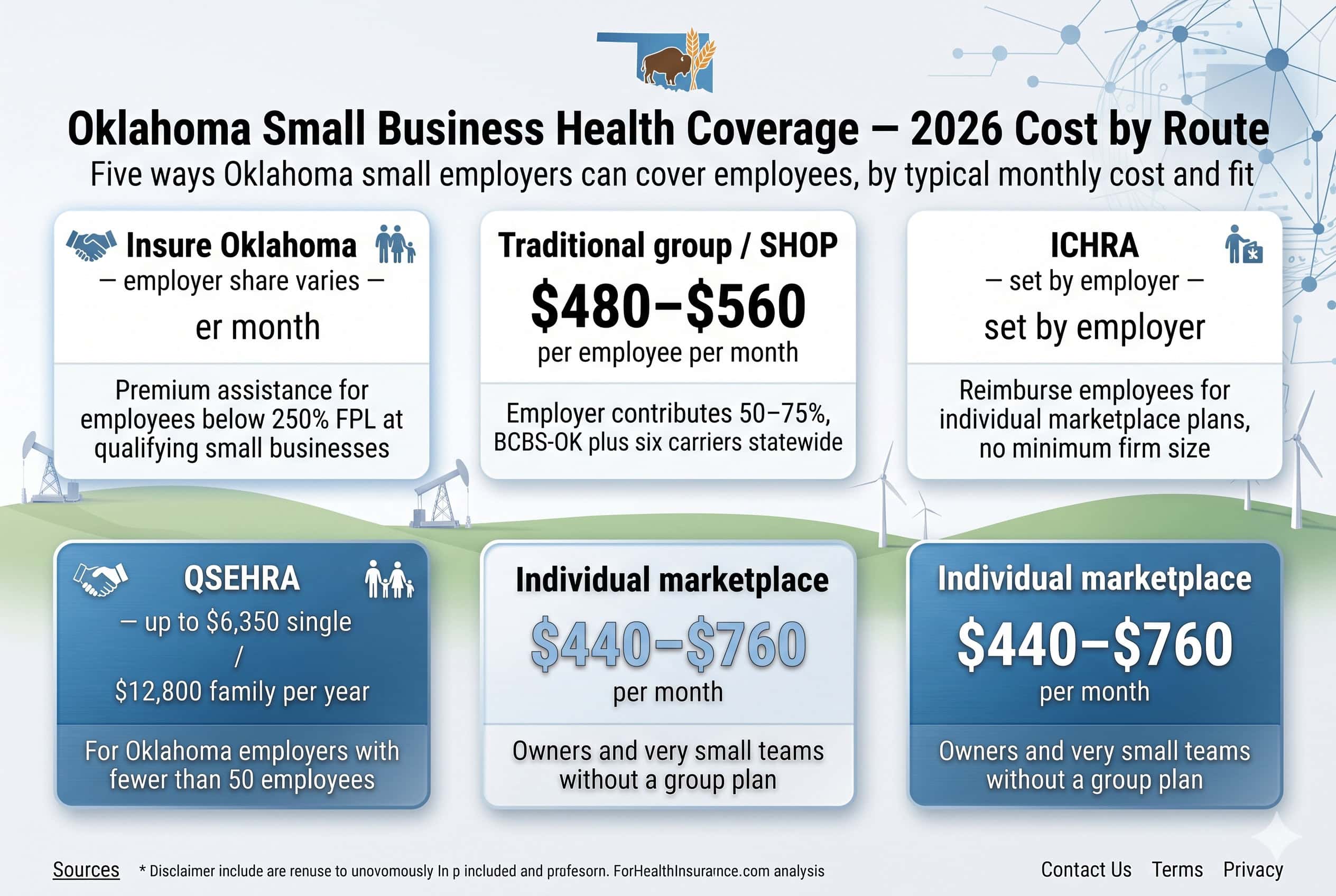
Oklahoma small employers shopping for small business health insurance in Oklahoma have five substantively different coverage routes for 2026. Traditional group plans and SHOP provide employer-sponsored coverage; ICHRA and QSEHRA reimburse employees for individual marketplace plans they choose themselves; Insure Oklahoma adds state-funded assistance on top of either route. The best structure for an Oklahoma small business depends on employee count, geography, income mix, and how much administrative involvement the owner wants.
| Option | How It Works | Min / Max Employees | Oklahoma-Specific Note |
|---|---|---|---|
| Traditional Group Plan | Employer selects and funds a group plan; employees enroll in employer-chosen coverage | 2–50 (small group) | BCBS-OK leads small business health insurance Oklahoma rural network depth; Medica and Ambetter competitive in OKC/Tulsa metro |
| SHOP (Small Business Marketplace) | Group coverage purchased through HealthCare.gov SHOP; employees choose from available plans | 1–50 | Qualifies for federal small business tax credit (up to 50%); limited carrier participation in some OK counties |
| ICHRA | Employer sets a monthly reimbursement amount; employees buy individual plans and submit for reimbursement | 1+ (no max) | Employees use HealthCare.gov marketplace; strong fit for rural OK businesses with employees in multiple counties |
| QSEHRA | Employer reimburses employees tax-free for individual coverage premiums and medical expenses | 1–49 (no existing group plan) | 2026 QSEHRA annual limits: $6,350 single / $12,800 family; Insure Oklahoma may not stack with QSEHRA — confirm |
| Insure Oklahoma (ESI) | State-funded premium assistance layered on top of a group or individual plan for qualifying businesses | 1–25 (income thresholds apply) | Oklahoma-only program; no equivalent in TX, KS, AR; self-employed and small employers below 250% FPL |
ICHRA or QSEHRA — best flexibility
Very small rural Oklahoma businesses seeking small business health insurance Oklahoma options often have employees in different counties with different carrier availability. An ICHRA lets employees in Cimarron County choose BCBS-OK (the most available carrier) while employees in Oklahoma County choose from five to six carriers — each buying the plan that fits their county. No single group plan can optimize across that geography. ICHRA removes the employer from carrier selection entirely.
Traditional group plan + Insure Oklahoma
Metro Oklahoma small businesses with employees concentrated in Oklahoma County or Tulsa County benefit from a traditional group plan where the employer negotiates a single carrier contract. Screen for Insure Oklahoma eligibility first — if average employee wages are below $50,000, the state assistance can meaningfully reduce the employer’s per-employee cost. BCBS-OK, Medica, and Ambetter all offer small group products in these markets.
Individual marketplace + Insure Oklahoma
Self-employed Oklahomans without employees aren’t buying group insurance — they’re buying individual coverage on HealthCare.gov and should screen for both federal APTC subsidies and Insure Oklahoma’s individual assistance component simultaneously. A self-employed Oklahoman below 250% of FPL may qualify for both. This is the most common scenario for sole proprietors, freelancers, and independent contractors in Oklahoma’s energy, agriculture, and trades sectors.
SHOP or traditional group — carrier matters
Oklahoma employers with 26–50 employees and workers spread across multiple counties face a carrier-availability challenge. BCBS-OK is the only carrier with a network in all 77 Oklahoma counties, making it the default choice for statewide small group coverage. For employers with employees concentrated in metro areas, a multi-plan SHOP enrollment gives employees carrier choice within the metro market, though SHOP’s Oklahoma carrier participation is more limited than the individual marketplace.
Oklahoma Small Business Health Insurance Cost Benchmarks for 2026
Small business health insurance in Oklahoma for 2026 depends on carrier, county, employee age mix, and how much the employer contributes. In OKC and Tulsa metro markets, group Silver premiums for a 35-year-old employee run roughly $480–$560 per month full-price; the employer typically contributes 50%–75% of that, with the employee paying $120–$280 per month. Rural Oklahoma counties — particularly in the panhandle — run $100–$200 more per month due to BCBS-OK near-monopoly pricing and higher network costs.
| Oklahoma Market | Group Silver Premium (35-yr-old, 2026) | Employer Share (75%) | Employee Share (25%) |
|---|---|---|---|
| OKC metro (Oklahoma County) | $480–$540/mo | $360–$405/mo | $120–$135/mo |
| Tulsa metro (Tulsa County) | $490–$550/mo | $368–$413/mo | $123–$138/mo |
| Mid-state rural (Garfield, Comanche) | $550–$620/mo | $413–$465/mo | $138–$155/mo |
| Panhandle (Cimarron, Texas, Beaver) | $640–$720/mo | $480–$540/mo | $160–$180/mo |
The panhandle premium gap affects small business health insurance in Oklahoma significantly — small businesses in Cimarron, Texas, and Beaver counties — employers paying 75% of a $680/month group Silver premium spend $510 per employee per month on health coverage, compared to roughly $360 in Oklahoma City. This is one reason ICHRA has become more attractive for Oklahoma businesses with rural employees: ICHRA lets the employer set a flat reimbursement amount rather than absorbing the full county-specific group premium, transferring some of the geographic cost variation to the individual market where federal subsidies can offset it for lower-income employees.
Get an Oklahoma Small Business Health Insurance Quote
A licensed Oklahoma broker screens for Insure Oklahoma eligibility, federal small business tax credit qualification, and compares group plan options from BCBS-OK, Medica, Ambetter, and others — building a per-employee cost analysis for your Oklahoma business. Free, no obligation.
Oklahoma Small Group Health Insurance Carriers for 2026
Oklahoma small group health insurance in Oklahoma for 2026 is led by Blue Cross Blue Shield of Oklahoma — the dominant carrier for both large and small group markets statewide. In OKC and Tulsa metro markets, Medica, Ambetter from Oklahoma Complete Health, Aetna CVS Health, and UnitedHealthcare also offer small group products, giving metro employers a genuine comparison. Rural small business health insurance Oklahoma options typically default to BCBS-OK as the primary carrier.
Blue Cross Blue Shield of Oklahoma (small group)
The most widely available small business health insurance Oklahoma carrier across all 77 counties. HCSC subsidiary with the deepest rural network reach, statewide PPO plan options, and contracts with OU Health, INTEGRIS Health, and Saint Francis Health System. Best choice for Oklahoma employers with employees in multiple counties or in rural markets where competitors don’t file group products.
Medica (small group)
Nonprofit carrier offering competitive small business health insurance Oklahoma Silver and Bronze pricing in OKC and Tulsa metro markets. Particularly competitive for Oklahoma employers whose employees are concentrated in Oklahoma County or Tulsa County and prioritize lower per-employee cost over statewide network breadth. Medica’s nonprofit structure and lower administrative overhead typically produce thinner margins and more competitive premiums in metro markets.
Ambetter from Oklahoma Complete Health (small group)
Centene’s Oklahoma small group carrier with statewide county participation. Notable dual role as both a small group carrier and a SoonerSelect managed-care organization — useful for Oklahoma employers whose employees cycle between SoonerCare and employer coverage based on income fluctuations (common in seasonal industries like agriculture and energy services). Competitive Bronze and Silver pricing in metro and select rural markets.
Aetna CVS Health and UnitedHealthcare (small group)
Both carriers offer small group products in OKC and Tulsa metro Oklahoma markets for 2026. Aetna’s CVS MinuteClinic integration makes it practical for employers with employees in areas with heavy CVS pharmacy presence. UnitedHealthcare’s national network is a strong fit for Oklahoma businesses with employees who travel or live in multiple states — energy sector employers with mobile workforces being the clearest example.
Frequently Asked Questions
Common questions about small business health insurance in Oklahoma cover Insure Oklahoma eligibility thresholds, whether a sole proprietor can get group coverage, how ICHRA works for rural Oklahoma employees, the federal small business tax credit requirements, and how BCBS-OK compares to other carriers for small group plans. Answers reflect 2026 Oklahoma program and carrier specifics.
What is Insure Oklahoma and does my business qualify?
Insure Oklahoma is the main state-level tool for small business health insurance Oklahoma owners need to check first — a state-funded premium assistance program for qualifying small employers and self-employed Oklahomans — with no equivalent in neighboring Texas, Kansas, or Arkansas. For the employer-sponsored insurance component, the business typically must have 25 or fewer full-time employees, with average annual wages below $50,000, and must contribute toward employee premiums. Employee income must be below 250% of the federal poverty level to receive Insure Oklahoma assistance. The program is administered through the Oklahoma Insurance Department and details on qualifying income thresholds are maintained by the Oklahoma Health Care Authority. Eligibility determination requires an application and income documentation — a licensed Oklahoma broker familiar with the program can walk employers through the process at no charge.
Can a self-employed person in Oklahoma get small business health insurance?
A self-employed person with no employees is buying individual health insurance rather than small business health insurance Oklahoma group coverage. Self-employed Oklahomans should enroll through HealthCare.gov for individual marketplace plans and screen for both federal Advance Premium Tax Credits (if income is between 138% and 400% of FPL) and Insure Oklahoma’s individual assistance component (if income is below 250% of FPL). Schedule C net profit determines MAGI for subsidy calculations. Self-employed Oklahomans above 400% of FPL should compare full-price marketplace Silver plans against off-exchange PPO options — the off-exchange market sometimes offers better pricing for higher-income sole proprietors.
How does ICHRA work for Oklahoma small businesses?
An ICHRA is increasingly popular for small business health insurance in Oklahoma — it lets the Oklahoma employer set a monthly tax-free reimbursement amount per employee — for example, $400 per month — and employees buy whatever individual marketplace plan fits their county and preferences, then submit premiums for reimbursement up to that cap. This is particularly well-suited for Oklahoma businesses with employees in multiple counties, since each employee can choose the carrier available in their county rather than being forced onto a single group plan with uneven network quality across Oklahoma’s 77 counties. ICHRAs have no minimum or maximum employee count. Employees must have qualifying individual coverage to use the ICHRA.
Which carrier is best for Oklahoma small business group plans?
For statewide small business health insurance in Oklahoma across all 77 counties: Blue Cross Blue Shield of Oklahoma is the only carrier with a consistent small group network in every county, including the panhandle. For OKC and Tulsa metro employers prioritizing lowest premium: Medica and Ambetter from Oklahoma Complete Health typically file more competitive small group Silver pricing in those markets than BCBS-OK. For businesses with a mobile or multi-state workforce: UnitedHealthcare’s national small group network provides the broadest out-of-state coverage. For businesses near CVS pharmacy locations: Aetna CVS Health’s integrated model may reduce employee prescription and primary care costs. The best carrier depends on where employees live and receive care.
Does Oklahoma require small businesses to offer health insurance?
No. Oklahoma has no state law requiring small business health insurance in Oklahoma for businesses (under 50 full-time equivalent employees) to offer health insurance. The federal ACA employer mandate applies only to businesses with 50 or more full-time equivalent employees — those businesses must offer affordable minimum-value coverage or face penalties. For Oklahoma small businesses under 50 FTEs, offering health insurance is entirely voluntary. However, Insure Oklahoma and the federal small business tax credit create meaningful financial incentives for small Oklahoma employers who do choose to offer coverage, and health benefits are an increasingly important factor in recruiting and retaining employees in competitive Oklahoma labor markets.
Compare Oklahoma Small Business Health Insurance Options
A licensed Oklahoma broker screens for Insure Oklahoma and federal tax credit eligibility, compares group plan costs from BCBS-OK, Medica, Ambetter, and other Oklahoma carriers, and models ICHRA versus group plan total costs for your employee headcount and geography. Free, no obligation.
Free small business health insurance Oklahoma consultation — covers all five options for your business in one call.
Related Oklahoma Health Insurance Resources
Complete 2026 overview — SoonerCare, marketplace, carriers, and costs.
Oklahoma Marketplace EnrollmentHealthCare.gov enrollment, SoonerCare vs marketplace, and tribal SEP rules.
Best Oklahoma Health Insurance CarriersBCBS-OK, Medica, Aetna CVS, Ambetter, and Community Care HMO compared.
Oklahoma Small Business Health InsuranceGroup plans, ICHRA, QSEHRA, and Insure Oklahoma options for Oklahoma employers.
Broker Disclosure
ForHealthInsurance.com is an independent health insurance agency serving Oklahoma businesses. We are not affiliated with any carrier or government agency. We help you compare plans and enroll in coverage that meets your needs at no extra cost to you.