Small Business Health Insurance Washington State 2026
Small business health insurance in Washington state in 2026 is available through Washington Healthplanfinder Business (the state’s SHOP exchange for employers with 1 to 50 FTE), direct group contracts with nine approved small group carriers, Individual Coverage Health Reimbursement Arrangements (ICHRA), and Qualified Small Employer HRAs (QSEHRA). Washington approved nine small group carriers for 2026 with an average rate increase of 12.8%. Washington does not require employers with fewer than 50 FTEs to offer health insurance — the federal ACA pay-or-play mandate applies only at 50+ FTEs — but two significant 2026 Washington law changes affect employers who do offer coverage: HB 1213 expanded PFML health benefit continuation requirements to employers with 25 or more employees, and the WA Cares Fund long-term care premium of 0.58% of gross wages continues for all employees. The Small Business Health Care Tax Credit provides up to 50% of premiums paid for employers with 25 or fewer FTEs and average wages at or below $56,000 per year who purchase through Washington Healthplanfinder Business. This guide covers every small business health insurance path in Washington state for 2026.

What brings you here today?
Small Business Health Insurance Options in Washington State
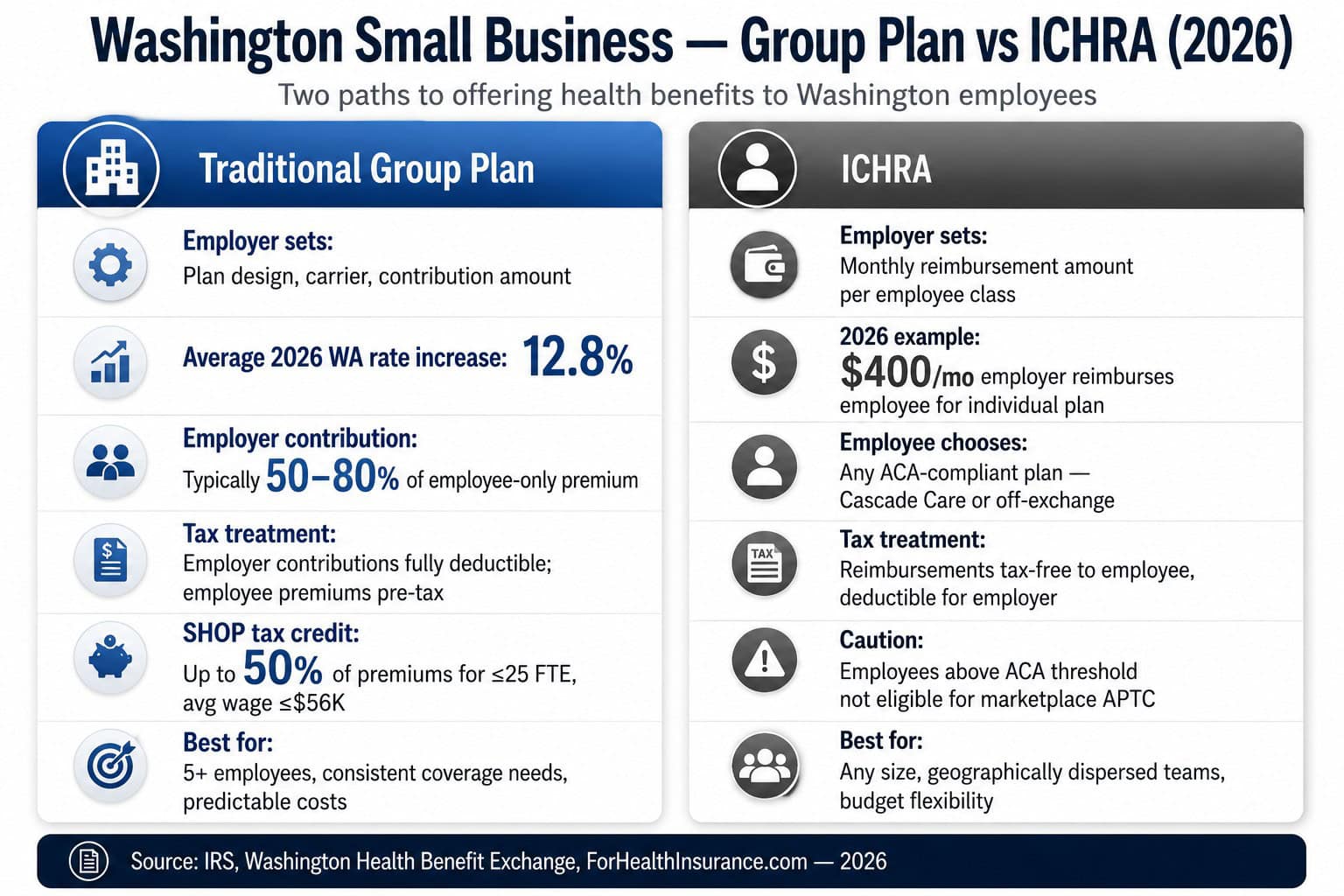
Washington small businesses have four main paths to offering employee health benefits: traditional group health insurance purchased directly from a carrier or through a broker, Washington Healthplanfinder Business (SHOP) for groups with 1–50 FTEs, an Individual Coverage HRA (ICHRA) that reimburses employees for individual plans tax-free, or a Qualified Small Employer HRA (QSEHRA) for businesses with fewer than 50 FTEs that don’t offer a group plan.
Traditional Group Health Plan
Who: Any Washington employer — no minimum employee count for most carriers. Typically requires 1+ enrolled employee (owner’s family may count).
How it works: Employer contracts directly with a carrier (Premera, Regence, Kaiser, LifeWise, Molina, etc.). Employer pays a share of employee premiums; employees pay the rest pre-tax through payroll.
Pros: Broadest plan choice, negotiated group rates, employer controls plan selection, tax-deductible for employer.
Best for: Businesses with 5+ employees wanting to offer consistent coverage with a predictable employer contribution.
Washington Healthplanfinder Business (SHOP)
Who: Washington employers with 1–50 FTEs. Employees and their families enroll through Washington Healthplanfinder.
How it works: Employer selects a plan or offers a choice across carriers available on the SHOP exchange. Employees enroll through wahealthplanfinder.org.
Key benefit: Only path to the Small Business Health Care Tax Credit — up to 50% of premiums for employers with ≤25 FTE and avg wages ≤$56,000/year.
Best for: Small Washington employers who qualify for the tax credit or want to offer employees a choice of plans.
ICHRA (Individual Coverage HRA)
Who: Any Washington employer of any size — no employee minimum or maximum.
How it works: Employer sets a monthly reimbursement amount per employee. Each employee buys their own ACA-compliant individual plan and submits premiums for reimbursement. Reimbursements are tax-free for employees and deductible for the employer.
Caution: Employees receiving ICHRA above ACA thresholds are not eligible for federal APTC marketplace subsidies. Works best for employees above the subsidy range.
Best for: Employers who want benefit flexibility without managing a group plan; businesses with geographically dispersed employees across multiple Washington counties.
QSEHRA
Who: Washington employers with fewer than 50 FTEs that do not offer a group health plan. 2026 maximum reimbursement: $6,350 per year per employee ($12,800 for family coverage).
How it works: Employer reimburses employees tax-free for individual health insurance premiums and qualified medical expenses, up to the annual IRS cap. Employees must have ACA-compliant coverage to receive reimbursements.
Best for: Very small Washington employers (1–10 employees) who cannot afford or do not want to manage a full group plan but want to offer some health benefit.
Washington Small Group Health Insurance Carriers for 2026
Washington approved nine carriers to sell small group health plans to employers with 1–50 FTEs for 2026, with an average approved rate increase of 12.8% across the market. Not every carrier serves every county — Premera Blue Cross covers 38 counties; Regence BlueShield serves 23; Kaiser Foundation Health Plan of Washington operates in 17 counties on an HMO model. Carrier availability and hospital network access varies significantly by county.
| Carrier | Small Group Counties | Key Hospital Network | Plan Model |
|---|---|---|---|
| Premera Blue Cross | 38 counties | Swedish, Providence, CHI Franciscan, UW Medicine | PPO / EPO / HMO |
| Regence BlueShield | 23 counties | Swedish, Providence (King Co. network narrowed 2026) | PPO / EPO |
| Kaiser Foundation Health Plan of WA | 17 counties | Kaiser Permanente facilities only | Closed HMO |
| LifeWise Health Plan of WA | 39 counties (statewide) | Swedish, Providence, CHI Franciscan | PPO |
| Molina Healthcare of WA | 18 counties | Community health centers, select hospitals | HMO / EPO |
| Asuris Northwest Health | Eastern WA counties | Sacred Heart, Deaconess (Spokane) | PPO (Regence affiliate) |
| Coordinated Care / Ambetter | Statewide | Community health centers, select hospitals | HMO |
| Providence Health Plan | Select counties | Providence Health System facilities | HMO / EPO |
| UnitedHealthcare of Oregon | Select counties | UW Medicine, MultiCare, Virginia Mason | PPO |
County-by-county carrier availability — verify before quoting
Washington’s small group carrier availability varies substantially by county. A Spokane-area employer may have access to Asuris Northwest and Premera but not to carriers that focus on western Washington. A rural Whatcom County employer may find that LifeWise is the only carrier with statewide reach. Washington’s Office of the Insurance Commissioner publishes the approved 2026 small group plans by carrier and county. A licensed Washington group broker can run a carrier availability check for your specific ZIP code and employee count at no charge.
Get a Washington Small Group Health Insurance Quote
A licensed Washington group health broker compares all nine approved 2026 small group carriers, checks county availability for your employee locations, calculates your Small Business Health Care Tax Credit eligibility, and presents group plan and ICHRA options side by side. Free — no obligation.
ICHRA vs Traditional Group Plan for Washington Employers
An ICHRA lets any Washington employer reimburse employees tax-free for individual health insurance premiums instead of managing a group plan. Employers set a monthly reimbursement amount — there is no IRS maximum for ICHRAs (unlike the capped QSEHRA). Employees choose their own Cascade Care or off-exchange plan and submit premiums for reimbursement. The main constraint: employees with ICHRA access above ACA affordability thresholds cannot claim federal APTC marketplace subsidies.
ICHRA works particularly well for Washington employers whose employees are geographically distributed across multiple counties — where one group carrier does not serve all locations — or for employers whose workforce includes both subsidy-ineligible and subsidy-eligible employees (ICHRA classes can be structured to offer different reimbursement levels by job category or location). Washington employers with employees in both Seattle metro and Spokane, for example, can use an ICHRA to let King County employees choose from Premera or Regence and Spokane employees choose from Asuris or Premera without managing two separate group contracts.
Example: Vancouver, WA landscaping company — 8 employees, spread across Clark and Cowlitz counties
A Vancouver-area small business offers employees an ICHRA of $350 per month. Each employee enrolls in their preferred ACA-compliant plan — some choose LifeWise (statewide), others choose Regence (available in Cowlitz County). The employer deducts the $350/month per employee as a business expense. Employees whose household income qualifies them for marketplace subsidies above the ICHRA affordability threshold can opt out of the ICHRA and use Washington Healthplanfinder subsidies instead. Total employer cost: $350 × 8 = $2,800/month — predictable and capped, with no carrier negotiations, no plan design decisions, and no minimum participation rate to manage.
Washington Employer Requirements and 2026 Law Changes
Washington state does not require employers with fewer than 50 FTEs to offer health insurance. The federal ACA employer mandate applies only to businesses with 50 or more full-time equivalent employees. However, two significant Washington law changes effective January 1, 2026 affect employers who do offer coverage: expanded PFML health benefit continuation requirements under HB 1213, and the continuation of WA Cares Fund premiums at 0.58% of gross wages.
Under HB 1213, Washington employers with 25 or more employees must now maintain an employee’s health insurance during any Paid Family and Medical Leave period where the employee has job protection rights. This requirement previously applied only to employers with 50 or more employees. The threshold expands further to 15+ employees in 2027 and 8+ employees in 2028. Employers must continue the same health coverage terms during protected PFML leave — they cannot change carriers, increase the employee’s premium share, or reduce benefits for a worker on covered leave. The 2026 PFML premium rate is 1.13% of gross wages up to the Social Security wage cap of $184,500, split between employer and employee.
The WA Cares Fund — Washington’s public long-term care insurance program, the first of its kind in the nation — collects premiums at 0.58% of gross wages with no Social Security cap. Full benefit availability begins July 2026, providing up to $36,500 in lifetime long-term care benefits. Washington employers must withhold and remit WA Cares premiums quarterly. Employees who purchased qualified private long-term care insurance before November 1, 2021 may have applied for a permanent exemption. WA Cares is separate from health insurance but affects total benefits cost for Washington employers planning overall compensation packages.
PFML + ACA leave interaction — verify health coverage continuation obligations
Washington PFML and federal FMLA must now run concurrently under HB 1213 — employees cannot stack leave periods. For employers at the 25-FTE threshold for the first time in 2026, this means new health coverage continuation obligations during PFML leave for any employee with job protection rights. Employers who reduce or cancel health coverage during a protected PFML period face potential state and federal liability. Washington’s Employment Security Department publishes updated PFML guidance for 2026 including the new job protection and health benefit continuation thresholds.
How to Enroll a Washington Small Business Group Plan
Washington small group health insurance is available year-round — unlike individual marketplace plans, group plans do not require open enrollment. New businesses can enroll at any time; existing employers typically renew annually. Enrollment through Washington Healthplanfinder Business is available year-round at wahealthplanfinder.org/business, or through a licensed Washington group broker at no additional cost.
Most Washington small group carriers require a minimum of 70% employee participation — meaning 70% of eligible employees (excluding those waiving due to other qualifying coverage such as a spouse’s employer plan) must enroll. A business with 10 eligible employees needs at least 7 enrolled. This participation threshold is evaluated at the time of initial enrollment and at each annual renewal. LifeWise and some other carriers may have different participation requirements for very small groups of 2 to 5 employees.
Washington group brokers — including ForHealthInsurance.com licensed agents — provide employer enrollment assistance at no cost to the employer. Broker commissions are included in the group premium rates already approved by the Washington Office of the Insurance Commissioner. An employer who enrolls through a broker pays the same premium as one who enrolls direct. Brokers provide census collection, carrier comparison across all nine approved Washington small group carriers, plan presentation to employees, and ongoing enrollment support for new hires and life events throughout the plan year. Employees who are not enrolled in the group plan can also explore individual health insurance options in Washington through Washington Healthplanfinder or off-exchange carriers.
Frequently Asked Questions
Common questions about small business health insurance in Washington state cover whether employers are required to offer coverage, what Washington Healthplanfinder Business is, how much group plans cost in 2026, how ICHRA works, and what HB 1213’s PFML health benefit continuation expansion means for employers at the 25-employee threshold.
Are Washington state employers required to provide health insurance?
Washington state does not require employers to offer health insurance regardless of business size. The federal ACA employer mandate requires applicable large employers — those with 50 or more full-time equivalent employees — to offer affordable minimum essential coverage or face potential pay-or-play penalties. Washington employers with fewer than 50 FTEs face no federal or state mandate to offer health insurance. However, offering coverage is often necessary for recruiting and retention in Washington’s competitive labor market, and the Small Business Health Care Tax Credit provides a federal incentive for businesses with 25 or fewer FTEs and average wages below $56,000 per year.
What is Washington Healthplanfinder Business?
Washington Healthplanfinder Business is Washington’s Small Business Health Options Program (SHOP) exchange, available to employers with 1 to 50 full-time equivalent employees. It allows small Washington employers to offer qualified health plans to employees through Washington Healthplanfinder, potentially qualifying for the Small Business Health Care Tax Credit. Employers can offer a single plan or a choice of plans across carriers. Enrollment is available year-round for new businesses and existing employers. Washington Healthplanfinder Business is administered by the Washington Health Benefit Exchange at wahealthplanfinder.org.
How much does small business health insurance cost in Washington state in 2026?
Small group health insurance in Washington state averaged a 12.8 percent rate increase for 2026 across approved plans. Actual monthly premiums depend on employee age, plan tier, and county — a group of five employees in King County will pay different rates than the same group in Yakima County. Employers typically contribute 50 to 80 percent of the employee-only premium; Washington has no state law requiring a specific employer contribution percentage for small groups, though most carriers require at least 50 percent employer contribution to participate in small group markets. Employee spouse and dependent coverage is priced separately.
What is an ICHRA and can Washington small businesses use it?
An Individual Coverage Health Reimbursement Arrangement (ICHRA) allows Washington employers of any size to reimburse employees tax-free for individual health insurance premiums — rather than offering a traditional group plan. The employer sets a monthly reimbursement amount; employees choose any ACA-compliant individual plan, including Cascade Care plans through Washington Healthplanfinder or off-exchange plans. ICHRA contributions are tax-deductible for the employer and tax-free for employees. An employee receiving ICHRA reimbursements above a threshold is not eligible for federal APTC subsidies, so ICHRA works best for employees who are above the marketplace subsidy range or whose individual plans cost less than the reimbursement amount.
How does Washington’s PFML law affect employer health benefits in 2026?
Under HB 1213, effective January 1, 2026, Washington employers with 25 or more employees must maintain the employee’s health insurance during any Paid Family and Medical Leave period where the employee has job protection rights. Previously this requirement applied only to employers with 50 or more employees. The threshold expands further to employers with 15 or more employees in 2027 and 8 or more in 2028. Employers must maintain the same health coverage terms during PFML leave — they cannot reduce benefits, increase employee premiums, or change carrier for an employee on protected leave. The PFML premium rate for 2026 is 1.13 percent of gross wages up to the Social Security wage cap.
Compare Washington Small Business Health Insurance Plans
A licensed Washington group health broker compares all 9 approved 2026 small group carriers, checks county availability for your employees, calculates your SHOP tax credit eligibility, and presents group plan and ICHRA options side by side. Free — no obligation.
Free Washington small business health insurance comparison — all carriers, all options, one call.
Explore Washington Health Insurance In Depth
Complete 2026 guide — Apple Health, Cascade Care, Cascade Care Savings, and all carriers.
Individual Washington Health InsuranceOn- and off-exchange options for self-employed workers and individuals in Washington.
Best Washington Health Insurance CarriersPremera, Regence, Kaiser, LifeWise, Molina — 2026 county networks compared.
Washington Healthplanfinder MarketplaceEnrollment guide for employees who need individual coverage through Healthplanfinder.
Washington Healthplanfinder BusinessOfficial SHOP exchange portal for Washington small employers — enroll and compare plans.
Affordable Washington Health InsuranceApple Health, APTC, Cascade Care Savings — every reduced-cost path for Washington residents.
Broker Disclosure
ForHealthInsurance.com is an independent health insurance agency serving Washington residents. We are not affiliated with any carrier or government agency. We help you compare plans and enroll in coverage that meets your needs at no extra cost to you.