South Dakota Health Insurance Marketplace 2026: HealthCare.gov Guide
The marketplace for South Dakota residents — also called the South Dakota health insurance exchange — runs through HealthCare.gov, the federally-facilitated platform used by 32 states without their own exchange. Three carriers participate for 2026: Avera Health Plans, Sanford Health Plan, and Wellmark Blue Cross Blue Shield. About 50,951 South Dakotans selected coverage for 2026, down from a record 54,721 the prior year as enhanced American Rescue Plan subsidies expired at the end of 2025. Roughly 83% of enrollees still qualify for premium tax credits, with subsidies averaging $568 per month — bringing the average subsidy-eligible South Dakotan’s monthly premium to about $118. This guide walks through the open enrollment window, how subsidies work in 2026, how to compare the three carriers, the step-by-step HealthCare.gov application process, and the alternatives for households above the 400% FPL subsidy threshold.

What brings you here today?
Why South Dakota Uses HealthCare.gov, Not a State Exchange
South Dakota uses the federally-facilitated marketplace at HealthCare.gov — the same federal platform serving 32 states without a state-based exchange. South Dakota never built its own exchange after the ACA passed in 2010, choosing instead to default to the federal platform. This means South Dakotans cannot enroll through any state-run portal; HealthCare.gov is the only legitimate channel for marketplace coverage with premium tax credits.
When the ACA’s exchange provisions took effect in 2014, states had three implementation options: build a fully state-based health insurance exchange, build a state-based exchange that uses the federal HealthCare.gov technology platform, or default to the federally-facilitated marketplace entirely. South Dakota chose the third option. Neighboring North Dakota, Iowa, Nebraska, and Wyoming all made the same choice. Minnesota built a state-based exchange (MNsure). The practical consequence for South Dakota residents is that all marketplace shopping, plan comparison, subsidy calculation, and enrollment happens through HealthCare.gov — with one exception described below.
The South Dakota Division of Insurance (housed within the Department of Labor and Regulation) regulates the carriers that participate in the marketplace, reviews and approves rate filings annually, and handles consumer complaints — but the Division does not operate the enrollment platform. The South Dakota Department of Social Services administers South Dakota Medicaid, which HealthCare.gov screens for automatically before displaying marketplace plan options. The federal exchange and the state Medicaid agency are connected through a real-time eligibility determination that routes applicants below 138% of FPL into Medicaid rather than subsidized marketplace coverage. The HealthCare.gov enrollment portal is the only authoritative entry point for South Dakota marketplace plans. HealthCare.gov is the single door to the South Dakota health insurance marketplace.
2027 Open Enrollment Period for South Dakota
Because South Dakota uses HealthCare.gov rather than a state exchange, its 2027 open enrollment follows the federal calendar: November 1, 2026 through January 15, 2027 on HealthCare.gov. South Dakota uses the federal calendar with no state extension. Enroll by December 15, 2026 for coverage starting January 1, 2027. Enroll between December 16, 2026 and January 15, 2027 for coverage starting February 1, 2027. Outside this window, a qualifying life event creates a 60-day special enrollment period.
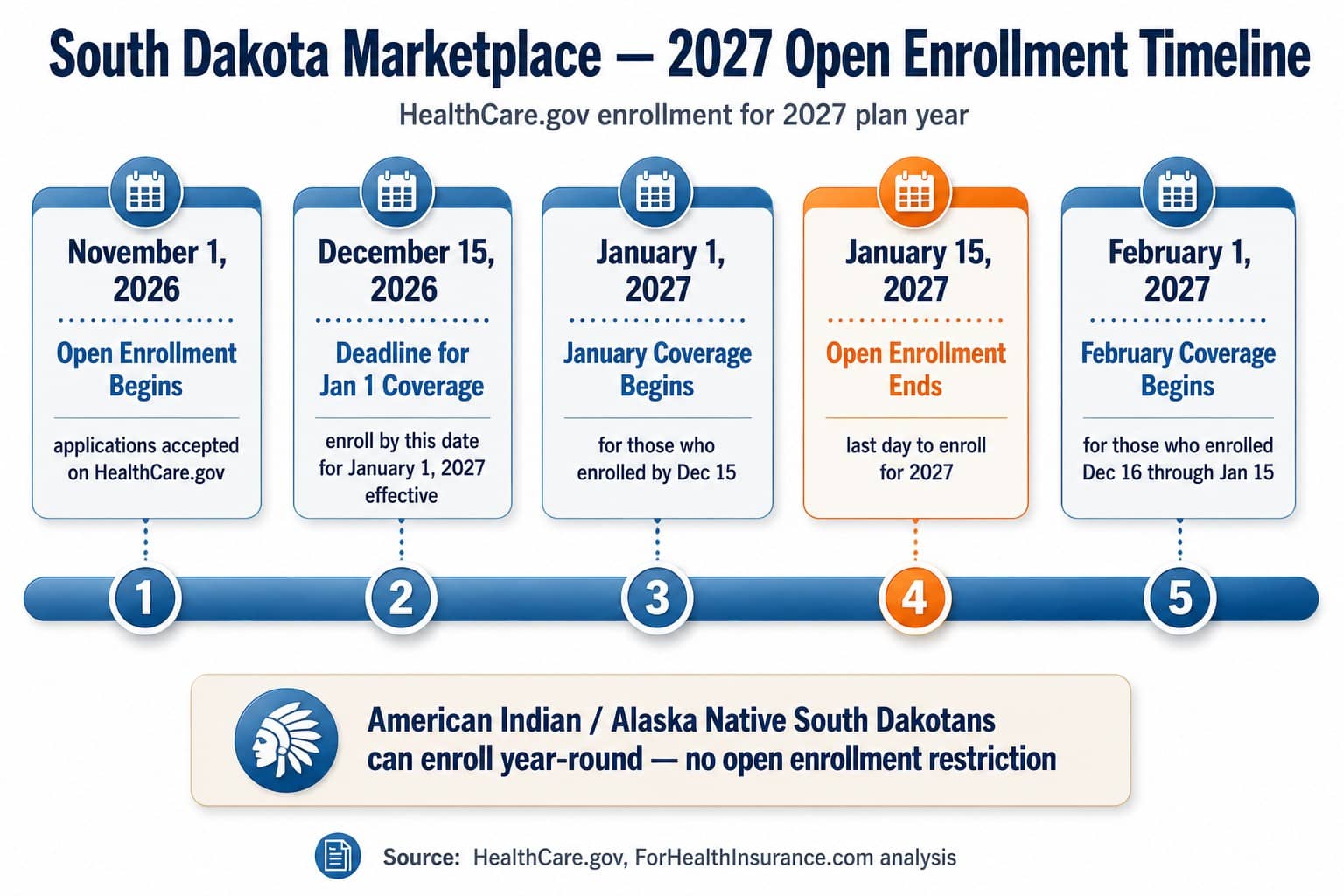
The two-tier deadline structure matters for South Dakotans who want to avoid a coverage gap. A South Dakotan whose employer-sponsored coverage ends December 31 should enroll by December 15 to ensure January 1 effective coverage. If that same person enrolls December 20, their effective date moves to February 1 — leaving a one-month coverage gap they may need to bridge with a short-term plan or COBRA continuation. The South Dakota Division of Insurance recommends starting the application well before December 15 to allow time for document verification, employer affordability calculations (if applicable), and any back-and-forth on income substantiation. Starting early is the safest way to lock in South Dakota health insurance marketplace coverage on time.
Outside the open enrollment window, enrollment requires a qualifying life event (QLE) that triggers a 60-day special enrollment period. Qualifying events include losing other coverage (job loss, COBRA expiration, aging off a parent’s plan at age 26, divorce), getting married, having or adopting a child, moving to South Dakota or to a different ZIP code with different plan availability, becoming a U.S. citizen, and certain other specific circumstances. The 60-day clock starts on the date of the event — not the date the applicant submits documentation. Applicants who miss the 60-day window must wait for the next open enrollment unless another QLE occurs. Missing the window closes the South Dakota health insurance marketplace until November.
Year-round enrollment for American Indian and Alaska Native South Dakotans
Members of federally recognized tribes — including the Oglala Sioux Tribe (Pine Ridge), Rosebud Sioux Tribe, Cheyenne River Sioux Tribe, Standing Rock Sioux Tribe, Lower Brule Sioux Tribe, Crow Creek Sioux Tribe, Yankton Sioux Tribe, Sisseton-Wahpeton Oyate, and Flandreau Santa Sioux Tribe — can enroll in marketplace coverage year-round with no open enrollment restriction. American Indian and Alaska Native enrollees can also change plans monthly, and may qualify for zero cost-sharing on Indian Health Service-referred care at incomes up to 300% of FPL. South Dakota Urban Indian Health and Oyate Health Center provide enrollment assistance specifically for tribal members. Tribal members have the broadest access to the South Dakota health insurance marketplace, available year-round.
South Dakota Subsidies: APTC, CSR, and the 2025 Cliff Return
South Dakotans between 138% and 400% of FPL qualify for Advance Premium Tax Credits in 2026 — about 83% of enrollees received subsidies averaging $568 per month. Households up to 250% of FPL also qualify for Cost-Sharing Reductions on Silver-tier plans, which lower deductibles and out-of-pocket costs. The American Rescue Plan’s enhanced subsidies expired at the end of 2025, so the 400% FPL subsidy cliff has returned for 2026.
The subsidy structure is built around the federal poverty level published by the Department of Health and Human Services. For 2026 marketplace coverage, the FPL thresholds applicable in South Dakota are: 138% of FPL is approximately $21,597 for a single adult and $44,367 for a family of four (the lower bound for marketplace subsidy eligibility because below that level South Dakotans qualify for expanded Medicaid). 250% of FPL is approximately $39,125 for a single adult and $80,375 for a family of four (the upper bound for Cost-Sharing Reductions). 400% of FPL is approximately $62,600 for a single adult and $128,600 for a family of four (the upper bound for Advance Premium Tax Credits in 2026 after the ARP enhancements expired). Subsidies remain the engine of the South Dakota health insurance marketplace.
| 2026 Income Level | Single Adult | Family of 4 | What You Qualify For |
|---|---|---|---|
| Up to 138% FPL | ≤ $21,597 | ≤ $44,367 | South Dakota Medicaid (expanded July 2023) |
| 138%–150% FPL | $21,597–$23,475 | $44,367–$48,225 | APTC + maximum CSR (94% AV Silver) |
| 150%–200% FPL | $23,475–$31,300 | $48,225–$64,300 | APTC + strong CSR (87% AV Silver) |
| 200%–250% FPL | $31,300–$39,125 | $64,300–$80,375 | APTC + limited CSR (73% AV Silver) |
| 250%–400% FPL | $39,125–$62,600 | $80,375–$128,600 | APTC only (no CSR) |
| Above 400% FPL | > $62,600 | > $128,600 | Full price — subsidy cliff in 2026 |
The return of the 400% FPL subsidy cliff is the single most consequential change for South Dakota marketplace shoppers in 2026. From 2021 through 2025, the American Rescue Plan and Inflation Reduction Act extended subsidy eligibility above 400% of FPL by capping marketplace premiums at 8.5% of household income for everyone — meaning a 60-year-old couple in Sioux Falls earning $90,000 (about 540% of FPL) could still receive several hundred dollars per month in APTC. That enhancement expired December 31, 2025. For 2026, South Dakotans above 400% of FPL pay full price with no subsidy — and South Dakota’s full-price benchmark Silver runs approximately $695 per month for a 40-year-old, with rates increasing with age. A 60-year-old couple above the cliff in 2026 may face combined premiums of $1,800–$2,200 per month with no federal assistance. That cliff is the sharpest edge in the South Dakota health insurance marketplace.
For South Dakotans squeezed by the cliff, off-exchange shopping becomes more attractive because off-exchange plans (which never qualified for APTC) compete on full-price terms anyway. Wellmark Blue Cross Blue Shield off-exchange plans frequently offer broader provider networks and BlueCard national reciprocity at premium points comparable to on-exchange Silver plans without subsidies — and for households above 400% of FPL, this is often the better value. Off-exchange PPO health insurance plans from Wellmark are widely available across South Dakota.
Get a Quote Through HealthCare.gov
A licensed agent screens for South Dakota Medicaid eligibility, calculates your 2026 APTC and CSR amounts, compares plans from Avera, Sanford, and Wellmark, and submits your HealthCare.gov application — covering all three carriers in one call. Free, no obligation.
Comparing the Three South Dakota Marketplace Carriers
The three carriers on HealthCare.gov for South Dakota — Avera Health Plans, Sanford Health Plan, and Wellmark BCBS — anchor different parts of the state. Avera and Sanford are owned by the two dominant in-state nonprofit health systems and primarily offer integrated-system HMO and EPO designs. Wellmark is the regional Blue Cross licensee with the broadest statewide network and BlueCard national reciprocity for South Dakotans who travel.
Sanford Health Plan
Owned by Sanford Health, the dominant integrated health system in eastern South Dakota and Sioux Falls. In-network access at Sanford USD Medical Center, Sanford Aberdeen, Sanford Vermillion, Sanford Watertown, and the broader Sanford clinic network. Best fit for South Dakotans whose primary care, specialists, and preferred hospitals are already in the Sanford system. Sanford is one of the three pillars of the South Dakota health insurance marketplace.
- Sanford USD Medical Center (Sioux Falls)
- Strong East River footprint
- HMO and EPO marketplace designs
- Lower premiums for Sanford-aligned providers
Avera Health Plans
Owned by Avera Health, the second largest in-state nonprofit health system. Anchored at Avera McKennan Hospital in Sioux Falls with the Avera network across eastern and central South Dakota — Avera Sacred Heart in Yankton, Avera St. Luke’s in Aberdeen, Avera Queen of Peace in Mitchell. Best fit for South Dakotans whose providers are inside the Avera system. Avera is the second carrier on the South Dakota health insurance marketplace.
- Avera McKennan (Sioux Falls)
- Eastern and central SD network
- HMO and EPO marketplace designs
- Lower premiums for Avera-aligned providers
Wellmark Blue Cross Blue Shield
Iowa-headquartered BCBS licensee serving South Dakota with the broadest statewide network — including West River and Rapid City via Monument Health contracts. BlueCard national reciprocity provides in-network access in all 50 states. Best fit for South Dakotans who travel out of state, split time across state lines, or have providers outside their county.
- Broadest statewide SD network
- Strong West River presence
- BlueCard national reciprocity
- Higher premiums than Sanford/Avera HMO
The choice between the three carriers comes down to which providers you use and where you live. Sioux Falls residents often have a real choice between all three — Sanford USD and Avera McKennan are both major Sioux Falls hospitals, and Wellmark contracts with both systems. East River residents in Watertown, Brookings, Yankton, and Mitchell typically choose between Sanford and Avera based on which system their primary care physician is part of, with Wellmark as the broader-network alternative at a higher premium. West River residents in Rapid City, Spearfish, Belle Fourche, and the rural counties west of the Missouri River often find Wellmark the most practical choice because Monument Health is reached through Wellmark contracts and the Avera and Sanford footprints are thinner. Verifying that your specific physicians and preferred hospital are in your chosen carrier’s network is the single most important pre-enrollment check — provider directories are available through HealthCare.gov and through each carrier’s website during open enrollment. Comparing all three is the core task on the South Dakota health insurance marketplace.
How to Apply Through HealthCare.gov in South Dakota
Applying for South Dakota marketplace coverage takes about 30 to 60 minutes on HealthCare.gov for most households. The application collects household composition, projected annual income, current coverage status, and citizenship verification, then automatically screens for South Dakota Medicaid before displaying marketplace plan options with your real-time APTC amount. Applicants below 138% of FPL are routed to South Dakota Medicaid through the Department of Social Services.
Gather your documents before you start
You will need household composition (everyone on your tax return — spouse, dependents), Social Security numbers for everyone applying, projected 2027 household income (annual MAGI), employer information if anyone has access to employer-sponsored coverage that meets ACA affordability standards, and immigration documents if applying for non-citizen household members. South Dakotans whose income fluctuates seasonally — agricultural workers, ranchers, contract workers — should estimate full-year projected income, not month-to-month. Accurate income keeps South Dakota health insurance marketplace subsidies correct.
Create or log into your HealthCare.gov account
Visit HealthCare.gov and create an account or log into your existing account if you’ve enrolled before. Returning enrollees should review prior-year information for accuracy — particularly income, household size, and current coverage. South Dakotans who enrolled in 2026 will have most of their information pre-filled and only need to update what has changed. Returning users move through the South Dakota health insurance marketplace fastest.
Complete the eligibility application
The HealthCare.gov application asks about household composition, income, current coverage, and any employer-sponsored coverage offers. The system runs a real-time eligibility determination that screens for South Dakota Medicaid (below 138% of FPL) and CHIP (children under 19 up to 204% of FPL) before showing marketplace plan options. If routed to South Dakota Medicaid, your application is forwarded to the Department of Social Services for final determination — Medicaid coverage typically takes effect the first of the month following approval. Timing the effective date is part of using the South Dakota health insurance marketplace well.
Compare plans from Avera, Sanford, and Wellmark
If you qualify for marketplace coverage, HealthCare.gov displays plan options from all three South Dakota carriers with your APTC and CSR amounts already applied. Compare on monthly premium after subsidy, deductible, out-of-pocket maximum, network breadth (Sanford system, Avera system, or Wellmark statewide), and prescription drug formulary if you take medications regularly. Use each carrier’s provider directory to verify your specific physicians and preferred hospital are in-network. Network checks come before price on the South Dakota health insurance marketplace.
Select a plan and pay your first premium
After selecting a plan, HealthCare.gov forwards your enrollment to the chosen carrier. Coverage does not begin until you pay your first premium directly to the carrier — Avera, Sanford, or Wellmark, depending on which plan you selected. Most carriers offer auto-pay enrollment from a checking account or credit card. Coverage begins January 1, 2027 if you enroll by December 15, 2026, or February 1, 2027 if you enroll between December 16 and January 15.
South Dakota residents who want help with the application can work with a free Navigator through Get Covered South Dakota (605-277-8405) or a community health center — Complete Health, Falls Community Health, Horizon Health, South Dakota Urban Indian Health, and Oyate Health Center all provide enrollment assistance. The federal HealthCare.gov call center (1-800-318-2596) is available 24/7. South Dakotans who prefer a licensed broker rather than a navigator — particularly those evaluating off-exchange PPO options alongside marketplace plans — can work with ForHealthInsurance.com at 888-215-4045. For the South Dakota Division of Insurance’s official consumer guide and rate filing information, see South Dakota Division of Insurance.
When the Marketplace Isn’t the Right Fit
The marketplace works well for South Dakotans between 138% and 400% of FPL who qualify for subsidies. It works less well for households above the 400% FPL cliff, those who need broader networks than Sanford or Avera HMO designs, and those whose providers span multiple states. For these South Dakotans, off-exchange shopping — particularly Wellmark BCBS PPO designs with BlueCard national reciprocity — often produces better value.
The clearest case for off-exchange shopping in South Dakota is the household above the 400% FPL subsidy cliff. A 60-year-old couple in Sioux Falls earning $130,000 (about 780% of FPL) gets zero APTC in 2026 and faces full-price marketplace premiums in the $1,800–$2,200 per month range. Wellmark off-exchange PPO designs at this premium point often offer broader provider networks, BlueCard national reciprocity, and no referral requirements — features that are valuable to a couple at this income level who travel, have providers in multiple states, or want maximum network flexibility. Off-exchange premiums for a 40-year-old in 2026 typically run $620–$780 per month; for older buyers above the cliff, the premium gap between on-exchange and off-exchange narrows considerably and sometimes inverts.
The second case is South Dakotans who travel for work or split time across state lines — agricultural sales representatives, oil and gas workers, regional managers, or retirees who winter in Arizona or Florida. Sanford and Avera HMO designs are anchored on integrated South Dakota health systems and provide limited or no out-of-state coverage outside emergencies. Wellmark BlueCard reciprocity gives South Dakotans in-network access to any BCBS-contracted provider in any state — Mayo Clinic in Rochester MN, MD Anderson in Houston, Cleveland Clinic in Ohio, or routine care in any state where a Wellmark member happens to be at the time. For South Dakotans who need this geographic flexibility, the marketplace’s HMO-dominant carrier mix is often a poor fit even with subsidies.
Frequently Asked Questions
Common questions about the South Dakota marketplace cover what the marketplace is, the 2027 open enrollment dates, subsidy eligibility thresholds, the three participating carriers, and whether PPO plans are available through HealthCare.gov.
What is the South Dakota health insurance marketplace?
The South Dakota health insurance marketplace — also called the South Dakota exchange — is the federally-facilitated platform at HealthCare.gov where South Dakota residents shop for, compare, and enroll in ACA-compliant individual and family coverage. South Dakota does not operate a state-based exchange. The marketplace offers plans from three carriers for 2026: Avera Health Plans, Sanford Health Plan, and Wellmark Blue Cross Blue Shield. About 50,951 South Dakotans selected marketplace plans for 2026 coverage, with roughly 83% qualifying for premium tax credits averaging $568 per month. That average is what makes the South Dakota health insurance marketplace affordable for most enrollees.
When is the South Dakota marketplace open enrollment period for 2027?
The 2027 open enrollment period in South Dakota runs November 1, 2026 through January 15, 2027 on HealthCare.gov. Enroll by December 15, 2026 for coverage starting January 1, 2027. Enroll between December 16, 2026 and January 15, 2027 for coverage starting February 1, 2027. Outside open enrollment, a qualifying life event — job loss, marriage, divorce, birth or adoption, moving to or within South Dakota, loss of other coverage — triggers a 60-day special enrollment period. American Indian and Alaska Native South Dakotans (Pine Ridge, Rosebud, Cheyenne River, and other tribal members) can enroll year-round with no open enrollment restriction.
How do I qualify for marketplace subsidies in South Dakota?
South Dakotans with household incomes between 138% and 400% of the federal poverty level qualify for Advance Premium Tax Credits (APTC) through the marketplace. For 2026, that range is approximately $21,597 to $62,600 for a single adult and $44,367 to $128,600 for a family of four. About 83% of South Dakota marketplace enrollees received APTC in 2026, with subsidies averaging $568 per month. Households up to 250% of FPL also qualify for Cost-Sharing Reductions (CSR) on Silver-tier plans, which lower deductibles and out-of-pocket costs. Below 138% of FPL, applicants are routed to South Dakota Medicaid (expanded July 2023). Above 400% of FPL, full-price marketplace plans apply with no subsidy.
Which carriers participate in the South Dakota marketplace for 2026?
Three carriers participate in the South Dakota marketplace through HealthCare.gov for 2026: Avera Health Plans (owned by Avera Health, anchored at Avera McKennan in Sioux Falls and across eastern and central South Dakota), Sanford Health Plan (owned by Sanford Health, anchored at Sanford USD Medical Center in Sioux Falls), and Wellmark Blue Cross Blue Shield (the Iowa-headquartered BCBS licensee with the broadest statewide network including West River and Rapid City via Monument Health contracts). Avera and Sanford primarily offer HMO and EPO plan designs through their integrated health system networks; Wellmark offers broader-network designs with BlueCard national reciprocity.
Can I enroll in a PPO plan through the South Dakota marketplace?
Wellmark Blue Cross Blue Shield offers broader-network plan designs through HealthCare.gov in South Dakota, including BlueCard national reciprocity that gives members in-network access in all 50 states. Avera Health Plans and Sanford Health Plan primarily offer HMO and EPO designs through their integrated health system networks. South Dakotans who prefer a true off-exchange PPO with the broadest national network and no referral requirements can also shop directly with carriers off-exchange — these plans are not eligible for premium tax credits but offer maximum network flexibility, typically running $620 to $780 per month for a 40-year-old in 2026.
Compare 2026 SD Marketplace Plans
A licensed agent screens for South Dakota Medicaid eligibility, calculates your APTC and CSR amounts, compares Avera Health Plans, Sanford Health Plan, and Wellmark BCBS, and submits your HealthCare.gov application — covering all three carriers and off-exchange PPO alternatives in one call. Free, no obligation.
Free SD marketplace comparison — covers all three carriers and off-exchange options.
Related South Dakota Health Insurance Resources
Complete SD coverage guide — Avera, Sanford, Wellmark, Medicaid, PPO, costs.
Affordable Coverage in South DakotaSubsidy strategies, average costs, and how to lower your 2026 premium.
SD Small Business Health InsuranceGroup plans, ICHRA, SHOP, and small group options for SD employers.
HealthCare.gov (Official)South Dakota’s official federal marketplace enrollment portal for 2027 plans.
SD Division of InsuranceCarrier rate filings, consumer complaints, and licensed agent verification.
KFF Subsidy CalculatorEstimate your 2026 APTC amount before applying through HealthCare.gov.
Broker Disclosure
ForHealthInsurance.com is an independent health insurance agency serving South Dakota residents. We are not affiliated with any carrier or government agency. We help you compare plans and enroll in coverage that meets your needs at no extra cost to you.