Affordable Health Insurance Washington State 2026
Finding affordable health insurance in Washington state in 2026 is largely a matter of knowing which program applies at which income level. Washington Apple Health covers adults at or below 138% of the federal poverty level — approximately $1,835 per month for a single adult — at zero cost with no premiums and no copays. Above that threshold, Washington Healthplanfinder’s Cascade Care plans stack two subsidy programs: federal Advance Premium Tax Credits averaging about $612 per month among eligible enrollees, and Cascade Care Savings — Washington’s state-funded subsidy adding $55 per member per month for households up to 250% of FPL. For 2026, more than 119,000 Washingtonians received Cascade Care Savings and over 188,000 received federal APTC through Washington Healthplanfinder. The result is that Washingtonians between 138% and 250% of FPL often pay $0 to $146 per month for coverage — among the lowest after-subsidy premiums of any state in the country. This guide covers every affordable health insurance path in Washington state for 2026, from free Apple Health to subsidized Cascade Care Gold to low-premium off-exchange options.

What brings you here today?
Compare costs by plan type
Bronze, Silver, Gold — what’s cheapest after subsidies?
See cost comparison ↓How Much Does Health Insurance Cost in Washington State?
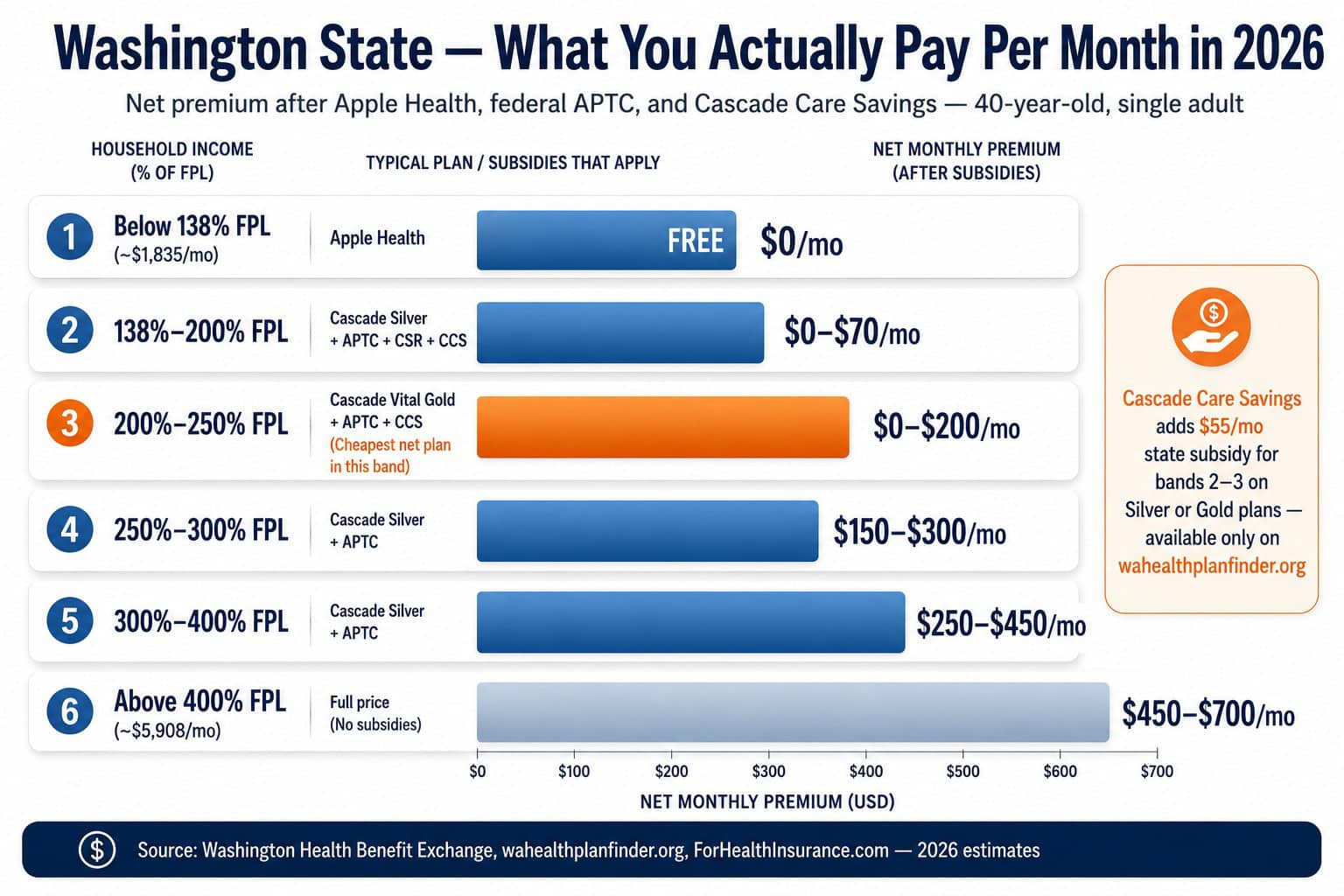
Affordable health insurance in Washington state in 2026 costs $0 to $146 per month for most subsidy-eligible enrollees on a Cascade Care plan through Washington Healthplanfinder. Unsubsidized full-price premiums for a 40-year-old run approximately $450 to $700 per month for Cascade Silver, depending on carrier and county. Apple Health is free for adults at or below 138% of the federal poverty level — about $1,835 per month in 2026.
Washington’s premium costs vary by county, age, tobacco use, and plan tier — but not by health status or pre-existing conditions. A 40-year-old in Spokane County pays a different benchmark premium than a 40-year-old in King County because carrier participation, local hospital costs, and risk pools differ across Washington’s geographic rating areas. The most reliable way to see actual 2026 premium figures for your specific county, age, and household size is through Washington Healthplanfinder at wahealthplanfinder.org, which shows all plans with net-after-subsidy amounts calculated in real time.
| Coverage Path | 2026 Monthly Cost | Income Range | Key Requirement |
|---|---|---|---|
| Apple Health (Medicaid) | $0 — no premiums, no copays | ≤138% FPL (~$1,835/mo single) | Apply at wahealthplanfinder.org, year-round |
| Cascade Silver + APTC + CSR + CCS | $0–$70/mo | 138%–200% FPL | Cascade Silver or Gold plan required for CCS |
| Cascade Vital Gold + APTC + CCS | $0–$200/mo | 200%–250% FPL | Often cheapest net plan in this range for 2026 |
| Cascade Silver/Gold + APTC only | $150–$450/mo | 250%–400% FPL | Federal APTC phases out above 400% FPL |
| Cascade Bronze full-price | $300–$500/mo | Above 400% FPL | HSA-eligible; all WA Bronze plans HSA-compatible |
| Cascade Silver full-price | $450–$700/mo | Above 400% FPL | Silver loading increases cost; Gold often better value |
| Off-exchange PPO | $360–$600/mo | Above 400% FPL | No APTC or Cascade Care Savings available off-exchange |
All 2026 Bronze plans on Washington Healthplanfinder are HSA-eligible — Washingtonians who purchase a Cascade Bronze plan can open a Health Savings Account and contribute up to $4,400 per year (single) or $8,750 per year (household) in pre-tax dollars that pay out tax-free for qualified medical expenses. For higher-income Washingtonians above the subsidy range who are generally healthy, the Bronze + HSA combination is one of the most cost-effective approaches available.
Free and Low-Cost Options: Apple Health and Cascade Care Savings
Washington offers two paths to free or near-free health insurance: Apple Health (Medicaid) for households at or below 138% of FPL, and the combination of federal APTC plus Cascade Care Savings for households from 138% to 250% of FPL. Over 119,000 Washingtonians received Cascade Care Savings during 2026 open enrollment; combined with federal APTC averaging $612 per month, net premiums for this group averaged roughly $70 to $146 per month — or lower on Cascade Vital Gold.
Apple Health
Who qualifies: Single adults earning up to ~$1,835/mo (138% FPL). Children up to 215% FPL. Pregnant women up to 193% FPL. Enrollment year-round — no open enrollment window.
How to enroll: Apply at wahealthplanfinder.org — the application screens for Apple Health automatically before showing marketplace plans.
Cascade Care Savings
Who qualifies: Households from 138%–250% FPL enrolled in a Cascade Care Silver or Gold plan through Washington Healthplanfinder. Non-federally-eligible enrollees receive $250/mo PMPM.
How to access: Select a Cascade Silver or Gold plan on Washington Healthplanfinder. Cascade Care Savings applies automatically after subsidy eligibility is confirmed.
Federal APTC
Who qualifies: Households from 138%–400% FPL (and above in some cases). Based on household income and the 2026 benchmark Silver plan premium in your county.
Note: Enhanced PTCs expired end of 2025. 2026 federal APTC reverted to pre-2021 formula — credits are smaller for moderate-income households compared to 2021–2025.
Cost-Sharing Reductions
Who qualifies: Households at 138%–250% FPL enrolled in a Silver plan. Approximately 17% of 2026 Washington Healthplanfinder enrollees received CSR.
Effect: A Cascade Silver plan with CSR can have an effective deductible under $500 and out-of-pocket max below $2,000 — comparable to Gold plan benefits at Silver plan (or lower) premiums.
Why Cascade Vital Gold Is Often Cheaper Than Silver in 2026
For most Washingtonians between 200% and 250% of FPL, Cascade Vital Gold has a lower net monthly premium than Cascade Silver in 2026. Washington’s premium alignment approach added a 43% load to Silver plan premiums on Washington Healthplanfinder — raising the benchmark plan premium and increasing federal APTC amounts. When that larger APTC is applied to Vital Gold, which has a lower base premium than loaded Silver, many enrollees find Vital Gold is cheaper than Silver or Bronze.
This is a Washington-specific dynamic that does not exist in most states. The 43% silver load is Washington’s mechanism for capturing larger federal cost-sharing reduction subsidies — the federal government stopped funding CSR payments directly, so Washington loads Silver plan premiums to generate equivalent subsidy value. The unintended benefit for income-eligible enrollees is that federal APTC — calculated against that inflated Silver benchmark — is generous enough to make Vital Gold essentially free or very low-cost in 2026.
Find Affordable Washington Health Insurance
A licensed Washington broker screens for Apple Health eligibility, calculates your exact federal APTC and Cascade Care Savings amounts, identifies whether Cascade Vital Gold or Silver is cheaper for your income level, and compares plans across Premera, Regence, Kaiser, Molina, LifeWise, and Ambetter. Free, no obligation.
How to Find the Cheapest Health Insurance in Your Washington County
Washington’s cheapest marketplace plan varies by county because carrier participation and local premium rates differ across the state’s geographic rating areas. King County (Seattle metro) typically has more carrier competition — and lower net premiums — than rural eastern Washington counties where fewer carriers participate. The most reliable approach is running a personalized quote through Washington Healthplanfinder, which shows actual net premiums for every available plan in your county after subsidies.
King, Snohomish, Pierce counties (Seattle metro)
Highest carrier competition in the state. Premera, Regence, Kaiser, LifeWise, Molina, Ambetter, CHPW, Wellpoint, and UnitedHealthcare all compete in parts of this area. 2026 note: Regence narrowed its King County hospital network — Swedish and Providence only, no UW Medicine or Virginia Mason. Kaiser is closed HMO. Premera and LifeWise offer the broadest hospital network in King County. Molina and Ambetter offer the lowest premiums.
Spokane County (Eastern Washington)
Premera Blue Cross, Kaiser (HMO), LifeWise, Molina, and Ambetter from Coordinated Care participate. Premera covers Sacred Heart Medical Center and Deaconess Hospital — the two major Spokane systems. LifeWise mirrors Premera’s network. Kaiser operates an eastern Washington HMO network. Spokane County is a separate rating area from western Washington; premiums for the same age and plan tier differ from Seattle-area pricing.
Yakima County (Central Washington)
Regence BlueShield, Kaiser, LifeWise, Molina, and UnitedHealthcare participate. Yakima Valley Memorial and Virginia Mason Franciscan (formerly Franciscan Health System) serve the area. Cascade Select (public option) plans are available in Yakima County for 2026, offering the lowest premium increases. Central Washington’s agricultural economy means a significant Apple Health and Cascade Care Savings-eligible population — apply through wahealthplanfinder.org year-round.
Rural and small counties (39 counties total)
LifeWise Health Plan of Washington is the most consistently statewide carrier — available in all 39 counties including Ferry, Garfield, Pend Oreille, Wahkiakum, and other low-population rural counties where Premera and Regence do not participate directly. In counties served only by LifeWise and Ambetter, plan choice is limited — Apple Health (year-round, no SEP required) is the most important affordability tool for income-eligible rural Washingtonians.
Washington’s Smart Planfinder tool — the fastest path to your actual cost
Washington Healthplanfinder’s Smart Planfinder asks about your expected healthcare use and prescriptions, then estimates total annual cost for each plan — premium plus expected out-of-pocket — not just the monthly premium. For budget-focused Washingtonians, this is more useful than sorting by premium alone. A Cascade Bronze plan at $50/mo that has a $3,000 deductible costs more total for a family that sees doctors regularly than a Cascade Vital Gold at $80/mo with a $0 deductible. Enter your information at wahealthplanfinder.org to see personalized total-cost estimates across all 86 plans.
Frequently Asked Questions
Common questions about affordable health insurance in Washington state cover the cheapest available options, whether free coverage exists (it does, through Apple Health), how Cascade Care Savings reduces premiums, Washington’s income limits for subsidized coverage, and why Cascade Vital Gold is often cheaper than Silver for moderate-income Washingtonians in 2026.
What is the cheapest health insurance option in Washington state?
For most Washingtonians, the cheapest health insurance option depends on income. Adults at or below 138 percent of FPL (approximately $1,835 per month for a single adult in 2026) qualify for Apple Health, Washington’s Medicaid program, which is free with no premiums or copays. For those above Apple Health income limits, Cascade Care Savings stacks Washington’s state subsidy of $55 per member per month on top of federal Advance Premium Tax Credits on a Cascade Silver or Gold plan through Washington Healthplanfinder. Enrollees between 138 percent and 250 percent of FPL who receive both the maximum federal APTC and Cascade Care Savings often pay $0 to $70 per month for a Cascade Gold plan.
Does Washington state have free health insurance?
Yes — Apple Health, Washington’s Medicaid program, is free for income-eligible residents. In 2026, a single adult earning up to approximately $1,835 per month qualifies for Apple Health with no premiums and no copays. Children qualify at higher income levels — up to 215 percent of FPL for free coverage, with CHIP available above that. Enrollment is year-round at wahealthplanfinder.org with no open enrollment window. For those above Apple Health income limits, Washington Healthplanfinder marketplace plans can be free or near-free after stacking federal APTC and Cascade Care Savings subsidies.
How does Cascade Care Savings make plans more affordable?
Cascade Care Savings is Washington’s state-funded premium subsidy that adds $55 per member per month for most enrollees with household income up to 250 percent of FPL — stacked on top of federal Advance Premium Tax Credits. Enrollees not eligible for federal subsidies, including some undocumented residents, receive $250 per member per month. Cascade Care Savings is available only on Cascade Care Silver or Gold plans through Washington Healthplanfinder. For 2026, over 119,000 Washingtonians received Cascade Care Savings. The subsidy applies automatically when you select an eligible Cascade plan and demonstrate income eligibility on your Healthplanfinder application.
What is the income limit for subsidized health insurance in Washington state?
In Washington state, health insurance subsidy eligibility in 2026 works on a sliding scale. Apple Health is free for adults at or below 138 percent of FPL — approximately $1,835 per month for one person. Federal Advance Premium Tax Credits begin just above that threshold and continue on a sliding scale; with the expiration of enhanced PTCs in 2026, credits phase out more aggressively above 400 percent of FPL (approximately $5,908 per month for one person). Cascade Care Savings is available through 250 percent of FPL — approximately $3,692 per month for one person. Above 400 percent of FPL, Washingtonians pay the full unsubsidized premium on marketplace plans.
Is a Bronze plan or Gold plan cheaper for a low-income Washingtonian?
For most Washingtonians between 138 percent and 250 percent of FPL in 2026, a Cascade Vital Gold plan is often cheaper than Cascade Silver or Bronze on a net-premium basis. Washington’s premium alignment approach — a 43 percent load on Silver plans — increased the benchmark plan premium, which in turn increased the size of federal APTC. When that larger APTC is applied to the Vital Gold plan (which has a lower full price than Silver after loading), many enrollees find Vital Gold’s net premium is lower than Cascade Silver or even Cascade Bronze. The answer is plan-and-income-specific — Washington Healthplanfinder’s Smart Planfinder tool shows actual net premiums after all subsidies.
Compare Affordable Washington Health Insurance Plans
A licensed Washington broker screens for Apple Health eligibility, calculates your exact APTC and Cascade Care Savings stack, identifies whether Cascade Vital Gold or Silver delivers the lowest net premium for your income, and compares all available plans in your county. Free — no obligation.
Free Washington health insurance comparison — covers every affordable path in one call.
Explore Washington Health Insurance In Depth
Complete 2026 guide — Apple Health, Cascade Care, Cascade Care Savings, and all carriers.
Washington Healthplanfinder MarketplaceHow to enroll through Healthplanfinder, compare 86 plans, and access subsidies.
Best Washington Health Insurance CarriersPremera, Regence, Kaiser, LifeWise, Molina — county footprints and hospital networks compared.
Individual Washington Health InsuranceOn- and off-exchange options for self-employed and workers between jobs in Washington.
Washington Small Business Health InsuranceGroup plans, ICHRA, SHOP, and 2026 carrier options for Washington small employers.
PPO Health Insurance PlansOff-exchange PPO plans for Washington residents above the subsidy range who need a national network.
Broker Disclosure
ForHealthInsurance.com is an independent health insurance agency serving Washington residents. We are not affiliated with any carrier or government agency. We help you compare plans and enroll in coverage that meets your needs at no extra cost to you.