Individual Health Insurance Washington State 2026
Individual health insurance in Washington state in 2026 is available through three separate markets — each with different costs, eligibility rules, and enrollment windows. Washington Healthplanfinder marketplace plans offer Cascade Care coverage from nine carriers with federal Advance Premium Tax Credits averaging about $612 per month for eligible enrollees, plus Washington’s state-funded Cascade Care Savings adding $55 per member per month for households up to 250% of the federal poverty level. Apple Health, Washington’s Medicaid program, covers adults at or below 138% of FPL — approximately $1,835 per month for a single adult — at zero cost year-round. Off-exchange private health insurance plans from Premera, LifeWise, and other carriers are available year-round without income requirements but without access to subsidies. Washington state also permits short-term health plans, though Washington restricts them to a maximum of 3 months — significantly shorter than the federal limit. This guide covers individual health insurance in Washington state for self-employed workers, early retirees, workers between jobs, and anyone else purchasing coverage on their own.

What brings you here today?
Individual Health Insurance Options in Washington State
Washington state residents purchasing individual health insurance in 2026 have four paths: Apple Health (Medicaid) at no cost for those at or below 138% of FPL, subsidized Cascade Care marketplace plans through Washington Healthplanfinder for most income levels, unsubsidized off-exchange private plans available year-round, and short-term plans limited to 3 months. Each path has different costs, eligibility rules, and what it covers.
Apple Health (Medicaid)
Who: Adults at or below 138% FPL (~$1,835/mo single, ~$3,779/mo family of four in 2026).
Cost: $0 — no premiums, no copays for covered services.
Enrollment: Year-round at wahealthplanfinder.org — no open enrollment window or qualifying event required.
Coverage: 10 ACA essential health benefits through managed care organizations including Molina, CHPW, Coordinated Care, UnitedHealthcare Community Plan, and Wellpoint.
Washington Healthplanfinder (On-Exchange)
Who: Anyone not eligible for employer coverage, Medicaid, or Medicare. Income above 138% FPL sees marketplace plans with subsidy options.
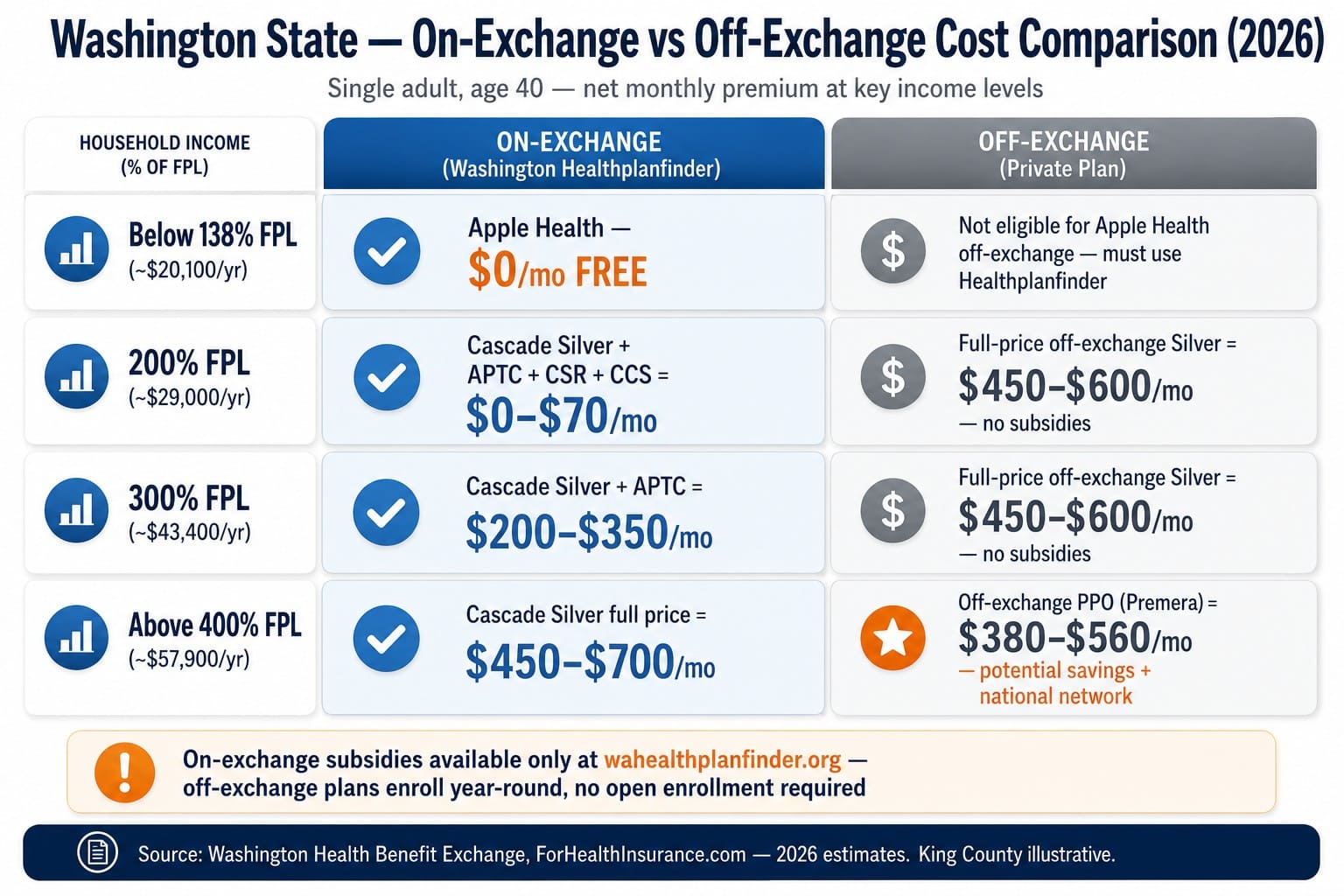
Cost: $0–$700/mo depending on income, plan tier, and subsidies. Cascade Care Savings adds $55/mo state subsidy for 138%–250% FPL.
Enrollment: Open enrollment Nov 1–Jan 15 annually; SEPs year-round for qualifying events; Apple Health year-round.
Plans: 86 qualified health plans from nine carriers — Bronze, Silver, Gold, and Catastrophic tiers.
Off-Exchange Private Plans
Who: Washingtonians above the subsidy range (above ~400% FPL) or who prefer a specific PPO network not available through Healthplanfinder. No income requirements.
Cost: $360–$650/mo for a 40-year-old without subsidies. Full ACA-compliant coverage, no pre-existing condition exclusions.
Enrollment: Year-round — no open enrollment window, no qualifying event required for off-exchange ACA plans.
Carriers: Premera Blue Cross, LifeWise, and select others. PPO network options with national BlueCard access available.
Short-Term Plans
Who: Washingtonians needing a bridge for 3 months or less — not a substitute for comprehensive coverage.
Cost: Typically $80–$250/mo for a healthy adult. Low premiums reflect limited benefits.
Restrictions: Washington limits short-term plans to 3 months maximum with no renewal. Not ACA-compliant — pre-existing conditions may be excluded, essential health benefits not covered.
Caution: Short-term plans do not count as qualifying coverage for Washington’s subsidy eligibility and do not prevent a coverage gap for APTC purposes.
On-Exchange vs Off-Exchange: Which Is Right for You?
On-exchange Cascade Care plans through Washington Healthplanfinder are the right choice for most Washingtonians because they are the only way to access federal APTC and Cascade Care Savings subsidies. Off-exchange private plans are better suited for Washingtonians above the subsidy threshold who want a specific PPO network, national BlueCard access, or year-round enrollment without a qualifying event.
| Factor | On-Exchange (Healthplanfinder) | Off-Exchange (Private) |
|---|---|---|
| Federal APTC subsidy available? | Yes — for 138%–400%+ FPL | No — full price only |
| Cascade Care Savings available? | Yes — for 138%–250% FPL on Silver/Gold | No |
| Open enrollment required? | Yes (Nov 1–Jan 15) — SEPs year-round | No — enroll any time of year |
| Plan types available | Cascade Care Bronze/Silver/Gold/Catastrophic | ACA PPO, EPO, HSA plans |
| National PPO network access | Limited — Cascade Care plans are WA-specific | Yes — Premera BlueCard covers nationwide |
| Pre-existing condition coverage | Yes — ACA-compliant | Yes — ACA-compliant off-exchange plans |
| Self-employed tax deduction | Yes — premiums deductible (after subsidy) | Yes — full premium deductible |
The decision typically comes down to subsidy eligibility. A Washington state resident at 250% of FPL (approximately $36,900/year for a single person) who enrolls on-exchange receives federal APTC plus $55/month Cascade Care Savings — potentially reducing a $500/month Silver premium to under $100. The same person buying off-exchange pays the full $500 premium with no subsidy offset. For Washingtonians above 400% of FPL who are generally healthy, an off-exchange Premera or LifeWise PPO may offer a broader hospital network at a comparable or lower total cost than a full-price on-exchange Silver plan.
Compare Individual Washington Health Insurance Plans
A licensed Washington broker compares on- and off-exchange options, calculates your APTC and Cascade Care Savings, and checks network coverage at Swedish, Providence, UW Medicine, Kaiser, and MultiCare. Free — no obligation.
Self-Employed Health Insurance in Washington State
Self-employed Washingtonians — freelancers, independent contractors, sole proprietors, and gig workers — purchase individual health insurance on their own because no employer provides group coverage. Washington Healthplanfinder is the best starting point for most self-employed residents because self-employment income counts toward subsidy eligibility — many qualify for federal APTC and Cascade Care Savings even at moderate incomes. Self-employed Washingtonians can also deduct 100% of health insurance premiums from federal taxable income.
Self-employment income is reported as net profit on Schedule C (or equivalent) for subsidy eligibility purposes. A self-employed Washington resident earning $45,000 in net profit falls at approximately 300% of FPL for a single person — qualifying for federal APTC that reduces the benchmark Silver plan premium significantly. Adding Cascade Care Savings ($55/month on a Cascade Silver or Gold plan) further reduces the net monthly cost. Health insurance premiums paid for the self-employed individual, their spouse, and dependents are 100% deductible from federal income taxes under IRC § 162(l) — reducing the effective after-tax cost of both on-exchange and off-exchange plans.
Example: Self-employed Bellevue web developer, $52,000 net income, age 38
At $52,000/year (approximately 346% of FPL for a single adult in 2026), this developer qualifies for federal APTC but not Cascade Care Savings (above 250% FPL cutoff). After APTC, net Cascade Silver premium is approximately $220–$280/month depending on carrier and King County zip code. The full premium paid is also 100% deductible from federal income taxes, reducing the effective cost further. If the developer’s income falls in a year — say, to $35,000 — eligibility shifts into the Cascade Care Savings range, adding the $55/month state subsidy automatically.
Washington state does not require self-employed individuals to have business health insurance — but the combination of marketplace subsidies, tax deductibility, and the ACA’s guaranteed issue rules (no exclusions for pre-existing conditions) makes individual health insurance in Washington far more accessible for self-employed workers than in the pre-ACA market. Washington’s Office of the Insurance Commissioner publishes consumer guides specifically for self-employed and small business owners purchasing individual coverage.
How to Enroll in Individual Health Insurance in Washington
Enrolling in individual health insurance in Washington state in 2026 outside of open enrollment is possible through Apple Health year-round, a Special Enrollment Period within 60 days of a qualifying life event, or through off-exchange carriers at any time. The next open enrollment for 2027 coverage begins November 1, 2026 at wahealthplanfinder.org.
Job loss is the most common trigger for individual health insurance enrollment in Washington. Losing employer-sponsored coverage creates a 60-day Special Enrollment Period — starting from the coverage loss date, not the job end date. A Washingtonian who loses job coverage on June 30 has until August 29 to enroll in a Cascade Care plan or Apple Health through Washington Healthplanfinder, or to select an off-exchange private plan from Premera or LifeWise. COBRA continuation from the prior employer plan is also available within 60 days of coverage loss — but COBRA premiums average 102% of the full group plan cost, which is often significantly higher than an on-exchange Cascade Care plan for income-eligible individuals.
For Washingtonians who need coverage now and do not have a qualifying life event, the options outside open enrollment are: Apple Health if income qualifies (year-round, free), off-exchange ACA-compliant plans from Premera or LifeWise (year-round enrollment, no subsidies), or a Washington-permitted short-term plan (3-month maximum, not ACA-compliant). Short-term health insurance in Washington is restricted to 3 months — Washington prohibits the longer-duration and renewable short-term plans available in many other states. Short-term plans do not cover pre-existing conditions, mental health, maternity care, or prescriptions, and are not a substitute for ACA-compliant individual coverage.
Frequently Asked Questions
Common questions about individual health insurance in Washington state cover what options exist without employer coverage, whether you can enroll after missing open enrollment, how much individual coverage costs, the best path for self-employed Washingtonians, and Washington’s 3-month restriction on short-term health plans.
What individual health insurance options are available in Washington state?
Washington state residents without employer coverage have three main individual health insurance paths for 2026. Apple Health (Medicaid) is free for adults at or below 138 percent of FPL — approximately $1,835 per month for a single adult. Washington Healthplanfinder marketplace plans offer Cascade Care plans from nine carriers with federal APTC and Cascade Care Savings subsidies for households up to 400 percent of FPL. Off-exchange private health insurance — including PPO plans from carriers like Premera — is available year-round without income requirements but without access to federal or state subsidies.
Can I get individual health insurance in Washington state if I missed open enrollment?
Yes, through three paths. Apple Health (Medicaid) is open year-round for income-eligible Washingtonians — no open enrollment window applies. A Special Enrollment Period (SEP) is available within 60 days of a qualifying life event such as job loss, marriage, birth, or moving. Off-exchange private health insurance plans from carriers like Premera and LifeWise are available year-round with no open enrollment restriction — they do not require a qualifying event but also do not qualify for federal APTC or Cascade Care Savings subsidies.
How much does individual health insurance cost in Washington state?
Individual health insurance in Washington state costs between $0 and approximately $700 per month for a 40-year-old depending on income and plan type. Apple Health is free for adults at or below 138 percent of FPL. Cascade Care marketplace plans after federal APTC and Cascade Care Savings average roughly $146 per month for subsidy-eligible enrollees in 2026. Full-price Cascade Silver premiums for a 40-year-old run approximately $450 to $700 per month depending on carrier and county. Off-exchange PPO plans typically cost $360 to $600 per month for a 40-year-old without subsidies.
What is the best health insurance for self-employed people in Washington state?
Self-employed Washingtonians have strong options on Washington Healthplanfinder because self-employment income is counted as household income for subsidy eligibility — meaning many qualify for federal APTC and Cascade Care Savings. A self-employed individual earning $40,000 per year (about 267 percent of FPL) qualifies for federal APTC and, on a Cascade Silver or Gold plan, for Cascade Care Savings of $55 per month. Self-employed Washingtonians can also deduct 100 percent of their health insurance premiums from federal income taxes, making even full-price plans more affordable on a net-cost basis. The deduction applies to premiums paid for the taxpayer, their spouse, and dependents.
Is short-term health insurance available in Washington state?
Short-term health insurance is available in Washington state but is heavily restricted compared to most states. Washington limits short-term health plans to a maximum duration of 3 months with no renewal option — Washington does not permit the 364-day or one-year renewable short-term plans allowed in many other states. Short-term plans in Washington are not ACA-compliant, do not cover pre-existing conditions, and do not include essential health benefits such as prescription coverage, maternity care, or mental health services. For Washingtonians who genuinely need coverage for 3 months or less, a short-term plan may bridge a gap. For longer gaps, an off-exchange private plan or Cascade Care marketplace plan through a qualifying SEP is more appropriate.
Get Individual Washington Health Insurance Quotes
A licensed Washington broker compares on-exchange Cascade Care plans, off-exchange Premera and LifeWise PPO options, calculates your APTC and Cascade Care Savings, and helps you enroll — including after job loss or other qualifying events. Free — no obligation.
Free individual health insurance comparison — covers all Washington options in one call.
Explore Washington Health Insurance In Depth
Complete 2026 guide — Apple Health, Cascade Care, Cascade Care Savings, and all carriers.
Washington Healthplanfinder MarketplaceStep-by-step Healthplanfinder enrollment, plan comparison, and subsidy guide.
Affordable Washington Health InsuranceApple Health, APTC, Cascade Care Savings, and the lowest-cost path for every income level.
Best Washington Health Insurance CarriersPremera, Regence, Kaiser, LifeWise, Molina — 2026 county footprints and hospital networks.
Washington Small Business Health InsuranceGroup plans for Washington employers — SHOP, ICHRA, and carrier options for small groups.
Washington Healthplanfinder (Official)Apply for Apple Health, compare plans, and calculate subsidies at wahealthplanfinder.org.
Broker Disclosure
ForHealthInsurance.com is an independent health insurance agency serving Washington residents. We are not affiliated with any carrier or government agency. We help you compare plans and enroll in coverage that meets your needs at no extra cost to you.