Level Funded Health Insurance vs. Fully Insured Coverage
When a business asks for group coverage quotes, two structurally different products often come back looking almost identical on the summary page. Both show a monthly amount per employee. Both list a deductible and a network. The difference is in who absorbs the cost when employees have an expensive year — and that difference does not appear anywhere on the first page of a proposal.
This comparison of level funded health insurance and fully insured coverage covers how each model is built, who carries the risk, which businesses each one suits, what happens at renewal, the reporting and compliance differences, and a straightforward way to decide between them.

Where are you in the decision?
What Level Funded Health Insurance Is
A level funded plan bills the employer a steady monthly amount split three ways: a claims fund that pays employee medical bills, an administration fee to the carrier, and a stop-loss premium that caps the employer’s exposure. If claims run below projection across the year, part of the unused claims fund may be returned to the business.
In level funded health insurance the word “level” refers to the billing, not the risk. The monthly invoice stays flat and predictable across the plan year, which is what makes the design workable for a business without a finance department. What varies is what happens at the end of the year, and that variability is the whole point of the model.
Technically these are self-funded plans wrapped in a structure that behaves like an insured product. That classification matters for regulation and reporting, and it is why level funded health insurance is grouped with self-funded arrangements in industry data rather than counted alongside fully insured coverage.
How Fully Insured Coverage Works
Under a fully insured plan the employer pays a fixed premium and the carrier accepts all claims risk. If the group has an expensive year the carrier absorbs the loss. If claims run low the carrier keeps the surplus. Employer-sponsored coverage averaged $9,325 for single and $26,993 for family coverage in 2025.
Rates for small groups are set from each enrolled employee’s age and location rather than the group’s own claims history, which means a small business is pooled with many others rather than judged on its own experience. That pooling is the source of the model’s predictability and also the reason a healthy group cannot convert good claims luck into savings.
Administration is simpler by a wide margin than under level funded health insurance. The carrier handles claims, appeals, and reporting, and the employer’s obligation is essentially to pay the invoice and distribute required notices. For a business without HR staff that reduction in workload is a real benefit, not a footnote.
The Core Difference: Who Carries the Claims Risk
Fully insured transfers claims risk entirely to the carrier for a fixed price. Level funded health insurance keeps capped risk with the employer in exchange for a possible refund. About 27 percent of covered workers at small firms were in self-funded arrangements in 2025, against 80 percent at large firms.
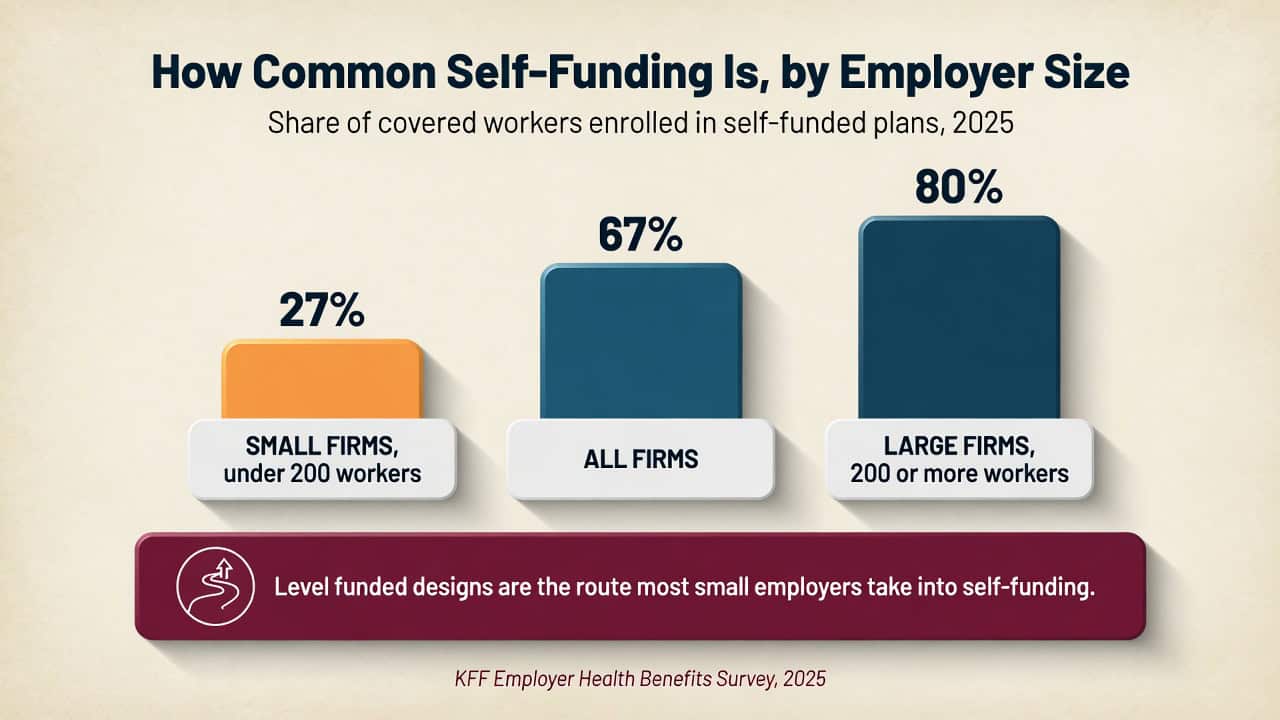
The KFF Employer Health Benefits Survey puts small-firm self-funded enrollment at 27 percent for 2025, up as level funded designs moved down-market. Stop-loss is what makes employer-held risk tolerable at small scale. Specific stop-loss caps what any single member’s claims can cost the plan, and aggregate stop-loss caps total claims across the group for the year. Together they convert an open-ended liability into a known worst case that a business can actually budget against.
The worst case is still worse than fully insured, though, and that is the honest framing. Under a fully insured plan the worst case equals the premium. Under level funded health insurance the worst case is the maximum funding level — higher than the expected monthly amount, even with stop-loss working exactly as designed.
A 15-employee firm is quoted $14,000 a month fully insured, or a level funded plan billing $12,600 a month with a maximum funding level of $15,400. In a low-claims year the level funded group might see roughly $9,000 of the unused claims fund returned after the plan year closes, putting its effective annual cost near $142,200 against $168,000 fully insured. In a bad year, claims run past projection, no refund is issued, and the carrier bills up to the maximum — about $184,800 for the year, roughly $16,800 more than the fully insured premium would have been. Same group, same plan design; the spread between the two outcomes is the risk the employer is agreeing to carry.
See What Both Models Cost for Your Group
Availability and pricing depend on employee count, ages, and ZIP code. Run a quote to compare options, or talk the funding question through with a licensed agent.
Which Businesses Each Model Fits
Level funded health insurance tends to suit younger, healthier groups with stable headcount and enough cash reserve to absorb a bad year. Fully insured suits businesses that need certainty, have an older or mixed-health workforce, or lack the administrative capacity to manage utilization reporting. Carriers now write level funded designs for groups as small as five employees.
Points toward level funded
A workforce skewing under 40, low historical utilization, steady headcount, cash reserve available, and an owner who will actually read the monthly claims reports.
Points toward fully insured
An older workforce, known chronic conditions in the group, tight cash flow, fluctuating headcount, or no one available to administer a more involved plan.
Underwriting differs
Level funded proposals typically require health questionnaires or claims history before a firm rate is issued. Small group fully insured rates are set from age and location.
Cash flow timing
Any refund arrives months after the plan year closes, so the savings are retrospective. The monthly outlay itself is not lower during the year.
The reserve question is the practical one
A business that would struggle to fund the maximum monthly amount for several consecutive months should treat that as a reason to stay fully insured, regardless of how favorable the projected pricing looks.
What Happens at Renewal Under Each Model
Fully insured renewals move with the community pool and the aging of the census. Level funded renewals respond directly to the group’s own claims. Family premiums rose 6 percent in 2025 and 7 percent in each of the two prior years, and carriers filed double-digit small-group rate requests heading into 2026.
A single expensive claimant can reshape a level funded renewal in a way it would not reshape a fully insured one. That is the trade-off working as designed rather than a failure of the product, but it is the point at which businesses most often reconsider the model, and it is worth anticipating before signing rather than discovering in year two.
Moving back to fully insured after a bad year on level funded health insurance is possible but not frictionless. The claims history that produced the poor renewal does not follow a small group into fully insured rating, which works in the employer’s favor, though timing the switch to the plan anniversary avoids employees restarting a deductible mid-year.
Reporting, Administration, and Compliance
Level funded plans are self-funded arrangements for regulatory purposes, which places more of the compliance burden on the employer as plan sponsor. Fully insured plans push most of that to the carrier. Both models carry federal disclosure duties, including delivering a summary of benefits and coverage to employees.
The added visibility that comes with level funded health insurance is genuinely useful to some employers and unwelcome to others. Monthly utilization reporting shows where the money goes — a level of insight fully insured plans do not provide — but it arrives as a recurring task that someone has to read and act on. The Department of Labor’s guidance for employers and advisers sets out what plan sponsors must distribute regardless of funding model.
State regulation differs between the two as well. Fully insured plans must include state-mandated benefits, while self-funded arrangements are generally governed by federal law instead. The NAIC maintains the directory of state insurance departments where mandate specifics can be confirmed.
One consequence worth knowing
Because state benefit mandates generally do not apply to self-funded arrangements, a level funded plan may not include a benefit that state law requires of fully insured coverage. Compare covered services directly rather than assuming parity.
How to Decide Between the Two
Work through four questions in order: can the business absorb the maximum funding amount for several months, is the workforce young and healthy, will someone read the monthly reports, and does the level funded proposal include benefits the group actually needs. Three yes answers point one direction; fewer point the other.
Ask for level funded health insurance quotes at the maximum funding level rather than at the expected level. A level funded proposal presented at its expected monthly cost against a fully insured premium is not a like-for-like comparison, because only one of those two numbers can increase during the year.
The deductible and network comparison still matters more than the funding question for most small groups. Workers at firms under 200 employees averaged a $2,631 single deductible in 2025, and a funding model that saves money while narrowing the network will produce complaints that outlast the savings. Details on that trade-off sit on the cost and employer contribution page.
If neither model fits
Businesses that cannot meet participation minimums or want a fixed budget line without sponsoring a plan at all have a third route. Reimbursement arrangements let an employer fund coverage employees buy themselves, described on the ICHRA and group coverage comparison page.
Frequently Asked Questions About Level Funded Health Insurance
What is level funded health insurance?
A level funded plan charges the employer a steady monthly amount split between a claims fund, an administration fee, and stop-loss protection. The employer carries claims risk up to a capped limit, and unused claims funding may be returned after the plan year closes.
How is level funded different from fully insured coverage?
Under a fully insured plan the carrier accepts all claims risk in exchange for a fixed premium and keeps any surplus. Under a level funded plan the employer accepts capped claims risk and may receive a refund if claims run below projection.
How many small businesses use self-funded arrangements?
About 27 percent of covered workers at small firms were enrolled in self-funded plans in 2025, compared with 80 percent at large firms and 67 percent across all firm sizes, according to KFF.
What is stop-loss insurance?
Stop-loss is the coverage that caps an employer’s claims exposure under a level funded or self-funded plan. Specific stop-loss limits the cost of any one member’s claims, and aggregate stop-loss limits total claims across the whole group for the year.
Can a small business with 10 employees get a level funded plan?
Often yes. Carriers have moved level funded designs down-market and now write them for groups as small as five employees in many states, though availability and the minimum group size vary by carrier and location.
Which model is safer for a small employer?
Fully insured coverage is more predictable than level funded health insurance because the monthly cost never varies with claims. Level funded caps exposure through stop-loss but still leaves renewal pricing tied to the group’s own claims experience rather than a broad community pool.
Related Small Business Health Insurance Resources
The full employer guide to coverage, costs, eligibility, and enrollment.
What Coverage Costs Per Employee2026 premium benchmarks, the employer share, and what drives a quote.
Comparing Carriers and QuotesNetwork, financial strength, quality ratings, and renewal behavior.
Requirements and Employer Size RulesFTE counting, the 50-employee threshold, and eligible employees.
Contribution and Participation RequirementsCarrier minimums, how waivers are counted, and the year-end relaxed window.
ICHRA vs. Group CoverageFunding coverage employees buy themselves instead of sponsoring a plan.
Compare Funding Models for Your Business
Pricing for both models depends on employee count, ages, and ZIP code. Run a quote to see the options side by side, or call to walk through the comparison.
Broker Disclosure
ForHealthInsurance.com is an independent health insurance agency serving businesses. We are not affiliated with any carrier or government agency. We help you compare plans and enroll in coverage that meets your needs at no extra cost to you.