Small Business Health Insurance in Minnesota: 2026 Group Plans & ICHRA
Small business health insurance in Minnesota for 2026 offers employers several pathways — traditional group plans through Blue Plus, HealthPartners, and Medica, SHOP marketplace coverage with federal tax credits for qualifying small businesses, or Individual Coverage Health Reimbursement Arrangements (ICHRAs) that reimburse employees for individual MNsure plans. Comparing small business health insurance in Minnesota means weighing these pathways against each other. This guide walks through each option for Minnesota employers with 1–50 employees, including how MNsure’s six-carrier individual market makes ICHRA particularly attractive for Minnesota businesses with employees across multiple counties.

What does your Minnesota business need?
Small Business Health Insurance Options in Minnesota
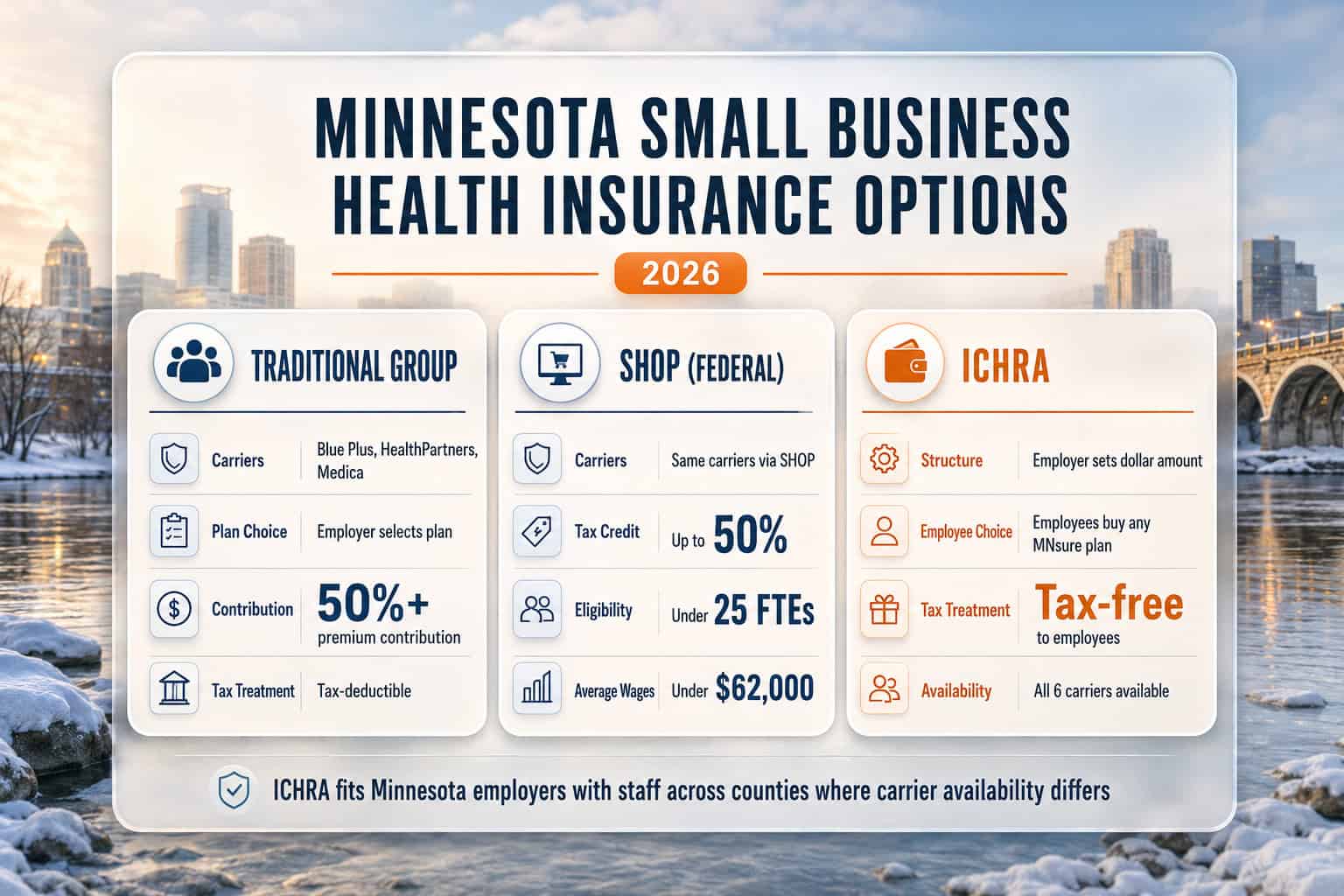
Minnesota small businesses with 1–50 employees have three primary coverage pathways for 2026: traditional small group plans purchased directly from carriers like Blue Plus, HealthPartners, and Medica; the federal SHOP marketplace with access to the Small Business Health Care Tax Credit; or an Individual Coverage Health Reimbursement Arrangement (ICHRA) that reimburses employees for individual MNsure plans on a tax-free basis. Each pathway has different cost structures, administrative requirements, and flexibility.
| Option | Eligible Businesses | Carriers in MN | Tax Credit Eligible | Employee Choice |
|---|---|---|---|---|
| Traditional small group | 1–50 FTE | Blue Plus, HealthPartners, Medica | No (unless through SHOP) | Employer selects plan; employees enroll |
| SHOP (federal) | 1–50 FTE | Same carriers via SHOP | Yes — under 25 FTE + avg wages under $62,000 | Employees may choose from available metal tiers |
| ICHRA | Any size | All 6 MNsure carriers available to employees | No (but contributions tax-free) | Full employee choice via MNsure or off-exchange |
| QSEHRA | Under 50 FTE, no group plan | Any — employees choose own plan | No (but contributions tax-free) | Full employee choice; max $6,350/individual in 2026 |
For many Minnesota small businesses — particularly those with employees across multiple counties where MNsure carrier availability differs — the ICHRA model offers unique advantages for small business health insurance in Minnesota. Rather than selecting a single group plan that may have network gaps for some employees, the business sets a monthly dollar amount (e.g., $450/employee) and employees use it to purchase any individual plan on MNsure. A Twin Cities employee can pick HealthPartners Silver while a Rochester employee selects Blue Plus PPO — with the employer’s per-employee cost staying fixed regardless of choice. The federal SHOP marketplace handles small group enrollment for Minnesota businesses pursuing the tax credit route.
Small Business Health Care Tax Credit in Minnesota
Minnesota small businesses purchasing coverage through SHOP may qualify for the federal Small Business Health Care Tax Credit — worth up to 50% of the employer’s premium contributions (35% for tax-exempt organizations). To qualify, the business must have fewer than 25 full-time equivalent employees, pay average annual wages under $62,000 (indexed annually), and cover at least 50% of employee-only premium costs. For a qualifying 10-employee Minnesota business, this credit can save $4,000–$10,000 per year.
The credit is claimed on the employer’s annual federal tax return using IRS Form 8941. The maximum credit applies to businesses with 10 or fewer FTEs and average wages under $32,000, phasing out as headcount approaches 25 and wages approach $62,000. Tax-exempt Minnesota organizations — including nonprofits — can claim up to 35% as a refundable credit. The credit is only available for SHOP-purchased plans, not for direct-to-carrier group plans from Blue Plus, HealthPartners, or Medica.
Example: St. Paul Design Studio, 9 Employees
A St. Paul graphic design studio with 9 full-time employees averaging $48,000/year purchases SHOP coverage, contributing $500/month per employee toward HealthPartners Silver premiums. Annual employer contribution: $54,000. The Small Business Health Care Tax Credit at approximately 30% (phased based on wages) returns roughly $16,200 — reducing effective employer cost to $37,800, or about $350/month per employee.
Does Minnesota Require Employers to Offer Health Insurance?
Minnesota has no state employer mandate requiring businesses to offer health insurance. The federal ACA employer mandate applies only to Applicable Large Employers with 50 or more full-time equivalent employees — Minnesota businesses with fewer than 50 FTEs face no federal penalty for not offering coverage. Approximately 91% of Minnesota businesses have fewer than 20 employees, making the vast majority exempt from any employer mandate.
For Minnesota businesses at or near the 50-FTE threshold, the federal penalty for not offering affordable, minimum-value coverage is $2,970 per full-time employee (minus the first 30) for 2026. A 55-FTE Minnesota business not offering coverage would face a potential penalty of approximately $74,250/year. Businesses approaching this threshold should evaluate whether small business health insurance in Minnesota through a group plan or ICHRA is more cost-effective than absorbing the penalty.
Minnesota Small Group Carriers for 2026
Small group health insurance in Minnesota is available from Blue Plus (Blue Cross Blue Shield of Minnesota), HealthPartners, and Medica. Blue Plus offers the broadest small group PPO network statewide. HealthPartners offers integrated care through its Alpine network with 87,000+ providers. Medica provides small group coverage in all 87 counties. Minnesota small group rate increases averaged approximately 12% for 2026 — lower than the individual market’s 22% increase, reflecting the more stable risk pool in employer-sponsored coverage.
A key feature of small business health insurance in Minnesota is community rating: small group premiums are based on employee ages, tobacco use, and county, not on the group’s health history. A 10-person Minneapolis group with an average employee age of 38 can expect Silver premiums of approximately $480–$580/month per employee before employer contributions. The Minnesota Department of Commerce small-group resources explain how the state regulates and approves small-group rates each year. For businesses exploring ICHRA, the Minnesota carrier comparison guide details the six individual-market carriers employees would choose from under ICHRA.
Compare Minnesota Small Business Health Plans
See group plan options from Blue Plus, HealthPartners, and Medica. Check SHOP tax credit eligibility and explore ICHRA alternatives for your Minnesota business.
ICHRA — An Alternative to Traditional Group Plans in Minnesota
An Individual Coverage Health Reimbursement Arrangement lets Minnesota employers set a fixed monthly dollar amount per employee — typically $400–$600 — which employees use to purchase individual plans through MNsure or off-exchange. Employer contributions are tax-deductible to the business and tax-free to the employee. Employees buying through MNsure with ICHRA funds may also qualify for premium tax credits if the employer contribution is below ACA affordability thresholds.
ICHRAs work particularly well for small business health insurance in Minnesota because of the state’s six-carrier individual market. A traditional group plan locks all employees into one carrier and network — suboptimal when a Twin Cities employee has access to HealthPartners Alpine while a Rochester employee needs Blue Plus PPO for network flexibility. With an ICHRA, each employee selects the MNsure plan that works best for their county and provider preferences, and the employer’s per-employee cost stays fixed regardless of which plan is chosen.
ICHRA works well when
Employees are spread across multiple Minnesota counties with different carrier availability. The business wants predictable, fixed monthly costs. Employees have diverse healthcare needs and prefer choosing their own plan type and metal tier.
Traditional group works well when
All employees are in the same metro area with similar carrier options. The business qualifies for SHOP tax credits (under 25 FTE, wages under $62,000). Employees prefer having the employer handle plan selection and administration.
How to Set Up Small Business Health Insurance in Minnesota
Setting up small business health insurance in Minnesota involves four decisions: coverage type (group plan, SHOP, or ICHRA), carrier selection for group plans, contribution level (minimum 50% of employee-only premiums for SHOP tax credit eligibility), and enrollment timing (group plans can start any month, not restricted to Open Enrollment). A licensed enrollment assistant can walk through all options at no cost to the business.
Count full-time equivalent employees (30+ hours/week). Minnesota businesses under 25 FTE with average wages under $62,000 should evaluate SHOP for the tax credit. Businesses with 1–5 employees often find ICHRA or QSEHRA more cost-effective than traditional group rates, which keeps small business health insurance in Minnesota affordable for the smallest employers.
Traditional group (employer selects carrier and plan), SHOP (employees may choose metal tier, tax credit available), or ICHRA (employer sets dollar amount, employees buy on MNsure). Each has different cost and administrative implications for Minnesota employers.
For group plans: Blue Plus, HealthPartners, and Medica serve the Minnesota small group market. Provide employee census data (ages, ZIPs, tobacco status) for accurate quotes. For ICHRA: set the monthly allowance and let employees quote individual MNsure plans themselves.
Group plans can start the first of any month — no Open Enrollment restriction. SHOP enrollment goes through the federal SHOP portal. Provide employees with plan details, contribution amounts, and network information. Coverage activates once the first premium payment clears.
Frequently Asked Questions About Minnesota Small Business Coverage
Is health insurance required for small businesses in Minnesota?
No. Minnesota has no state employer mandate. The federal ACA employer mandate applies only to businesses with 50 or more full-time equivalent employees. Minnesota businesses with fewer than 50 FTEs can offer small business health insurance voluntarily without penalty. Approximately 91% of Minnesota businesses fall below the 50-FTE threshold.
What is the Small Business Health Care Tax Credit?
The tax credit is worth up to 50% of the employer’s premium contributions (35% for tax-exempt organizations) for small businesses purchasing coverage through SHOP. To qualify, the business must have fewer than 25 full-time equivalent employees, pay average annual wages under $62,000, and cover at least 50% of employee-only premiums. Claimed on the federal tax return using IRS Form 8941.
What carriers offer small group plans in Minnesota?
Blue Plus (Blue Cross Blue Shield of Minnesota), HealthPartners, and Medica are the primary small group carriers in Minnesota for 2026. Blue Plus offers the broadest statewide PPO network. HealthPartners offers integrated care through the Alpine network. Medica covers all 87 Minnesota counties. Small group rate increases for 2026 averaged approximately 12%, lower than the individual market’s 22% increase.
What is an ICHRA and how does it work in Minnesota?
An Individual Coverage Health Reimbursement Arrangement lets employers set a fixed monthly dollar amount per employee for health insurance. Employees use that allowance to buy individual plans through MNsure or off-exchange. Employer contributions are tax-deductible and tax-free to employees. ICHRAs work particularly well for Minnesota businesses with employees across multiple counties where MNsure carrier availability varies.
Can my employees keep MNsure subsidies with an ICHRA?
It depends on the ICHRA contribution amount and employee income. If the employer’s ICHRA contribution is considered “affordable” under ACA standards, the employee generally cannot also claim MNsure premium tax credits. If the contribution is below the affordability threshold, the employee can decline the ICHRA and receive MNsure subsidies instead. A licensed enrollment assistant can run the affordability calculation for each employee.
How much does small business health insurance cost in Minnesota?
Small group Silver premiums in Minnesota for 2026 run approximately $480–$580/month per employee for a group with an average age of 38 in Hennepin County. Costs vary by employee ages, county, carrier, and metal tier. Businesses qualifying for the SHOP tax credit can reduce effective costs by up to 50% of premium contributions. ICHRA costs are fixed at whatever monthly amount the employer sets — there is no minimum requirement.
Related Minnesota Health Insurance Resources
Explore related guides covering Minnesota health insurance across the state, low-cost coverage and MNsure subsidy strategies, carrier rankings by cost and network, and PPO plan options offering out-of-network flexibility for your team.
Plans, carriers, costs, and enrollment across the state.
Affordable Plans & SavingsLow-cost options, MNsure subsidies, and ways to cut premiums.
Best Health Insurance in MinnesotaTop carriers ranked by cost, network, and member satisfaction.
PPO Health InsuranceOut-of-network flexibility and broader provider access.
Find Coverage for Your Minnesota Team
Compare group plans, SHOP tax credit eligibility, and ICHRA options for your Minnesota business. Licensed enrollment assistance at no cost.
Broker Disclosure
ForHealthInsurance.com is an independent health insurance agency serving Minnesota businesses. We are not affiliated with any carrier or government agency. We help you compare plans and enroll in coverage that meets your needs at no extra cost to you.