The Small Business Health Care Tax Credit: Who Actually Qualifies
A federal credit exists that can offset a large share of what a business spends on employee coverage. It is also narrower than most summaries suggest, and a great many businesses that assume they qualify do not — usually because of a single requirement about where the coverage was purchased.
This page sets out all four small business health care tax credit qualification tests, what the credit is worth on a sliding scale, why the purchase requirement disqualifies so many employers, how owners and family members are treated, the two-year limit, and how the credit is claimed.

What do you need to know?
The Four Tests an Employer Must Pass
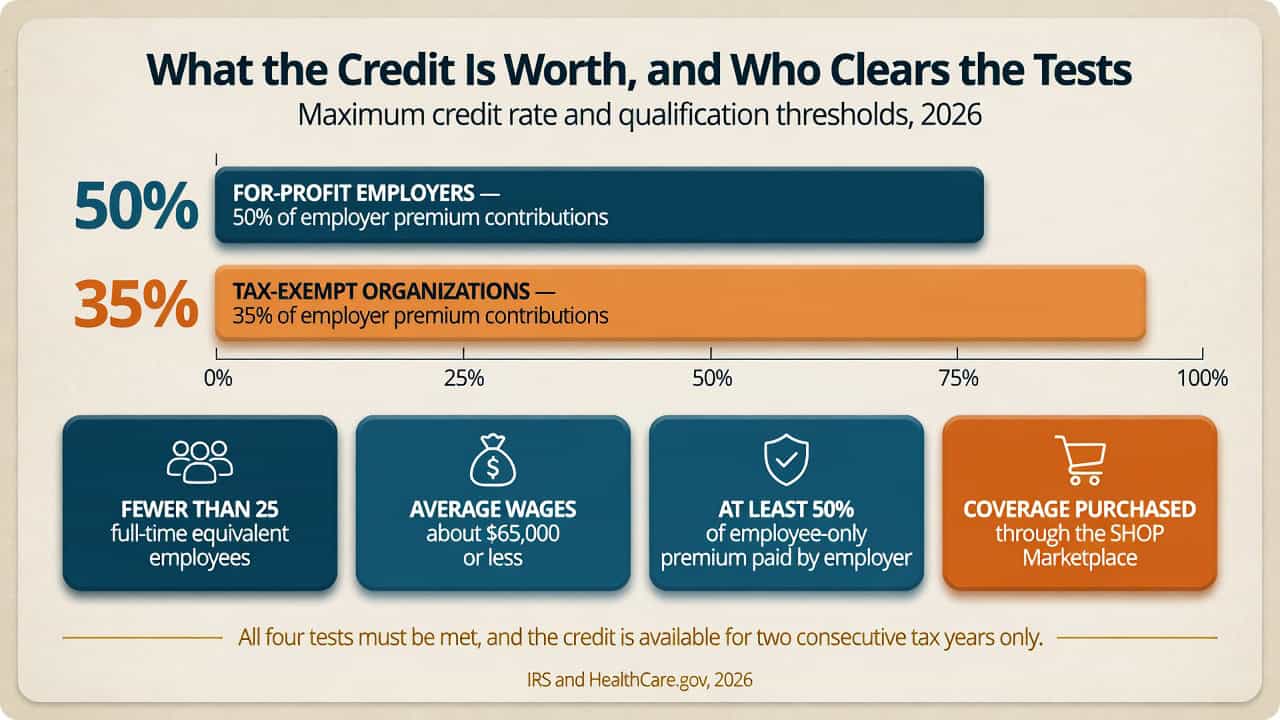
Four conditions apply, and all four must be met. Fewer than 25 full-time equivalent employees. Average annual wages of roughly $65,000 or less. Payment of at least 50 percent of employee-only premium costs. And enrollment in a qualified health plan through the SHOP Marketplace. Failing any one disqualifies the business entirely.
The wage test disqualifies more employers from the small business health care tax credit than the headcount test does. A ten-person firm paying professional salaries will clear the size requirement comfortably and fail on average wages, because the threshold sits well below what many skilled trades and professional services businesses pay. The figure is indexed for inflation and moves each year.
Full-time equivalent counting follows the standard federal method, so part-time hours are totaled and divided by 2,080. That works in an employer’s favor here — a business with 30 people on the roster may sit under 25 FTEs and qualify on size where a headcount reading would have ruled it out.
Both numeric thresholds move
The wage limit is indexed for inflation and has climbed steadily since the credit took effect, while the 25 FTE ceiling and the 50 percent contribution floor are fixed in statute. An employer close to the wage line in one year may fall inside it the next without changing anything about payroll.
What the Credit Is Worth
Up to 50 percent of employer premium contributions for for-profit businesses, and up to 35 percent for tax-exempt organizations. The full amount reaches only employers with fewer than 10 full-time equivalent employees averaging about $27,000 or less in wages. Above those points the credit tapers and disappears entirely at 25 FTEs or the upper wage limit.
The small business health care tax credit runs on a sliding scale, which means the headline 50 percent figure describes a small subset of qualifying businesses rather than the typical outcome. A firm with 18 employees at moderate wages qualifies for a materially smaller credit than the maximum, and the taper runs on both dimensions at once — size and wages each pull the number down independently.
A landscaping company with 8 full-time equivalent employees averaging $26,000 in wages contributes $48,000 toward SHOP premiums for the year. Sitting under both taper thresholds, it claims close to the full 50 percent — roughly $24,000 back. A design studio with 18 full-time equivalent employees averaging $45,000 contributes the same $48,000, but is well into the taper on both size and wages, and claims only a fraction of that. Both firms qualify, both spend identically, and the credit is worth several times more to one than the other — which is why the value has to be estimated from the actual census rather than the headline rate. Either way it runs for two consecutive tax years only.
Two consecutive tax years is the hard limit on the small business health care tax credit. After the second year the credit ends permanently for that employer, which means it should be treated as a temporary offset during the first years of offering coverage rather than as an ongoing reduction in what health benefits cost.
The SHOP Requirement That Disqualifies Most Employers
Enrolling through the Small Business Health Options Program is generally the only route to the credit. Coverage purchased directly from a carrier or through an agent outside SHOP does not qualify, regardless of how well the business meets the other three tests. A limited exception applies where no SHOP plan is available in the area.
This single requirement is why the small business health care tax credit reaches far fewer employers than the size and wage thresholds alone would suggest. The credit is tied to a specific purchasing channel, not to the act of providing coverage, and a business already covered through a plan bought elsewhere cannot claim it retroactively by reclassifying that coverage.
Worth stating plainly
Group coverage arranged outside the SHOP Marketplace does not qualify for the small business health care tax credit. Employers weighing the credit should confirm the purchasing channel before assuming any tax benefit, and compare total cost both ways rather than assuming the credit produces the lower net figure.
The IRS has issued guidance covering employers in areas where no SHOP plan is offered, which is the narrow circumstance in which coverage bought elsewhere may still support a claim. Details sit in the IRS guidance on the credit and the SHOP Marketplace, and HealthCare.gov summarizes the eligibility tests in plainer language.
Compare Coverage Options and Pricing
Whatever route a business takes, the starting point is knowing what coverage costs. Enter the employee count to compare plans, or talk the options through with a licensed agent.
How Owners and Family Members Are Treated
Owners are excluded from the calculation entirely. Sole proprietors, partners, more than two percent shareholders of an S corporation, owners of more than five percent of the business, and family members of any of those are left out of the employee count, the wage average, and the premiums counted toward the credit.
For very small businesses this exclusion often removes most of the benefit of the small business health care tax credit. A four-person company where two of the four are the owner and a spouse is calculating the credit on two employees, not four, and the premiums paid on the owners’ own coverage do not count toward the reimbursable base at all.
The exclusion cuts one helpful way, though. Owner wages are removed from the average wage calculation, so a business where the owner draws a high salary is not pushed over the wage threshold by their own compensation. The average is computed across rank-and-file employees only.
Seasonal workers are handled separately again
Employees working 120 days or fewer in the year are generally left out of the full-time equivalent count, which can keep a business with a heavy seasonal roster inside the 25 FTE ceiling that a raw headcount would have breached.
Family member definitions are broad
The exclusion extends to a range of relatives of an owner, not just a spouse. A family-run business should establish which people are excluded before estimating the credit, because the calculation can change substantially.
How the Credit Is Claimed
The credit is claimed on IRS Form 8941, Credit for Small Employer Health Insurance Premiums, filed with the business return. The form calculates full-time equivalent employees, average annual wages, and qualifying premiums paid. Tax-exempt organizations claim it as a refundable credit through a different filing route.
Claiming the small business health care tax credit is mostly a matter of assembling records before the form is started. That means the employer identification number used for employment taxes, total hours worked by all employees during the year, total wages paid, and the premiums paid on qualifying coverage, separated from any amounts paid on behalf of excluded owners.
The distinction between for-profit and tax-exempt filing matters more than it first appears. For a for-profit business the credit reduces tax liability, so a business with no liability in a given year gets no immediate benefit. Tax-exempt organizations receive it as a refundable credit against payroll tax liabilities instead. IRS Form 8941 and its instructions set out both paths.
Before counting on the credit
Treat the small business health care tax credit as a possible reduction rather than a planning assumption. It requires a specific purchasing channel, expires after two years, excludes owners, and tapers on two dimensions at once. Confirm eligibility with a tax professional before letting it influence which coverage a business chooses.
Frequently Asked Questions About the Small Business Health Care Tax Credit
Who qualifies for the small business health care tax credit?
An employer with fewer than 25 full-time equivalent employees, average annual wages of roughly $65,000 or less, that pays at least 50 percent of employee-only premium costs and enrolls in coverage through the SHOP Marketplace. All four tests must be met.
How much is the credit worth?
Up to 50 percent of employer premium contributions for for-profit businesses and up to 35 percent for tax-exempt organizations. The full amount goes to employers with fewer than 10 full-time equivalent employees averaging about $27,000 or less in wages.
Does coverage have to be purchased through SHOP?
Yes, in almost all cases. Enrolling in a qualified health plan through the Small Business Health Options Program is generally the only route to the credit. Coverage bought outside SHOP does not qualify, apart from a limited exception where no SHOP plan is available.
How many years can the credit be claimed?
Two consecutive tax years. After that the credit is no longer available to the employer, which is why it should be treated as a temporary offset rather than an ongoing reduction in the cost of coverage.
What form is used to claim the credit?
IRS Form 8941, Credit for Small Employer Health Insurance Premiums. It calculates full-time equivalent employees, average annual wages, and qualifying premiums paid, and is filed with the business tax return.
Do business owners count toward the credit calculation?
No. Sole proprietors, partners, more than two percent shareholders of an S corporation, owners of more than five percent of the business, and family members of those owners are excluded from both the employee count and the wage and premium figures.
Related Small Business Health Insurance Resources
The full employer guide to coverage, costs, eligibility, and enrollment.
What Coverage Costs Per Employee2026 premium benchmarks, the employer share, and what drives a quote.
Requirements and Employer Size RulesFTE counting, participation minimums, and the 50-employee threshold.
Comparing Carriers and QuotesNetwork, financial strength, quality ratings, and renewal behavior.
Level-Funded vs. Fully InsuredHow the two group funding models price, refund, and renew differently.
ICHRA vs. Group CoverageFunding coverage employees buy themselves instead of sponsoring a plan.
See What Coverage Costs for Your Business
Pricing depends on employee count, ages, and ZIP code. Run a quote to compare plans and costs, or call to talk through the options with a licensed agent.
Broker Disclosure
ForHealthInsurance.com is an independent health insurance agency serving businesses. We are not affiliated with any carrier or government agency. We help you compare plans and enroll in coverage that meets your needs at no extra cost to you.