Utah Health Insurance Marketplace 2026: HealthCare.gov
The marketplace for Utah residents — also called the Utah health insurance exchange — runs through HealthCare.gov, the federally-facilitated platform Utah uses for individual coverage (Utah operates Avenue H separately as a small business state exchange). The 2026 Utah health insurance marketplace lost an entire carrier when Aetna exited the individual market nationwide at the end of 2025, and saw Molina Healthcare contract dramatically to only two southwest counties — making 2026 one of the most disruptive marketplace transitions Utah has experienced. Six carriers remain for 2026: SelectHealth (the dominant carrier with ~278,000 members), Regence BlueCross BlueShield of Utah (the primary PPO option), BridgeSpan Health, University of Utah Health Plans (~150,000 total members), Molina (now limited to Washington and Iron Counties), and Imperial Health Plan. About 1 in 7 Utah adults ages 19-64 buys individual coverage through the Utah health insurance marketplace, with roughly 77% receiving Advance Premium Tax Credits. The 2026 weighted average rate increase came in at 14.2% — moderate by national standards thanks to the Utah Insurance Department’s effective state rate review process. The 2027 open enrollment window is shorter than 2026 — running November 1 through December 15, 2026 only — under a federal rule change that took effect in 2025. This guide walks through the open enrollment window, how subsidies work in 2026 above Utah’s expanded Medicaid threshold, how to compare the six remaining carriers, the step-by-step HealthCare.gov application process, and the Avenue H alternative for small Utah employers.
What brings you here today?
Why Utah Uses HealthCare.gov for Individual + Avenue H for Small Business
Utah operates a hybrid marketplace structure unique among states: HealthCare.gov for individual Utah health insurance enrollment plus a state-based small group exchange called Avenue H for employers. The Utah health insurance exchange for individuals is federally-facilitated, while the Utah Insurance Department directly administers Avenue H for small employer groups of 50 or fewer employees.
When the ACA’s exchange provisions took effect in 2014, states had three implementation options: build a fully state-based exchange, build a state-based exchange that uses HealthCare.gov technology, or default to the federally-facilitated marketplace. Utah chose a hybrid approach unique among states — defaulting to the federal HealthCare.gov platform for the Utah health insurance marketplace serving individual buyers while retaining its existing pre-ACA small employer exchange (Avenue H, originally created in 2010) for small group employer coverage. The practical consequence for Utah residents is that all individual marketplace shopping, plan comparison, subsidy calculation, and enrollment happens through HealthCare.gov, while small Utah employers shop separately through Avenue H.
The Utah Insurance Department regulates carrier compliance for both channels and conducts effective state rate review on individual market filings. This rate review process is one reason Utah’s 2026 weighted average rate increase came in at +14.2% — moderate compared to states like Tennessee (+37.5%) or Colorado where federal CMS review alone applied. Utah Insurance Department signed off on most carrier filings as proposed in October 2025. The Utah Department of Health and Human Services administers expanded Medicaid (in effect since January 2020) and CHIP for children up to 200% of FPL. The HealthCare.gov enrollment portal is the only authoritative entry point for Utah individual marketplace plans with premium tax credits.
2027 Open Enrollment for the Utah Marketplace
Utah’s 2027 open enrollment arrives in a year of carrier disruption — the first 45-day federal cycle plus the aftermath of Aetna’s market exit and Molina’s service area contraction. The Utah health insurance marketplace window runs November 1 through December 15, 2026 only on HealthCare.gov, with no January extension. Coverage starts January 1, 2027. Outside this window, a qualifying life event creates a 60-day SEP. Utah Medicaid stays year-round.
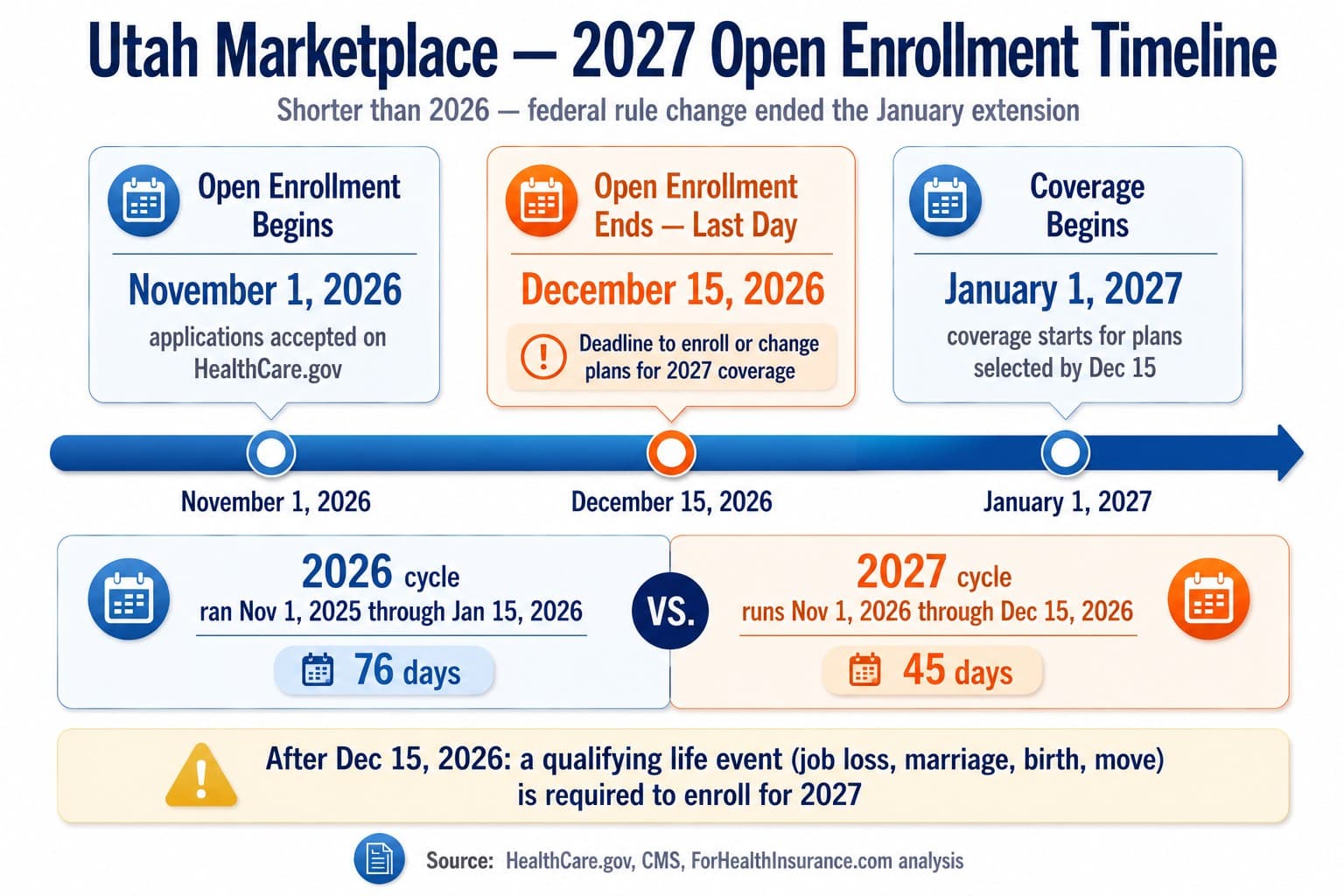
The shortened open enrollment window is the most consequential procedural change for Utah marketplace shoppers in 2026 going into 2027 — and it arrives in a year when Utah is also absorbing two major carrier changes. Aetna exited the individual market entirely at the end of 2025, and Molina Healthcare reduced its Utah service area to only Washington and Iron Counties for 2026 (about 16,620 Molina members affected). From 2022 through 2025, Utah’s open enrollment ran 76 days from November 1 through January 15. The federal rule change that took effect in 2025 reduced that to 45 days starting with the 2027 plan year — November 1 through December 15 only. Utahns accustomed to the January 15 deadline risk missing 2027 coverage entirely if they don’t act by December 15, 2026.
For Utahns who miss December 15, a special enrollment period reopens the Utah health insurance marketplace on HealthCare.gov for 60 days after a qualifying life event. In Utah that most often means an Aetna or Molina displacement counted as loss of coverage, a Silicon Slopes job change, a move between Wasatch Front ZIP codes where carrier networks differ, or a new baby in a state with one of the nation’s highest birth rates. The 60-day clock runs from the event itself, not from when paperwork is filed, and the compressed 2027 window pushes more Utahns onto SEPs than the old January 15 deadline ever did.
Auto-renewal after Aetna’s exit and Molina’s contraction needs verification
HealthCare.gov auto-renews most Utah marketplace enrollees who don’t actively select a plan during open enrollment — typically into the same plan from the same carrier, with updated 2027 premium and subsidy amounts. But auto-renewal logic broke for thousands of Utahns whose 2025 carrier (Aetna) or 2026 service area (Molina outside two counties) no longer existed at renewal time. HealthCare.gov assigned displaced enrollees to default carriers based on geographic availability — a process that doesn’t account for provider network match or plan design preference. Utahns whose 2025 or 2026 coverage was with Aetna or Molina should actively shop during November 1 – December 15, 2026 rather than relying on auto-renewal, even if HealthCare.gov has already assigned them to a new carrier.
Utah Subsidies: APTC, CSR, and the Medicaid Floor
Utahns between 138% and 400% of FPL qualify for Advance Premium Tax Credits in 2026. Below 138% of FPL, Utahns qualify for expanded Medicaid (in effect since January 2020) rather than marketplace subsidies — a key difference from non-expansion states where coverage gaps exist. About 77% of Utah marketplace enrollees received subsidies in 2026. Households up to 250% of FPL also qualify for Cost-Sharing Reductions on Silver-tier plans.
The Utah subsidy structure differs from non-expansion states because of Proposition 3, the 2018 ballot initiative that brought full Medicaid expansion to Utah effective January 1, 2020. Utah adults ages 19-64 with household incomes up to 138% of the federal poverty level qualify for Medicaid coverage rather than Utah health insurance marketplace subsidies. For 2026 coverage, the relevant FPL thresholds applicable in Utah are: 138% of FPL is approximately $21,597 for a single adult and $44,367 for a family of four (the upper bound for Utah Medicaid expansion eligibility, and the lower bound for marketplace subsidy eligibility). 250% of FPL is approximately $39,125 for a single adult and $80,375 for a family of four (the upper bound for Cost-Sharing Reductions). 400% of FPL is approximately $62,600 for a single adult and $128,600 for a family of four (the upper bound for APTC after the ARP enhancements expired at the end of 2025).
| 2026 Income Level | Single Adult | Family of 4 | What You Qualify For |
|---|---|---|---|
| Below 138% FPL | < $21,597 | < $44,367 | Utah Medicaid (expanded since Jan 2020) |
| 138%–150% FPL | $21,597–$23,475 | $44,367–$48,225 | APTC + maximum CSR (94% AV Silver) |
| 150%–200% FPL | $23,475–$31,300 | $48,225–$64,300 | APTC + strong CSR (87% AV Silver) |
| 200%–250% FPL | $31,300–$39,125 | $64,300–$80,375 | APTC + limited CSR (73% AV Silver) |
| 250%–400% FPL | $39,125–$62,600 | $80,375–$128,600 | APTC only (no CSR) |
| Above 400% FPL | > $62,600 | > $128,600 | Full price — subsidy cliff in 2026 |
Utah’s expanded Medicaid path matters for marketplace shoppers because HealthCare.gov screens applicants for Utah Medicaid eligibility automatically before displaying marketplace plan options. Applicants below 138% of FPL are routed to the Utah Department of Health and Human Services Medicaid application rather than seeing marketplace plans. This eliminates the coverage gap that exists in non-expansion states like Tennessee, Texas, or Florida, where households below 100% of FPL who don’t qualify for limited categorical Medicaid have no affordable coverage path. Utah’s expanded Medicaid is administered year-round with rolling eligibility — separate from the marketplace’s open enrollment cycle.
For Utahns squeezed by the 400% FPL cliff at the upper end, off-exchange shopping becomes more attractive because off-exchange plans (which never qualified for APTC) compete on full-price terms anyway. Regence BlueCross BlueShield of Utah off-exchange PPO plans frequently offer broader provider networks and BlueCard national reciprocity at premium points comparable to on-exchange Silver plans without subsidies — particularly relevant after Utah’s 14.2% rate increase for 2026. Off-exchange Regence PPO health insurance plans are available across Utah for households above the cliff. Compare designs on the Utah health insurance plans page, or weigh subsidy strategies on affordable health insurance in Utah.
Get a Quote Through HealthCare.gov
Before you lock in a 2027 plan on HealthCare.gov, a licensed Utah agent checks whether you or your kids qualify for expanded Medicaid or CHIP, estimates your premium tax credit and cost-sharing help, and lines up SelectHealth, Regence, BridgeSpan, University of Utah Health Plans, Molina, and Imperial for your county. One call covers every Utah carrier.
Comparing the Six Remaining Utah Marketplace Carriers
The six carriers remaining on the Utah health insurance marketplace for 2026 — after Aetna’s exit and Molina’s service area contraction — each occupy distinct strategic positions. SelectHealth dominates statewide with about 278,000 members anchored on Intermountain Healthcare. Regence BCBS provides PPO designs with BlueCard reciprocity. UofU Health Plans serves Wasatch Front academic medical care. BridgeSpan, Molina, and Imperial fill regional niches.
SelectHealth (Intermountain)
The largest carrier on the Utah health insurance exchange — about 278,000 marketplace members in 2026 — owned by Intermountain Healthcare. Direct integration with Intermountain Medical Center, LDS Hospital, McKay-Dee, Utah Valley Hospital, Dixie Regional, and dozens of clinics. Available all Utah counties. Primarily HMO designs requiring PCP selection. +12.8% rate increase for 2026.
- ~278,000 marketplace members
- All Utah counties
- Intermountain integrated
- HMO primary, PCP-coordinated
Regence BlueCross BlueShield of Utah
Utah’s primary PPO carrier and the dominant Blue Cross Blue Shield licensee. Regence BCBS offers PPO designs with BlueCard national reciprocity, giving Utah members in-network access in all 50 states. No PCP gatekeeping or specialist referrals. Strongest fit for Utahns who travel for work, split time across state lines, or have providers across multiple systems. Major Utah metros.
- Utah’s primary PPO carrier
- BlueCard national reciprocity
- No referrals required
- Major UT metros
University of Utah Health Plans
The University of Utah Health system insurance arm — about 150,000 total members across individual, group, Medicare, and Medicaid lines. Strong integration with University of Utah Hospital (the state’s only academic medical center), Huntsman Cancer Institute, and University of Utah Health clinics. Best fit for Salt Lake City and Wasatch Front residents whose care anchors at UofU Health. +17.6% rate increase for continuing 2026 plans.
- ~150,000 total members
- UofU Health system integrated
- Wasatch Front primary
- +17.6% on continuing plans
BridgeSpan Health
Cambia Health Solutions affiliate offering individual marketplace coverage in select Utah counties. Original Utah footprint was Davis and Weber Counties when BridgeSpan re-entered eight years ago, with selective expansion since. Strong HSA-eligible Bronze options. Forty-year-old Silver around $794 monthly with $3,100 deductible; Bronze $604 with HSA eligibility. RealValue network with no specialist referrals required. +16.0% rate increase for 2026.
- Davis, Weber, select counties
- HSA-eligible Bronze and HDHP
- No specialist referrals
- +16.0% rate increase 2026
Molina Healthcare
National managed care carrier that dramatically reduced Utah service area for 2026. Molina exited most counties where it operated and continues only in Washington County (St. George) and Iron County (Cedar City) for 2026. About 16,620 members affected by the contraction. +31.6% rate increase in continuing service area. Most affected members switched to other carriers during 2026 open enrollment.
- Washington + Iron Counties only
- ~16,620 members affected
- +31.6% rate increase 2026
- Most members switched carriers
Imperial Health Plan of the Southwest
Regional carrier offering low-premium individual marketplace plans in select Utah counties. Imperial typically posts the lowest monthly Silver premiums — around $684 per month for a 40-year-old non-tobacco user, about $91 below the state average. Trade-off is higher deductibles and out-of-pocket maximums than SelectHealth or Regence. Best fit for healthy Utahns prioritizing the lowest monthly premium.
- Lowest avg UT Silver premium
- ~$684/mo for 40-yr-old Silver
- Higher deductibles trade-off
- Healthy under-40 fit
The choice between the six carriers in the Utah health insurance marketplace comes down to where you live and which health system you use. Salt Lake County and Wasatch Front residents can compare all six and frequently optimize between SelectHealth (broadest Intermountain access), University of Utah Health Plans (academic medical center integration), and Regence BCBS (PPO with BlueCard national reciprocity). Davis and Weber Counties add BridgeSpan strongly. Utah County (Provo/Orem) typically chooses between SelectHealth and Regence on the Utah health insurance marketplace. Washington and Iron Counties (St. George, Cedar City) have the unique 2026 distinction of being the only Utah counties where Molina continues to participate.
How to Apply Through HealthCare.gov in Utah
Applying for Utah health insurance marketplace coverage takes about 30 to 60 minutes on HealthCare.gov for most households. The application collects household composition, projected annual income, current coverage status, and citizenship verification, then automatically screens for Utah Medicaid (expanded) and CHIP before displaying marketplace plan options with your real-time APTC amount. Apply by December 15, 2026 for 2027 coverage starting January 1, 2027.
Gather your documents before you start
You will need household composition (everyone on your tax return — spouse, dependents), Social Security numbers for everyone applying, projected 2027 household income (annual MAGI), employer information if anyone has access to employer-sponsored coverage that meets ACA affordability standards, and immigration documents if applying for non-citizen household members. Utahns whose income fluctuates — Silicon Slopes contract workers, outdoor recreation industry guides, real estate agents in Park City and Salt Lake County, freelance creative workers — should estimate full-year projected income realistically rather than picking a number that maximizes upfront subsidy.
Create or log into your HealthCare.gov account
Visit HealthCare.gov and create an account or log into your existing account if you’ve enrolled before. Returning enrollees should review prior-year information for accuracy — particularly income, household size, and current coverage. Utahns who enrolled in 2026 will have most information pre-filled and only need to update what has changed. Be aware that auto-renewal may have placed you in a different carrier than your 2025 plan due to Aetna’s exit or Molina’s service area contraction.
Complete the eligibility application
The HealthCare.gov application asks about household composition, income, current coverage, and any employer-sponsored coverage offers. The system runs a real-time eligibility determination that screens for Utah Medicaid (expanded since 2020 — adults 19-64 up to 138% FPL) and CHIP (children up to 200% of FPL). If routed to Utah Medicaid, your application is forwarded to the Utah Department of Health and Human Services for final determination. Unlike non-expansion states, no Utah residents fall into a coverage gap below 138% FPL.
Compare plans from all six remaining Utah carriers
If you qualify for marketplace coverage, HealthCare.gov displays plan options from all available Utah carriers in your county — SelectHealth (statewide), Regence BCBS (major metros), BridgeSpan (Davis/Weber + select), UofU Health Plans (Wasatch Front), Molina (Washington/Iron only), and Imperial (select counties) — with your APTC and CSR amounts already applied. Compare on monthly premium after subsidy, deductible, OOP max, network breadth, and prescription drug formulary. Use each carrier’s provider directory to verify your specific physicians and preferred hospital are in-network.
Select a plan and pay your first premium
After selecting a plan, HealthCare.gov forwards your enrollment to the chosen carrier. Coverage does not begin until you pay your first premium directly to the carrier — SelectHealth, Regence BCBS, BridgeSpan, UofU Health Plans, Molina, or Imperial, depending on which plan you selected. Most carriers offer auto-pay enrollment from a checking account or credit card. For 2027 coverage, enroll by December 15, 2026; coverage begins January 1, 2027.
Utah residents who want help with the application can work with a free Navigator through Utah’s network of HealthCare.gov-certified navigators, listed through the Utah Insurance Department. The federal HealthCare.gov call center (1-800-318-2596) is also available 24/7. Utahns who prefer a licensed broker rather than a navigator — particularly those evaluating off-exchange Regence BCBS PPO options or comparing the Utah health insurance marketplace plans against ICHRA-compatible alternatives — can work with ForHealthInsurance.com at 888-215-4045. For the Utah Insurance Department’s official consumer guide and rate filing information, see Utah Insurance Department.
When the Utah Marketplace Isn’t the Right Fit
The Utah health insurance marketplace works well for Utahns between 138% and 400% of FPL who qualify for subsidies. It works less well for households above the 400% FPL cliff facing the full 14.2% rate increase, those who need broader networks than the HMO designs offered by SelectHealth and UofU Health Plans, and those whose providers span multiple states. For these Utahns, off-exchange Regence BCBS PPO often produces better value.
The clearest case for off-exchange shopping in Utah is the household above the 400% FPL subsidy cliff. A 60-year-old couple in Salt Lake City earning $135,000 (about 810% of FPL) gets zero APTC in 2026 and faces full-price marketplace premiums in the $1,500-$2,000 per month range after the 14.2% rate increase. Off-exchange Regence BCBS PPO designs at this premium point often offer broader provider networks, BlueCard national reciprocity, and access to HSA-eligible plan designs not always available on-exchange — features valuable to a couple at this income level who travel, have providers in multiple states, or want maximum network flexibility. Off-exchange premiums for a 40-year-old in Utah for 2026 typically run $580 to $810 per month.
The second case is Utahns who travel for work or split time across state lines — Silicon Slopes tech professionals serving multi-state clients, outdoor recreation industry workers splitting time between Utah and out-of-state locations, retirees who winter in Arizona or California, regional sales representatives, professional athletes, and ski industry workers with seasonal multi-state arrangements. Most Utah marketplace carriers (SelectHealth, UofU Health Plans, BridgeSpan, Molina) offer HMO designs that provide limited or no out-of-state coverage outside emergencies. Regence BCBS BlueCard reciprocity gives Utahns in-network access to any BCBS-contracted provider in any state — an essential feature for Utahns who need geographic flexibility. For Utahns who need this kind of access, the marketplace’s HMO-dominant carrier mix is often a poor fit even with subsidies.
Frequently Asked Questions
Common questions about the Utah health insurance marketplace cover what the marketplace is, the shorter 2027 open enrollment window, subsidy eligibility thresholds above the Medicaid floor, the six remaining participating carriers after Aetna’s exit, and what changed in the Utah marketplace for 2026.
What is the Utah health insurance marketplace?
The Utah health insurance marketplace — also called the Utah health insurance exchange — is the federally-facilitated platform at HealthCare.gov where Utah residents shop for and enroll in ACA-compliant individual and family coverage. Utah does not operate a state-based individual exchange (it does operate Avenue H separately for small group employers). Six carriers offer marketplace plans for 2026: SelectHealth, Regence BlueCross BlueShield of Utah, BridgeSpan, University of Utah Health Plans, Molina Healthcare, and Imperial Health Plan. Aetna exited the individual market entirely at the end of 2025.
When is the Utah marketplace open enrollment period for 2027?
The 2027 open enrollment period in Utah runs November 1, 2026 through December 15, 2026 on HealthCare.gov — shorter than the 2026 cycle due to a federal rule change that took effect in 2025. There is no January extension for 2027. Coverage selected during open enrollment takes effect January 1, 2027. Outside open enrollment, a qualifying life event triggers a 60-day special enrollment period. Utah Medicaid (expanded since January 2020) is available year-round, separate from the marketplace open enrollment cycle.
How do I qualify for marketplace subsidies in Utah?
Utahns with household incomes between 138% and 400% of the federal poverty level qualify for Advance Premium Tax Credits through the marketplace. Below 138% of FPL, Utahns qualify for expanded Medicaid (in effect since January 2020) rather than marketplace subsidies. For 2026 marketplace coverage, the APTC range is approximately $21,597 to $62,600 for a single adult and $44,367 to $128,600 for a family of four. Households up to 250% of FPL also qualify for Cost-Sharing Reductions on Silver-tier plans, which lower deductibles and out-of-pocket costs.
Which carriers participate in the Utah marketplace for 2026?
Six carriers participate in the Utah marketplace through HealthCare.gov for 2026: SelectHealth (statewide, dominant carrier with about 278,000 members), Regence BlueCross BlueShield of Utah (PPO leader with BlueCard reciprocity), BridgeSpan Health (Davis, Weber, and select counties), University of Utah Health Plans (Wasatch Front primary), Molina Healthcare (only two southwest counties for 2026 — Washington and Iron), and Imperial Health Plan (low-premium option in select counties). Aetna exited the individual market entirely at the end of 2025.
What changed in the Utah marketplace for 2026?
Two major changes affected Utah marketplace enrollees for 2026. First, Aetna exited the individual market entirely nationwide at the end of 2025, meaning Utah Aetna enrollees in 2025 needed to actively select a new carrier during open enrollment. Second, Molina Healthcare dramatically reduced its Utah service area — about 16,620 Molina members had their carrier exit most counties, with Molina continuing only in Washington and Iron Counties for 2026. The remaining six carriers absorbed most displaced enrollees. The 2026 weighted average rate increase came in at 14.2%, moderate by national standards thanks to Utah Insurance Department’s effective state rate review.
Compare 2026 UT Marketplace Plans
Above the cliff? Off-exchange Regence PPO often beats a full-price HealthCare.gov Silver after Utah’s 14.2% increase, with BlueCard national access on top. A licensed Utah agent runs both numbers, confirms the Medicaid and CHIP floor for your household, and verifies your Intermountain or University of Utah Health doctors before you commit to 2027 coverage.
Free UT marketplace comparison — covers all six carriers and off-exchange options.
Related Utah Health Insurance Resources
Complete UT coverage guide — six carriers, expanded Medicaid, costs, and the 14.2% rate increase.
UT Health Insurance PlansPlan tiers (Bronze, Silver, Gold), HMO vs PPO designs, and how to choose your carrier.
Affordable Coverage in UtahSubsidy strategies, average costs, and how to lower your 2026 premium after the rate increase.
Utah Small Business Health InsuranceAvenue H, ICHRA, and small group plans for Utah employers up to 50 employees.
Individual Health Insurance UtahSelf-employed, freelance, and private coverage paths in Utah, on-exchange and off-exchange.
HealthCare.gov (Official)Utah’s official federal marketplace enrollment portal for 2027 plans.
Utah Insurance DepartmentCarrier rate filings, consumer complaints, and licensed agent verification.
KFF Subsidy CalculatorEstimate your 2026 APTC amount before applying through HealthCare.gov.
Broker Disclosure
ForHealthInsurance.com is an independent health insurance agency serving Utah residents. We are not affiliated with any carrier or government agency. We help you compare plans and enroll in coverage that meets your needs at no extra cost to you.