Utah Small Business Health Insurance 2026: Avenue H Guide
Utah small business health insurance for 2026 sits at a unique structural intersection among state markets — Utah operates its own state-based SHOP exchange called Avenue H (running since 2010, predating the ACA), the state has been a national leader in defined-contribution employer benefits since the Patty Conner administration of Avenue H, and Utah’s substantial Silicon Slopes tech corridor and outdoor recreation industry have made the state one of the highest-ICHRA-adoption markets in the nation. Utah employers with 1-50 full-time-equivalent employees have three primary Utah small business health insurance paths in 2026: Avenue H state SHOP exchange (defined-contribution, employer commits flat dollar amount per employee, employees choose from ~140 plans), traditional small group plans purchased directly from carriers like SelectHealth (the dominant Utah carrier), Regence BlueCross BlueShield of Utah (the PPO leader with BlueCard reciprocity), or University of Utah Health Plans, and ICHRA Individual Coverage Health Reimbursement Arrangement where the employer reimburses employees tax-free for individual marketplace premiums. The federal small business tax credit covers up to 50% of qualifying employer contributions for groups with ≤25 FTEs and average wages under $66,600 in 2026. This guide walks through Avenue H mechanics, ICHRA versus group plan economics, federal tax credit eligibility, the carrier landscape for Utah small employers, and how to choose between paths for the typical Utah small business — particularly relevant in 2026 as the individual marketplace absorbs Aetna’s exit and Molina’s contraction, reshaping the calculus on which Utah small business health insurance approach produces the best outcome.

What brings you here today?
Three Utah Small Employer Paths Compared
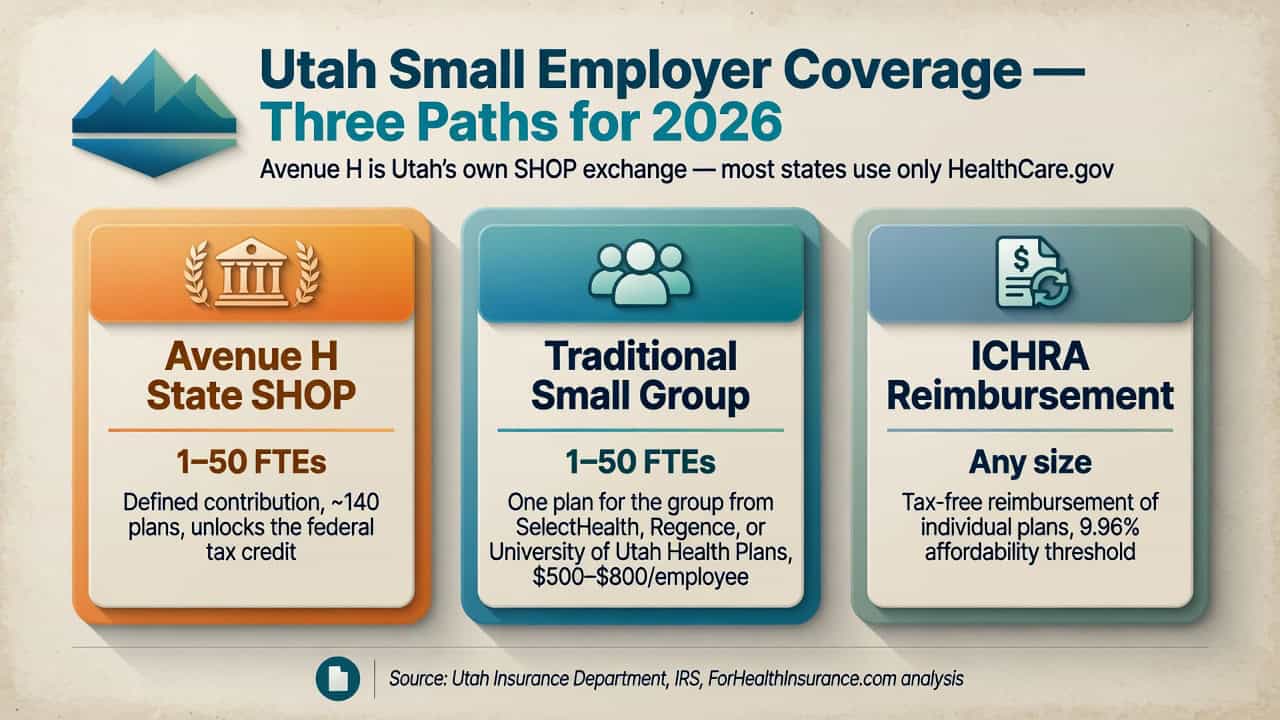
Utah small business health insurance has three primary paths in 2026: Avenue H state SHOP exchange (defined-contribution, ~140 plans), traditional small group plans direct from SelectHealth, Regence BCBS, or UofU Health Plans (defined-benefit, employer picks one plan), and ICHRA reimbursement of individual marketplace plans. Utah is one of the few states operating its own state-based SHOP exchange — most states use HealthCare.gov for both individual and small business.
Avenue H
Utah’s state-based small business exchange operating since 2010 — predating the ACA. Defined-contribution architecture: employer commits flat dollar amount per employee per month; employees shop from ~140 plans across participating Utah small business health insurance carriers (SelectHealth and others). Administered by the Utah Insurance Department for groups with 1-50 FTEs. Federal small business tax credit eligibility runs through Avenue H. Employees pay any premium difference between employer contribution and chosen plan.
- 1-50 FTE eligibility
- ~140 plan options
- Defined-contribution model
- Federal tax credit eligible
Direct small group plans
Traditional defined-benefit small group plans purchased directly from Utah small business health insurance carriers — SelectHealth (anchored on Intermountain Healthcare), Regence BlueCross BlueShield of Utah (PPO leader with BlueCard national reciprocity), University of Utah Health Plans (UofU Health system integration), and BridgeSpan in select counties. Employer picks one plan for the entire group; employees enroll or decline. Premiums typically run $500-$800 per employee per month with the employer paying 50-80% of employee-only premiums.
- 1-50 FTE eligibility
- Single plan for whole group
- Employer picks one carrier
- $500-$800/employee/mo typical
ICHRA
Individual Coverage Health Reimbursement Arrangement — federal program effective January 1, 2020. Utah employers of any size reimburse employees tax-free for individual marketplace premiums. Employees keep their own coverage when they leave. Contributions can vary by employee class (full-time vs part-time, salaried vs hourly). High adoption rate among Utah Silicon Slopes tech employers and outdoor recreation industry. The 2026 affordability threshold is 9.96% of household income; if exceeded, employees can opt out and claim APTC instead.
- Any size employer
- Variable contributions by class
- Employee keeps coverage on departure
- 9.96% affordability threshold 2026
The three Utah small business health insurance paths are not mutually exclusive in practice — many Utah small employers run combined approaches. A 30-employee Silicon Slopes tech company in Lehi might offer ICHRA to remote employees outside Utah while operating a traditional small group plan from SelectHealth for the Utah-based core team. A 12-employee professional services firm in Salt Lake City might use Avenue H for the broader employee population while offering a richer traditional plan to executives. A 5-employee construction subcontractor in Ogden might use ICHRA exclusively because it’s the simplest administrative path. The choice between paths depends on employee demographics, geographic concentration, premium variance tolerance, administrative capacity, and whether the federal tax credit eligibility (which runs through Avenue H specifically) tips the math.
Avenue H: Utah’s State SHOP Exchange
Avenue H is Utah’s pioneering state-based small business health insurance exchange — operational since 2010, before the ACA was enacted, and one of the earliest defined-contribution employer benefits markets in the United States. The Utah Insurance Department administers Avenue H for employers with 1-50 employees. Approximately 140 plans are offered across participating carriers. Employer commits flat dollar contribution; employees shop and pay any difference.
Avenue H predates federal exchange architecture by several years. Former Utah Governor Jon Huntsman signed HB 133 in 2008 establishing the Utah Health Exchange, expanded by HB 188 in 2009, with operations launching in 2010. Governor Gary Herbert’s administration negotiated with HHS in 2012-2013 to operate Avenue H as Utah’s state-based SHOP exchange while accepting the federally-facilitated individual marketplace at HealthCare.gov — a hybrid arrangement unique among states. HHS approved this structure in May 2013, and Avenue H has operated continuously since, processing the substantial majority of Utah small group enrollment volume. The Utah Insurance Department oversees plan certification, rate review, and risk adjustment through the Utah Defined Contribution Risk Adjuster Board.
The Avenue H mechanics differ from federal SHOP exchange architecture in two important ways. First, Avenue H employers commit a flat dollar contribution rather than a percentage of premium — meaning a 5-employee Utah business might commit $400 per employee per month regardless of which plan each employee picks. Second, employees can pick different plans at different premiums, with the employer’s contribution treated as a fixed budget; employees pay any difference between employer contribution and their chosen plan premium directly. This Utah small business health insurance defined-contribution architecture gives employers cost predictability that traditional group plans don’t offer — the employer’s exposure is capped at the per-employee monthly contribution regardless of plan choice or claims experience.
| Avenue H Feature | How It Works |
|---|---|
| Eligibility | Utah employers with 1-50 full-time-equivalent employees |
| Plan options | ~140 plans across participating carriers |
| Contribution model | Flat dollar per employee per month (defined contribution) |
| Variable contributions | Allowed by employee class — age, family size, waiting period |
| Employer 50% rule | Employer must contribute at least 50% of employee-only premium |
| Federal tax credit | Available through Avenue H for ≤25 FTE / under $66,600 avg wages |
| Open enrollment | Year-round (rolling enrollment for new groups) |
| Broker support | Avenue H broker directory; brokers required for many enrollments |
| HSA compatibility | HSA-eligible plans available; excess contribution can roll to HSA |
Avenue H is one of the few state-based SHOP exchanges still operating
Most states with state-based SHOP exchanges have either shut them down (federal SHOP enrollment dropped sharply after 2017 when HealthCare.gov stopped processing SHOP enrollments) or merged them with broader state exchanges. Utah is one of the few states maintaining a continuously-operating state-based SHOP exchange — Avenue H has run uninterrupted since 2010. This continuity matters for Utah small business health insurance because Avenue H has accumulated 16 years of operational experience, broker network depth, and carrier relationships that newer SHOP exchanges in other states haven’t matched. Combined with Utah’s hybrid individual-federal/small-business-state structure, the result is a Utah small business market with administrative depth that doesn’t exist in states defaulting to federal-only architecture.
ICHRA vs Traditional Group Plan: Which Wins for Utah Employers
ICHRA wins for Utah small employers in three specific situations: when employees are geographically dispersed (remote workforce, multi-state hiring), when the employer wants predictable defined-contribution costs without group plan participation requirements, and when employees would benefit from broader carrier choice including off-exchange Regence BCBS PPO plans. Traditional group plans win when employees are concentrated in one Utah metro and prefer a single high-quality plan rather than choosing among options.
The ICHRA-versus-group calculation for Utah small business health insurance differs from many other states because of three Utah-specific factors. Utah’s HMO-dominant individual marketplace (SelectHealth and University of Utah Health Plans both primarily HMO) means employees on ICHRA who want PPO design have limited on-exchange options and frequently shop off-exchange Regence BCBS PPO. Utah’s substantial Silicon Slopes tech sector along the Wasatch Front has produced one of the highest ICHRA adoption rates in the nation — partly because tech-sector employees often prefer choosing their own coverage and partly because tech-sector employers value the predictable defined-contribution cost structure. Utah’s outdoor recreation industry and substantial seasonal workforce (ski industry, guides, Sundance) creates employee classes that fit ICHRA’s variable-contribution architecture better than group plan one-size-fits-all designs.
Choose ICHRA when:
Your Utah employees are geographically dispersed across multiple states, your team is primarily remote, you want predictable monthly costs without group plan claims experience exposure, your employees want carrier choice beyond what one group plan offers (especially Regence BCBS PPO with BlueCard national reciprocity), or you’re a Silicon Slopes tech company offering benefits to a younger workforce that values flexibility. ICHRA contribution amounts can vary by employee class.
Choose traditional group plan when:
Your Utah employees are concentrated in one metro (Salt Lake City, Provo, Ogden), the team prefers a single high-quality plan, the employer wants to handle plan administration centrally, employees use the same provider network (e.g., everyone uses Intermountain or everyone uses University of Utah Health), or the employer wants to demonstrate a unified benefits commitment across the team. Group plans are typically administratively simpler than ICHRA in single-metro businesses.
Choose Avenue H when:
You want defined-contribution architecture (like ICHRA) but with employer-curated plan options (unlike ICHRA’s full marketplace). You qualify for the federal small business tax credit (≤25 FTE, under $66,600 avg wages, employer pays ≥50% of employee-only premium). You want one administrative platform handling both employer and employee enrollment. Avenue H is often the right answer for Utah small business health insurance buyers between ICHRA and traditional group plans on the spectrum.
Choose combined approach when:
Your Utah small business has distinct employee classes — full-time vs part-time, executive vs staff, on-site vs remote, salaried vs hourly. ICHRA’s employee class architecture allows different reimbursement amounts for different classes. Many Utah small employers combine traditional group plan for core Utah-based staff with ICHRA for remote or part-time employees, or run Avenue H for non-executive staff while offering richer benefits separately to leadership.
Compare Avenue H, ICHRA, and Group Plans
Avenue H, a traditional group plan, or ICHRA each win for a different kind of Utah employer. A licensed small business agent prices all three for your team, runs the federal tax-credit check that only Avenue H unlocks, and stress-tests ICHRA affordability against your actual employee mix before you commit.
Federal Small Business Tax Credit Eligibility
The federal small business health care tax credit covers up to 50% of employer premium contributions (35% for tax-exempt employers) for qualifying Utah small businesses. Eligibility: fewer than 25 full-time-equivalent employees, average annual wages under approximately $66,600 in 2026 (indexed annually), employer pays at least 50% of employee-only premium, and coverage purchased through Avenue H. Available for two consecutive years.
The federal small business tax credit is the single largest financial offset available to qualifying Utah small employers and frequently determines whether Avenue H is the right Utah small business health insurance path. The credit is calculated as a percentage of employer contributions toward employee premiums — up to 50% for for-profit employers, up to 35% for tax-exempt nonprofits. The maximum credit phases down as both FTE count and average wages increase, with full phase-out at 25 FTEs or $66,600 average wages (2026 indexed levels). The credit is available for two consecutive tax years, so a Utah employer using Avenue H could receive substantial offsets in 2026 and 2027 before the credit window expires for that employer.
| Eligibility Factor | Threshold (2026) | Notes |
|---|---|---|
| FTE count (max for full credit) | ≤10 FTEs | Phases down between 10 and 25 FTEs |
| FTE count (max for any credit) | <25 FTEs | Above 25 FTEs = no credit |
| Average annual wages (max for full) | ~$30,000 | Phases down between $30,000 and $66,600 |
| Average annual wages (max for any) | ~$66,600 | Above this = no credit |
| Employer contribution minimum | 50% of employee-only premium | Standard ACA minimum |
| Coverage source | Avenue H (Utah SHOP) | Tax credit only available through SHOP |
| For-profit credit | Up to 50% of contributions | Sliding scale based on size and wages |
| Tax-exempt credit | Up to 35% of contributions | Sliding scale based on size and wages |
| Duration | Two consecutive tax years | Once started, two-year window |
The Utah Insurance Department’s published example illustrates the math clearly: a Utah small employer with 10 employees averaging $25,000 in annual wages who contributes $70,000 toward employee premiums in a tax year qualifies for a $35,000 federal tax credit — 50% of contributions. The employer pays $35,000 net for $70,000 worth of employee health coverage, with the $35,000 IRS credit reducing the federal tax bill dollar-for-dollar. For tax-exempt nonprofits, the same scenario produces a $24,500 credit (35%). The credit is claimed on Form 8941. For Utah small business health insurance buyers in the eligible range, the tax credit can effectively halve coverage costs for two consecutive years — frequently the deciding factor in choosing Avenue H over ICHRA or off-exchange paths.
The two-year credit window starts when you first claim it — plan timing carefully
The federal small business tax credit is available for any two consecutive tax years per employer, but once you start claiming it, the two-year window runs continuously. A Utah employer who claims the credit in 2026 must claim again in 2027 (if eligible) to maximize benefit — there’s no resetting the window by skipping a year. For Utah small employers approaching the FTE phase-out boundary (around 20-25 FTEs) or the wage phase-out boundary (around $50,000-$66,600 average wages), starting the credit during a year of maximum credit value rather than during a phase-down year produces meaningfully higher total benefit. Coordinate timing with your tax accountant before initial enrollment.
Utah Small Group Carrier Landscape
Utah small group health insurance carriers for 2026 mirror the individual marketplace structure: SelectHealth dominates as the Intermountain Healthcare insurance arm with statewide network, Regence BlueCross BlueShield of Utah serves as the primary PPO option with BlueCard national reciprocity, University of Utah Health Plans anchors the Wasatch Front academic medical center market, and BridgeSpan operates in select counties. The carrier landscape narrowed in 2026 with Aetna’s exit and Molina’s contraction.
The Utah small business health insurance carrier landscape has the same structural features as Utah’s individual marketplace because most carriers serve both markets. SelectHealth contracts directly with Intermountain Healthcare network — Intermountain Medical Center, LDS Hospital, McKay-Dee Hospital in Ogden, Utah Valley Hospital in Provo, Dixie Regional in St. George, and dozens of clinics statewide. SelectHealth small group plans are predominantly HMO designs requiring primary care physician selection and specialist referrals. The carrier serves all Utah counties for both individual and group lines and is typically the largest small group carrier by enrollment for Utah employers based in the Salt Lake County and Wasatch Front geography.
Regence BlueCross BlueShield of Utah is Utah’s primary small group PPO option. Small group Regence BCBS PPO plans include BlueCard national reciprocity — giving Utah small business employees in-network access in all 50 states without referrals. This matters disproportionately for Utah small business health insurance buyers in the Silicon Slopes tech corridor (where employees frequently travel for client engagements), outdoor recreation industry (multi-state guide and ski industry workforce), and professional services firms with multi-state client bases. Regence small group plans are available across most major Utah metros. University of Utah Health Plans serves the Wasatch Front academic medical center market with strong integration to UofU Hospital, Huntsman Cancer Institute, and UofU Health clinics. BridgeSpan operates in Davis and Weber Counties plus select expansion. Imperial Health Plan and Molina (now in two southwest counties only) primarily serve individual market rather than small group.
For Utah small employers whose ICHRA-eligible employees want maximum carrier choice and PPO design, off-exchange Regence BCBS PPO plans purchased on the individual market frequently produce the best fit. Off-exchange Regence BCBS PPO plans for Utah individuals typically run $580-$810 per month for a 40-year-old in 2026, with broader networks than on-exchange equivalents and HSA-eligible high-deductible designs available. For ICHRA employers who reimburse employees for these plans, the result is often broader carrier flexibility than any single Utah small business group plan can match. Off-exchange Regence PPO health insurance plans are widely chosen by ICHRA-eligible Utah employees for network breadth and BlueCard reciprocity. Employees can compare designs on the Utah health insurance plans page or the individual health insurance Utah guide.
Frequently Asked Questions
Common questions about Utah small business health insurance for 2026 cover the three primary paths (Avenue H, traditional group, ICHRA), how Avenue H works as a defined-contribution exchange, ICHRA vs group plan economics, federal tax credit eligibility, and whether very small businesses with just a handful of employees can afford coverage.
What are the small business health insurance options in Utah for 2026?
Utah small business health insurance for 2026 has three primary paths: Avenue H (Utah’s state-based SHOP exchange operating since 2010 with defined-contribution architecture), traditional small group plans purchased directly from carriers like SelectHealth, Regence BlueCross BlueShield of Utah, and University of Utah Health Plans, and ICHRA (Individual Coverage Health Reimbursement Arrangement) where employers reimburse employees for individual marketplace plan premiums. Utah employers with 1-50 full-time-equivalent employees qualify for all three paths. The federal small business tax credit covers up to 50% of premiums for groups with ≤25 FTEs and average annual wages under $66,600.
What is Avenue H and how does it work?
Avenue H is Utah’s state-based small business health insurance exchange, operating since 2010 — predating the Affordable Care Act. Avenue H uses a defined-contribution model: the employer commits a flat dollar amount per employee per month, and employees shop from a curated set of plans, paying any premium difference themselves. This contrasts with traditional defined-benefit group plans where the employer picks one plan for everyone. Avenue H is administered by the Utah Insurance Department and serves Utah small employers with 1-50 employees. Approximately 140 plans are offered across participating carriers including SelectHealth and others.
What is ICHRA and is it better than group health insurance for Utah employers?
ICHRA (Individual Coverage Health Reimbursement Arrangement) is a federal program effective January 1, 2020 that allows Utah employers of any size to reimburse employees tax-free for individual marketplace health insurance premiums. ICHRA is often the better fit for Utah small employers in three situations: when employees prefer choosing their own plans on HealthCare.gov, when the employer wants predictable defined-contribution costs without group plan participation requirements, and when employees would benefit from broader carrier choice including off-exchange Regence BCBS PPO. ICHRA contributions can vary by employee class. The 2026 affordability threshold is 9.96% of household income.
What is the federal small business health insurance tax credit in Utah?
The federal small business health care tax credit covers up to 50% of employer premium contributions for qualifying Utah small businesses (35% for tax-exempt employers). Eligibility: fewer than 25 full-time-equivalent employees, average annual wages under approximately $66,600 in 2026 (indexed annually), employer pays at least 50% of employee-only premium costs, and coverage is purchased through Avenue H (Utah’s SHOP exchange). Example: a Utah employer with 10 employees averaging $25,000 wages contributing $70,000 toward premiums could receive a $35,000 tax credit. The credit is available for two consecutive years.
Can a Utah small business with 5 employees afford health insurance in 2026?
Yes, Utah small employers with as few as 1 full-time employee can qualify for Utah small business health insurance through three paths in 2026. For a typical 5-employee business: traditional small group plans run roughly $500-$800 per employee per month with the employer typically paying 50-80% of employee-only premiums. ICHRA reimbursements can be set at any flat-dollar amount the employer chooses (commonly $400-$600 per month per employee in Utah). Avenue H defined-contribution allows the employer to set a flat budget regardless of which plans employees choose. Combined with the federal small business tax credit (up to 50% of contributions for ≤25 FTE Utah employers), the actual employer cost is often substantially lower than the gross premium.
Get UT Small Business Coverage Quote
Tell us your headcount, where your employees live, and your budget per worker, and a licensed Utah small business agent returns the lowest-total-cost path, whether that is Avenue H with the tax credit, a SelectHealth or Regence group plan, or ICHRA reimbursement of individual coverage.
Free UT small business consultation — covers all three paths and federal tax credit calculation.
Related Utah Health Insurance Resources
Complete UT coverage guide — six carriers, expanded Medicaid, costs, and the 14.2% rate increase.
UT Health Insurance MarketplaceHealthCare.gov enrollment, the shorter 2027 OEP, and the application walkthrough.
UT Health Insurance PlansCarrier comparison, plan tiers, and HMO vs PPO designs.
Affordable Coverage in UtahSubsidy strategies, average costs, and how to lower your 2026 premium.
Individual Health Insurance UtahSelf-employed, freelance, and private coverage paths in Utah, on-exchange and off-exchange.
Utah SHOP / Avenue H (Official)Utah Insurance Department’s official page on the Small Business Health Options Program.
ICHRA (HealthCare.gov Official)Federal guidance on ICHRA affordability rules, employer requirements, and 2026 thresholds.
Utah Insurance DepartmentCarrier rate filings, consumer complaints, and licensed agent verification.
Broker Disclosure
ForHealthInsurance.com is an independent health insurance agency serving Utah businesses. We are not affiliated with any carrier or government agency. We help you compare plans and enroll in coverage that meets your needs at no extra cost to you.