Minnesota Health Insurance Marketplace: MNsure Enrollment Guide for 2026
MNsure is Minnesota’s state-based health insurance marketplace — the only place to access premium tax credits and the gateway to MinnesotaCare and Medical Assistance. This guide covers how MNsure works, which carriers offer plans in your area, what changed for 2026 after enhanced subsidies expired, and how to navigate enrollment whether you’re new to the marketplace or switching plans after a record year of premium increases.

What do you need help with?
What Is MNsure and How Does It Work?
MNsure is Minnesota’s state-based health insurance marketplace, launched in 2013 as one of the original ACA exchanges. MNsure serves as a single application portal for three coverage programs: private health plans with premium tax credits (for households above 200% FPL), MinnesotaCare (Minnesota’s Basic Health Program for 138–200% FPL), and Medical Assistance (Medicaid, for those under 138% FPL). During the 2026 open enrollment period, 139,251 Minnesotans enrolled in private plans through MNsure — an 8% decline from 2025’s 151,512.
What makes the Minnesota health insurance marketplace unique nationally is the MinnesotaCare program. In most states, residents earning between 138% and 200% of the Federal Poverty Level ($21,597–$30,120 for an individual) enroll in marketplace plans with large subsidies. In Minnesota, this population goes into MinnesotaCare instead — a state-run program with premiums from $0 to $80/month and comprehensive benefits. This means MNsure’s private plan enrollment skews higher-income than the national marketplace average: only 46% of MNsure enrollees receive APTC compared to 92% nationally, and only 9.6% receive cost-sharing reductions compared to over 50% nationally.
MNsure is also the only place to access federal premium tax credits in Minnesota. Plans purchased directly from carriers or through brokers off-exchange carry the same ACA benefits but are not eligible for subsidies. For the 46% of MNsure enrollees who do receive APTC, the average monthly credit is $360 — and eligible families save an average of $600 per month on coverage. The MNsure website allows anonymous plan browsing year-round, even outside of open enrollment.
Plans and Carriers on the Minnesota Health Insurance Marketplace
Six carriers offer individual plans through the Minnesota health insurance marketplace for 2026: Blue Plus, HealthPartners, HealthPartners Insurance Company (new for 2026), Medica, UCare (now under Medica following a December 2025 acquisition), and Quartz. Most Minnesotans can choose from at least three carriers, and Twin Cities metro residents have access to all six. The approved average rate increase across all carriers was 22% for 2026 — the largest since 2017.
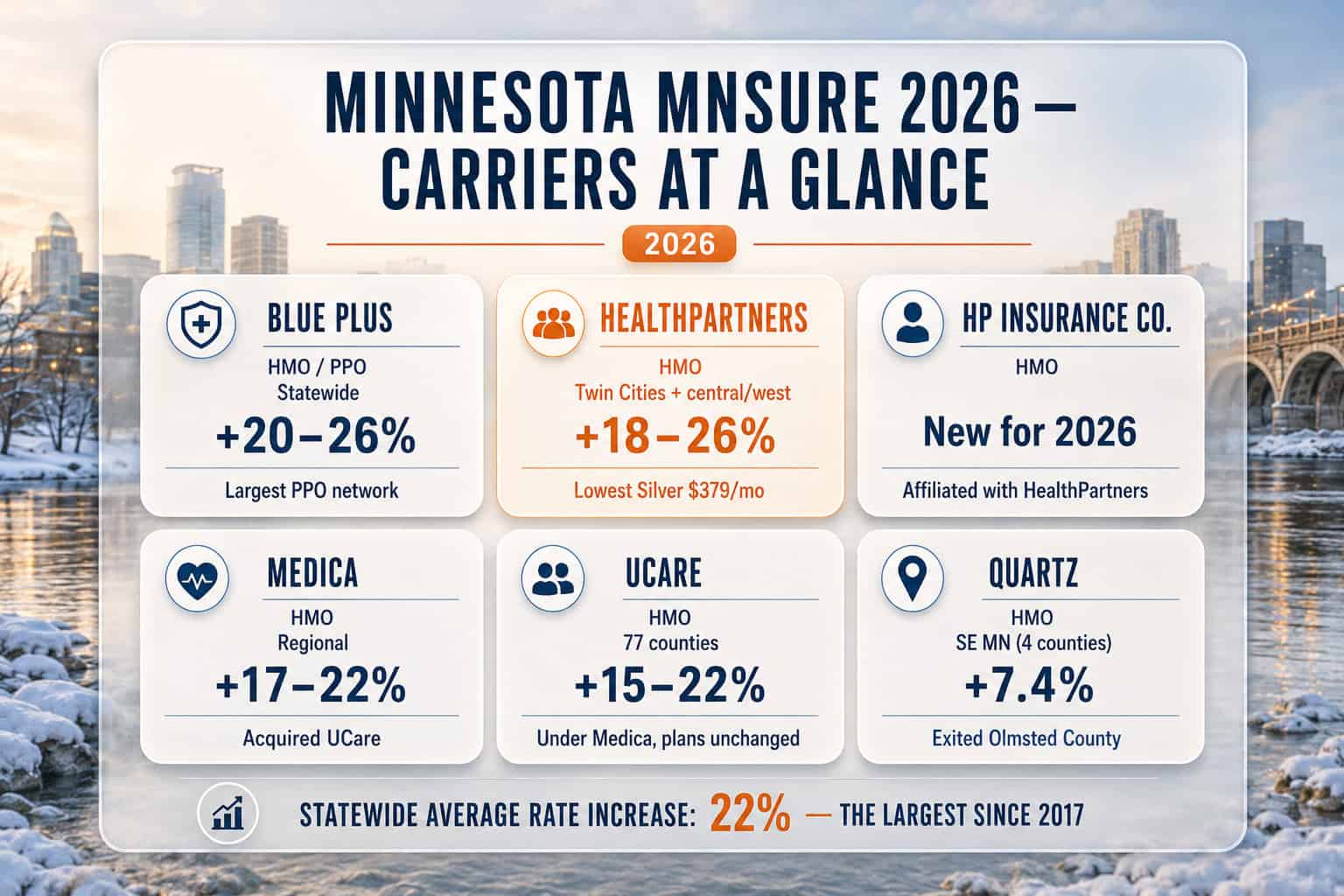
HealthPartners offers the lowest Silver premiums on MNsure at approximately $379/month for a 40-year-old — and operates an integrated care system with its own clinics and hospitals. The Alpine network, HealthPartners’ broadest individual plan network, includes 87,000+ providers across HealthPartners, Park Nicollet, Allina Health, CentraCare, M Health Fairview, Essentia Health, and Sanford Health — covering the Twin Cities, St. Cloud, Duluth, Albert Lea, and central/western Minnesota.
Blue Plus (Blue Cross Blue Shield of Minnesota’s marketplace entity) is the only carrier offering PPO-style flexibility on MNsure, with networks that include Allina Health and M Health Fairview. UCare, despite the December 2025 Medica acquisition, continues operating under its own name for 2026 with unchanged benefits, networks, and premiums — covering 77 of Minnesota’s 87 counties with one of the broadest HMO networks available. Quartz posted the smallest rate increase at 7.4% but serves only four counties in southeastern Minnesota and exited Olmsted County (Rochester) for 2026. The carrier comparison guide evaluates each carrier’s network, pricing, and ratings in detail.
All Bronze plans are HSA-eligible for 2026: For the first time, every Bronze plan sold through the Minnesota health insurance marketplace qualifies for use with a Health Savings Account. In prior years, consumers had to enroll in a specifically designated high-deductible health plan to use an HSA — and many Bronze plans didn’t qualify. This change simplifies HSA pairing for cost-conscious enrollees choosing Bronze coverage on MNsure.
How to Enroll on MNsure
Enrollment on the Minnesota health insurance marketplace follows a streamlined process: create an MNsure account, complete a single application that determines eligibility for Medical Assistance, MinnesotaCare, or private plans with subsidies, compare plans using the Shop and Compare tool, and select a plan and pay your first premium. Open enrollment for 2026 ran November 1, 2025 through January 15, 2026. Plans selected by December 15 began January 1; plans selected by January 15 began February 1.
Visit MNsure.org and create an account. You’ll need Social Security numbers, income information, and employer details for household members. MNsure’s single application determines which program you qualify for — you don’t need to know in advance whether you’re eligible for Medical Assistance, MinnesotaCare, or marketplace plans.
MNsure routes you to the right program based on income: Medical Assistance for those under 138% FPL ($21,597 individual), MinnesotaCare for 138–200% FPL ($21,597–$30,120), or marketplace plans with premium tax credits for those above 200% FPL. If you qualify for APTC, the application shows your estimated monthly subsidy amount before you start shopping.
MNsure’s Shop and Compare tool displays all available plans in your county with after-subsidy premiums. For 2026, all Bronze plans are HSA-eligible — new this year. In the Twin Cities metro you’ll see plans from all six carriers; in rural counties you may see two or three. Compare on premium, network, and whether your doctors are in-network. A record 87% of returning enrollees switched plans during the 2026 enrollment — most moving to lower-cost options.
After selecting, pay your first month’s premium to activate coverage. A record number of Minnesotans contacted MNsure for enrollment help in 2026 — free assistance is available from certified navigators and brokers statewide. Call MNsure at 855-366-7873 for help choosing the right plan.
Enrollment changes coming for 2027: Starting in fall 2026, open enrollment will end December 31 (not January 15) under new federal rules — all plans will take effect January 1. Starting in 2028, automatic reenrollment will be eliminated for enrollees receiving tax credits, meaning you’ll need to actively confirm eligibility each year to maintain subsidies.
Shop MNsure Plans for Your Area
With HealthPartners Silver at $379/month and six carriers competing in the Twin Cities, comparing all options on the Minnesota health insurance marketplace is the best way to find affordable 2026 coverage. Check your subsidy eligibility and see after-subsidy pricing.
Financial Assistance on the Minnesota Marketplace
Financial assistance on the Minnesota health insurance marketplace works differently from most states: residents under 200% FPL are covered by MinnesotaCare, not marketplace subsidies, so premium tax credits on MNsure apply only to households between 200% and 400% FPL — roughly $30,120 to $60,240 for an individual in 2026. Among MNsure enrollees, 46% receive APTC averaging $360/month. Cost-sharing reductions reach only 9.6% of enrollees — far below the national 50%+ — because MinnesotaCare absorbs that population.
The expiration of Enhanced Premium Tax Credits at the end of 2025 reduced financial assistance for approximately 90,000 Minnesotans. Those earning above roughly $62,000/year ($84,000 for a couple) no longer qualify for any tax credit. For those still eligible, the standard ACA subsidy structure caps premium contributions as a percentage of household income — but at higher percentages than during the EPTC era. MNsure estimates eligible families still save an average of $600/month through the marketplace, but the number of eligible families has shrunk significantly.
| Income (Individual) | % of FPL | Program | Estimated Monthly Cost |
|---|---|---|---|
| Under $21,597 | Under 138% | Medical Assistance (Medicaid) | $0 |
| $21,597–$30,120 | 138%–200% | MinnesotaCare (BHP) | $0–$80/month |
| $30,120–$45,180 | 200%–300% | MNsure with APTC | ~$140–$345/month after subsidies |
| $45,180–$60,240 | 300%–400% | MNsure with APTC (reduced) | ~$345–$505/month after subsidies |
| Over $60,240 | Over 400% | MNsure — full price (no subsidy) | ~$379–$800+/month depending on tier |
MinnesotaCare enrollment is year-round and handled through the same MNsure application. Approximately 105,000 Minnesotans are currently enrolled in MinnesotaCare, which offers comprehensive coverage at $0–$80/month. Residents whose income fluctuates between MinnesotaCare and marketplace eligibility — common among seasonal workers, freelancers, and gig economy workers — can transition between programs through MNsure without a gap in coverage. Self-employed Minnesotans and those running a small company may also weigh group coverage or an ICHRA against a marketplace plan; the Minnesota small business health insurance guide compares those employer pathways. The affordable coverage guide covers MinnesotaCare eligibility thresholds and the transition process in detail.
Special Enrollment Periods on MNsure
Outside of open enrollment, Minnesota residents can enroll on MNsure through a special enrollment period triggered by a qualifying life event — including losing other health coverage, getting married, having a baby, moving to a new county, or losing Medical Assistance or MinnesotaCare eligibility. Special enrollment periods typically last 60 days from the qualifying event. Native Americans can enroll in or change MNsure plans at any time without a qualifying event.
MNsure recognizes the same qualifying life events that the federal marketplace uses; the federal special enrollment period list details which events qualify and the documentation each requires. The Medical Assistance and MinnesotaCare transition pathway is particularly important in Minnesota’s marketplace. As Medicaid redeterminations continue and the One Big Beautiful Bill Act introduces new eligibility changes starting in fall 2026, more Minnesotans may lose Medical Assistance or MinnesotaCare coverage and need to transition to MNsure private plans. The CMS marketplace oversight resources explain how state-based exchanges like MNsure operate under federal rules. During the post-pandemic Medicaid unwinding, approximately 12,500 Minnesotans successfully selected MNsure private plans out of roughly 39,500 determined QHP-eligible — a 30% uptake rate that MNsure has worked to improve through targeted outreach.
Example: Seasonal Worker in St. Louis County
A 35-year-old resort worker near Ely earns approximately $18,000 during the off-season (October–April) and $40,000 during the summer tourist season (May–September). During low-income months, he qualifies for MinnesotaCare at $0–$40/month. When summer income pushes him above 200% FPL, he transitions to an MNsure private plan — a HealthPartners Silver through the Alpine network at approximately $170/month after a subsidy of roughly $210/month. MNsure handles this transition through the same application, and the qualifying event (income change) triggers a special enrollment period automatically.
What Changed on MNsure for 2026
The 2026 plan year brought the most significant changes to the Minnesota health insurance marketplace since its launch: a 22% average premium increase, the expiration of Enhanced Premium Tax Credits, UCare’s court-ordered rehabilitation and acquisition by Medica, HealthPartners Insurance Company entering as a new entity, Quartz exiting Olmsted County, the elimination of catastrophic plans, and all Bronze plans becoming HSA-eligible. MNsure enrollment dropped 8% to 139,251 private plan enrollees.
The consumer behavior shift was dramatic. MNsure reported an 87% increase in plan switching — the vast majority of switchers moved to lower-cost plans. Plan cancellations rose 50% year-over-year, and the trend toward “buying down” (choosing a cheaper tier or carrier) increased 112% compared to 2025. For enrollees who lost enhanced subsidy eligibility, the average premium increase was $177/month. Despite record outreach by MNsure’s navigator and broker network, affordability pressures drove the 8% enrollment decline — the first significant drop since the marketplace launched.
The elimination of catastrophic plans on MNsure means all existing catastrophic enrollees were automatically moved to Bronze plans offered by their current carrier. Combined with the new HSA eligibility for all Bronze plans, this creates a cleaner Bronze tier for 2026 — every Bronze plan on MNsure now works with a Health Savings Account, and no lower-tier option exists below Bronze. The MNsure enrollment guide details how each change affects plan selection.
UCare acquisition — what it means for enrollees: On December 17, 2025, UCare was placed into court-ordered rehabilitation due to financial difficulties. Medica acquired UCare’s individual and family plans. For 2026, UCare plans continue under the UCare name with the same benefits, networks, and premiums. No action is required from current UCare enrollees — the transition is administrative only.
Frequently Asked Questions About the Minnesota Health Insurance Marketplace
What is MNsure?
MNsure is Minnesota’s state-based health insurance marketplace, launched in 2013 under the Affordable Care Act. It serves as a single portal for three coverage programs: private marketplace plans with premium tax credits, MinnesotaCare (the state’s Basic Health Program for incomes between 138–200% FPL), and Medical Assistance (Medicaid for incomes under 138% FPL). MNsure is the only place to access federal financial help for private plan premiums in Minnesota. For 2026, 139,251 Minnesotans enrolled in private plans through MNsure.
When is open enrollment on MNsure?
Open enrollment on MNsure runs from November 1 through January 15 each year. Plans selected by December 15 begin January 1, and plans selected by January 15 begin February 1. Starting with the 2027 plan year, a new federal rule will end open enrollment on December 31 — the January 15 deadline will be eliminated. Outside of open enrollment, qualifying life events trigger a 60-day special enrollment period. MinnesotaCare and Medical Assistance enrollment is year-round.
How many carriers are on MNsure for 2026?
Six carriers offer individual plans through MNsure for 2026: Blue Plus (BCBS Minnesota), HealthPartners, HealthPartners Insurance Company (new for 2026), Medica, UCare (now under Medica), and Quartz (southeastern Minnesota only, 4 counties). Most Minnesotans can choose from at least three carriers. Twin Cities metro residents have access to all six. HealthPartners offers the lowest Silver premiums at $379/month for a 40-year-old.
What is MinnesotaCare and who qualifies?
MinnesotaCare is Minnesota’s Basic Health Program — one of only two in the nation (New York’s Essential Plan is the other). It covers residents earning between 138% and 200% of the Federal Poverty Level ($21,597–$30,120 for an individual in 2026) with comprehensive benefits at $0–$80/month. Approximately 105,000 Minnesotans are enrolled. MinnesotaCare enrollment is year-round through MNsure — no open enrollment restriction. Because MinnesotaCare covers this income group, MNsure’s private plan enrollment skews higher-income than the national marketplace average.
Can I still get subsidies on MNsure in 2026?
Yes — 46% of MNsure private plan enrollees receive premium tax credits in 2026, averaging $360/month, and eligible families save an average of $600/month. However, Enhanced Premium Tax Credits expired at the end of 2025, which means Minnesotans earning above approximately $62,000/year ($84,000 for a couple) no longer qualify for any subsidy. Standard ACA credits remain available for incomes between 200% and 400% FPL ($30,120–$60,240 for an individual). Note that Minnesota’s subsidy floor is 200% FPL, not 100%, because MinnesotaCare covers the 138–200% FPL population.
What happened to UCare?
On December 17, 2025, UCare was placed into court-ordered rehabilitation due to financial difficulties. Medica acquired UCare’s individual and family plans. If you’re enrolled in a UCare plan for 2026, your coverage continues unchanged — same benefits, network, premiums, and plan name. UCare covered 77 Minnesota counties with one of the broadest HMO networks on MNsure. The acquisition does not require action from enrollees.
Related Minnesota Health Insurance Resources
Explore related guides covering Minnesota health insurance across the state, low-cost coverage and MNsure subsidy strategies, carrier rankings by cost and network, and PPO plan options offering out-of-network flexibility.
Plans, carriers, costs, and enrollment across the state.
Affordable Plans & SavingsLow-cost options, MNsure subsidies, and ways to cut premiums.
Best Health Insurance in MinnesotaTop carriers ranked by cost, network, and member satisfaction.
PPO Health InsuranceOut-of-network flexibility and broader provider access.
Enroll Through Minnesota’s MNsure Marketplace
Six carriers, MinnesotaCare for low-income households, and the MPSP reinsurance program keeping premiums 25% lower — MNsure is where Minnesotans find coverage. Compare 2026 plans for your county and check your eligibility for financial assistance.
Broker Disclosure
ForHealthInsurance.com is an independent health insurance agency serving Minnesota residents. We are not affiliated with any carrier or government agency. We help you compare plans and enroll in coverage that meets your needs at no extra cost to you.