Affordable Health Insurance Utah 2026: Cost Guide
Affordable health insurance in Utah for 2026 sits in a more favorable position than most Mountain West states. Utah’s 14.2% weighted average rate increase is moderate compared to states like Tennessee (37.5%) or Colorado where federal CMS review alone applied — the Utah Insurance Department’s effective state rate review process kept increases closer to medical inflation. Combined with full Medicaid expansion (in effect since January 2020 via Proposition 3), this means Utah has one of the cleaner affordability landscapes among non-state-exchange-using states. Adults ages 19-64 with incomes up to 138% of FPL qualify for Utah Medicaid; those between 138% and 400% qualify for marketplace subsidies on HealthCare.gov. Full-price benchmark Silver plans run $684-$794 per month for a 40-year-old non-tobacco user across the six remaining carriers (Imperial, SelectHealth, Regence BCBS, BridgeSpan, UofU Health Plans, and Molina in two southwest counties). About 77% of Utah marketplace enrollees still qualify for Advance Premium Tax Credits. The harder news: the 400% FPL cliff returned for 2026 with the ARP enhanced subsidies expiring December 31, 2025 — meaning above-subsidy households face the full 14.2% rate increase with no federal assistance. This guide covers actual 2026 costs across all six Utah carriers, subsidy maximization strategies for households above the Medicaid floor at 138% FPL, when each metal tier is the right call, and when off-exchange Regence BCBS PPO produces better value than the marketplace for above-cliff households.

What brings you here today?
What Utah Coverage Actually Costs in 2026
Affordable health insurance Utah pricing in 2026 starts at about $513 per month for a Bronze plan and runs to about $856 per month for Gold for a 40-year-old non-tobacco user before subsidies. Imperial Health Plan posts the lowest statewide Silver at around $684/mo. After APTC, subsidy-eligible Utahns pay substantially less. The moderate 14.2% rate increase makes Utah more affordable than states facing 30%+ increases like Tennessee.
Bronze plans
$513–$640/moFull-price benchmark for a 40-year-old non-tobacco user. Lowest premium, highest deductible ($5,000–$8,000 typical). Imperial Health Plan typically posts the lowest Bronze premium in Utah at $513/mo. Many SelectHealth and BridgeSpan Bronze plans are HSA-eligible. Best for Utah households above 250% of FPL who don’t expect heavy medical use.
Silver plans (full price)
$684–$794/moFull-price benchmark for a 40-year-old non-tobacco user. The benchmark tier — APTC is calculated against the second-cheapest Silver plan in your county. Eligible for Cost-Sharing Reductions up to 250% of FPL. Imperial runs lowest at $684; BridgeSpan around $794 with $3,100 deductible. SelectHealth and Regence BCBS Silver typically fall in the $720-$780 range.
Gold plans
$766–$856/moFull-price benchmark for a 40-year-old non-tobacco user. Higher premium, lower deductible ($1,300–$3,200 typical). Imperial Gold around $766 with $1,125 deductible; BridgeSpan Gold around $856 with $1,500 deductible. SelectHealth Select Gold 1500 offers no deductible for office visits. Platinum tier is generally not available on the Utah marketplace for 2026.
Subsidy-eligible average
~$455/mo subsidyAverage APTC for the 77% of Utah marketplace enrollees who qualified for premium tax credits in 2026. After subsidy, many subsidy-eligible Utahns pay between $50 and $300 per month depending on income, age, and plan choice. Utah’s 138% Medicaid expansion floor means no coverage gap exists below the marketplace subsidy threshold — different from non-expansion states.
The Utah 2026 cost story is dominated by what didn’t happen: a massive rate increase. The +14.2% weighted average is moderate by national standards thanks to the Utah Insurance Department’s effective state rate review process — substantially smaller than the +37.5% Tennessee absorbed under federal CMS-only review. This is what makes affordable health insurance Utah shoppers find more attainable than buyers in many other states. Utah’s increase was uneven across carriers: SelectHealth approved approximately +12.8% (with about 278,000 affected members), BridgeSpan approximately +16.0%, University of Utah Health Plans +17.6% on continuing plans, and Molina +31.6% in its sharply contracted service area. This carrier variation matters less in Utah than in many states because SelectHealth — the dominant carrier — absorbed one of the smaller rate increases. Premiums vary further by age (a 60-year-old pays roughly 3× what a 21-year-old pays under federal age-rating rules), tobacco use (carriers can charge tobacco users up to 50% more in Utah), and county.
What’s not visible in the headline numbers: the 2025 expiration of enhanced American Rescue Plan subsidies meaningfully changed the affordability picture for many Utah households. From 2021 through 2025, ARP enhancements capped marketplace premiums at 8.5% of household income for everyone — meaning even households above 400% of FPL received some federal assistance. That enhancement expired December 31, 2025. For 2026, the 400% FPL subsidy cliff returned to its pre-ARP form: above the threshold, no federal subsidy applies, and full-price premiums (now 14.2% higher than in 2025) kick in. The cliff effect is real in Utah but less severe than in states with larger underlying rate increases — the dollar gap between just-below-cliff and just-above-cliff households is smaller in Utah than in Tennessee or Colorado.
The Utah marketplace uses two federal subsidies — Advance Premium Tax Credits and Cost-Sharing Reductions — calculated against your projected 2027 household income. APTC reduces your monthly premium directly. CSR is available only on Silver plans for households up to 250% of FPL. Both are calculated automatically by HealthCare.gov. Utah’s 138% FPL floor (Medicaid expansion threshold) differs from non-expansion states’ 100% threshold and creates no coverage gap.
Utah’s subsidy structure is built around the federal poverty level published by HHS, but with a Utah-specific lower bound at 138% of FPL because of the state’s Medicaid expansion (effective January 2020 via Proposition 3). Below 138% of FPL, Utahns are routed to Medicaid through the Utah Department of Health and Human Services rather than seeing marketplace plans — meaning affordable health insurance Utah’s lowest-income residents get is free Medicaid rather than subsidized marketplace coverage. This eliminates the coverage gap that exists in non-expansion states like Tennessee, Texas, Florida, and Georgia, where households below 100% of FPL who don’t fit limited categorical Medicaid have no affordable coverage path. For 2026 marketplace coverage, the relevant FPL thresholds applicable to Utah are: 138% of FPL is approximately $21,597 for a single adult and $44,367 for a family of four (the lower bound for marketplace subsidy eligibility); 250% of FPL is approximately $39,125 single and $80,375 family of four (the upper bound for CSR); 400% of FPL is approximately $62,600 single and $128,600 family of four (the upper bound for APTC after ARP expired).
| 2026 Income Range | Single Adult | Family of 4 | What You Get |
|---|---|---|---|
| Below 138% FPL | < $21,597 | < $44,367 | Utah Medicaid (expanded since Jan 2020) |
| 138%–150% FPL | $21,597–$23,475 | $44,367–$48,225 | APTC + 94% AV Silver (CSR maximum) |
| 150%–200% FPL | $23,475–$31,300 | $48,225–$64,300 | APTC + 87% AV Silver (CSR strong) |
| 200%–250% FPL | $31,300–$39,125 | $64,300–$80,375 | APTC + 73% AV Silver (CSR limited) |
| 250%–400% FPL | $39,125–$62,600 | $80,375–$128,600 | APTC only (no CSR) |
| Above 400% FPL | > $62,600 | > $128,600 | No subsidy — cliff returned in 2026 |
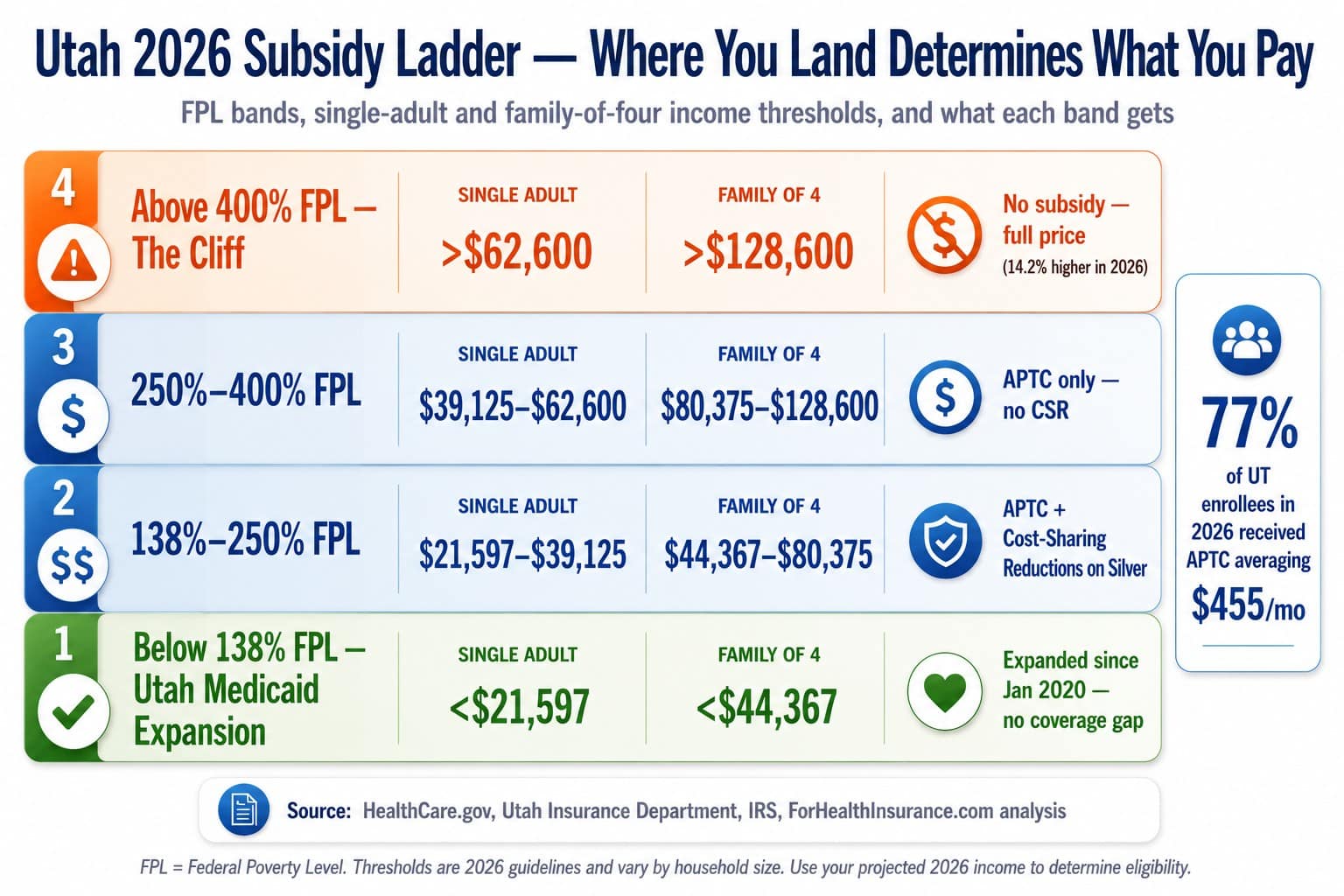
Utah’s Medicaid expansion eliminates the coverage gap that exists in non-expansion states
Utah voters approved Proposition 3 in 2018, with full Medicaid expansion taking effect January 1, 2020. Adults ages 19-64 with incomes up to 138% of FPL qualify for Utah Medicaid coverage administered by the Utah Department of Health and Human Services. This is structurally different from non-expansion states like Tennessee, Texas, Florida, Mississippi, Alabama, Georgia, and South Carolina, where 100,000-150,000+ residents per state fall into the coverage gap below 100% of FPL with no Medicaid pathway and no marketplace subsidies. In Utah, every adult below 138% of FPL has a coverage path — eliminating the affordability dead zone that defines individual market dynamics in non-expansion states. The Utah Department of Health and Human Services administers expanded Medicaid year-round with rolling eligibility, separate from the marketplace’s open enrollment cycle.
Five Strategies to Lower Your Utah Premium
Five strategies typically lower the cost of affordable health insurance Utah residents pay: maximize APTC by accurately projecting income above the 138% Medicaid floor, pick Silver if you qualify for CSR, choose Bronze for low expected medical use above 250% FPL, contribute to an HSA-eligible plan, and shop off-exchange Regence BCBS PPO if above the 400% FPL cliff. Each strategy works for a different income band.
Finding affordable health insurance Utah residents can actually use comes down to matching the right strategy to the right income band — and Utah’s specific market structure shapes which strategy applies. Unlike non-expansion states, Utah’s 138% FPL Medicaid floor means subsidy-eligible individual marketplace shoppers all earn at least $21,597 single or $44,367 family of four; below that, Utah Medicaid is the answer rather than the marketplace. Unlike states without effective state rate review, Utah Insurance Department’s review process kept the 2026 weighted increase at +14.2% — moderate enough that traditional subsidy strategies (Silver+CSR, accurate income projection) still produce strong outcomes without needing aggressive off-exchange shopping. Unlike states without a Platinum tier offering, Utah’s Bronze-Silver-Gold-only marketplace narrows the highest-AV decision space — Utahns expecting heavy medical use compare Gold from SelectHealth, Regence, and BridgeSpan rather than Platinum. The five strategies below reflect these Utah-specific dynamics.
Project your 2027 income accurately above the 138% Medicaid floor
APTC is calculated against your projected 2027 household Modified Adjusted Gross Income, and accurate projection is the foundation of affordable health insurance Utah shoppers can actually afford. For Utahns near the 138% FPL boundary, accurate projection determines whether you go to Utah Medicaid (free) or the marketplace (subsidized). Under-projecting income means HealthCare.gov gives you a larger monthly subsidy than you actually qualify for — the IRS reconciles at tax time and you owe back the overpayment. For Utahns whose income fluctuates — Silicon Slopes contract workers, outdoor recreation industry guides in Park City and Moab, real estate agents, freelance creative workers in Salt Lake City — estimate annual MAGI realistically.
Pick Silver if you qualify for CSR (138%–250% FPL)
Cost-Sharing Reductions are the most undervalued benefit in the Utah marketplace and the single highest-leverage pathway to affordable health insurance Utah subsidy-eligible buyers can access. A Silver plan with CSR at 94% AV (for households at 138%–150% FPL) outperforms a standard Gold plan on actuarial value while costing less per month after APTC. Utahns in this income band who pick Bronze instead — chasing the lowest monthly premium — almost always come out worse on total annual cost when medical events occur. CSR is automatic on Silver plans and only on Silver plans. Switching from Bronze to Silver with CSR is the single highest-leverage adjustment most subsidized Utahns can make.
Choose Bronze if above 250% FPL with low expected use
Above 250% of FPL, CSR no longer applies, and Silver loses its primary advantage over Bronze. For Utahns in their 30s and 40s with no chronic conditions and a strong cash position to absorb the higher Bronze deductible, Bronze produces real annual savings. The premium gap between Silver and Bronze for a 40-year-old in Utah is typically $130–$220 per month — about $1,560–$2,640 per year. Imperial Health Plan typically posts the lowest Bronze premiums at around $513/mo. Many SelectHealth and BridgeSpan Bronze plans qualify for HSA-eligible designs.
Use an HSA-eligible plan to reduce taxable income
Many SelectHealth Bronze and BridgeSpan HDHP plans are HSA-eligible for 2026 — turning an HSA strategy into another path toward affordable health insurance Utah high-deductible plan buyers can leverage at tax time. HSA contributions are tax-deductible (federal — Utah has state income tax at 4.65%, so HSA contributions also reduce Utah state taxable income), grow tax-free, and are tax-free when used for qualified medical expenses. The 2026 HSA contribution limit is $4,300 self-only, $8,550 family. For Utahns in the 22%–32% federal marginal tax bracket plus 4.65% Utah state, an HSA contribution of $4,300 reduces total tax by approximately $1,146-$1,576.
Shop off-exchange Regence BCBS PPO if above 400% FPL
Above the 400% FPL subsidy cliff, on-exchange and off-exchange compete on full-price terms — and after Utah’s 14.2% on-exchange rate increase, off-exchange Regence BCBS PPO often wins on both price and network, becoming the practical answer to affordable health insurance Utah above-cliff buyers should evaluate first. Regence BlueCross BlueShield of Utah off-exchange PPO plans frequently offer broader provider networks, BlueCard national reciprocity, and more flexible plan designs. Off-exchange Regence PPO premiums for a 40-year-old in 2026 typically run $580 to $810 per month, comparable to or slightly below full-price on-exchange Silver.
Calculate Your Utah Subsidy
Utah’s expanded Medicaid floor at 138% of FPL changes the math for lower-income households before subsidies even enter the picture. A licensed Utah agent checks that floor first, then runs APTC and CSR across SelectHealth, Regence, BridgeSpan, University of Utah Health Plans, Molina, and Imperial to find your lowest total annual cost, on-exchange or off.
Real-World Utah Cost Scenarios
Real Utah households experience the 2026 marketplace differently depending on which of the state’s six remaining carriers serve their county and where their income falls relative to Utah’s 138% Medicaid floor and the returned 400% FPL cliff. Four scenarios below — a single adult in Salt Lake City, a Provo family of four, a Park City pre-retiree, and a self-employed Sandy couple above the cliff — show how affordable health insurance Utah residents find depends on metro and carrier mix.
The scenarios below use Utah’s actual 2026 carrier rates, the state’s specific FPL thresholds (Utah’s 138% Medicaid floor, not the non-expansion-state 100%), and Utah-anchored geography — Salt Lake City’s Silicon Slopes tech corridor and dual hospital systems, Provo/Utah County’s Intermountain dominance, Park City’s outdoor recreation and ski industry economy, and Sandy’s affluent Wasatch Front professional class. They demonstrate why affordable health insurance Utah buyers find differs meaningfully from neighboring states like Colorado (which operates a state-based exchange with substantially different rate review) or Nevada (which has its own state-based exchange and different carrier mix). They also show why the path to affordable health insurance Utah subsidy economics differ from non-expansion states like Tennessee, where the coverage gap below 100% FPL distorts entire income-band economics and shifts the lower bound of marketplace eligibility.
Scenario 1: Single 28-year-old in Salt Lake City, $34,000 income (215% FPL)
Eligibility: APTC + Silver CSR at 87% AV (above the 138% Medicaid floor by a comfortable margin).
Best plan: SelectHealth Silver with CSR or Imperial Silver with CSR. Full-price Silver runs about $560-$640 per month for a 28-year-old; APTC reduces premium to roughly $50-$110 per month; CSR drops the deductible from ~$5,500 to ~$2,200. Total expected annual cost (premium + average OOP) is around $2,000-$2,700.
Why not Bronze: Bronze at 28 might run $30-$70 per month after APTC — but the deductible jumps to $7,500+ and there’s no CSR. If a single hospitalization or surgery occurs, Bronze costs $5,000+ more than Silver for this income band.
Scenario 2: Family of four in Provo, $95,000 income (295% FPL)
Eligibility: APTC only — above the CSR threshold of 250% FPL.
Best plan: Depends on care-use pattern. SelectHealth Silver dominates in Utah County given Intermountain Utah Valley Hospital integration. If the family expects routine care only, Bronze runs about $650-$880 per month after APTC for a family of four after the 14.2% rate increase. If anyone in the family has a chronic condition, Gold from SelectHealth or Regence BCBS produces lower total annual cost despite the higher monthly premium. Regence BCBS Silver PPO is the right call if the family travels or has providers across systems.
Key trade-off: $150-$300 per month premium difference between Bronze and Gold compounds to $1,800-$3,600 per year. Whether that pays for itself depends entirely on actual medical use.
Scenario 3: Single 55-year-old in Park City, $52,000 income (332% FPL)
Eligibility: APTC only — above CSR threshold.
Best plan: Regence BlueCross BlueShield of Utah PPO Silver, given Park City’s substantial seasonal multi-state work patterns (ski industry, outdoor recreation, Sundance, real estate). At 55, full-price Silver runs about $1,150-$1,400 per month in Utah after the rate increase; APTC reduces this to roughly $300-$430 per month. Park City residents who travel for work or have providers in Salt Lake County and out-of-state benefit from Regence BCBS BlueCard reciprocity.
Special consideration: Pre-Medicare bridge coverage. At 55, this household is 10 years from Medicare. Choosing a plan with reasonable provider continuity to Medicare-aged providers reduces friction at age 65.
Scenario 4: Self-employed couple in Sandy, $145,000 combined (above 400% FPL cliff)
Eligibility: No APTC — above the cliff facing the full 14.2% rate increase.
Best plan: Off-exchange Regence BCBS PPO. Full-price on-exchange Silver for two 50-year-olds runs about $1,800-$2,200 per month combined after the rate increase. Off-exchange Regence BCBS PPO at the same age runs $1,400-$1,700 per month combined and offers BlueCard national reciprocity, broader networks, and HSA-eligible plan design options. For a self-employed couple at this income level, the HSA contribution alone (up to $8,550 in 2026 for family coverage) reduces federal taxes by $1,800-$2,700 plus Utah state tax savings.
Why not on-exchange: No APTC means on-exchange offers nothing structural that off-exchange doesn’t. Off-exchange Regence BCBS PPO often produces broader networks and better tax-advantaged plan design at lower premiums after the rate increase.
Above the 400% FPL Cliff: When Off-Exchange Regence PPO Wins
Utahns above 400% of FPL — single adults earning more than $62,600 or families of four earning more than $128,600 in 2026 — get zero APTC with the return of the subsidy cliff and face the full 14.2% rate increase. For these above-cliff households, on-exchange and off-exchange compete on full-price terms, and off-exchange Regence BCBS PPO often produces better total value than on-exchange Silver or Gold.
Utah’s above-cliff math is structurally different from non-expansion states because of the carrier mix. Utah’s marketplace is HMO-dominant (SelectHealth, University of Utah Health Plans, BridgeSpan, Molina, Imperial all primarily HMO), making Regence BlueCross BlueShield of Utah the only meaningful PPO option. For above-cliff Utahns who don’t get APTC anyway and who often need network flexibility — Silicon Slopes tech professionals serving multi-state clients, outdoor recreation industry workers splitting time between Utah and out-of-state locations, ski industry seasonal staff, retirees who winter in Arizona or California, regional sales representatives — off-exchange Regence BCBS PPO is frequently the structural answer to affordable health insurance Utah above-cliff buyers most often need to evaluate first. The math is more favorable in Utah than in states with steeper rate increases: Utah’s 14.2% bump produces a smaller premium gap than Tennessee’s 37.5%, but the network-flexibility premium that Regence BlueCard reciprocity provides remains valuable regardless.
The specific dollar math: full-price on-exchange Silver runs $684-$794 per month for a 40-year-old in Utah after the 14.2% rate increase. Off-exchange Regence BCBS PPO at the same age typically runs $580-$810 per month with broader provider networks, BlueCard national reciprocity (in-network access in all 50 states), and access to HSA-eligible plan designs that aren’t always available on-exchange. For households that don’t need APTC anyway, off-exchange often produces better network value at competitive cost — and after the 14.2% rate increase, off-exchange Regence PPO frequently undercuts on-exchange Silver on price for above-cliff households. The price gap is smaller than in states like Tennessee with 37.5% rate increases, but the network-flexibility premium that Regence BlueCard reciprocity provides remains valuable regardless.
For Utahns evaluating off-exchange PPO options nationwide — particularly those who want to compare plans by ZIP code, network footprint, and HSA-eligible designs — off-exchange Regence PPO health insurance plans are available nationwide with quotes by ZIP code and no referral requirements. Compare designs on the Utah health insurance plans page, or the full Utah health insurance guide. Above-cliff Utahns frequently come out ahead off-exchange when they account for network breadth, BlueCard national reciprocity, and HSA tax savings on top of premium — making off-exchange Regence BCBS PPO the practical answer to affordable health insurance Utah above-cliff buyers most often need.
The cliff is asymmetric — under-projecting income matters more above 400% FPL after 2026’s rate increase
For Utahns whose income hovers near the 400% FPL line, accurate income projection matters more than at any point since the ACA started. Under-projecting (estimating 380% of FPL when actual ends up at 410%) means HealthCare.gov gives APTC during the year — and then the IRS recovers the entire annual subsidy at tax time when actual income exceeds the cliff threshold. With Utah’s full-price 2026 premiums up 14.2% versus 2025, the dollar value of recovered APTC is correspondingly larger (though smaller than in states with 30%+ rate increases). Above-cliff households are not protected by the same APTC repayment caps that apply to subsidized households. For self-employed Utahns, Silicon Slopes contract workers, outdoor recreation guides with seasonal income variation, and freelancers in Salt Lake City’s creative economy, projecting conservatively above the cliff and shopping off-exchange Regence BCBS PPO eliminates this tax-time recovery risk entirely.
Frequently Asked Questions
Common questions about affordable health insurance Utah residents shop for in 2026 cover actual costs after the 14.2% rate increase, premium-lowering strategies, the cheapest available plans, off-exchange Regence BCBS PPO economics, and subsidy income thresholds above the Medicaid floor.
How much does affordable health insurance cost in Utah for 2026?
Affordable health insurance Utah residents shop for in 2026 starts at about $513 per month for a Bronze plan and runs to about $856 per month for Gold for a 40-year-old non-tobacco user before subsidies. Imperial Health Plan typically posts the lowest Silver premium statewide at around $684 per month. After Advance Premium Tax Credits, subsidy-eligible Utahns pay substantially less — Utah benefits from the moderate 14.2% rate increase compared to states facing 30%+ increases. About 77% of Utah marketplace enrollees qualified for subsidies in 2026.
How can I lower my Utah health insurance premium?
Five strategies typically lower the cost of affordable health insurance Utah residents pay: maximize APTC by accurately projecting income above Utah’s 138% Medicaid floor, pick Silver if you qualify for Cost-Sharing Reductions (138%-250% FPL), choose Bronze for low expected medical use above 250% FPL with HSA-eligible designs, contribute to a Health Savings Account through an HSA-eligible plan, and shop off-exchange Regence BCBS PPO if above the 400% FPL subsidy cliff. Each strategy works for a different income band and care-use pattern.
What is the cheapest health insurance plan in Utah?
Imperial Health Plan typically posts the lowest on-exchange premiums in Utah for 2026, with Silver around $684 per month for a 40-year-old non-tobacco user (about $91 below the state average) and Bronze around $513 per month. With APTC, the cheapest Silver plan often runs $0 to $200 per month for households at 138%-250% of FPL. However, the cheapest premium is rarely the cheapest total annual cost. For households eligible for Cost-Sharing Reductions (up to 250% of FPL), a Silver plan with CSR almost always produces the lowest combined annual cost.
Are off-exchange PPO plans more affordable in Utah?
Off-exchange Regence BlueCross BlueShield of Utah PPO plans are not eligible for premium tax credits and are not the affordable choice for Utahns below 400% of FPL who would qualify for substantial subsidies on-exchange. Above the 400% FPL subsidy cliff, however, off-exchange PPO becomes more competitive — full-price on-exchange Silver runs about $684 to $794 per month for a 40-year-old after the 14.2% rate increase, while off-exchange Regence BCBS PPO runs $580 to $810 per month with broader networks and BlueCard national reciprocity. For above-cliff households who don’t get APTC anyway, off-exchange Regence PPO often produces better network value at comparable or lower cost.
What income qualifies for marketplace subsidies in Utah?
Utahns with household incomes between 138% and 400% of the federal poverty level qualify for Advance Premium Tax Credits in 2026. Below 138% of FPL, Utahns qualify for expanded Medicaid (in effect since January 2020) rather than marketplace subsidies. For 2026 marketplace coverage, the APTC range is approximately $21,597 to $62,600 for a single adult and $44,367 to $128,600 for a family of four. About 77% of Utah marketplace enrollees received APTC in 2026. Cost-Sharing Reductions on Silver plans are available up to 250% of FPL ($39,125 single, $80,375 family of four).
Get Your Real After-Subsidy UT Quote
Two Utah households at the same income can pay very different totals depending on county, carrier, and whether they clear the Medicaid floor. A licensed Utah agent works your APTC, CSR, and the 138% floor, then prices off-exchange Regence PPO for above-cliff buyers, and gives you the real annual figure for your situation.
Free UT subsidy calculation — covers all six carriers and on-exchange/off-exchange comparison.
Related Utah Health Insurance Resources
Complete UT coverage guide — six carriers, expanded Medicaid, costs, and the 14.2% rate increase.
UT Health Insurance MarketplaceHealthCare.gov enrollment, the shorter 2027 OEP, and the application walkthrough.
UT Health Insurance PlansCarrier comparison, plan tiers, and HMO vs PPO designs.
Utah Small Business Health InsuranceAvenue H, ICHRA, and small group plans for Utah employers up to 50 employees.
Individual Health Insurance UtahSelf-employed, freelance, and private coverage paths in Utah, on-exchange and off-exchange.
HealthCare.gov (Official)Utah’s official federal marketplace enrollment portal.
KFF Subsidy CalculatorEstimate your 2026 APTC amount before applying through HealthCare.gov.
Utah MedicaidExpanded Medicaid coverage applications and eligibility for adults up to 138% FPL.
Broker Disclosure
ForHealthInsurance.com is an independent health insurance agency serving Utah residents. We are not affiliated with any carrier or government agency. We help you compare plans and enroll in coverage that meets your needs at no extra cost to you.