Individual Health Insurance Utah 2026: Self-Employed
Individual health insurance Utah residents shop for in 2026 serves a working-age population shaped by two forces other states do not share in the same combination: Utah expanded Medicaid in 2020, so adults below 138% of the federal poverty level are routed to Medicaid rather than the individual market, and the Silicon Slopes technology corridor between Salt Lake City and Provo generates an unusually large base of self-employed contractors, equity-compensated freelancers, and startup founders who buy their own coverage. Above the 138% Medicaid floor, the individual health insurance Utah carriers sell runs through six companies — SelectHealth, Regence BlueCross BlueShield of Utah, University of Utah Health Plans, BridgeSpan, Molina, and Imperial — after Aetna exited the market at the end of 2025 and Molina contracted to two counties. This guide maps every individual health insurance Utah path for 2026: on-exchange marketplace plans through HealthCare.gov, off-exchange Regence PPO sold directly without subsidies, ICHRA reimbursement through Silicon Slopes and outdoor-recreation employers, and the income and life-event circumstances that route Utahns into each one.

What brings you here today?
Who Buys Individual Health Insurance in Utah
About one in nine working-age Utahns buys individual health insurance Utah carriers offer rather than taking employer coverage. Because expanded Medicaid covers adults below 138% of FPL, the individual market here skews toward self-employed Silicon Slopes contractors, outdoor-recreation and gig workers, early retirees bridging to Medicare, and graduates aging off a parent’s plan at 26.
The shape of the individual health insurance Utah market follows the state’s economy and its 2020 Medicaid expansion. The Silicon Slopes technology corridor running from Lehi and Draper through Provo produces a large population of software contractors, designers, and startup founders who take 1099 income or run single-member LLCs, plus equity-compensated employees between funding events who buy their own coverage during gaps. Utah’s outdoor-recreation industry — guiding, gear, and seasonal tourism work centered on Park City, Moab, and the Cottonwood canyons — generates seasonal and self-employed earners with variable annual income. Real estate agents, financial advisors, and small-business owners across the Wasatch Front round out the self-employed core.
Beyond the self-employed, distinct life-event groups enter the individual market each year. Graduates from the University of Utah, BYU, Utah State, Utah Valley University, and Weber State aging off parental coverage at 26 enroll on their own. Early retirees ages 55 to 64 who leave employer plans before Medicare need bridge coverage. Utahns displaced by Aetna’s 2025 market exit or Molina’s service-area contraction re-enter through Special Enrollment Periods. And employees of small Utah businesses under 50 FTE that do not sponsor benefits buy individual coverage as the practical alternative, sometimes funded through an employer ICHRA.
Utah’s expanded Medicaid reshapes the bottom of the individual market
In non-expansion states, adults between 100% and 138% of FPL buy individual marketplace plans because they have no Medicaid pathway. Utah expanded Medicaid in 2020, so that band is covered by Medicaid instead, and the individual health insurance Utah market effectively begins at 138% of FPL. The practical effect is a cleaner subsidy story than non-expansion states: there is no coverage gap below 100% of FPL in Utah, and the lowest-income individual shoppers are generally those whose income fluctuates across the 138% line — common among Park City seasonal workers and commission-based Silicon Slopes contractors — who may move between Medicaid and subsidized marketplace coverage within a single year.
Three Coverage Paths for Utah Individual Buyers
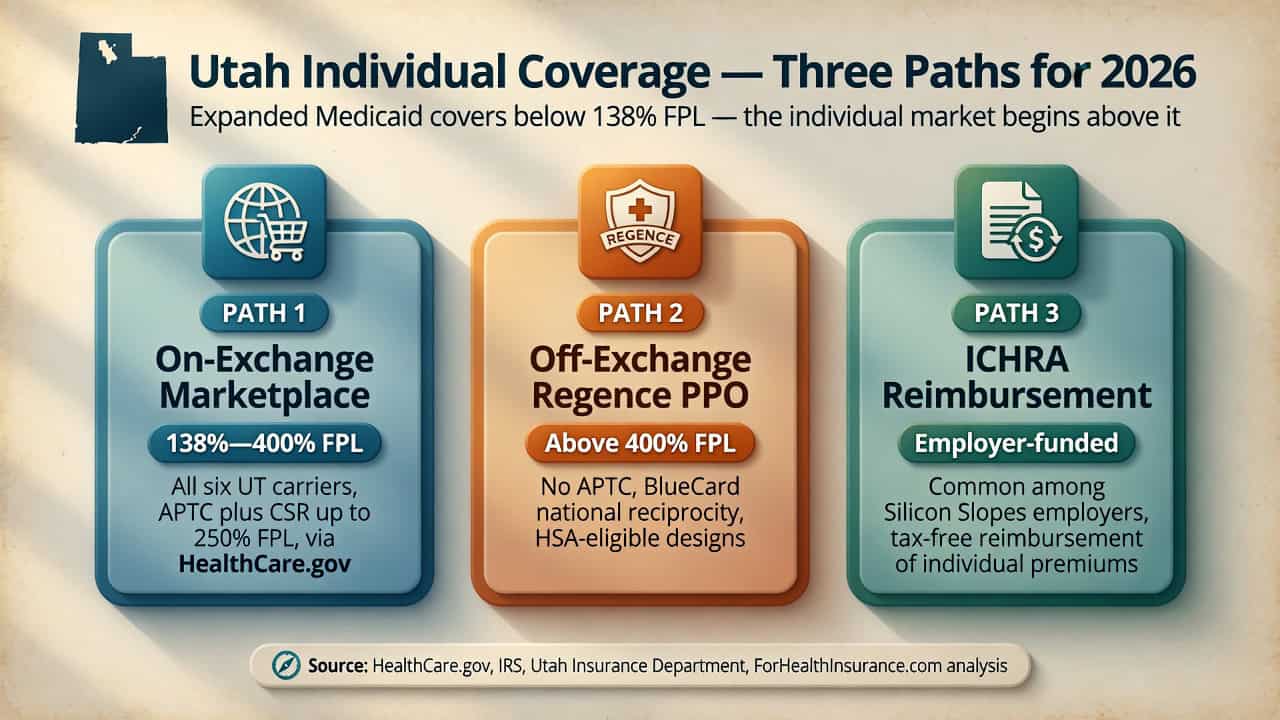
Utah individual buyers route through one of three 2026 paths: on-exchange marketplace plans on HealthCare.gov for households between the 138% Medicaid floor and 400% of FPL who qualify for APTC, off-exchange Regence PPO sold directly for above-cliff buyers or specific designs, or ICHRA reimbursement when a Silicon Slopes or other Utah employer funds individual coverage.
On-exchange marketplace via HealthCare.gov
The default path for most Utah individual buyers above the Medicaid floor. Plans from all six carriers — SelectHealth, Regence, University of Utah Health Plans, BridgeSpan, Molina, and Imperial — are sold with APTC subsidies, and Cost-Sharing Reductions apply on Silver up to 250% of FPL. Open enrollment for 2027 runs November 1 through December 15, 2026.
- All six UT carriers available
- APTC for 138%—400% FPL
- CSR on Silver up to 250% FPL
- 2027 OEP: Nov 1 — Dec 15, 2026
Off-exchange Regence PPO direct
Sold directly by Regence BlueCross BlueShield of Utah without going through HealthCare.gov, and never eligible for APTC. The right path for Utahns above the 400% cliff and for those wanting HSA-eligible PPO designs or the broad statewide network and BlueCard national reciprocity that matter to Silicon Slopes travelers and outdoor-recreation workers crossing state lines.
- Regence PPO, broad statewide network
- BlueCard national reciprocity
- HSA-eligible high-deductible designs
- No APTC eligibility
ICHRA-funded individual plans
For Utahns whose employer offers an Individual Coverage Health Reimbursement Arrangement instead of a group plan. The employee buys an individual plan and the employer reimburses tax-free up to a set limit. ICHRA adoption is notably high among Silicon Slopes tech employers and outdoor-recreation businesses that previously offered no benefits.
- Buy any individual marketplace plan
- Employer reimburses tax-free
- High Silicon Slopes adoption
- 9.96% affordability test for 2026
The choice among these three paths turns on income, employer status, and design priorities. For Utahns between 138% and 400% of FPL with no employer offer, on-exchange through HealthCare.gov almost always wins on total cost because APTC and CSR are unavailable through any other path. For above-cliff Utahns or those who want Regence PPO breadth and BlueCard reciprocity, off-exchange direct purchase usually produces better network value. For Utahns whose employer funds an ICHRA, buying an individual plan and taking the tax-free reimbursement is the right move. Many Utahns run all three numbers before deciding.
Self-Employed Utah: Tax Strategy and Plan Selection
Self-employed Utahns can deduct individual health insurance premiums above the line on their federal return, which lowers adjusted gross income and, in turn, the very income figure that sets APTC. A licensed agent coordinates the self-employed deduction with subsidy eligibility so a Silicon Slopes contractor does not leave either tax break on the table.
For Utah’s large self-employed population, the federal self-employed health insurance deduction is the single most valuable lever. A Silicon Slopes contractor, a Park City guide running a sole proprietorship, or a Salt Lake real estate agent can deduct individual health insurance premiums above the line on Schedule 1, reducing adjusted gross income dollar for dollar. Because APTC is calculated from a household’s modified adjusted gross income, the deduction and the subsidy interact: lowering AGI through the deduction can increase the APTC a household receives, and the two must be solved together rather than separately. This is circular math — the deduction changes the subsidy, which changes the net premium, which changes the deduction — and it is exactly the calculation a licensed agent and a tax preparer coordinate for self-employed Utahns.
Plan selection for self-employed Utahns also depends on care patterns and network. A healthy 30-something software contractor with sporadic care use often does best in a Bronze or HSA-eligible high-deductible plan, pairing it with a Health Savings Account that delivers a second federal tax deduction on top of the premium deduction. A self-employed Utahn managing a chronic condition usually comes out ahead in Silver or Gold despite the higher premium, because the lower deductible and out-of-pocket maximum cap total annual cost. Network matters too: SelectHealth is anchored on Intermountain Healthcare, University of Utah Health Plans integrates the University of Utah Health system, and Regence PPO offers the broadest statewide and national access for Utahns who travel for client work.
Get Your Utah Individual Coverage Quote
Whether you are a Silicon Slopes contractor, a seasonal guide whose income swings across the Medicaid line, or a couple bridging to Medicare, a licensed Utah agent maps your projected income to Medicaid, APTC, or off-exchange Regence PPO, works in the self-employed deduction, and hands you the lowest-cost individual path. Free, no obligation.
Lost Employer Coverage: SEP, COBRA, and the Marketplace
Losing employer coverage in Utah opens a 60-day Special Enrollment Period on HealthCare.gov, and after the 2025 Aetna exit and Molina contraction, a discontinued plan also counts as a qualifying event. For most Utahns a subsidized marketplace plan beats COBRA, which charges the full premium plus a 2% fee with no access to APTC.
Utahns who lose job-based coverage face a fork: continue the old plan through COBRA, or enroll in an individual marketplace plan during the Special Enrollment Period the loss triggers. COBRA keeps the exact plan and network but charges the entire premium plus a 2% administrative fee with no subsidy, which in Utah typically means $600 to $900 a month for a single adult and far more for a family. A subsidized marketplace plan for a Utahn between 138% and 400% of FPL almost always costs less, because APTC is unavailable to COBRA enrollees. The trade-offs that favor COBRA are narrow: mid-year deductible already met, or a specific Intermountain or University of Utah Health specialist relationship the employer plan covers that a new individual plan would not.
Utah’s 2025 carrier disruption adds a wrinkle. When Aetna left the individual market and Molina pulled back to two counties, displaced enrollees received a discontinuation notice that itself qualifies as loss of coverage, opening a 60-day SEP to pick a new individual health insurance Utah plan rather than accepting an auto-assigned carrier. The 60-day clock runs from the date coverage ends, not from when paperwork is filed, and with the shorter 2027 open enrollment window more Utahns will rely on SEPs in early 2027 than in years when the January 15 deadline absorbed late enrollers.
Above 400% FPL: Off-Exchange Regence PPO and ICHRA Paths
Utahns above 400% of FPL get no APTC, so the comparison is full-price on-exchange Silver versus off-exchange Regence PPO. After the 14.2% rate increase, Regence PPO often wins on total value through broader networks, BlueCard national reciprocity, and HSA-eligible designs, while ICHRA-funded employees may have an employer-reimbursed path that changes the math entirely.
Above the 400% FPL cliff — single income about $62,600, family of four about $128,600 — no subsidy applies, so a Utahn pays full price whether on-exchange or off. That removes the usual reason to stay on HealthCare.gov and makes off-exchange Regence PPO health insurance plans the practical comparison. Off-exchange Regence PPO for a 40-year-old typically runs about $580 to $810 a month in 2026, offers the broadest statewide network plus BlueCard reciprocity in all 50 states, and includes HSA-eligible high-deductible designs that pair with a Health Savings Account for an added federal deduction. For above-cliff self-employed Utahns who also take the premium deduction, that stack of tax advantages often beats a full-price on-exchange Silver plan on total annual cost.
ICHRA changes the picture for Utahns whose employer reimburses individual premiums. Because Silicon Slopes adoption is high, many above-cliff Utah tech workers are not actually paying full freight — an employer ICHRA reimburses the individual plan tax-free, so the effective cost is the premium minus the reimbursement. In those cases the right plan is whichever individual product the employee values most, often a Regence PPO for network breadth, with the ICHRA absorbing much of the premium. A licensed agent confirms the 2026 ICHRA affordability threshold of 9.96% of household income, since an offer above that lets the employee decline and claim APTC instead where eligible.
Utah Individual Coverage: Real Cost Examples
Real Utah individual buyers land very differently by income, age, county, and employment. The four examples below {EM} a Salt Lake software contractor, a Provo recent graduate, a Park City seasonal guide near the Medicaid floor, and a St. George early-retiree couple above the cliff {EM} show how individual health insurance Utah shoppers find varies by household circumstance.
| Utah Individual Buyer | Income / FPL | Best Path | Approx. Monthly Cost |
|---|---|---|---|
| Salt Lake software contractor, age 32 | $62,000 (385% FPL) | On-exchange Silver from SelectHealth or Regence + self-employed deduction | $250—$340/mo after APTC |
| Provo graduate aging off parental at 26 | $34,000 (216% FPL) | On-exchange Silver with CSR from SelectHealth or UofU Health Plans | $50—$120/mo after APTC + CSR |
| Park City seasonal recreation guide, age 38 | $28,000 (174% FPL, variable) | On-exchange Silver with strong CSR; Medicaid in low-income months | $10—$70/mo after APTC + CSR |
| St. George early-retiree couple, ages 61 and 59 | $92,000 combined (above 400% cliff) | Off-exchange Regence PPO (above cliff) | $1,500—$1,950/mo combined |
The Salt Lake contractor scenario captures the largest individual health insurance Utah subgroup: moderate-to-high-income self-employed professionals who benefit from both APTC and the self-employed deduction. At 385% of FPL this contractor qualifies for APTC but not CSR, so Silver from SelectHealth or Regence runs about $250 to $340 a month after subsidy, and the premium deduction trims the effective annual cost by roughly $900 to $1,500 depending on bracket. The Park City guide scenario shows the Medicaid-floor dynamic unique to expansion states like Utah: in strong-earning months the guide is a subsidized marketplace enrollee, but a slow season can drop income below 138% of FPL and shift coverage to Medicaid, so the agent sets up a plan that handles that movement cleanly.
The Provo graduate scenario is the highest-leverage individual health insurance Utah outcome: a 26-year-old at 216% of FPL who picks Silver gets both APTC and CSR, which raises the Silver actuarial value and cuts the deductible sharply, often landing at $50 to $120 a month — sometimes below the employee share of an entry-level employer plan. The St. George couple scenario is the clean above-cliff case: with no subsidy at $92,000 combined, off-exchange Regence PPO at about $1,500 to $1,950 a month combined usually beats a full-price on-exchange Silver while adding BlueCard reciprocity for the travel common among Utah retirees.
Frequently Asked Questions
Who needs individual health insurance in Utah?
Utah residents typically need individual health insurance when they lack employer-sponsored coverage and earn too much for expanded Medicaid. Because Utah expanded Medicaid in 2020, adults below 138% of the federal poverty level are routed to Medicaid rather than the individual market, so the individual health insurance Utah carriers sell mostly serves households above that floor: self-employed Silicon Slopes contractors and tech freelancers, outdoor-recreation and gig workers around Park City and Moab, early retirees ages 55 to 64 bridging to Medicare, recent graduates aging off a parent’s plan at 26, and employees of small Utah businesses that do not offer benefits.
What is the difference between on-exchange and off-exchange individual plans in Utah?
On-exchange plans are sold through HealthCare.gov and qualify for Advance Premium Tax Credits for households between Utah’s 138% expanded-Medicaid floor and 400% of the federal poverty level. Off-exchange plans are sold directly by carriers such as Regence BlueCross BlueShield of Utah without the subsidy pathway. Inside the subsidy range, on-exchange almost always wins on total cost. Above the 400% cliff (single about $62,600, family of four about $128,600), off-exchange Regence PPO often delivers better value through broader networks, BlueCard national reciprocity, and HSA-eligible designs not always sold on HealthCare.gov.
How much does individual health insurance cost in Utah?
Full-price individual coverage in Utah for a 40-year-old non-tobacco user runs roughly $513 to $856 per month in 2026 by metal tier after the 14.2% weighted rate increase: Bronze about $513 to $640, Silver about $684 to $794, and Gold about $766 to $856. After Advance Premium Tax Credits, subsidy-eligible Utahns pay far less. Off-exchange Regence PPO for the same age typically runs about $580 to $810 per month. Costs vary by age, county, tier, tobacco use, and household size.
When can I enroll in individual health insurance in Utah?
Open enrollment for 2027 coverage on HealthCare.gov runs November 1 through December 15, 2026, shorter than prior years after a federal rule change, with coverage effective January 1, 2027. Outside that window a qualifying life event opens a 60-day Special Enrollment Period; qualifying events include losing job-based coverage, an Aetna or Molina plan no longer being offered in your area, marriage, divorce, birth or adoption, moving within or to Utah, and aging off a parent’s plan at 26. Some off-exchange individual plans remain available year-round.
Is individual health insurance more expensive than employer plans in Utah?
Without subsidies, individual coverage in Utah is usually pricier than the employee share of an employer plan, since Utah employers typically pay 70% to 80% of the premium. With Advance Premium Tax Credits, individual marketplace plans are often comparable to or cheaper than employer coverage below 400% of FPL, especially for self-employed Utahns who deduct premiums above the line. Against COBRA after a job loss, individual marketplace coverage almost always wins on cost because COBRA charges the full premium plus a 2% administration fee while marketplace plans can qualify for APTC.
Compare 2026 UT Individual Plans
Bring your income, your providers, and any employer ICHRA offer, and a licensed Utah agent prices all six carriers, applies APTC and CSR, weighs off-exchange Regence PPO for above-cliff buyers, and points you to the lowest-total-cost individual path for your 2027 coverage. Free, no obligation.
Related Utah Health Insurance Resources
Complete UT coverage guide — six carriers, expanded Medicaid, costs, and the 14.2% rate increase.
UT Health Insurance MarketplaceHealthCare.gov enrollment, the shorter 2027 OEP, and the application walkthrough.
UT Health Insurance PlansSelectHealth, Regence, UofU Health Plans, BridgeSpan, Molina, Imperial compared by tier and network.
Affordable Coverage in Utah2026 subsidies, average costs, and strategies to lower your premium after the 14.2% increase.
Utah Small Business Health InsuranceAvenue H, ICHRA, and small group plans for Utah employers up to 50 employees.
HealthCare.gov (Official)Utah’s official federal marketplace enrollment portal for 2027 plans.
IRS Self-Employed Deduction GuideFederal rules for the self-employed health insurance deduction on Schedule 1.
Utah MedicaidExpanded Medicaid eligibility and applications for adults up to 138% of FPL.
Broker Disclosure
ForHealthInsurance.com is an independent health insurance agency serving Utah residents. We are not affiliated with any carrier or government agency. We help you compare plans and enroll in coverage that meets your needs at no extra cost to you.