Small Business Health Insurance: A 2026 Guide for Employers
Offering health coverage is one of the bigger decisions a business owner makes, and most of the guidance out there is written for companies with hundreds of employees. This guide is written for the other end of the market — the shop with four people, the agency with twelve, the contractor who just hired a second crew.
It covers what small business health insurance costs in 2026, which businesses are allowed to buy a group plan, whether coverage is required at all, how employers and employees split the bill, what plan types are available, and when a business can start a plan. Where the rules differ depending on company size, that is spelled out.

What brings you here today?
What Small Business Health Insurance Costs in 2026
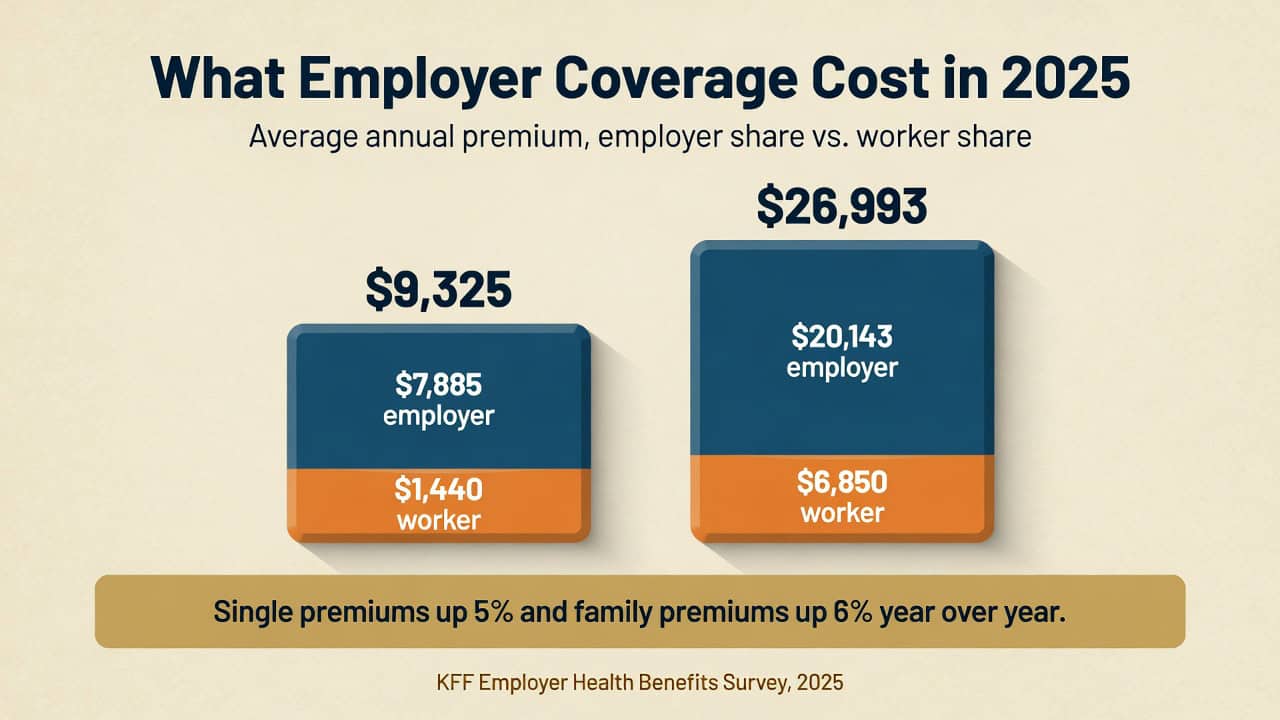
Employer-sponsored coverage, which includes small business health insurance, averaged $9,325 a year for single coverage and $26,993 for family coverage in 2025, according to KFF — roughly $777 and $2,249 per month. Single premiums rose 5 percent and family premiums 6 percent over the prior year, and carriers filed double-digit small-group increases heading into 2026.
Those averages describe the total premium, not what the employer writes on the check. Workers contributed an average of $1,440 toward single coverage and $6,850 toward family coverage in 2025, per the KFF Employer Health Benefits Survey, leaving employers with roughly $7,885 and $20,143 respectively. The split matters more than the headline number when a business is budgeting per head.
Small business health insurance cost varies with the age of the workforce more than most owners expect. Firms where at least 35 percent of workers are 50 or older averaged $9,599 for single coverage against $9,068 at younger firms, and $27,699 against $26,332 for family coverage. A five-person company can see a materially different quote than a five-person company down the street purely on census.
Which Businesses Can Buy a Small Group Plan
Most states define the small group market as employers with 1 to 50 full-time equivalent employees. California, Colorado, New York, and Vermont extend it to 100. A business generally needs at least one enrolled employee who is not the owner or the owner’s spouse, and it must have a genuine employer-employee relationship on payroll.
Full-time equivalent counting is where owners most often miscalculate. Two employees working 15 hours a week count as roughly one FTE, not two. The federal method sums the hours worked by part-time staff across the year and divides by 2,080. A restaurant with eight part-time servers and three full-time cooks may sit closer to 7 FTEs than the 11 people on its roster.
Businesses structured as sole proprietorships with no W-2 employees generally cannot buy small group coverage, and neither can a company whose only enrollees are the owner and spouse. Seasonal workers are excluded from the count when they work fewer than 120 days in the year. Independent contractors issued a 1099 are not employees for this purpose. The full eligibility rules for small business health insurance cover the edge cases in more detail.
Worth checking first
The FTE count that determines small group eligibility and the FTE count that determines the employer mandate use similar but not identical rules. A business near either threshold should run both calculations rather than assuming one answer covers both.
Is a Small Business Required to Offer Health Insurance?
No. The federal employer shared responsibility provision applies only to applicable large employers — those averaging 50 or more full-time equivalent employees in the prior calendar year. Businesses below 50 FTEs face no federal penalty for declining to offer coverage, and roughly 96 percent of U.S. firms sit under that line.
The IRS applicable large employer rules set the threshold using a monthly average across the prior year, so a business that spikes above 50 during a busy quarter is not automatically an ALE. Seasonal worker exceptions apply when the overage lasts 120 days or fewer.
Crossing 50 FTEs changes the obligation substantially. An ALE must offer coverage meeting minimum value to at least 95 percent of full-time employees and their dependents, and that coverage must be affordable under the federal contribution test or the employer faces a penalty assessed per employee per month. A business approaching 45 to 48 FTEs should plan for the threshold rather than discover it at year end, because small business health insurance obligations change materially once it is crossed.
State rules can differ
A handful of states and cities impose their own employer coverage or spending requirements that begin below 50 employees. Federal exemption does not always mean local exemption.
How Employers and Employees Split the Cost
There is no federal minimum employer contribution for small group coverage. Carriers set their own floor, commonly 50 percent of the employee-only premium, and most also require that 70 percent of eligible employees enroll. In practice employers paid about 85 percent of single premiums and 75 percent of family premiums in 2025.
Participation requirements are the quieter of the two rules and the one that derails more applications. Employees with other coverage — a spouse’s plan, Medicare, military coverage — are typically excluded from the participation calculation rather than counted as declines, which helps a small firm clear the threshold. Businesses that cannot meet participation still have a path: most carriers waive both the participation and contribution minimums during a special federal window running November 15 through December 15 each year.
A nine-person landscaping company has six employees eligible for coverage. Two are on a spouse’s plan and are set aside from the calculation, leaving four. Three enroll. Participation is measured at 3 of 4, or 75 percent — above a typical 70 percent requirement. The company qualifies even though only a third of its total headcount enrolled.
Employers are free to contribute more than the carrier minimum, and many use contribution level as a recruiting lever. There is no requirement to contribute anything toward dependent or family tiers, which is why the family premium gap between employer and worker share is wider than the single-coverage gap in most small business health insurance arrangements.
See What Coverage Would Cost Your Business
Enter your employee count and compare plan options and pricing side by side. No obligation, and licensed agents are available to walk through the numbers.
Plan Types Small Employers Choose
PPO plans remained the most common design in 2025, covering 46 percent of workers with employer coverage, followed by high-deductible plans with a savings option at 33 percent. Deductibles run considerably higher at small firms: workers at companies under 200 employees averaged $2,631 for single coverage against $1,670 at larger firms.
The deductible gap is the defining difference between small and large employer coverage. More than half of covered workers at small firms — 53 percent — faced a single deductible of at least $2,000 in 2025, and 36 percent faced at least $3,000. Roughly 72 percent had an out-of-pocket maximum above $3,000, with one in five above $6,000.
Network breadth is usually the deciding factor for businesses with employees spread across a region or working remotely in multiple states. A plan built on a narrow local network can price attractively and still fail a workforce that does not all live near the same hospital system, which is why network breadth deserves as much attention as premium when comparing small business health insurance options.
Fully Insured Compared With Level-Funded Coverage
A fully insured plan charges a fixed monthly premium and the carrier carries all claims risk. A level-funded plan charges a steady monthly amount split between claims funding and stop-loss protection, with a possible refund if claims run below projection. About 27 percent of covered workers at small firms were in self-funded arrangements in 2025.
Level-funded designs have moved down-market considerably, and carriers now write them for groups as small as five employees. The appeal is the refund mechanism and monthly claims reporting that fully insured plans do not provide. The trade-off is variability: a group with a bad claims year receives no refund, and renewal pricing responds to that group’s own experience rather than a broad community pool.
Fully insured coverage remains the simpler choice for most businesses under 25 employees, particularly those without an internal HR function. Premium is predictable, administration sits with the carrier, and there is no claims exposure to model. A side-by-side comparison of the two funding models covers how each behaves at renewal.
The Small Business Health Care Tax Credit
The federal Small Business Health Care Tax Credit is worth up to 50 percent of employer premium contributions, or 35 percent for tax-exempt employers, for two consecutive tax years. It requires coverage purchased through the Small Business Health Options Program. Coverage bought outside SHOP does not qualify.
Eligibility narrows quickly. According to HealthCare.gov’s guidance on the credit, an employer needs fewer than 25 full-time equivalent employees, an average employee salary around $65,000 or less, and must pay at least 50 percent of full-time employees’ premium costs. The credit is largest for businesses with fewer than 10 employees averaging $27,000 or less in wages, and it phases out entirely at the upper wage limit.
Employers claim it on IRS Form 8941. More than two percent shareholders of an S corporation, owners of more than five percent of the business, and their family members are excluded from the calculation — which removes a large share of very small companies from meaningful benefit.
Check before assuming
The credit applies only to SHOP-purchased small business health insurance and only for two consecutive tax years. Businesses evaluating total cost should compare a SHOP plan carrying the credit against non-SHOP pricing before deciding, since the credit does not automatically produce the lower net cost.
Alternatives to a Traditional Group Plan
Two reimbursement arrangements let an employer fund coverage without sponsoring a group plan. A QSEHRA is limited to businesses under 50 employees and carries annual contribution caps set by the IRS. An ICHRA has no size limit and no contribution cap, and reimburses employees for individual policies they buy themselves.
The structural difference matters for employers with a dispersed or part-time workforce. Under either arrangement, employees choose their own plan and keep it if they leave, and the employer’s cost is a fixed budget line rather than a renewal negotiation. The trade-off is that employees shop individually, which some workforces welcome and others experience as a reduction in benefit.
ICHRA also allows an employer to set different contribution amounts for defined employee classes — full-time, part-time, seasonal, or by geography — provided the classes follow federal rules. Businesses weighing this against small business health insurance should model both, since the arrangement that costs less is not consistent across workforce profiles.
When a Business Can Start Coverage
Small group coverage has no annual open enrollment restriction for the employer. A business can begin a plan effective the first of any month, typically with 10 to 15 days of lead time for the carrier. Employees enroll during the group’s initial enrollment window, at the annual renewal, or after a qualifying life event.
Waiting periods for new hires on small business health insurance are capped at 90 days under federal rules, and employers commonly set 30 or 60 days instead. The Department of Labor’s employer guidance covers the notice and disclosure obligations that attach once a plan is in place, including summary of benefits and coverage delivery.
The November 15 through December 15 window is the exception worth marking on a calendar. During that period most carriers relax participation and contribution minimums for January 1 effective dates, which is often the only realistic path for a business that cannot clear a 70 percent participation requirement the rest of the year.
Documents a business needs to apply
Carriers generally request a recent quarterly wage and tax statement, a completed employer application, an employee census with dates of birth and ZIP codes, and signed enrollment or waiver forms from every eligible employee. Businesses operating less than a full quarter usually substitute payroll records and articles of organization.
Frequently Asked Questions About Small Business Health Insurance
How many employees does a business need to buy a group health plan?
In most states one enrolled employee is enough, though many carriers want at least one employee who is not the owner or a spouse. Small group rules generally cover employers with 1 to 50 full-time equivalent employees, and 1 to 100 in California, Colorado, New York, and Vermont.
Is a small business required to offer health insurance?
No. The federal employer shared responsibility rules apply only to applicable large employers with 50 or more full-time equivalent employees. Roughly 96 percent of U.S. firms fall below that threshold and face no federal penalty for not offering coverage.
How much does small business health insurance cost per employee?
Small business health insurance pricing follows the wider employer market. KFF recorded an average annual premium of $9,325 for single coverage and $26,993 for family coverage in 2025, which works out to roughly $777 and $2,249 per month. Employers typically pay the larger share of both figures.
How much does an employer have to contribute toward premiums?
There is no federal minimum. Carriers commonly set their own floor at 50 percent of the employee-only premium. Employers are not required to contribute anything toward dependent or family coverage, and many do not.
Can a business enroll in a group plan at any time of year?
Yes. Unlike individual coverage, small group plans have no annual open enrollment restriction for the employer. A business can start a plan on the first of any month, and employees join during the group’s own enrollment window or after a qualifying life event.
What is the difference between fully insured and level-funded coverage?
A fully insured plan charges a fixed monthly premium and the carrier absorbs all claims risk. A level-funded plan charges a steady monthly amount but the employer bears part of the claims risk, with a refund possible if claims run low. About 27 percent of covered workers at small firms were in self-funded arrangements in 2025.
Related Small Business Health Insurance Resources
Premium benchmarks per employee, cost drivers, and how to budget a first-year plan.
Eligibility and Employer Size RulesFTE counting, the 50-employee threshold, and who qualifies as an eligible employee.
Comparing Carriers and Getting QuotesWhat separates carriers on network, service, and renewal behavior for small groups.
Contribution and Participation RequirementsCarrier minimums, how waivers are counted, and the year-end relaxed window.
Level-Funded vs. Fully InsuredHow the two funding models price, refund, and renew differently.
ICHRA vs. Group CoverageReimbursement arrangements compared against sponsoring a traditional group plan.
The Small Business Health Care Tax CreditSHOP requirements, wage and size limits, and how the credit is calculated.
Enrollment and Waiting PeriodsEffective dates, new hire waiting periods, and qualifying life events.
Compare Small Business Health Insurance Plans
Pricing depends on employee count, ages, and ZIP code. Run a quote to see real numbers for your business, or talk it through with a licensed agent.
Broker Disclosure
ForHealthInsurance.com is an independent health insurance agency serving businesses. We are not affiliated with any carrier or government agency. We help you compare plans and enroll in coverage that meets your needs at no extra cost to you.