Small Business Health Insurance Cost: What Employers Pay in 2026
The first question most owners ask is simple: what is this going to run per person, per month. The honest answer is that a quote depends on who works there and where they live, but the market averages give a reliable starting point for a budget.
This page breaks down small business health insurance cost per employee, how much of that lands on the business versus the worker, what makes one quote higher than another, what employees pay in deductibles, how much a business is required to chip in, what to expect at renewal, and the levers that actually move the number down.

What are you trying to figure out?
Small Business Health Insurance Cost Per Employee
Employer coverage averaged $9,325 a year for single coverage and $26,993 for family coverage in 2025, or roughly $777 and $2,249 a month. Those are total premiums before the split between business and worker. Small business health insurance cost tracks close to these figures, though quotes move with age and location.
Budgeting small business health insurance cost from the monthly number is more useful than from the annual one, because that is how carriers bill and how payroll deduction works. A business covering four employees on single coverage at the market average is looking at roughly $3,108 a month in total premium before anyone contributes anything.
Plan design shifts the baseline meaningfully. High-deductible plans paired with a savings option, which must meet the IRS minimum deductible and out-of-pocket rules for HSA-qualified coverage, averaged $8,620 a year for single coverage and $25,379 for family coverage in 2025 — about $718 and $2,115 a month. That is a real reduction in premium, paid for by higher cost exposure when employees use care.
What the Business Pays After the Employee Share
Workers contributed an average of $1,440 toward single coverage and $6,850 toward family coverage in 2025, leaving employers with roughly $7,885 and $20,143. That is about $657 and $1,679 a month per enrolled employee. The employer share is the figure that belongs in a payroll budget.
The gap between the two tiers is the part of small business health insurance cost that most surprises owners. Workers paid about 16 percent of single premium but 26 percent of family premium in 2025, according to the KFF Employer Health Benefits Survey. That asymmetry exists because most employers set a contribution on the employee-only tier and leave dependent coverage largely to the worker.
A six-person firm has four employees on single coverage and two on family coverage. At market averages, total premium runs about $6,606 a month. If the business contributes at the market-typical rate, its share is roughly $6,016 a month and employees cover about $1,590 through payroll deduction.
What Drives the Price of a Quote
Age is the single largest driver. Firms where at least 35 percent of workers are 50 or older averaged $9,599 for single coverage in 2025 against $9,068 at younger firms, and $27,699 against $26,332 for family coverage. ZIP code, plan design, and tobacco use account for most of the remaining variation.
Small business health insurance cost for a small group is built from each enrolled employee’s age and location rather than from the group’s claims history, so two businesses in the same building with different age profiles receive different quotes. A company that hires three people in their twenties will see its per-employee average fall at the next renewal without changing anything about the plan.
Geography matters more than most owners expect. Premiums for the same plan design vary substantially between metropolitan areas and rural rating regions within a single state, which is why a multi-location business often sees a wider spread across its census than it anticipated.
What does not drive the price
For small groups, the business’s own claims from prior years does not set the rate the way it does in the large group market. Industry classification also carries far less weight than it does for workers’ compensation.
Deductibles and Out-of-Pocket Costs at Small Firms
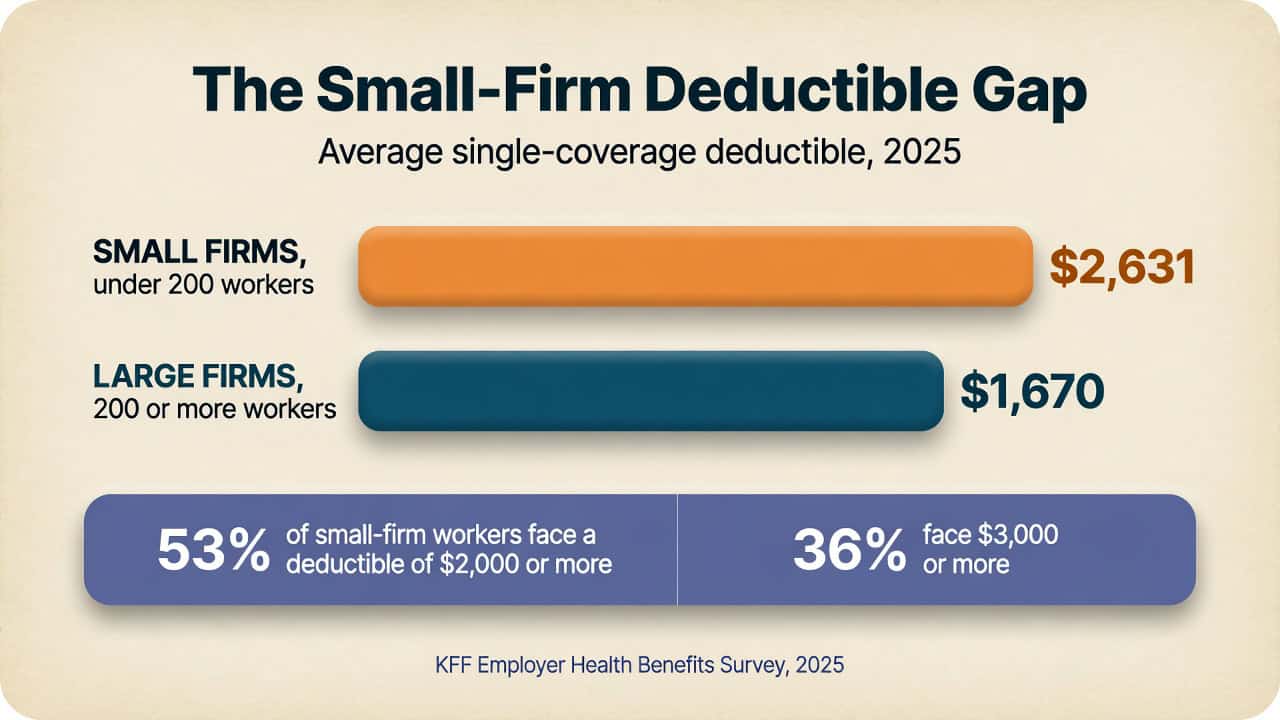
Workers at firms under 200 employees averaged a $2,631 single deductible in 2025 against $1,670 at larger firms. More than half — 53 percent — faced a deductible of at least $2,000, and 36 percent faced at least $3,000. Lower premium at small firms is frequently purchased with higher employee cost exposure.
Out-of-pocket maximums follow the same pattern, and both belong in any full accounting of small business health insurance cost. Roughly 72 percent of small-firm workers faced a single-coverage out-of-pocket maximum above $3,000 in 2025, and about one in five faced a maximum above $6,000. When comparing two quotes, the deductible and the maximum together describe the real employee experience more accurately than premium alone.
See Pricing for Your Actual Census
National averages are a starting point. Enter your employee count to compare plans and pricing built on your group, or talk the numbers through with a licensed agent.
How Much a Business Is Required to Contribute
No federal rule sets a minimum employer contribution for small groups. Carriers set their own floor, most commonly 50 percent of the employee-only premium. Across the market employers paid about 84 percent of single premium and 74 percent of family premium in 2025, well above the typical carrier minimum.
Contribution level and participation move together, and both shape the final small business health insurance cost. Most carriers pair a 50 percent contribution floor with a requirement that about 70 percent of eligible employees enroll, and a business that contributes generously usually clears participation more easily because fewer workers decline. Raising the contribution is often the cheapest way to fix a participation shortfall.
Dependent tiers sit outside the requirement. A business can contribute 100 percent of employee-only premium and nothing toward spouses or children and still satisfy the carrier. That structure is common and explains most of the gap between the single and family employer share. Full detail on both thresholds lives on the contribution and participation requirements page.
One threshold to watch
Businesses at or above 50 full-time equivalent employees face a separate federal affordability test on the employee contribution under the IRS employer shared responsibility provisions. That test is unrelated to carrier minimums and carries a per-employee penalty.
What Happens to Small Business Health Insurance Cost at Renewal
Family premiums rose 6 percent in 2025 and 7 percent in each of the two prior years, against general inflation of 2.7 percent and wage growth of 4 percent. Carriers filed double-digit small-group rate requests heading into 2026, so a renewal increase above the national average is common rather than exceptional.
Renewal quotes arrive roughly 60 to 90 days before the plan anniversary, which is the window in which a business has leverage. Shopping the market at that point is straightforward; attempting it two weeks out generally is not, because underwriting and enrollment paperwork take time to assemble.
Aging is a quiet contributor. Because small group rates are built on each employee’s current age, a stable workforce produces a premium increase every year even with no change in plan, no claims, and no carrier rate action. Owners who account for that in advance are less often caught by a renewal that looks unexplained.
Ways to Reduce Small Business Health Insurance Cost
Four levers move the number reliably: shifting plan design toward a higher deductible, changing the contribution structure across tiers, comparing carriers rather than accepting a renewal, and evaluating a different funding model. Moving from an average plan to an HDHP with a savings option cut annual single premium by about $705 in 2025.
Plan design is the fastest lever on small business health insurance cost and the one with the clearest trade-off. The premium savings are real, but they transfer cost to employees who use care, and a workforce with several people managing chronic conditions may find the change unpopular enough to hurt participation.
Funding model is the slower lever with the larger potential swing. About 27 percent of covered workers at small firms were in self-funded arrangements in 2025, a share that has grown as level-funded designs moved down-market. The comparison of level-funded and fully insured coverage covers where each model prices better.
The SHOP tax credit, and who actually clears it
Businesses purchasing through the Small Business Health Options Program may qualify for a federal tax credit worth up to 50 percent of employer premium contributions. Eligibility is narrow — fewer than 25 full-time equivalent employees, an average salary around $65,000 or less, and at least 50 percent contribution — and the HealthCare.gov guidance on the credit lays out the full test. Coverage bought outside SHOP does not qualify.
What does not reliably lower the cost
Reducing the number of enrolled employees rarely helps, because per-employee rating means a smaller group is not a cheaper group. Delaying the effective date does not avoid a rate increase either, since small group rates are set at the plan year and apply from whichever month the plan begins.
Frequently Asked Questions About Small Business Health Insurance Cost
How much does small business health insurance cost per employee per month?
Employer coverage averaged $777 a month for single coverage and $2,249 for family coverage in 2025. After the worker share, employers carried roughly $657 and $1,679 a month respectively. Actual quotes vary with employee ages, ZIP code, and plan design.
What percentage of premium does an employer have to pay?
No federal minimum exists. Carriers commonly require at least 50 percent of the employee-only premium. Across the market, employers paid about 84 percent of single premiums and 74 percent of family premiums in 2025.
Why did the quote come back higher than the national average?
Age is the largest single driver. Firms where at least 35 percent of workers are 50 or older averaged $9,599 for single coverage in 2025 against $9,068 at younger firms. Location, plan design, and tobacco use also move the number.
Do employees at small companies pay higher deductibles?
Yes. Workers at firms under 200 employees averaged a $2,631 single deductible in 2025 compared with $1,670 at larger firms. More than half faced a deductible of at least $2,000 and 36 percent faced at least $3,000.
How much do premiums increase at renewal?
Small business health insurance cost rises most years regardless of claims. Family premiums rose 6 percent in 2025 and 7 percent in each of the two prior years. Carriers filed double-digit small-group rate requests heading into 2026, so a renewal above the national average is common rather than exceptional.
Does an employer have to contribute toward family coverage?
No. Carrier contribution minimums apply to the employee-only tier. Many small employers contribute nothing toward dependent tiers, which is why workers paid an average of $6,850 toward family coverage in 2025 against $1,440 for single.
Related Small Business Health Insurance Resources
The full employer guide to coverage, eligibility, plan types, and enrollment.
Eligibility and Employer Size RulesFTE counting, the 50-employee threshold, and who counts as an eligible employee.
Contribution and Participation RequirementsCarrier minimums, how waivers are counted, and the year-end relaxed window.
Level-Funded vs. Fully InsuredHow the two funding models price, refund, and renew differently.
The Small Business Health Care Tax CreditSHOP requirements, wage and size limits, and how the credit is calculated.
Comparing Carriers and Getting QuotesWhat separates carriers on network, service, and renewal behavior for small groups.
Compare Small Business Health Insurance Cost Side by Side
Pricing depends on employee count, ages, and ZIP code. Run a quote to see real numbers for the business, or talk it through with a licensed agent.
Broker Disclosure
ForHealthInsurance.com is an independent health insurance agency serving businesses. We are not affiliated with any carrier or government agency. We help you compare plans and enroll in coverage that meets your needs at no extra cost to you.