Affordable Health Insurance in Nebraska: 2026 Medicaid, Subsidies & Low-Cost Plans
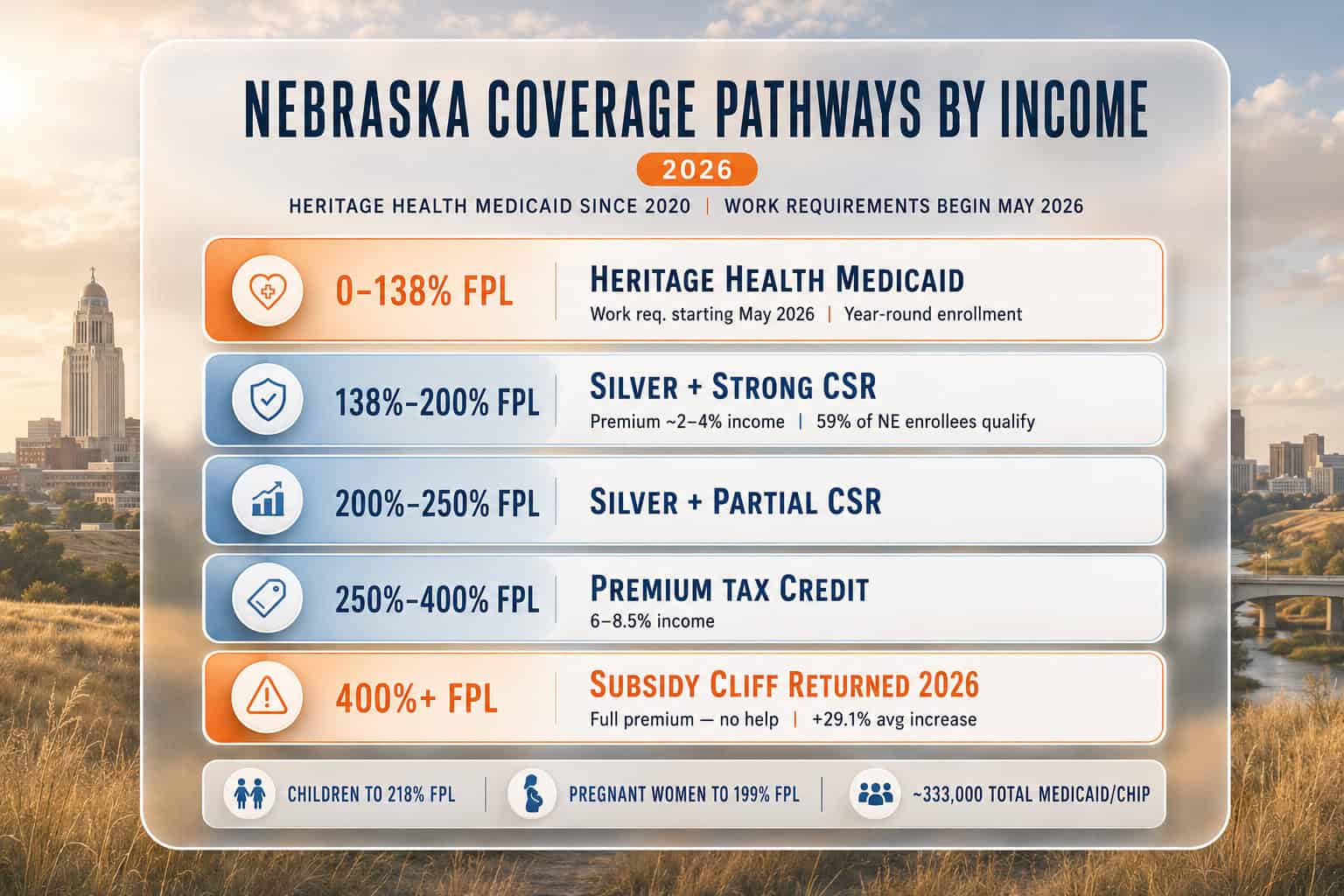
Affordable health insurance in Nebraska for 2026 is defined by two storylines unfolding simultaneously. The first is Heritage Health Medicaid — voter-approved in 2018 and launched in October 2020 — covering approximately 333,000 Nebraskans through a managed care system that integrates physical health, behavioral health, dental, and pharmacy under one coordinated umbrella. New Medicaid work requirements beginning May 1, 2026 add complexity for expansion adults. The second storyline is the marketplace, where five carriers compete but the weighted average rate increase of +29.1% — among the steepest nationally — collides with the return of the subsidy cliff after enhanced credits expired. For the 59% of NE marketplace enrollees earning under $37,651, subsidies still provide significant help. For those above 400% FPL, the cliff eliminates all assistance. This guide covers every pathway to affordable Nebraska coverage.

Where does your household fall?
Heritage Health: Nebraska’s Voter-Approved Medicaid Expansion
Medicaid is the foundation of affordable health insurance Nebraska offers — the state expanded it in October 2020 through the Heritage Health Adult program — the result of Initiative 427, approved by voters in November 2018. Adults ages 19–64 with income up to 138% FPL (approximately $20,782 single or $42,780 family of four) qualify. Total Medicaid and CHIP enrollment stands at approximately 333,000, with roughly 70,000 in the expansion adult group. Heritage Health integrates physical health, behavioral health, dental, and pharmacy into a single managed care system.
Nebraska’s Medicaid expansion was distinctive — voters chose it directly through a ballot initiative after the legislature had declined to act. Heritage Health combines coverage under managed care organizations, providing coordinated care that most state Medicaid programs deliver in silos. Children qualify with household income up to 218% FPL. Pregnant women qualify up to 199% FPL with 12 months of postpartum coverage. Enrollment is year-round through ACCESSNebraska online, by phone at 1-855-632-7633, or at a local DHHS office. The HealthCare.gov application automatically screens for Medicaid eligibility. During the pandemic unwinding, approximately 24,000 people transitioned from Heritage Health to marketplace coverage.
New for 2026: Medicaid Work Requirements Starting May 1
Starting May 1, 2026, Nebraska DHHS will enforce Medicaid work requirements for Heritage Health Adult members — 80 hours per month of work, school, apprenticeship, work-program participation, community service, or meeting a minimum income threshold of approximately $580/month. Many exemptions apply for parents, caregivers, and those with medical hardships. This is the most significant change to affordable health insurance in Nebraska since Medicaid expansion launched in 2020.
The work requirements apply to most adults enrolled through Medicaid expansion (Heritage Health Adult) — defined as ages 19–64, not pregnant, not disabled, not on Medicare, and meeting income limits. Current members will be checked at renewal; those with eligibility periods ending on or after July 31, 2026 are the first group evaluated. New applicants starting in May 2026 must show compliance for the month before applying. Exemptions include parents or guardians of children under 13, caregivers of disabled individuals, and those with temporary medical hardships. Additional federal rulemaking is expected, and rules may evolve. Contact Nebraska DHHS or an Enroll Nebraska navigator for the most current details.
Heritage Health members — respond to renewal notices: If your eligibility period ends on or after July 31, 2026, you may be the first group checked for work requirement compliance. Watch for renewal notices from Nebraska DHHS and respond by the deadline. If you qualify for an exemption (parenting, caregiving, medical hardship), report it proactively. Members who lose Medicaid may qualify for a Special Enrollment Period to enroll in marketplace coverage with subsidy eligibility.
Marketplace Subsidies After the Enhanced Credit Expiration
Premium tax credits still make affordable health insurance in Nebraska possible for households between 138% and 400% FPL, but the enhanced subsidies in place since 2021 expired at the end of 2025. The subsidy cliff returned — Nebraskans above 400% FPL receive no credit. Below 400% FPL, credits cap the benchmark Silver as a percentage of income. The +29.1% weighted average rate increase compounds the challenge — net premiums rose even for subsidized enrollees.
The numbers tell the story. In 2025, 59% of NE marketplace enrollees earned under $37,651 — qualifying for the strongest subsidies and cost-sharing reductions. For this group, Silver with CSR remains the best value: deductibles drop dramatically at no extra premium. For enrollees between 250% and 400% FPL, credits still offset a significant portion of the rate increase. Above 400% FPL, the full +29.1% applies with no help. A 40-year-old Omaha resident earning $62,000 pays the full BCBS NE Silver EPO at $872/month. At $60,240, credits reduce that to roughly $425/month. Credits reconcile at tax time via IRS Form 8962. The NE 2026 pricing and quotes shows after-subsidy pricing from all five carriers.
| Household Income (% FPL) | Best NE Coverage Path | Typical Net Cost |
|---|---|---|
| Under 138% FPL | Heritage Health Medicaid (work req. starting May 2026) | $0/month |
| 138%–150% FPL | Silver + strong CSR | ~$0–$50/month |
| 150%–200% FPL | Silver + CSR | ~$50–$180/month |
| 200%–250% FPL | Silver + limited CSR | ~$180–$320/month |
| 250%–400% FPL | Silver or Bronze + subsidy | ~$320–$550/month |
| 400%+ FPL | Full-price marketplace (5 carriers) | $662+/month (cheapest Bronze EPO) |
Children’s Coverage: Medicaid and CHIP to 218% FPL
Nebraska covers children through Medicaid and CHIP with household income up to 218% FPL (approximately $66,400 for a family of four) — among the more generous thresholds nationally. Children’s coverage includes physical health, dental, vision, and behavioral health through Heritage Health managed care. Enrollment is year-round — no Open Enrollment restriction applies. Children’s Medicaid work requirements do not apply; the work rules affect only Heritage Health Adult members.
Many Nebraska families where parents purchase marketplace plans can enroll children in Medicaid or CHIP at lower cost than adding them to the parents’ Silver plan. A Grand Island family earning $55,000 with two children may qualify for children’s coverage at no premium while parents buy a Medica CHI Silver plan with subsidies. Pregnant women qualify for Medicaid with household income up to 199% FPL, with coverage continuing for 12 months postpartum. Apply through ACCESSNebraska or through the iServe Nebraska application portal launched in 2023.
Example — Grand Island family of four, $55,000: At roughly 180% FPL, the two children qualify for Medicaid or CHIP at no premium (the threshold runs to 218% FPL). The parents enroll separately in a Medica CHI Silver plan with premium tax credits and cost-sharing reductions, keeping the household’s total coverage cost far below adding everyone to one marketplace plan. Splitting children onto Medicaid/CHIP while parents take a subsidized Silver plan is often the cheapest path for Nebraska families in this income range.
Find the Most Affordable NE Coverage for 2026
Check Heritage Health Medicaid eligibility, marketplace subsidy qualification, and children’s Medicaid/CHIP. Licensed enrollment assistance walks through every affordable health insurance in Nebraska pathway at no cost — serving Omaha, Lincoln, Grand Island, Kearney, and rural NE.
Managing the Cliff: MAGI Strategies for NE Farmers and Self-Employed
The subsidy cliff at 400% FPL ($60,240 single / $124,800 family of four) is the central affordable health insurance Nebraska challenge for marketplace-eligible residents in 2026. A single person earning $60,000 qualifies for substantial credits. At $61,000, those credits disappear. HSA contributions ($4,150), traditional IRA contributions ($7,000–$8,000 if 50+), and Schedule F deduction timing can keep MAGI below the threshold for agricultural operators and self-employed Nebraskans.
Nebraska’s agricultural economy makes the cliff especially volatile for affordable health insurance in Nebraska. Corn prices, cattle markets, ethanol demand, crop insurance payouts, and CRP income all affect MAGI and fluctuate unpredictably. A central Nebraska farmer who projects $55,000 MAGI but receives an unexpected $15,000 crop insurance payout crosses the cliff — losing all marketplace subsidies for the year. Quarterly MAGI tracking and mid-year HealthCare.gov updates are essential. Timing equipment purchases, prepaying seed and fertilizer, and maximizing retirement contributions before year-end can pull MAGI back below 400% FPL. The NE individual & self-employed coverage guide covers self-employed deduction strategies alongside cliff management. The Nebraska Department of Insurance publishes consumer resources on understanding coverage costs.
Five Strategies for the Cheapest NE Coverage
Finding the cheapest affordable health insurance in Nebraska requires matching income to coverage path. Under 138% FPL: Heritage Health Medicaid at $0. Under 250% FPL: Silver with cost-sharing reductions (deductibles drop sharply). Above 250% FPL with minimal care: Bronze EPO saves monthly spend — BCBS NE Bronze EPO at $662 is the cheapest statewide. Above 400% FPL: MAGI reduction strategies to get below the cliff. In Lincoln: Oscar at $681 Silver beats all other carriers.
The carrier comparison is the most underused affordability tool in Nebraska. An Omaha resident with access to five carriers should not default to BCBS NE without checking Ambetter Bronze (often cheaper), Oscar Silver (if available), and UHC Silver (lowest deductible at ~$4,000). A Grand Island resident using CHI Health should evaluate Medica CHI plans against BCBS NE’s broader-network PPO health insurance plan options. Workers with access to a job-based plan should also weigh that route — the NE small business coverage guide covers group plans and employer ICHRA contributions that can undercut individual-market pricing. The HealthCare.gov window-shopping tool shows every available option by ZIP code with subsidy calculations applied.
Affordability Questions From Nebraska Residents
Who qualifies for Heritage Health Medicaid in Nebraska?
Adults ages 19–64 with household income up to 138% FPL — approximately $20,782 for a single adult or $42,780 for a family of four. Children qualify to 218% FPL. Pregnant women to 199% FPL with 12 months postpartum coverage. Heritage Health integrates physical health, behavioral health, dental, and pharmacy. Apply year-round at ACCESSNebraska or by calling 1-855-632-7633. Work requirements begin May 2026 for expansion adults.
What are the new Medicaid work requirements?
Starting May 1, 2026, Heritage Health Adult members must complete 80 hours/month of work, school, apprenticeship, community service, or meet a $580/month income threshold. Parents of children under 13, caregivers of disabled individuals, and those with medical hardships may be exempt. Current members are checked at renewal — eligibility periods ending July 31, 2026 or later are evaluated first. Additional federal guidance is expected.
How do marketplace subsidies work in NE after the enhanced credits expired?
Premium tax credits still exist below 400% FPL, capping the benchmark Silver at a percentage of income. Enhanced subsidies expired at the end of 2025 — the cliff returned, eliminating help above 400% FPL. In 2025, 59% of NE enrollees earned under $37,651 and qualified for the strongest subsidies. The +29.1% average rate increase compounds costs even for subsidized enrollees. Credits reconcile at tax time via IRS Form 8962.
How can NE farmers manage the subsidy cliff?
HSA contributions ($4,150), traditional IRA contributions ($7,000–$8,000), and Schedule F deduction timing can lower MAGI below 400% FPL. Track MAGI quarterly. Time equipment purchases and prepay seed/fertilizer before year-end. Watch for unexpected crop insurance payouts or CRP income that can push MAGI above the cliff. Update HealthCare.gov mid-year if income changes significantly.
What if I lose Medicaid due to work requirements?
Heritage Health members who lose coverage due to work requirement non-compliance may qualify for a Special Enrollment Period to enroll in marketplace coverage through HealthCare.gov. Subsidies may be available depending on income. First verify whether you qualify for an exemption — parents, caregivers, and those with medical hardships are often exempt. Contact an Enroll Nebraska navigator or licensed agent for help transitioning.
Which carrier has the cheapest plans in Nebraska?
It depends on location and metal tier. Oscar has the cheapest Silver in Lincoln at approximately $751/month. BCBS NE EPO has the cheapest Silver in Omaha at $872/month. BCBS NE Bronze EPO at $662 is the cheapest statewide Bronze option. Ambetter is competitive on Bronze pricing in many areas. UHC has the lowest Silver deductible at approximately $4,000 — best total value for high utilizers. After subsidies, net costs vary significantly by income.
Related Nebraska Health Insurance Resources
Explore the rest of the Nebraska cluster — from the statewide market overview to marketplace enrollment, temporary coverage, and national PPO networks.
The statewide 2026 market: carriers, costs, and coverage options across Omaha, Lincoln, and greater NE.
Nebraska Marketplace & EnrollmentHow HealthCare.gov works for Nebraskans, Special Enrollment Periods, and Open Enrollment timing.
Short-Term Nebraska CoverageTemporary plans for gaps between jobs, and when a marketplace SEP is the better choice.
Explore Every NE Affordability Pathway
Check Heritage Health Medicaid eligibility, marketplace subsidies, children’s coverage, and work requirement exemptions. Licensed enrollment assistance at no cost — serving every Nebraska county.
Broker Disclosure
ForHealthInsurance.com is an independent health insurance agency serving Nebraska residents. We are not affiliated with any carrier or government agency. We help you compare plans and enroll in coverage that meets your needs at no extra cost to you.