Small Business Dental Insurance: What Employers Need to Know
Dental is the benefit small employers most often skip and employees most often notice. It costs a fraction of medical coverage, the claims are predictable, and staff actually use it — yet a majority of small businesses still do not offer it.
This guide covers what small business dental insurance actually pays for, what it costs per employee in 2026, why smaller firms lag so far behind larger ones, how waiting periods and annual maximums work, the difference between DPPO and DHMO designs, and what setting up a plan involves.

What are you trying to work out?
What Small Business Dental Insurance Covers
Nearly every group dental plan splits services three ways, commonly written as 100-80-50: full payment for preventive care such as cleanings and exams, roughly 80 percent of basic work such as fillings, and about 50 percent of major work such as crowns, bridges, and dentures. Orthodontics, when included, carries its own separate lifetime maximum.
Preventive care being covered in full is the part of small business dental insurance that drives usage. Two cleanings and an exam per year at no cost to the employee is a benefit people actually claim, which is why dental shows some of the highest take-up of any voluntary benefit. The American Dental Association notes that people with dental benefits are more than twice as likely to visit a dentist than those without.
The tiering explains where employees still face real cost. A crown at 50 percent coverage leaves a meaningful bill, and that is before the annual maximum enters the picture. Small business dental insurance reduces cost rather than eliminating it, and setting that expectation with staff up front prevents most complaints.
What It Costs Per Employee
Dental is a rounding error next to medical. Employer health coverage averaged $9,325 a year for single coverage in 2025, while dental premiums run a small fraction of that per employee per month. Dental premiums have also risen less than 1 percent a year for eight consecutive years, well below general inflation.
Employer contribution toward small business dental insurance follows the same pattern as medical but at a much smaller absolute cost. Many businesses cover 50 to 100 percent of employee-only dental premium and leave dependent tiers to the worker, which keeps the budget line modest while still making the benefit real.
Voluntary arrangements are also common heading into 2026, where the employer sponsors the plan and employees pay the full premium through payroll deduction. The business gets group pricing and payroll convenience at effectively no premium cost, which is why voluntary small business dental insurance is often the first step for firms not ready to fund a benefit outright.
Why Small Employers Offer It Less Often
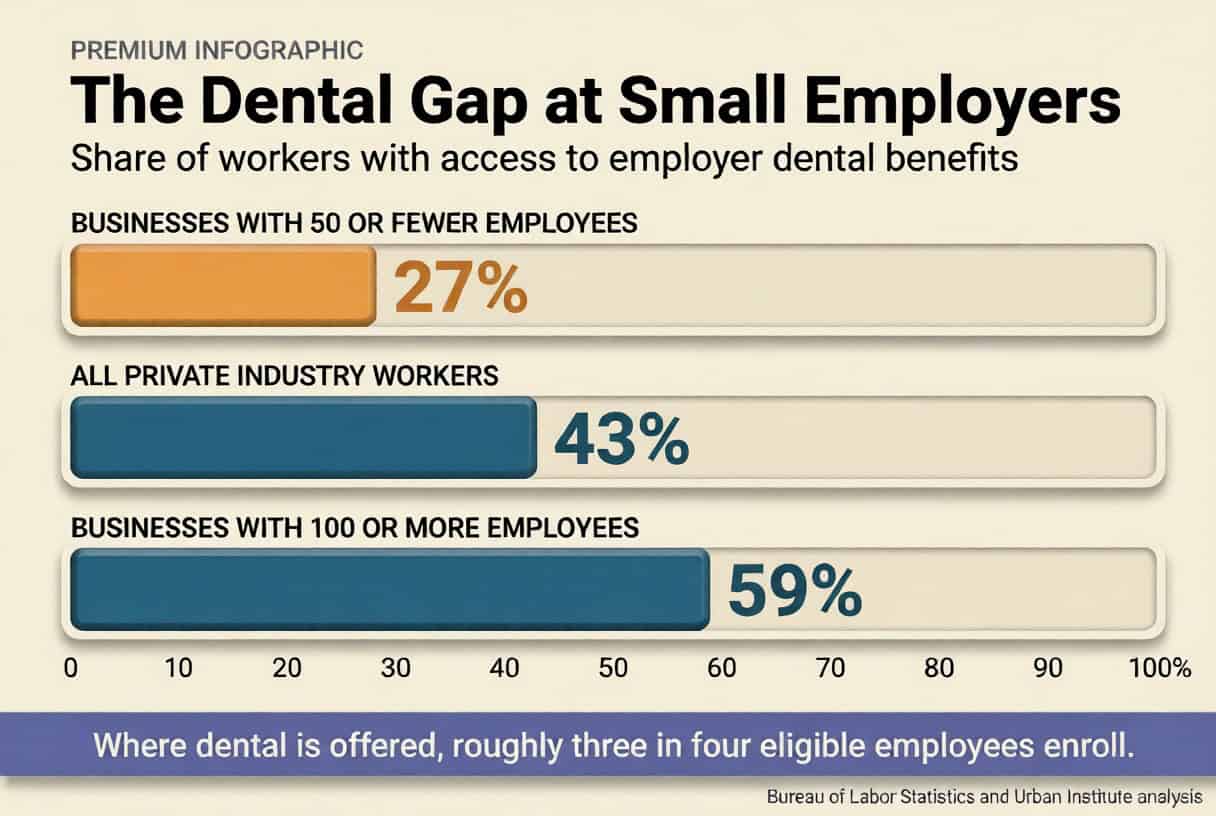
About 43 percent of private industry workers had access to dental benefits in 2024, according to the Bureau of Labor Statistics. Urban Institute analysis of that data puts access at just 27 percent for businesses with 50 or fewer full-time equivalents, against 59 percent at firms with 100 or more.
The small business dental insurance gap is not really about cost, given how modest premiums are. It is about administration and attention: a small employer choosing benefits generally solves medical first and runs out of bandwidth. Dental gets deferred to next year, then the year after. The Bureau of Labor Statistics employee benefits data tracks these access rates each year.
That gap is also the opportunity. In a hiring market where a candidate is comparing two offers, dental is a visible, easily understood difference that costs the business far less than an equivalent salary bump. Where it is offered, roughly three in four eligible employees enroll.
See Dental Pricing for Your Business
Enter your employee count to compare plans and pricing, or talk the options through with a licensed agent.
Waiting Periods and Annual Maximums
Two plan features cause most of the confusion. A waiting period delays coverage for basic and major work, commonly six to twelve months. An annual maximum caps what the plan pays per person per year, typically $1,000 to $2,500. Preventive care generally starts immediately and sometimes does not count toward the maximum.
The small business dental insurance annual maximum works in the opposite direction from a medical out-of-pocket maximum, which trips up almost everyone the first time. In medical coverage the maximum protects the patient by capping what they pay. In dental it caps what the insurer pays, and everything beyond it falls to the employee.
An employee needs a crown priced at $3,200 late in the plan year, after already using $600 of a $1,500 annual maximum on earlier basic work. The plan pays 50 percent of major work, or $1,600 toward the crown — but only $900 of that is left under the maximum ($1,500 minus the $600 already used). The employee ends up covering $2,300 of the $3,200 bill, not the $1,600 the 50-percent figure alone would suggest. The maximum, not the coinsurance percentage, is what actually decided the employee’s cost here.
Waiting periods are more negotiable in the group market than most employers realize. Carriers frequently shorten or waive them for group business, particularly where employees are moving from prior coverage. It is a reasonable thing to ask about when comparing small business dental insurance quotes.
Worth asking about
Some plans roll unused annual maximum into the following year, and some exclude preventive visits from counting toward the maximum at all. Both meaningfully increase the value of the same headline benefit.
DPPO Compared With DHMO
A dental PPO lets employees see any dentist, paying less in network, and is the dominant design at more than 80 percent of the market. A dental HMO requires using a network dentist and typically has no annual maximum and no deductible, trading choice for lower and more predictable cost.
DPPO points
Employees keep their current dentist. Out-of-network care is covered at a lower rate rather than excluded. Higher premium, and an annual maximum applies.
DHMO points
Lower premium, no annual maximum, fixed copays. Employees must use a network dentist, and network depth varies sharply by area.
The deciding test
Check whether the dentists your employees already use are in the network. Dental loyalty runs deep, and a plan that forces a switch generates complaints quickly.
Offering both
Some carriers allow a choice between designs within one group, letting cost-sensitive employees take the DHMO while others keep broader access.
The American Dental Association’s summary of dental benefit trends tracks the shift toward PPO designs and the growing focus on in-network care.
Setting Up a Group Dental Plan
Requirements are generally lighter than for medical. Most carriers write group dental for as few as two enrolled employees, participation minimums are easier to clear, and the paperwork is a census and an employer application. Plans can usually take effect on the first of a month.
Businesses already sponsoring medical coverage can often add small business dental insurance at the same anniversary date, which keeps enrollment periods and administration aligned. Businesses without medical can still buy dental on its own — the two are not linked, and a standalone dental plan is a legitimate first benefit for a firm not ready to fund medical.
Premiums an employer pays toward employee dental coverage are generally deductible as a business expense. Treatment of owner premiums varies by entity type, so that specific question is worth putting to a tax professional rather than assuming. The U.S. Small Business Administration’s overview of employee health benefits covers how group coverage fits into a broader benefits package.
What to compare across quotes
When comparing small business dental insurance, look past premium at four things: the annual maximum, the waiting periods on basic and major work, whether orthodontia is included and at what lifetime cap, and the network. Two plans at similar monthly cost can differ substantially on all four, and those differences are what employees experience.
Frequently Asked Questions About Small Business Dental Insurance
How much does small business dental insurance cost per employee?
Dental premiums are a small fraction of medical. Where employer medical coverage averaged $9,325 a year for single coverage in 2025, dental typically runs a few tens of dollars per employee per month. Dental premiums have risen less than 1 percent a year for eight consecutive years.
How many employees does a business need for a group dental plan?
Small business dental insurance is written by most carriers group dental for as few as two enrolled employees, and some for one. Requirements are generally looser than for medical coverage because claims are smaller and more predictable.
What does the 100-80-50 structure mean?
It describes how a plan splits cost by service category: 100 percent of preventive care such as cleanings and exams, 80 percent of basic work such as fillings, and 50 percent of major work such as crowns, bridges, and dentures. Nearly all dental plans follow some version of this.
Do small business dental plans have waiting periods?
Often yes for basic and major services, commonly six to twelve months. Preventive care is usually available immediately. Group plans frequently waive or shorten waiting periods that individual plans would apply.
What is a dental annual maximum?
The most the plan will pay toward an enrollee’s care in a plan year. Common levels run from $1,000 to $2,500 per person. Unlike medical out-of-pocket maximums, this caps what the insurer pays rather than what the patient pays.
Is dental insurance a deductible business expense?
Premiums an employer pays toward employee dental coverage are generally deductible as a business expense. Rules differ for owners depending on business structure, so confirm the treatment for a specific entity with a tax professional.
Related Small Business Coverage Resources
How dental plans work — what’s covered, plan types, and annual maximums.
Is Dental Insurance Worth It?The cost math on premiums, annual maximums, and what care actually costs.
Dental Insurance With No Waiting PeriodHow waiting periods work, which plans skip them, and when they get waived.
Major Dental ServicesWhat insurance pays toward crowns, root canals, dentures and implants.
Orthodontic InsuranceWhat plans pay toward braces, and why the lifetime cap decides it.
Small Business Health InsuranceThe full employer guide to medical coverage, costs, eligibility and enrollment.
What Health Coverage Costs Per Employee2026 medical premium benchmarks and what drives a quote.
Comparing Carriers and QuotesNetwork, financial strength, quality ratings, and renewal behavior.
Compare Small Business Dental Insurance Plans
Pricing depends on employee count and location. Run a quote to see options side by side, or call to talk through plan design with a licensed agent.
Broker Disclosure
ForHealthInsurance.com is an independent health insurance agency serving businesses. We are not affiliated with any carrier or government agency. We help you compare plans and enroll in coverage that meets your needs at no extra cost to you.