Major Dental Services: What Insurance Actually Covers
Crowns, root canals, dentures, implants and surgical extractions all sit in the same category on a dental plan, and it is the category where coverage is weakest. Plans typically pay half, and there is a ceiling on how much they will pay at all.
This page sets out what falls into that category, what each procedure costs at national averages, exactly where the annual maximum stops helping, why implants are treated differently from everything else, and what to do when a treatment plan is larger than the coverage.

What do you need to work out?
What Counts as Major Dental Work
Major dental services are the restorative and surgical procedures a plan pays least toward — typically about 50 percent. Crowns, bridges, dentures, root canals, surgical extractions and, where covered at all, implants. The classification matters because it sets both the coverage share and the waiting period.
The boundary between basic and major is not universal. A simple extraction is usually basic at around 80 percent, while a surgical extraction of an impacted wisdom tooth is usually major at around 50 percent. Deep cleaning falls either side depending on the carrier. Two plans can classify the same procedure differently, which changes what you pay by hundreds of dollars.
That variability is worth checking before buying rather than after. When comparing plans, ask which category each procedure you expect falls into, not just what the major dental services percentage is.
What Each Procedure Costs
National averages run about $1,100 for a root canal, $1,369 for a crown, and $1,953 for dentures. A root canal followed by a crown on the same tooth averages $2,469 together, which is more than many plans will pay in an entire year across all major dental services.
Those figures come from a national cost study covering all 50 states and the District of Columbia, published in FAIR Health Consumer’s dental cost estimator data. Regional variation is substantial, and the “you pay” column assumes the annual maximum has not already been reached — which, as the next section shows, is a large assumption. Whatever lands in that column and stays unreimbursed may be deductible as an itemized medical expense above 7.5% of adjusted gross income; see IRS Publication 502 for what qualifies.
Where the Annual Maximum Runs Out
Plans cap what they pay per person per year, commonly $1,000 to $2,500. Because major dental services are the expensive ones, a single tooth requiring a root canal and crown can consume most of a mid-range maximum. Everything after that is paid in full by the patient.
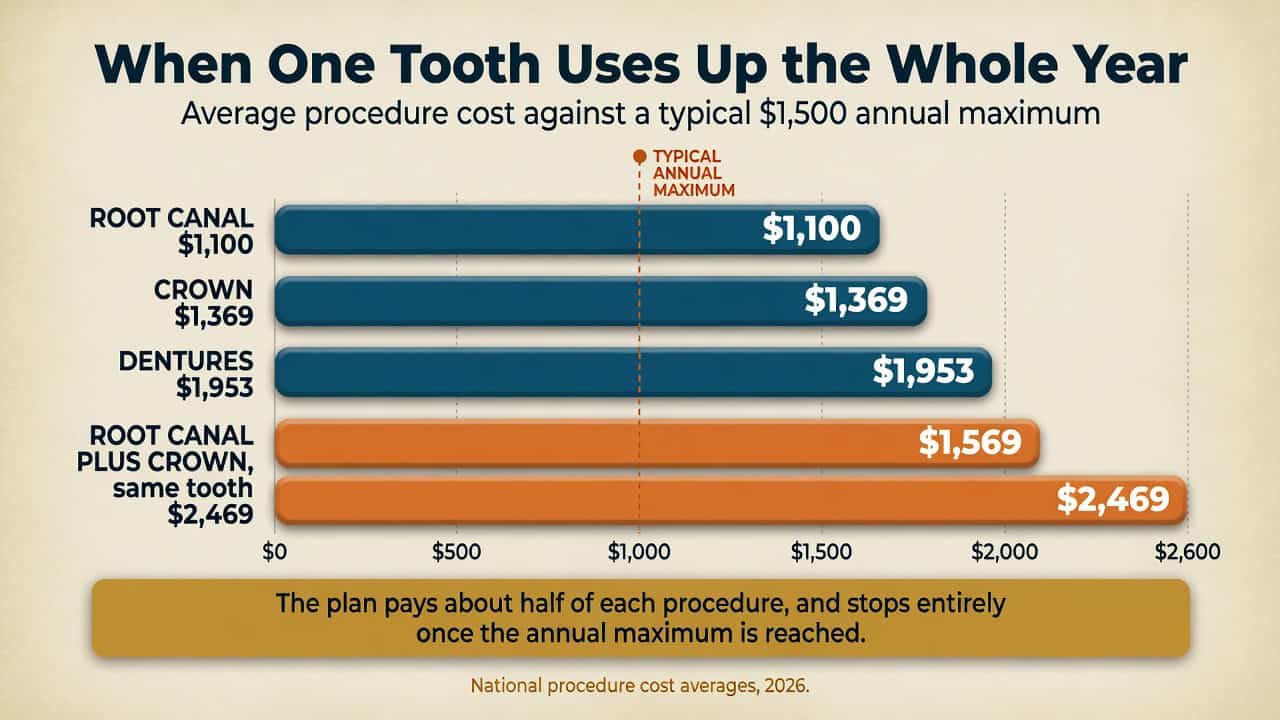
A plan covering major dental services at 50 percent with a $1,500 annual maximum. A root canal and crown totalling $2,469 would attract $1,234 in coverage at the stated percentage — inside the cap. But add a second crown later that year and the plan pays only $266 more before stopping. The second crown effectively costs $1,103.
Staging treatment across two plan years is the standard workaround, and most dentists will discuss it if asked. Work completed in December and January draws on two separate maximums rather than one, which on a $1,500 plan doubles the available benefit for the same course of treatment.
Compare Annual Maximums Before You Need Them
The cap matters more than the premium for anyone expecting major work. Run a quote to compare plans, or call to talk through the numbers.
Implants Are the Exception
Implants are the least consistently covered procedure in dentistry. Some plans exclude them outright, some treat them as major dental services at around 50 percent, and some cover an alternative such as a bridge instead. A single implant commonly runs several thousand dollars before any coverage.
Excluded entirely
Still common, particularly on lower-premium individual plans. The plan pays nothing toward the implant, though it may cover the crown placed on top.
Covered as major work
Around 50 percent, subject to the annual maximum. Given implant costs, the cap is usually reached long before the procedure is complete.
Least expensive alternative
Some plans pay only what a bridge would have cost, leaving the difference to the patient even where implants are nominally covered.
Missing tooth clause
Excludes replacing teeth already missing when the policy began. It does not expire, so it can block implant coverage indefinitely.
Check this specific wording before buying
If an implant is the reason for shopping, ask the carrier in writing whether implants are covered, at what percentage, whether a least-expensive-alternative provision applies, and whether the tooth in question falls under a missing tooth clause.
Waiting Periods on Major Work
Individual plans commonly impose six to twelve months before paying for major dental services, which is the longest wait in a typical plan. Group coverage through an employer frequently has none, and carriers often waive the wait with proof of twelve months of prior continuous dental coverage.
This is why timing matters more here than anywhere else in dental coverage. Someone told they will need a crown eventually, but not urgently, is in an ideal position: coverage taken out today clears its waiting period well before the work is needed. Someone told they need it next month generally cannot solve the problem with a new policy.
Deferring treatment carries its own risk. CDC figures show roughly one in five adults aged 20 to 64 has at least one untreated cavity, and untreated decay progresses toward exactly the major dental services this page describes. The CDC’s cavity statistics track that prevalence.
Getting the Most From Coverage
Four moves help materially: stage treatment across plan years, confirm the procedure’s category before treatment, get a pre-treatment estimate from the carrier in writing, and check whether preventive visits count toward the annual maximum. Some plans exclude preventive from the cap, which preserves it for major work.
A pre-treatment estimate is the most underused of these. Most carriers will review a proposed treatment plan and state in advance what they will pay, which removes the guesswork before a large bill rather than after. Dentists submit these routinely when asked.
Where to check plan terms
Policy language is filed with state regulators, and state insurance departments handle disputes over how coverage terms are applied. The NAIC maintains the directory of state insurance departments where those records can be checked.
Frequently Asked Questions About Major Dental Services
Does dental insurance cover implants?
Some plans do and many do not. Where implants are covered they are usually treated as a major service at around 50 percent, subject to the annual maximum and often a missing tooth clause. Coverage for implants is the single most variable item between plans.
How much does insurance pay toward a crown?
Typically about 50 percent, since crowns are classified as major services. At a national average of $1,369 that means roughly $685 from the plan, provided the annual maximum has not already been used.
What is the annual maximum and how does it affect major work?
It caps what the plan pays per person per year, commonly $1,000 to $2,500. A root canal and crown on one tooth average $2,469 combined, so a single problem can exhaust a modest maximum before any other treatment is considered.
Are wisdom teeth removals covered?
Usually yes. Simple extractions are often treated as basic services at around 80 percent, while surgical extractions of impacted teeth are typically major services at around 50 percent. Complex cases are sometimes billed to medical insurance instead.
Is there a waiting period for major dental services?
Commonly six to twelve months on individual plans. Group plans through an employer frequently have none, and carriers often waive the wait with proof of twelve months of prior continuous dental coverage.
What if my treatment plan costs more than the annual maximum?
Ask the dentist about staging treatment across two plan years so each year draws its own maximum. For very large treatment plans, a dental savings plan discounting the whole bill can be worth more than a capped reimbursement.
Related Coverage Resources
How dental plans work — what’s covered, plan types, and annual maximums.
Is Dental Insurance Worth It?The cost math on premiums, annual maximums, and what care actually costs.
Dental Insurance With No Waiting PeriodHow waiting periods work, which plans skip them, and when they get waived.
Orthodontic InsuranceWhat plans pay toward braces, and why the lifetime cap decides it.
Small Business Dental InsuranceGroup dental, what it costs per employee, and how to set it up.
Comparing Carriers and QuotesNetwork, financial strength, quality ratings, and renewal behavior.
Find Coverage for Major Dental Services
Coverage percentages, annual maximums and waiting periods vary widely. Run a quote to compare them side by side, or call a licensed agent.
Broker Disclosure
ForHealthInsurance.com is an independent health insurance agency serving small businesses nationwide. We are not affiliated with any carrier or government agency. We help you compare plans and enroll in coverage that meets your needs at no extra cost to you.