Small Business Health Insurance in Nebraska: 2026 Group Plans & ICHRA
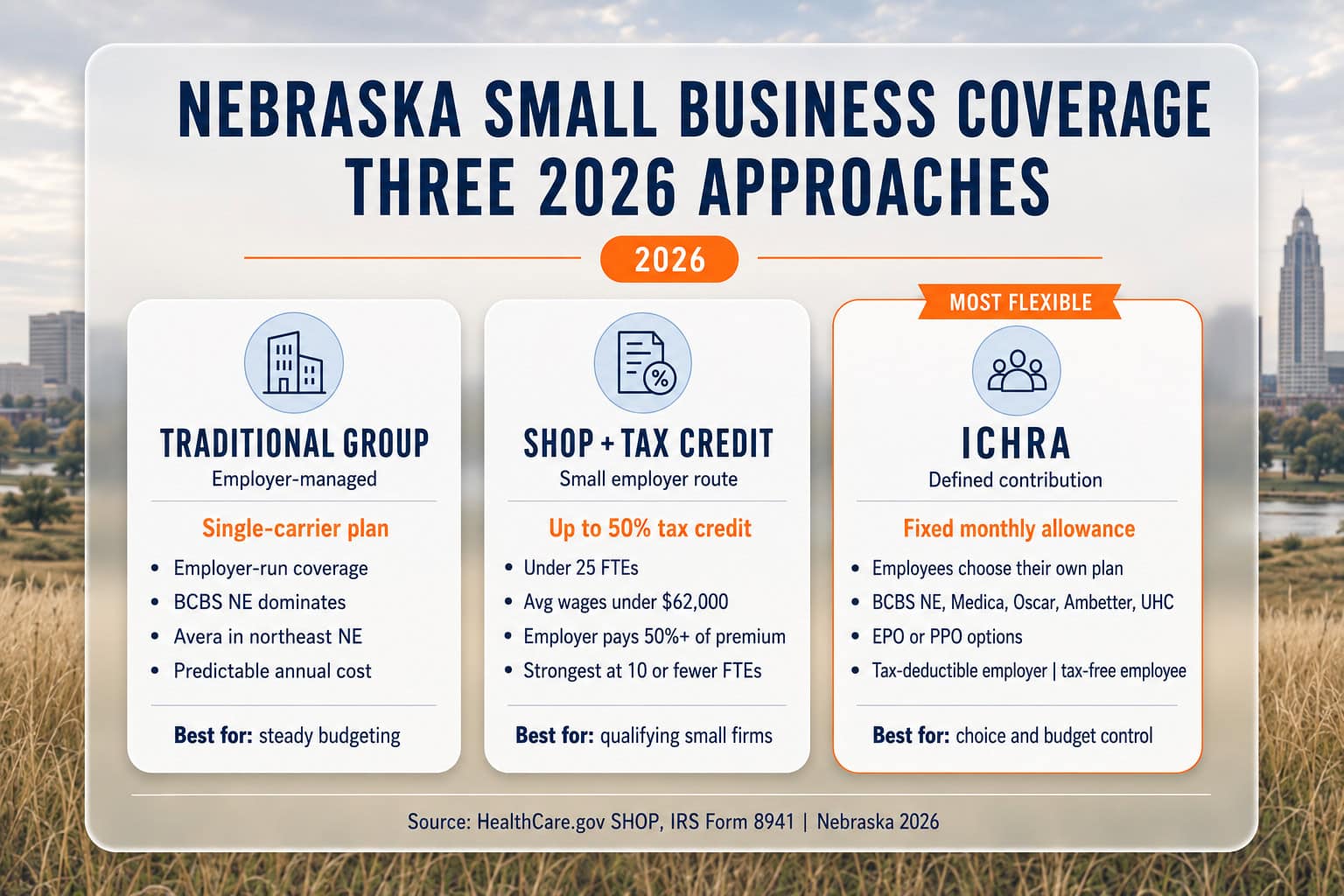
Nebraska small business health insurance gives employers with 1–50 employees three coverage approaches for 2026: traditional small group plans from carriers including BCBS NE, Medica, UnitedHealthcare, and new entrant Avera Health in northeast Nebraska; the SHOP marketplace through HealthCare.gov with potential tax credits; or an Individual Coverage Health Reimbursement Arrangement (ICHRA) that reimburses employees for individual marketplace plans from five carriers. ICHRA is particularly compelling in Nebraska because the individual marketplace offers five carriers with both EPO and PPO options — giving Omaha employees access to BCBS NE, Medica CHI Health plans, Oscar, Ambetter, and UHC, while the employer’s cost stays fixed. With the individual market’s +29.1% rate increase, Nebraska small business health insurance group plans may offer more predictable year-over-year costs for businesses that prefer employer-managed coverage.

What does your Nebraska business need?
Three Coverage Approaches for Nebraska Employers
Nebraska small business health insurance for 2026 gives employers with 1–50 employees three pathways: traditional small group plans from multiple carriers including new entrant Avera Health, the SHOP marketplace through HealthCare.gov with access to the Small Business Health Care Tax Credit, or an ICHRA that reimburses employees for individual marketplace plans from five carriers. Each approach has different cost structures, administrative requirements, and flexibility for the 2026 plan year.
| Option | Eligible | NE Carriers | Tax Credit |
|---|---|---|---|
| Traditional small group | 1–50 FTE | BCBS NE, Medica, UHC, Avera (NE NE) | No (unless via SHOP) |
| SHOP on HealthCare.gov | 1–50 FTE | Available SHOP carriers | Yes — under 25 FTE + wages under $62,000 |
| ICHRA | Any size | Employees choose from 5 individual carriers | No (contributions tax-free) |
| QSEHRA | Under 50 FTE, no group plan | Employees choose any carrier | No (contributions tax-free); max $6,350/individual |
Avera Health — a South Dakota-based health system expanding into Nebraska — entered the small group market for 2026 in northeast Nebraska, adding a new carrier option for employers in that region. For ICHRA, employees access five individual marketplace carriers (BCBS NE, Medica, Oscar, Ambetter, UHC) and choose based on their own providers and county. A Lincoln employee might select Oscar for the cheapest Silver at $751/month while an Omaha employee chooses Medica for CHI Health network access — the employer’s cost stays fixed regardless. The NE carrier comparison details the individual-market plans employees would select under ICHRA.
The SHOP Tax Credit: Up to 50% Back for Qualifying NE Employers
Nebraska small business health insurance starts with three routes. Nebraska small businesses purchasing coverage through the federal SHOP marketplace may qualify for the Small Business Health Care Tax Credit — worth up to 50% of premium contributions (35% for tax-exempt organizations). The business must have fewer than 25 full-time equivalent employees, pay average annual wages under $62,000, and cover at least 50% of employee-only premiums. For a qualifying 8-employee Nebraska business, this credit can save $3,000–$9,000 per year.
The credit is claimed on the federal tax return using IRS Form 8941. The maximum 50% applies to businesses with 10 or fewer FTEs and average wages under $32,000, phasing out as headcount approaches 25 and wages approach $62,000. SHOP enrollment goes through HealthCare.gov’s Small Business portal. Tax-exempt Nebraska organizations — nonprofits, churches, community organizations — can claim up to 35% as a refundable credit.
Example — Grand Island Manufacturing Shop, 12 Employees: A Grand Island manufacturer with 12 full-time employees averaging $38,000/year purchases SHOP coverage, contributing $550/month per employee toward Medica CHI Silver premiums with direct CHI Health Good Samaritan network access. Annual employer contribution: $79,200. The Small Business Health Care Tax Credit at approximately 35% (phased on wages and headcount) returns roughly $27,720 — reducing effective employer cost to $51,480, or about $357/month per employee. Nebraska small business health insurance through SHOP with the tax credit can cut effective costs by a third or more for qualifying employers.
Compare NE Small Business Coverage Options
Nebraska small business health insurance quotes from BCBS NE, Medica, Oscar, Ambetter, UHC, and northeast-Nebraska newcomer Avera take about ten minutes to compare side by side. A licensed enrollment assistant handles SHOP tax-credit eligibility, ICHRA setup, and employer contribution strategy at no cost — serving Omaha, Lincoln, Grand Island, Kearney, and every Nebraska community.
Why ICHRA Works in Nebraska’s Five-Carrier Market
An Individual Coverage Health Reimbursement Arrangement lets Nebraska employers set a fixed monthly dollar amount per employee — typically $400–$600 — which employees use to buy individual plans through HealthCare.gov. Employer contributions are tax-deductible and tax-free to employees. ICHRA is especially powerful in Nebraska because the individual marketplace has five carriers with both EPO and PPO options — more network variety than most traditional group plans can offer.
Consider an Omaha marketing agency with 10 employees. A traditional group plan locks everyone into one carrier and one network type. With ICHRA at $500/month per employee, a designer who uses CHI Health picks Medica’s CHI network plan. An account manager who travels to Kansas City and Chicago selects BCBS NE PPO for nationwide BlueCard access — the kind of broad PPO health insurance plan that lets employees see out-of-state providers without referrals. A junior developer in Lincoln chooses Oscar for the cheapest Silver at $751/month. Each employee optimizes for their own doctors, travel patterns, and budget. The employer’s cost stays fixed at $500/employee regardless of carrier selection.
ICHRA works well when
Employees have diverse provider needs — some use Nebraska Medicine, others prefer CHI Health, Bryan, or Methodist. Some employees travel out of state and need PPO. The business wants predictable, fixed monthly costs. Employees in Lincoln benefit from Oscar’s lower pricing while Omaha employees access broader carrier competition.
Traditional group works well when
The business qualifies for the SHOP tax credit (under 25 FTE, wages under $62,000). All employees use the same health system. Employees prefer the employer managing plan selection. A branded group benefit matters for recruitment — particularly in Omaha’s competitive finance and insurance labor market.
Does Nebraska Require Employers to Offer Coverage?
Nebraska has no state employer mandate requiring businesses to offer health insurance. The federal ACA employer mandate applies only to Applicable Large Employers with 50 or more full-time equivalent employees — NE businesses with fewer than 50 FTEs face no federal penalty for not offering coverage. The vast majority of Nebraska businesses fall below this threshold. Nebraska small business health insurance is voluntary for most employers, but offering coverage can be a competitive advantage in attracting talent.
For NE businesses at or near the 50-FTE threshold, the federal penalty for not offering affordable, minimum-value coverage is $2,970 per full-time employee (minus the first 30) for 2026. A 55-FTE Nebraska business not offering coverage faces approximately $74,250/year in penalties. With Heritage Health Medicaid work requirements starting May 2026, some employees who lose Medicaid eligibility may look to employer coverage as an alternative — businesses approaching the 50-FTE threshold should factor this potential demand increase into their coverage strategy. Employees waiting on a group plan’s start date or caught between jobs may bridge the gap with Nebraska short-term health insurance until employer coverage or marketplace enrollment begins. Rate filings are reviewed by the Nebraska Department of Insurance under Commissioner Eric Dunning.
Setting Up Coverage for a Nebraska Business
Setting up Nebraska small business health insurance involves four decisions: coverage type (group, SHOP, or ICHRA), carrier selection for group plans, contribution level (minimum 50% of employee-only premiums for SHOP tax credit), and enrollment timing. NE group plans can start the first of any month — no Open Enrollment restriction for employer coverage. Nebraska small business health insurance through any of these paths can be set up with a licensed enrollment assistant at no cost.
Count employees and set a budget
Count full-time equivalent employees (30+ hours/week). Nebraska businesses under 25 FTE with average wages under $62,000 should evaluate SHOP for the tax credit. Businesses with 1–5 employees often find ICHRA or QSEHRA cost-effective — five individual marketplace carriers give employees genuine choice even in small groups.
Choose a coverage approach
Traditional group (employer selects from BCBS NE, Medica, UHC, or Avera in northeast NE), SHOP through HealthCare.gov (tax credit available), or ICHRA (employer sets dollar amount, employees choose from five individual carriers with EPO and PPO options). Each has different administrative and cost trade-offs.
Get quotes from NE small group carriers
Provide employee census data (ages, ZIP codes, tobacco status) for group quotes. BCBS NE dominates the small group market with EPO and PPO options. Medica offers CHI Health network group plans. Avera Health is a 2026 new entrant in northeast Nebraska. For ICHRA: set the monthly allowance and let employees quote individual plans.
Enroll and communicate to employees
Group plans can start the first of any month. SHOP enrollment goes through HealthCare.gov’s Small Business portal. For ICHRA, ensure employees understand how to enroll on HealthCare.gov and choose among BCBS NE (EPO or PPO), Medica (CHI Health), Oscar (cheapest in Lincoln), Ambetter, or UHC. A licensed enrollment assistant handles enrollment at no cost.
Employer Coverage Questions From Nebraska Businesses
Is health insurance required for NE small businesses?
No. Nebraska has no state employer mandate. The federal ACA mandate applies only to businesses with 50 or more full-time equivalent employees. The vast majority of NE businesses fall below 50 FTEs and can offer small business health insurance voluntarily without penalty. Heritage Health Medicaid work requirements starting May 2026 may increase employee demand for employer coverage.
What is the SHOP tax credit worth in Nebraska?
Up to 50% of premium contributions (35% for tax-exempt organizations). The NE business must have fewer than 25 FTEs, pay average wages under $62,000, and cover at least 50% of employee-only premiums through SHOP on HealthCare.gov. Maximum credit applies to 10 or fewer FTEs with wages under $32,000. Claimed on the federal return using IRS Form 8941.
Why does ICHRA work well in Nebraska?
Nebraska’s individual marketplace has five carriers with both EPO and PPO options — more network variety than most group plans. ICHRA gives each employee access to BCBS NE (EPO or PPO with BlueCard), Medica (CHI Health), Oscar (cheapest in Lincoln), Ambetter, and UHC. The employer sets a fixed monthly amount. Contributions are tax-deductible for the business and tax-free to employees.
Who is Avera Health and why does it matter for NE small group?
Avera Health is a South Dakota-based health system that entered Nebraska’s small group market for 2026 in northeast Nebraska. This adds a new carrier option for employers in that region — increasing competition and potentially improving pricing for businesses in communities like Norfolk, Columbus, and Fremont. Avera operates hospitals and clinics across the region with an integrated care model.
How do Medicaid work requirements affect small businesses?
Heritage Health Medicaid work requirements beginning May 2026 may cause some lower-wage employees to lose Medicaid eligibility. Those employees may look to employer coverage as an alternative. NE businesses near the 50-FTE threshold should factor this potential demand increase into their coverage strategy. Employees who lose Medicaid may also qualify for marketplace Special Enrollment Periods.
Can employees keep marketplace subsidies with an ICHRA?
It depends on the ICHRA amount and employee income. If the employer’s contribution is considered “affordable” under ACA standards, the employee generally cannot also claim premium tax credits. If the contribution is below the affordability threshold, the employee can decline the ICHRA and receive subsidies instead. A licensed enrollment assistant can run the affordability calculation for each employee.
Related Nebraska Health Insurance Resources
Explore the rest of the Nebraska cluster — from the statewide market overview to marketplace enrollment, low-cost coverage, and national PPO networks.
The statewide 2026 market: carriers, costs, and coverage options across Omaha, Lincoln, and greater NE.
Nebraska Marketplace & EnrollmentHow HealthCare.gov works for Nebraskans, including SHOP for small employers and Open Enrollment timing.
Affordable Nebraska CoverageHeritage Health Medicaid, premium tax credits, and the lowest-cost paths to NE coverage.
Find Coverage for Your Nebraska Team
Compare group plans, SHOP tax credits, and ICHRA options with five marketplace carriers. Licensed enrollment assistance at no cost — serving Omaha, Lincoln, Grand Island, Kearney, and every NE community.
Broker Disclosure
ForHealthInsurance.com is an independent health insurance agency serving Nebraska businesses. We are not affiliated with any carrier or government agency. We help you compare plans and enroll in coverage that meets your needs at no extra cost to you.