Small Business Health Insurance in New Hampshire: 2026 Group Plans & ICHRA
New Hampshire small business health insurance benefits from the same structural advantage as the individual market: the state’s 1332 reinsurance waiver, four-carrier on-exchange competition, and Commissioner DJ Bettencourt’s rigorous rate oversight keep premiums among the lowest nationally. NH employers with 1–50 employees have three coverage approaches for 2026: traditional small group plans, the SHOP marketplace through HealthCare.gov with potential tax credits, or an Individual Coverage Health Reimbursement Arrangement (ICHRA) that reimburses employees for individual marketplace plans from four on-exchange carriers — Ambetter, Matthew Thornton (Anthem), Harvard Pilgrim, and WellSense — at the nation’s lowest individual premiums. Small group rate increases averaged approximately 7.5%–20% depending on plan and carrier — significantly less volatile than the individual market’s +28.1%. With Granite Advantage Medicaid premiums and work requirements arriving mid-2026, some lower-wage employees may look to employer coverage as an alternative — making the small business benefits decision timelier than ever.

What does your NH business need?
ICHRA at the nation’s lowest premiums
Employee choice from 4 on-exchange carriers
See ICHRA advantage ↓Three Coverage Approaches for NH Employers
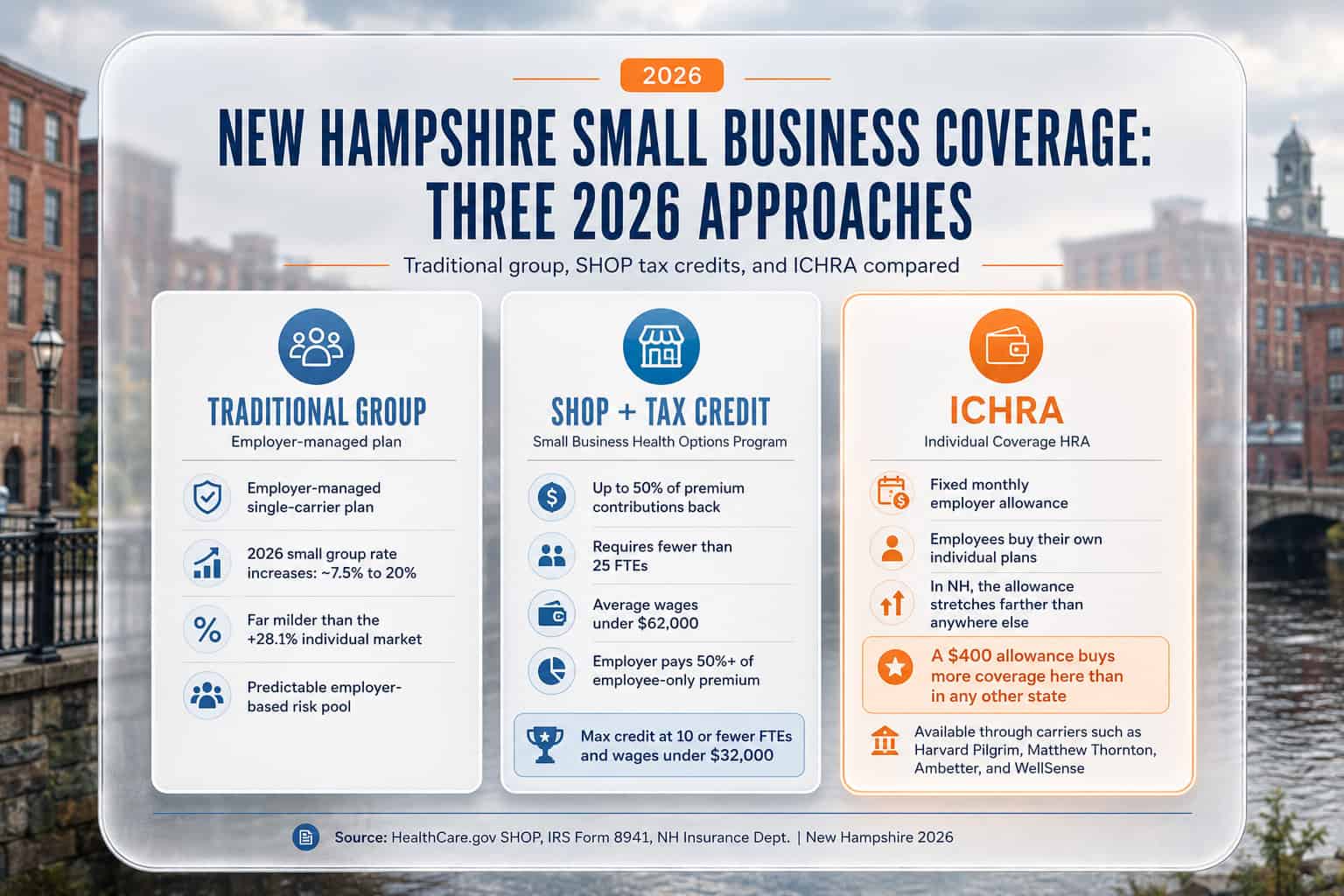
New Hampshire small business health insurance for 2026 gives employers with 1–50 employees three pathways: traditional small group plans with rate increases averaging 7.5%–20%, the SHOP marketplace through HealthCare.gov with access to the Small Business Health Care Tax Credit, or an ICHRA that reimburses employees for individual marketplace plans from four on-exchange carriers at the nation’s lowest premiums. Each approach benefits from NH’s structural cost advantage.
| Option | Eligible | NH Carriers | Tax Credit |
|---|---|---|---|
| Traditional small group | 1–50 FTE | Anthem, Harvard Pilgrim, others | No (unless via SHOP) |
| SHOP on HealthCare.gov | 1–50 FTE | Available SHOP carriers | Yes — under 25 FTE + wages under $62,000 |
| ICHRA | Any size | Employees choose from 4 on-exchange carriers | No (contributions tax-free) |
| QSEHRA | Under 50 FTE, no group plan | Employees choose any carrier | No (contributions tax-free); max $6,350/individual |
New Hampshire small business health insurance through ICHRA is particularly compelling because employees access the nation’s lowest individual marketplace premiums. A Manchester employee might select Ambetter for the cheapest Silver while a Concord employee chooses Harvard Pilgrim for Dartmouth Health network access — the employer’s cost stays fixed regardless. Small group rate increases of 7.5%–20% are more moderate than the individual market’s +28.1%, making traditional group plans a stable option for businesses that prefer employer-managed coverage. The NH carrier comparison details individual-market plans employees would select under ICHRA.
The SHOP Tax Credit: Up to 50% Back for Qualifying NH Employers
New Hampshire small business health insurance buyers purchasing coverage through the federal SHOP marketplace may qualify for the Small Business Health Care Tax Credit — worth up to 50% of premium contributions (35% for tax-exempt organizations). The business must have fewer than 25 full-time equivalent employees, pay average annual wages under $62,000, and cover at least 50% of employee-only premiums. NH’s low-premium environment means the employer’s base contribution is already lower than most states.
The credit is claimed on the federal tax return using IRS Form 8941. The maximum 50% applies to businesses with 10 or fewer FTEs and average wages under $32,000. SHOP enrollment goes through HealthCare.gov’s Small Business portal. Tax-exempt NH organizations — nonprofits, churches, community organizations — can claim up to 35% as a refundable credit. In NH’s no-income-tax environment, the credit flows entirely through the federal return.
Example — Portsmouth Restaurant, 8 Employees: A Portsmouth restaurant with 8 full-time employees averaging $36,000/year purchases SHOP coverage, contributing $420/month per employee toward Harvard Pilgrim Silver premiums with Seacoast provider network access. Annual employer contribution: $40,320. The Small Business Health Care Tax Credit at approximately 38% (phased on wages) returns roughly $15,322 — reducing effective employer cost to $24,998, or about $260/month per employee. New Hampshire small business health insurance through SHOP with the tax credit is among the most affordable employer coverage options in the country thanks to the reinsurance waiver’s effect on underlying premiums.
Compare NH Small Business Coverage Options
New Hampshire small business health insurance quotes from Harvard Pilgrim, Matthew Thornton, Ambetter, and WellSense take about ten minutes to compare side by side. Because NH carries the nation’s lowest individual premiums, an ICHRA allowance stretches further here than in any other state. A licensed enrollment assistant handles SHOP tax-credit eligibility, ICHRA setup, and employer contribution strategy at no cost — serving Manchester, Nashua, Concord, the Seacoast, and the Upper Valley.
Why ICHRA Works in NH’s Lowest-Premium Market
An Individual Coverage Health Reimbursement Arrangement lets NH employers set a fixed monthly dollar amount per employee — typically $350–$500 — which employees use to buy individual plans through HealthCare.gov. Employer contributions are tax-deductible and tax-free to employees. ICHRA is especially powerful for New Hampshire small business health insurance because employees access the nation’s lowest individual marketplace premiums from four on-exchange carriers — making each employer dollar stretch further than in any other state.
Consider a Concord tech firm with 6 employees. A traditional group plan locks everyone into one carrier. With ICHRA at $400/month per employee, a developer who uses Dartmouth Health picks Harvard Pilgrim. A marketing lead who travels to Boston frequently selects Matthew Thornton (Anthem) for broader network reach. A junior designer chooses Ambetter for the lowest premium, pocketing the allowance difference. Each employee optimizes for their own providers and needs. Employees who want the broadest provider access often compare PPO health insurance plans and their nationwide networks before settling on a carrier. The employer’s cost stays fixed at $400/employee — and because NH individual premiums are the lowest nationally, that $400 buys more coverage value here than anywhere else.
ICHRA works well when
Employees have diverse provider needs — some use Dartmouth Health, others prefer Elliot, Catholic Medical Center, or Seacoast hospitals. Some need Boston specialist access through Harvard Pilgrim. The business wants predictable, fixed monthly costs. NH’s lowest-nationally individual premiums maximize each ICHRA dollar.
Traditional group works well when
The business qualifies for the SHOP tax credit (under 25 FTE, wages under $62,000). All employees use the same health system. Employees prefer the employer managing plan selection. A branded group benefit matters for recruitment — particularly for NH tech and biotech firms competing with Boston-area employers.
Does New Hampshire Require Employers to Offer Coverage?
New Hampshire has no state employer mandate requiring businesses to offer health insurance. The federal ACA employer mandate applies only to Applicable Large Employers with 50 or more full-time equivalent employees — NH businesses with fewer than 50 FTEs face no federal penalty for not offering coverage. New Hampshire small business health insurance is voluntary for the vast majority of Granite State employers.
For NH businesses at or near the 50-FTE threshold, the federal penalty for not offering affordable, minimum-value coverage is $2,970 per full-time employee (minus the first 30) for 2026. With Granite Advantage Medicaid premiums and work requirements arriving mid-2026, some lower-wage employees who lose Medicaid may look to employer coverage as an alternative — businesses approaching the 50-FTE threshold should factor this potential demand increase into their coverage strategy. Rate filings are reviewed by the NH Insurance Department under Commissioner DJ Bettencourt.
Setting Up Coverage for a New Hampshire Business
Setting up New Hampshire small business health insurance involves four decisions: coverage type (group, SHOP, or ICHRA), carrier selection for group plans, contribution level (minimum 50% of employee-only premiums for SHOP tax credit), and enrollment timing. NH group plans can start the first of any month — no Open Enrollment restriction for employer coverage.
Count employees and set a budget
Count full-time equivalent employees (30+ hours/week). NH businesses under 25 FTE with average wages under $62,000 should evaluate SHOP for the tax credit. Businesses with 1–5 employees often find ICHRA or QSEHRA cost-effective — four on-exchange carriers at the nation’s lowest premiums give employees genuine choice even in small groups.
Choose a coverage approach
Traditional group (employer selects carrier), SHOP through HealthCare.gov (tax credit available), or ICHRA (employer sets dollar amount, employees choose from four on-exchange carriers plus Anthem’s off-exchange HMO). NH’s low individual premiums make ICHRA especially dollar-efficient — $400/month buys more here than in any other state.
Get quotes from NH small group carriers
Provide employee census data (ages, ZIP codes, tobacco status) for group quotes. Small group rate increases average 7.5%–20% for 2026 — more moderate than the individual market. For ICHRA: set the monthly allowance and let employees quote individual plans from Ambetter, Matthew Thornton, Harvard Pilgrim, and WellSense.
Enroll and communicate to employees
Group plans can start the first of any month. SHOP enrollment goes through HealthCare.gov’s Small Business portal. For ICHRA, ensure employees understand how to enroll on HealthCare.gov and choose among four carriers. Verify Dartmouth Health, Elliot, and Seacoast network alignment for each employee. A licensed agent handles enrollment at no cost.
Employer Coverage Questions From NH Businesses
Is health insurance required for NH small businesses?
No. New Hampshire has no state employer mandate. The federal ACA mandate applies only to businesses with 50 or more full-time equivalent employees. The vast majority of NH businesses fall below 50 FTEs and can offer small business health insurance voluntarily. Granite Advantage Medicaid changes (premiums, work requirements) arriving mid-2026 may increase employee demand for employer coverage.
What is the SHOP tax credit worth in New Hampshire?
Up to 50% of premium contributions (35% for tax-exempt organizations). The NH business must have fewer than 25 FTEs, pay average wages under $62,000, and cover at least 50% of employee-only premiums through SHOP on HealthCare.gov. Maximum credit applies to 10 or fewer FTEs with wages under $32,000. NH’s low-premium base means the employer’s contribution — and the credit amount — starts lower than most states, but so does the total cost.
Why is ICHRA especially effective in New Hampshire?
Because employees access the nation’s lowest individual marketplace premiums. A $400/month ICHRA allowance buys more coverage in NH than in any other state — employees can select from four on-exchange carriers including Harvard Pilgrim (Dartmouth Health network), Matthew Thornton (Anthem), Ambetter (competitive pricing), and WellSense (behavioral health). The employer’s cost is fixed while each employee optimizes for their own providers.
How do small group rate increases compare to the individual market?
Small group rate increases in NH average approximately 7.5%–20% for 2026 — significantly more moderate than the individual market’s +28.1% weighted average increase. Small group rates reflect a more stable employer-based risk pool. Commissioner Bettencourt’s rate review applies to both markets. For businesses choosing between group and ICHRA, the rate difference is a factor worth evaluating.
How might Granite Advantage changes affect my employees?
Granite Advantage Medicaid premiums ($60–$100/month) and work requirements (80 hours/month) arriving mid-2026 may cause some lower-wage employees to lose Medicaid coverage. Those employees may look to employer-sponsored group coverage or ICHRA as an alternative. NH businesses should consider whether offering coverage — even a modest ICHRA allowance — could help retain employees affected by Medicaid changes.
Can employees keep marketplace subsidies with an ICHRA?
It depends on the ICHRA amount and employee income. If the employer’s contribution is considered “affordable” under ACA standards, the employee generally cannot also claim premium tax credits. If the contribution is below the affordability threshold, the employee can decline the ICHRA and receive subsidies instead. A licensed enrollment assistant can run the affordability calculation for each employee.
Related New Hampshire Health Insurance Resources
Explore the rest of New Hampshire’s 2026 coverage landscape — from the statewide market overview to marketplace enrollment, low-cost options, and nationwide PPO plans.
Your complete guide to coverage options, costs, and enrollment across New Hampshire.
NH Health Insurance MarketplaceHow to shop, compare, and enroll in ACA plans on New Hampshire’s marketplace.
NH Affordable Health InsuranceSubsidies, cost-saving strategies, and the cheapest ways to get covered in New Hampshire.
Find Coverage for Your New Hampshire Team
Compare group plans, SHOP tax credits, and ICHRA options at the nation’s lowest individual premiums. Licensed enrollment assistance at no cost — serving Manchester, Nashua, Concord, the Seacoast, and every NH community.
Broker Disclosure
ForHealthInsurance.com is an independent health insurance agency serving New Hampshire businesses. We are not affiliated with any carrier or government agency. We help you compare plans and enroll in coverage that meets your needs at no extra cost to you.