Oregon Health Insurance Marketplace 2026: Enrollment Guide
The Oregon health insurance marketplace works differently from both fully federal and fully state-run systems. Oregon operates a state-based marketplace that uses the federal HealthCare.gov platform: residents start at OregonHealthCare.gov, the site of the state marketplace agency, and are routed to the federal system to finish enrolling. About 126,000 Oregonians held marketplace plans heading into 2026, roughly 60 percent of them with a premium tax credit. This guide explains how the marketplace is structured, who should use it, how to enroll step by step, the 2026 deadlines, how subsidies apply, and the documents needed to sign up.

How the Oregon Health Insurance Marketplace Works in 2026
The Oregon health insurance marketplace is a state-based exchange that runs on the federal platform. The state agency, the Oregon Health Insurance Marketplace (OHIM), sits inside the Department of Consumer and Business Services and handles plan certification and outreach. The actual enrollment transaction happens on HealthCare.gov, which Oregon adopted after Cover Oregon closed in 2015.
| Function | Handled By |
|---|---|
| Plan certification & outreach | OHIM (state, within DCBS) |
| Enrollment & eligibility processing | HealthCare.gov (federal platform) |
| Consumer front door | OregonHealthCare.gov |
| Subsidy determination | Federal rules, applied at enrollment |
This hybrid keeps costs and risk lower than running a standalone exchange while letting Oregon keep state control over which carriers and plans qualify. It also means the screening that happens during enrollment is built to route applicants automatically toward the Oregon Health Plan or OHP Bridge when their income qualifies, rather than defaulting everyone into a marketplace plan. A fuller breakdown of how those three coverage tiers fit together lives on the Oregon health insurance guide.
Who Should Shop the Oregon Marketplace
The Oregon marketplace is the right channel for residents who do not qualify for the no-cost coverage tiers and do not have affordable job-based insurance. In practice that means most households above 200 percent of the federal poverty level, since income below that line generally routes to OHP or OHP Bridge instead.
Self-employed Oregonians and contractors are among the most common marketplace users, because they rarely have employer coverage and their income often sits in the subsidized band. Households whose income changes during the year should report updates promptly, since a shift can move someone between the marketplace and OHP Bridge.
Enrolling Through OregonHealthCare.gov: Step by Step
Enrolling in the Oregon health insurance marketplace follows a consistent path whether a resident works with an agent or goes it alone. The whole process usually takes 30 to 60 minutes once income and household details are on hand.
- Estimate 2026 income. Project the household’s modified adjusted gross income for the full year — this drives both subsidy size and whether anyone qualifies for OHP or OHP Bridge.
- Start at OregonHealthCare.gov. Begin on the state site, which routes the application to the HealthCare.gov platform and connects to free local help if needed.
- Complete the application. Enter household, income, and citizenship or immigration details. The system screens for OHP, OHP Bridge, and marketplace subsidies at once.
- Review the subsidy result. See the premium tax credit amount, then compare plans with the credit already applied.
- Choose a plan and confirm. Compare metal tiers and carrier networks, select coverage, and confirm. Pay the first premium to activate the plan.
Open Enrollment and Special Enrollment Periods
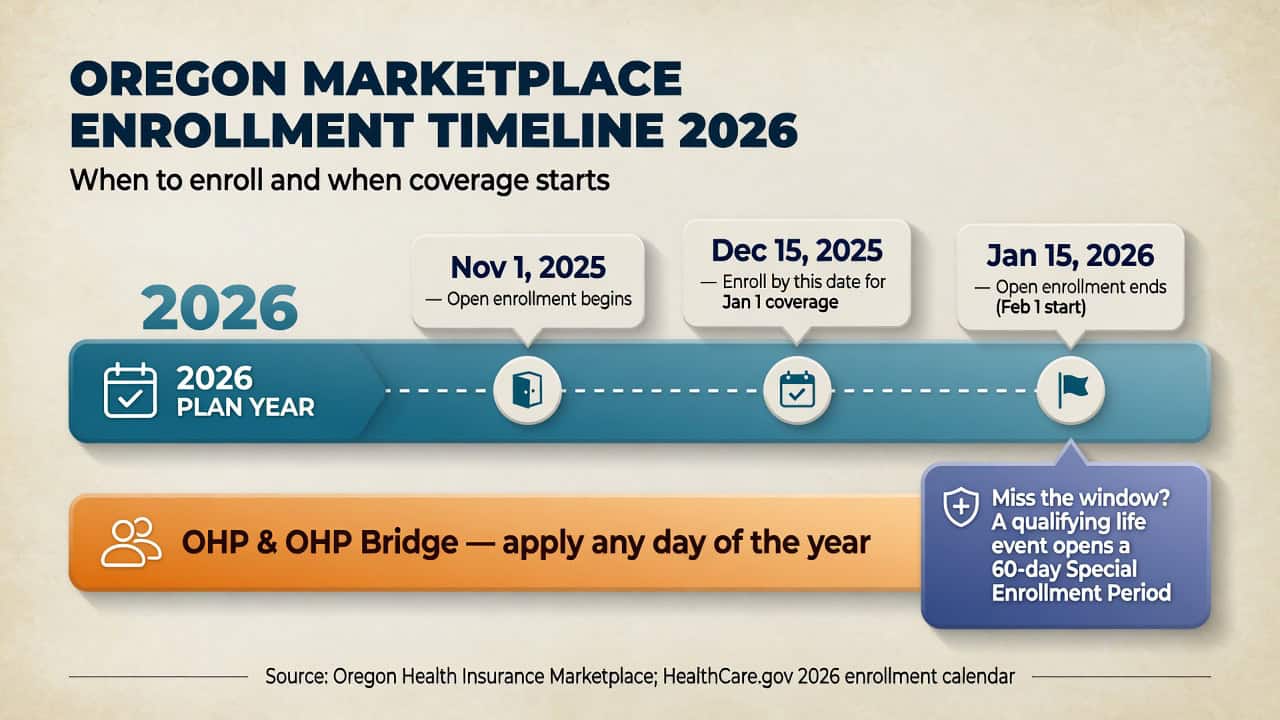
Oregon marketplace coverage for 2026 had an open enrollment window of November 1, 2025 through January 15, 2026. Outside that window, only a qualifying life event opens the door through a Special Enrollment Period. OHP and OHP Bridge stand apart, accepting applications every day of the year.
| Path | Window | Coverage Start |
|---|---|---|
| Open enrollment | Nov 1 – Jan 15 | Jan 1 or Feb 1 by date |
| Lost job-based coverage | 60 days before/after | First of next month |
| Marriage / birth / adoption | 60 days after | Event date or next month |
| Moved into Oregon | 60 days after | First of next month |
| OHP / OHP Bridge | Year-round | Often first of next month |
How Subsidies Apply When You Enroll
About 60 percent of Oregon’s roughly 126,000 marketplace enrollees used a premium tax credit for 2026, and the credit is applied during enrollment rather than claimed later. The marketplace calculates it from projected household income against the benchmark Silver plan in the applicant’s rating area, then subtracts it from the monthly premium.
For 2026 the enhanced federal credits expired, so eligibility reverted to the pre-2021 range of 100 to 400 percent of poverty, with no credit above that line. Two Oregon-specific factors still shape what enrollees actually pay. OHP Bridge removes the 138-to-200 percent band from the marketplace entirely, so the lowest-income shoppers are routed to no-cost coverage instead of a subsidized plan. And Oregon’s 1332 reinsurance waiver lowers the benchmark premium itself, which means each remaining credit covers more of the bill than it would in a non-waiver state.
Get Help Enrolling in the Oregon Marketplace
Navigating OregonHealthCare.gov, the HealthCare.gov platform, and OHP screening at once is where most enrollment mistakes happen. A licensed Oregon agent confirms subsidy and OHP Bridge eligibility, compares carriers in the right rating area, and completes enrollment at no cost.
Get a Quote Call 888-215-4045Documents and Information You’ll Need
Having the right details ready is what keeps an Oregon marketplace application from stalling. The single most important item is a realistic projection of 2026 household income, because it drives both the subsidy and any OHP or OHP Bridge determination.
- Projected 2026 income for the whole household, including self-employment and seasonal earnings.
- Social Security numbers and birth dates for everyone applying for coverage.
- Immigration document numbers for any family members who are not citizens.
- Employer coverage details if anyone in the household is offered a job-based plan.
- Current plan information if renewing or switching from existing coverage.
Applicants who report income changes mid-year should keep documentation current, since the marketplace and the Oregon Health Authority both use it to confirm eligibility and prevent coverage gaps.
Marketplace vs Off-Marketplace Plans in Oregon
Oregon residents can buy individual coverage either on the marketplace or directly from a carrier, and the underlying plans are frequently the same. The dividing line is the subsidy: a premium tax credit can be applied only to a marketplace plan, so the choice usually comes down to whether a household qualifies for one.
| Situation | Better Channel |
|---|---|
| Eligible for a premium tax credit | Marketplace (only place the credit applies) |
| Above 400% FPL, no credit for 2026 | Compare both — plans often identical |
| Wants a plan type not sold on-exchange | Off-marketplace, with an agent’s help |
| Qualifies for OHP or OHP Bridge | Neither — apply for the no-cost program |
For households that get no federal credit in 2026, the practical advice is to compare on network and total cost rather than assume the marketplace is cheaper. A deeper look at carrier choices sits on the best Oregon health plans comparison.
Frequently Asked Questions
What is the difference between OregonHealthCare.gov and HealthCare.gov?
OregonHealthCare.gov is the website of the Oregon Health Insurance Marketplace, the state agency that runs outreach, plan certification, and consumer help. HealthCare.gov is the federal enrollment platform that actually processes the application and sign-up. Oregon is a state-based marketplace that uses the federal platform, so residents typically start at OregonHealthCare.gov for guidance and are routed to the HealthCare.gov system to complete enrollment. The two work together rather than competing — one is the state front door, the other is the federal engine.
Who runs the Oregon health insurance marketplace?
The Oregon Health Insurance Marketplace, often abbreviated OHIM, is a division of the Oregon Department of Consumer and Business Services. It certifies which plans appear on the marketplace, runs statewide outreach and education, and supports a network of licensed agents and community partners. Because Oregon uses the federal HealthCare.gov platform for the enrollment transaction itself, OHIM focuses on the consumer-facing and regulatory side rather than operating its own enrollment software, an arrangement adopted after the 2015 closure of Cover Oregon.
Can I get a subsidy through the Oregon marketplace for 2026?
Yes. Premium tax credits are available only through the marketplace, and about 60 percent of Oregon marketplace enrollees received one for 2026. For 2026 the credits reverted to pre-2021 rules, so eligibility runs from 100 to 400 percent of the federal poverty level, and households above 400 percent receive no federal credit. The credit is calculated from household income and the cost of the benchmark Silver plan in the applicant’s rating area, then applied directly to lower the monthly premium at enrollment.
What happens if I miss Oregon open enrollment?
If the November 1 to January 15 window closes, a marketplace enrollment requires a qualifying life event that opens a Special Enrollment Period — for example losing job-based coverage, getting married, having a baby, or moving into Oregon. Most of these give a 60-day window to enroll. The Oregon Health Plan and OHP Bridge are the exception: they accept applications year-round, so a resident whose income qualifies for those programs never has to wait for open enrollment.
Do I have to use the marketplace, or can I buy off-exchange in Oregon?
Oregon residents can buy individual coverage either through the marketplace or directly from a carrier off-exchange, and the plans are often identical. The deciding factor is the subsidy: premium tax credits are available only on marketplace plans. A household that qualifies for a credit should almost always enroll through the marketplace. A household above 400 percent of poverty that gets no credit for 2026 may find off-exchange options worth comparing, since the plan and price are frequently the same.
What do I need to enroll in the Oregon marketplace?
To enroll in the Oregon health insurance marketplace, an applicant needs projected 2026 household income, Social Security numbers and dates of birth for everyone applying, immigration document numbers for any non-citizen family members, information about any employer coverage offered to the household, and a record of any current plan. Having an income estimate ready is the most important step, because the marketplace uses projected modified adjusted gross income to determine both subsidy eligibility and whether anyone in the household qualifies for OHP or OHP Bridge instead.
Related Oregon Health Insurance Resources
Explore the rest of the Oregon cluster: the full coverage guide, the six-carrier comparison, costs and affordability, plan types and tiers, individual and self-employed coverage, and small business group plans.
The complete 2026 overview: OHP, OHP Bridge, carriers, costs, and enrollment.
Best Oregon Health PlansCarrier ratings and 2026 comparisons across all six Oregon insurers.
Oregon Costs & AffordabilityPremium ranges, the subsidy cliff, and after-credit affordability for 2026.
Oregon Plans & TiersBronze, Silver, Gold, and Platinum plus HMO, PPO, and EPO types in Oregon.
Individual Oregon CoverageSelf-employed and individual market options, MAGI, and Bridge eligibility.
Oregon Small Business CoverageGroup plans, the tax credit, and 2026 small-group options for employers.
Enroll in an Oregon Marketplace Plan for 2026
From the first income estimate to the final plan confirmation, ForHealthInsurance.com handles the Oregon health insurance marketplace process, screens for OHP and OHP Bridge, and compares every carrier at no extra cost.
Get a Quote Call 888-215-4045Broker Disclosure
ForHealthInsurance.com is an independent health insurance agency serving Oregon residents. We are not affiliated with any carrier or government agency. We help you compare plans and enroll in coverage that meets your needs at no extra cost to you.