Individual Health Insurance Oregon 2026: Self-Employed Guide
Individual health insurance in Oregon is the coverage you buy yourself when no employer provides it — the route for the self-employed, freelancers, contractors, early retirees, and anyone between jobs. In Oregon that decision runs through a three-tier system: no-cost OHP or OHP Bridge below 200 percent of poverty, and a subsidized or private marketplace above it. This guide covers who needs individual coverage, how the self-employed estimate income, the OHP and Bridge options, marketplace versus private plans, and how to get covered after losing a job.

Who Needs Individual Health Insurance in Oregon
Individual health insurance in Oregon serves everyone who does not get a plan through a job or a public program. If you buy your own coverage, you are in the individual market — and in Oregon that market is unusually friendly, with six carriers and a no-cost tier for lower incomes that pulls many would-be individual buyers into OHP Bridge instead.
| Who | Why Individual Coverage |
|---|---|
| Self-employed & freelancers | No employer plan; income varies year to year |
| Contractors & gig workers | 1099 income, no group benefits |
| Early retirees (pre-65) | Bridge to Medicare eligibility |
| Between jobs | Coverage gap after leaving an employer |
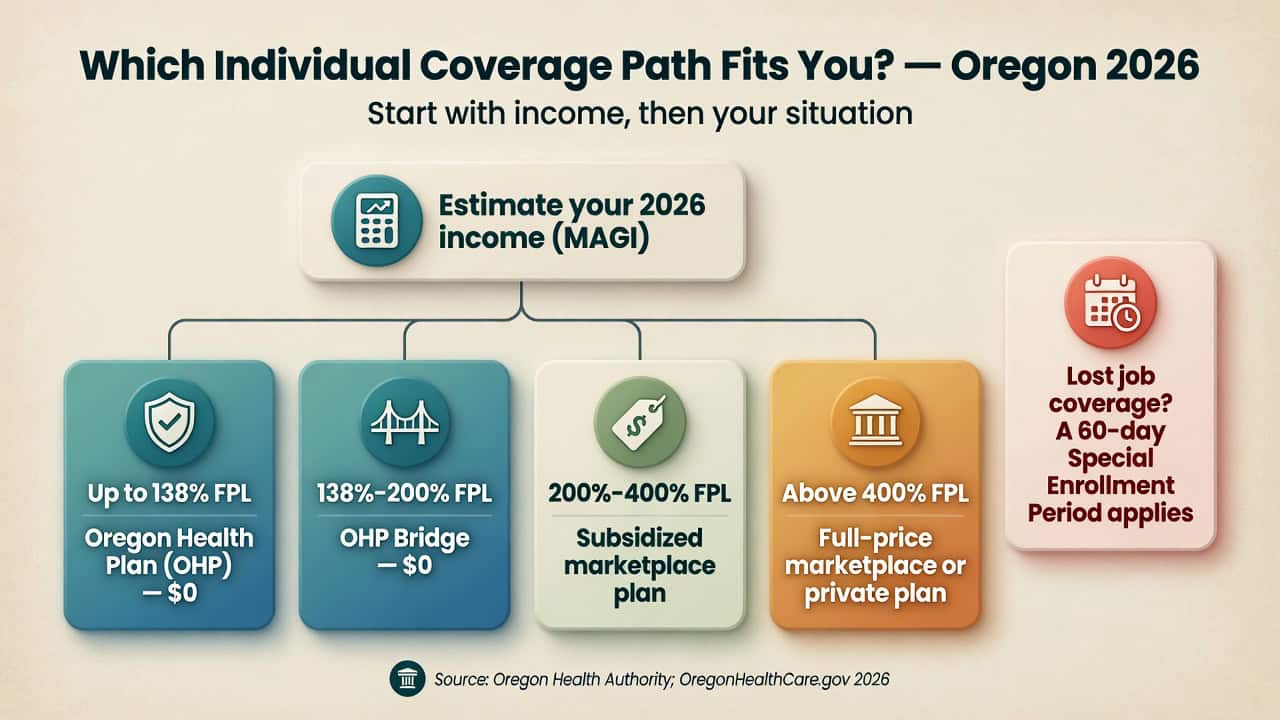
The first step for any of these Oregonians is an income estimate, because it decides whether the answer is free OHP or OHP Bridge, a subsidized marketplace plan, or a full-price private plan. That single screening question routes the entire individual coverage decision in Oregon.
Estimating MAGI as a Self-Employed Oregonian
For self-employed Oregonians, the number that drives everything is modified adjusted gross income, or MAGI — roughly net self-employment income after business expenses, plus any other taxable income. MAGI sets OHP and OHP Bridge eligibility and the size of any premium tax credit, so a careful projection is the most valuable step in buying individual coverage.
Because self-employment income swings, an Oregonian near the 200 percent poverty line can move between free OHP Bridge and a subsidized marketplace plan from one year to the next. Reporting income changes promptly at OregonHealthCare.gov keeps the household in the right tier and avoids surprises.
Individual Coverage Below 200% FPL: OHP and OHP Bridge
For lower-income individual buyers, Oregon often replaces a marketplace premium with no-cost coverage. OHP covers residents up to 138 percent of poverty, and OHP Bridge covers adults from 138 to 200 percent — the band that would carry a real premium in most states. Both are no-cost and delivered through 16 Coordinated Care Organizations.
| Income | Program | Cost |
|---|---|---|
| Up to 138% FPL | Oregon Health Plan | $0 |
| 138%–200% FPL | OHP Bridge | $0 |
| Above 200% FPL | Marketplace or private plan | Premium (credit if eligible) |
This is why many Oregonians who think they need to buy individual health insurance in Oregon actually qualify for free coverage instead. A single application at the marketplace screens for OHP and OHP Bridge first and only shows paid individual plans if the household does not qualify for the no-cost tiers.
Get an Oregon Individual Health Insurance Quote
Whether you are self-employed, between jobs, or retiring before Medicare, a licensed Oregon agent estimates your MAGI, screens OHP and OHP Bridge eligibility, and compares individual marketplace and private plans across every carrier at no cost.
Get a Quote Call 888-215-4045Individual Marketplace Plans Above 200% FPL
Oregonians above 200 percent of poverty buy individual health insurance in Oregon through the marketplace, where premium tax credits apply on a sliding scale up to 400 percent of poverty. Above 400 percent, no federal credit applies for 2026, but Oregon’s reinsurance program keeps full-price premiums lower than most states.
| Income Band | What Applies |
|---|---|
| 200%–250% FPL | Subsidy plus Silver cost-sharing reductions |
| 250%–400% FPL | Premium tax credit on a sliding scale |
| Above 400% FPL | Full price; reinsurance keeps rates lower |
For the 200-to-250 percent band, a Silver plan captures cost-sharing reductions and is usually the best individual value. Higher earners who lose the credit at the 400 percent cliff should compare metal tiers and networks on total cost, since Oregon’s six carriers compete in every county.
Losing Job-Based Coverage: SEPs vs COBRA in Oregon
An Oregonian who loses job-based coverage gets a 60-day Special Enrollment Period to pick up an individual plan through OregonHealthCare.gov, and the income drop often newly qualifies them for OHP, OHP Bridge, or a larger subsidy. The SEP rules are federal, but the Oregon options on the other side are what make the choice favorable.
| Path | Cost | Subsidy |
|---|---|---|
| Individual marketplace (SEP) | Premium (often subsidized) | Yes, if eligible |
| OHP / OHP Bridge | $0 if income qualifies | N/A — no premium |
| COBRA | Full premium + admin fee | No |
COBRA lets a worker keep the exact employer plan, but at the full unsubsidized premium plus a fee — usually the most expensive option. For most Oregonians, an individual marketplace plan during the Special Enrollment Period, or newly available OHP Bridge after an income drop, costs far less than COBRA for comparable coverage.
Private vs Marketplace Individual Plans in Oregon
Private health insurance in Oregon refers to individual plans bought directly from a carrier off the marketplace, rather than through OregonHealthCare.gov. The plans are frequently the same coverage; the deciding factor is the premium tax credit, which can be applied only to a marketplace plan.
| Situation | Better Choice |
|---|---|
| Eligible for a tax credit | Marketplace — only place the credit applies |
| Above 400% FPL, no credit for 2026 | Compare private and marketplace — often identical |
| Wants a plan not sold on-exchange | Private off-marketplace, with an agent’s help |
For a household that gets no credit in 2026, private health insurance in Oregon and a marketplace plan usually cost the same, so the comparison comes down to network and plan design. For anyone who qualifies for a subsidy, the marketplace almost always wins because the credit cannot follow a private off-exchange plan.
Frequently Asked Questions
Who needs individual health insurance in Oregon?
Individual health insurance in Oregon is for residents who do not get coverage through an employer: the self-employed, freelancers and gig workers, contractors, early retirees before Medicare, and people between jobs. Anyone who buys their own plan rather than getting it from a job or a public program is in the individual market. In Oregon, lower-income individual buyers may instead qualify for no-cost OHP or OHP Bridge, which a single application screens for automatically before showing marketplace plans.
How do self-employed Oregonians estimate income for coverage?
Self-employed Oregonians estimate modified adjusted gross income, or MAGI, which is roughly net self-employment income after business expenses plus any other taxable income. MAGI is what determines OHP and OHP Bridge eligibility and the size of any premium tax credit. Because self-employment income varies, a careful annual projection matters: estimate too high and you overpay; estimate too low and you may owe credit back at tax time. Reporting income changes during the year keeps the estimate accurate.
Is private health insurance the same as marketplace coverage in Oregon?
Private health insurance in Oregon usually means an individual plan bought directly from a carrier off the marketplace, while marketplace coverage is bought through OregonHealthCare.gov. The plans are often identical, but premium tax credits can be applied only to marketplace plans. A household eligible for a credit should enroll through the marketplace; one above 400 percent of poverty that gets no credit for 2026 may compare private off-exchange plans, since the coverage and price are frequently the same.
Can I get individual coverage after losing my job in Oregon?
Yes. Losing job-based coverage triggers a Special Enrollment Period of 60 days to enroll in an individual marketplace plan in Oregon. That is usually a better value than COBRA, which lets you keep the employer plan but requires paying the full premium plus an administrative fee with no subsidy. A marketplace plan may qualify for a premium tax credit, and lower-income workers may newly qualify for OHP or OHP Bridge after the income drop.
What is the cheapest individual health insurance in Oregon?
The cheapest individual coverage in Oregon is free for those who qualify: OHP for residents up to 138 percent of the federal poverty level, and OHP Bridge for adults from 138 to 200 percent. Above that, the lowest-premium individual plan is usually Bronze, though a subsidized Silver plan can cost less overall once cost-sharing reductions are counted for households between 100 and 250 percent of poverty. An income estimate determines which applies.
Can I buy individual health insurance outside open enrollment in Oregon?
An individual marketplace plan can be bought outside the November-to-January open enrollment window only with a qualifying life event — losing job-based coverage, marriage, birth, adoption, or moving into Oregon — which opens a 60-day Special Enrollment Period. The Oregon Health Plan and OHP Bridge are different: they accept applications year-round, so an income-eligible individual can enroll in those programs at any time without waiting for a window or an event.
Related Oregon Health Insurance Resources
Explore the rest of the Oregon cluster: the full coverage guide, marketplace enrollment, the six-carrier comparison, costs and affordability, plan types and tiers, and small business group plans.
The complete 2026 overview: OHP, OHP Bridge, carriers, costs, and enrollment.
Oregon Marketplace GuideStep-by-step enrollment through OregonHealthCare.gov and the federal platform.
Best Oregon Health PlansCarrier ratings and 2026 comparisons across all six Oregon insurers.
Oregon Costs & AffordabilityPremium ranges, the subsidy cliff, and after-credit affordability for 2026.
Oregon Plans & TiersBronze, Silver, Gold, and Platinum plus HMO, PPO, and EPO types in Oregon.
Oregon Small Business CoverageGroup plans, the tax credit, and 2026 small-group options for employers.
Find the Best Individual Health Insurance in Oregon
From estimating MAGI to screening OHP Bridge to comparing marketplace and private plans, ForHealthInsurance.com finds the right individual coverage for self-employed and independent Oregonians at no extra cost.
Get a Quote Call 888-215-4045Broker Disclosure
ForHealthInsurance.com is an independent health insurance agency serving Oregon residents. We are not affiliated with any carrier or government agency. We help you compare plans and enroll in coverage that meets your needs at no extra cost to you.