Small Business Health Insurance Oregon 2026: Full Guide
Small business health insurance in Oregon for 2026 gives employers three real routes to cover a team: a traditional small-group plan, an ICHRA that reimburses workers for individual coverage, or sending employees to the Oregon marketplace. Oregon small-group premiums rose a weighted average of about 11.5 percent for 2026, and eight carriers compete for groups of 1 to 50 employees. This guide covers the options, the carriers and rates, the Small Business Health Care Tax Credit, how ICHRA works in Oregon, what employers contribute, and how to set coverage up.

Oregon Small Business Health Insurance Options for 2026
Oregon employers choosing small business health insurance in Oregon weigh three structures that suit different team sizes and budgets. A small-group plan covers businesses with 1 to 50 full-time-equivalent employees; ICHRA reimburses individual premiums tax-free; and very small or sole-owner businesses often use the individual marketplace directly. The right route depends on headcount, budget, and how much administration an owner wants.
| Option | Best For | How It Works |
|---|---|---|
| Small-group plan | 1–50 FTEs | Employer buys one group plan; shares premium |
| ICHRA | Any size | Employer reimburses individual-plan premiums tax-free |
| Individual marketplace | Sole owners, no employees | Owner enrolls through OregonHealthCare.gov |
A small-group plan generally requires at least one common-law employee beyond the owner, the owner’s spouse, or family. A sole proprietor with no other employees usually cannot buy small-group coverage and instead shops the individual market, where OHP Bridge may also cover lower-income owners. Matching the structure to the business is the first decision before comparing any carrier.
Oregon Small Group Market: Carriers and 2026 Rates
Eight carriers filed 2026 small-group rates in Oregon, and approved increases ran from roughly 5 percent at PacificSource to 21.5 percent at Providence, for a weighted average near 11.5 percent. That is higher than the individual market’s 9.7 percent but still anchored by Oregon’s largely Oregon-based carriers and competitive market.
| 2026 Small-Group Measure | Oregon |
|---|---|
| Carriers filing rates | 8 companies |
| Weighted average increase | ~11.5% |
| Lowest approved increase | ~5% (PacificSource) |
| Highest approved increase | 21.5% (Providence) |
| Eligible group size | 1–50 full-time-equivalent |
The same Oregon-headquartered names that lead the individual market — Moda, Regence, PacificSource, and Providence — anchor the small-group market, so an employer’s carrier choice often comes down to which network includes the providers employees already use. A licensed agent can compare all eight carriers for a specific county and group.
The Small Business Health Care Tax Credit
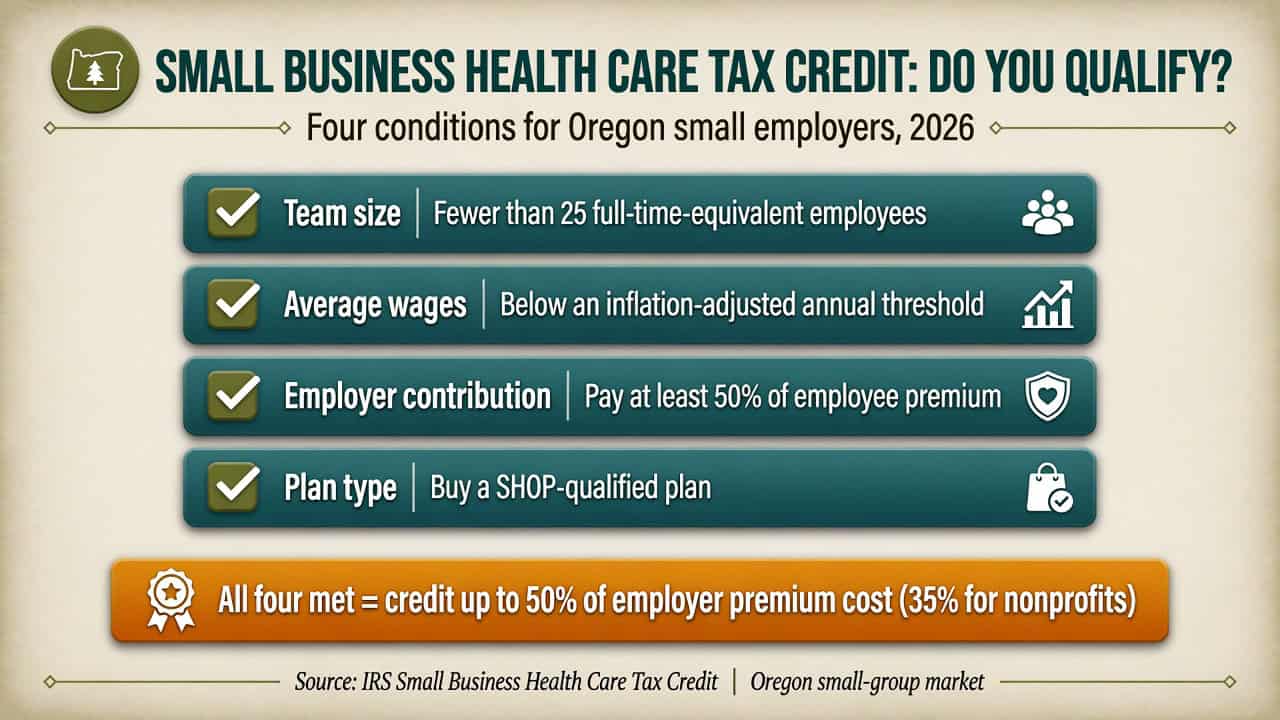
Oregon small employers that buy a SHOP-qualified plan can claim a federal credit that materially cuts the cost of small business health insurance in Oregon. The Small Business Health Care Tax Credit is worth up to 50 percent of employer premium contributions, or 35 percent for tax-exempt employers.
The federal rules are the same in every state, but the path runs through Oregon’s small-group market. To qualify, a business must have fewer than 25 full-time-equivalent employees, pay average annual wages below an inflation-adjusted threshold, contribute at least 50 percent of the employee premium, and enroll in a SHOP-qualified plan. The credit is available for two consecutive tax years and is claimed on the business tax return, so pairing it with the right Oregon carrier plan is what turns eligibility into savings.
Compare Oregon Small Business Coverage Options
Group plan, ICHRA, or marketplace — the right structure depends on headcount, budget, and tax-credit eligibility. A licensed Oregon agent compares all eight small-group carriers, checks Small Business Health Care Tax Credit eligibility, and sets up coverage at no cost.
Get a Quote Call 888-215-4045ICHRA: An Alternative to Group Coverage in Oregon
Oregon’s competitive individual marketplace — six carriers and at least five in every county — makes ICHRA an unusually strong fit for small businesses in the state. An Individual Coverage Health Reimbursement Arrangement lets an employer reimburse workers tax-free for individual premiums and medical costs instead of running a group plan.
The mechanics are federal and identical everywhere: the employer sets a monthly allowance, employees buy their own individual plan, and reimbursements are tax-free to both sides. What makes it work well in Oregon is the local market — a deep individual marketplace for employees to shop, plus the OHP Bridge program that covers lower-income workers separately, so an ICHRA allowance stretches further. ICHRA has no minimum participation requirement and fits businesses of any size.
What Oregon Small Businesses Pay and Contribute
What an Oregon small business pays for health insurance depends on employee ages, plan tier, carrier network, and how the premium is split. Most Oregon employers contribute at least half of the employee premium, which is also the floor for claiming the tax credit.
| Cost Factor | Typical Oregon Practice |
|---|---|
| Employer premium share | 50%+ of employee-only premium |
| Dependent coverage | Often employee-paid or partially shared |
| Plan tier offered | Commonly Silver or Bronze group plans |
| 2026 small-group trend | ~11.5% weighted average increase |
Contributing 50 percent or more is both a competitive norm and the threshold for the Small Business Health Care Tax Credit, so many Oregon employers set their contribution there deliberately. An agent can model the after-credit cost of small business health insurance in Oregon before the business commits to a plan.
How to Set Up Oregon Small Business Coverage
Setting up small business health insurance in Oregon is more flexible than individual coverage because small-group plans can start any month of the year, not just during open enrollment. The process runs through a licensed agent or carrier rather than a public website.
- Confirm eligibility. Verify the business has 1 to 50 full-time-equivalent employees and at least one non-owner employee.
- Choose a structure. Decide between a small-group plan, ICHRA, or directing employees to the marketplace.
- Compare carriers. Review the eight Oregon small-group carriers for the business’s county and employee networks.
- Set contribution and check the credit. Choose an employer share — at least 50 percent to qualify for the tax credit on a SHOP-qualified plan.
- Enroll and onboard. Finalize the plan, collect employee elections, and set the effective date.
Because small-group coverage is not tied to the annual window, an Oregon business can launch a plan whenever it is ready. Working with a broker keeps the eight-carrier comparison, tax-credit check, and ICHRA-versus-group decision in one place.
Frequently Asked Questions
How many employees do you need for Oregon small business health insurance?
Oregon small-group health insurance is available to businesses with 1 to 50 full-time-equivalent employees. The business generally must have at least one common-law employee who is not the owner, the owner’s spouse, or a family member. Sole proprietors with no employees usually buy individual coverage through the Oregon marketplace instead. At 50 or more full-time-equivalent employees, a business becomes an Applicable Large Employer and falls under the federal employer mandate.
What is the Small Business Health Care Tax Credit?
The Small Business Health Care Tax Credit is a federal credit worth up to 50 percent of what an employer pays toward employee premiums, or 35 percent for tax-exempt employers. To qualify, a business must have fewer than 25 full-time-equivalent employees, pay average annual wages below an inflation-adjusted threshold, contribute at least 50 percent of premium cost, and buy a SHOP-qualified plan. The credit is available for two consecutive tax years and is claimed on the business return.
Can Oregon small businesses use ICHRA instead of a group plan?
Yes. An Individual Coverage Health Reimbursement Arrangement lets an Oregon employer reimburse workers tax-free for individual marketplace premiums and qualified medical costs instead of offering a traditional group plan. ICHRA has no minimum participation requirement and works for businesses of any size, which makes it appealing in Oregon where the individual marketplace is competitive and the OHP Bridge program covers lower-income workers separately. Employees buy their own plan and the employer sets a monthly allowance.
How much do Oregon small businesses pay for health insurance?
Oregon small-group premiums rose a weighted average of about 11.5 percent for 2026, with approved carrier increases ranging from roughly 5 percent at PacificSource to 21.5 percent at Providence. Most Oregon employers contribute 50 percent or more of the employee premium, which is also the minimum needed to claim the Small Business Health Care Tax Credit. Actual cost depends on employee ages, plan tier, and the carrier’s network in the business’s county.
Do Oregon small businesses have to offer health insurance?
No. Oregon businesses with fewer than 50 full-time-equivalent employees are not required to offer health insurance under federal law, and Oregon has no separate state mandate for small employers. Coverage is optional but widely offered to attract and keep workers. Businesses that reach 50 or more full-time-equivalent employees become Applicable Large Employers and must offer affordable, adequate coverage or face a federal shared-responsibility penalty.
How do Oregon small businesses enroll in coverage?
Oregon small businesses enroll in group coverage through a licensed agent or directly with a carrier, and small-group plans can be started at any time of year rather than only during open enrollment. To claim the Small Business Health Care Tax Credit, the plan must be SHOP-qualified. A broker compares the eight small-group carriers, confirms tax-credit eligibility, and handles setup, contribution design, and ICHRA as an alternative when it fits better.
Related Oregon Health Insurance Resources
Explore the rest of the Oregon cluster: the full coverage guide, marketplace enrollment, the six-carrier comparison, costs and affordability, plan types and tiers, and individual and self-employed coverage.
The complete 2026 overview: OHP, OHP Bridge, carriers, costs, and enrollment.
Oregon Marketplace GuideStep-by-step enrollment through OregonHealthCare.gov and the federal platform.
Best Oregon Health PlansCarrier ratings and 2026 comparisons across all six Oregon insurers.
Oregon Costs & AffordabilityPremium ranges, the subsidy cliff, and after-credit affordability for 2026.
Oregon Plans & TiersBronze, Silver, Gold, and Platinum plus HMO, PPO, and EPO types in Oregon.
Individual Oregon CoverageSelf-employed and individual market options, MAGI, and Bridge eligibility.
Set Up Oregon Small Business Health Insurance
From group plans to ICHRA to the tax credit, ForHealthInsurance.com compares every Oregon small-group carrier and finds the right structure for your team at no extra cost.
Get a Quote Call 888-215-4045Broker Disclosure
ForHealthInsurance.com is an independent health insurance agency serving Oregon businesses. We are not affiliated with any carrier or government agency. We help you compare plans and enroll in coverage that meets your needs at no extra cost to you.