Affordable Health Insurance Oregon 2026: Costs & Options
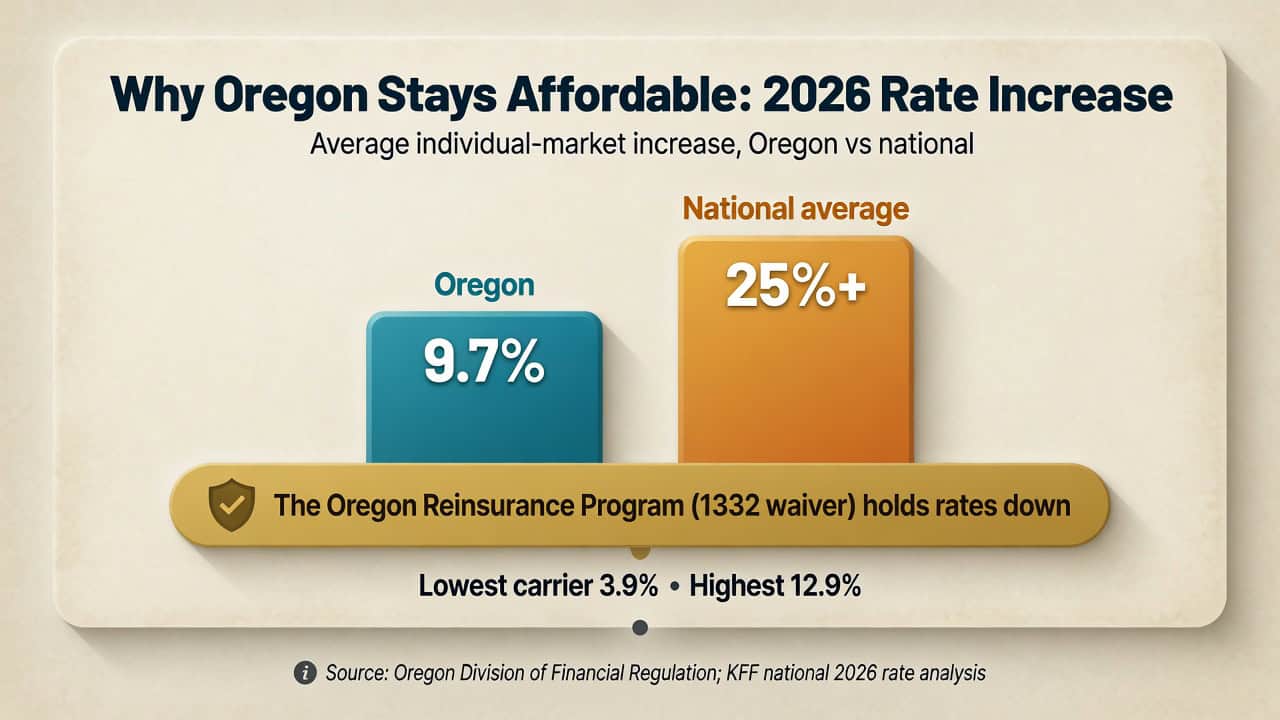
Finding affordable health insurance in Oregon for 2026 starts with a fact most cost guides miss: the cheapest coverage in the state is free. Residents up to 200 percent of the federal poverty level qualify for no-cost OHP or OHP Bridge, and everyone above that shops a marketplace that Oregon keeps unusually cheap through its reinsurance program. Oregon’s finalized 2026 rate increase was just 9.7 percent — against a national average above 25 percent. This guide covers the free tiers, how the 1332 reinsurance waiver lowers premiums, the cheapest metal tier, regional price differences, and concrete ways to cut a premium.

How Affordable Is Health Insurance in Oregon for 2026?
Affordable health insurance in Oregon depends almost entirely on income, because the state stacks two no-cost programs beneath the marketplace. A household’s first question is not which plan, but which tier it lands in. Below 200 percent of poverty, coverage is free. Above it, the marketplace applies, and Oregon’s reinsurance program keeps those premiums lower than most states.
| Who You Are | Cheapest Coverage | Typical Monthly Cost |
|---|---|---|
| Up to 138% FPL | Oregon Health Plan | $0 |
| 138%–200% FPL | OHP Bridge | $0 |
| 200%–400% FPL | Subsidized Silver or Bronze | Sliding scale after credit |
| Above 400% FPL | Lowest-cost Bronze (no credit) | $420–$1,400 by age |
This is the most important affordability insight in Oregon: a single adult earning $30,000 pays nothing through OHP Bridge, while in many other states the same income would buy a subsidized marketplace plan with a real monthly premium. Knowing the exact income thresholds — and reporting income accurately — is what separates free coverage from a needless premium.
Oregon’s Cheapest Coverage Is Free: OHP and OHP Bridge
For more than a third of Oregonians, affordable health insurance in Oregon means no premium at all. The Oregon Health Plan covers residents up to 138 percent of poverty, and OHP Bridge — the Basic Health Program Oregon launched in July 2024 — covers adults under 65 from 138 to 200 percent. Neither charges a premium, copay, or deductible.
Because eligibility turns on projected annual income, a household near the 200 percent line should estimate carefully. A modest raise or a strong freelance quarter can push income above the Bridge ceiling and into marketplace premiums, while a slower year can pull it back into no-cost coverage. Reporting changes promptly keeps the household in the cheapest tier it qualifies for.
How Oregon’s 1332 Reinsurance Waiver Keeps Premiums Down
The single biggest reason Oregon marketplace premiums stay affordable is the Oregon Reinsurance Program, a 1332 waiver in place since 2018. It reimburses carriers for a slice of their highest-cost claims, which lets insurers file lower base rates for everyone in the individual market.
| 2026 Rate Measure | Oregon | National |
|---|---|---|
| Avg. individual-market increase | 9.7% | 25%+ |
| Lowest carrier increase | 3.9% (PacificSource) | — |
| Highest carrier increase | 12.9% (Kaiser) | — |
| Carriers per county (minimum) | 5 | Varies widely |
The waiver lowers full-price premiums whether or not a household receives a subsidy, so it benefits the above-400-percent buyers who get no federal credit in 2026 just as much as subsidized enrollees. Combined with a competitive market — at least five carriers in every county — the reinsurance program is why Oregon’s 2026 increase came in at roughly a third of the national figure.
Find the Most Affordable Oregon Plan for Your Income
A few hundred dollars of income can be the difference between a free OHP Bridge plan and a marketplace premium. A licensed Oregon agent screens for OHP and Bridge eligibility, then compares reinsurance-reduced plans across every carrier at no cost.
Get a Quote Call 888-215-4045Bronze, Silver, or Gold: Which Is Cheapest in Oregon?
Bronze plans carry Oregon’s lowest monthly premium, but the cheapest premium is not always the cheapest year. The right answer depends on income and how much care the household expects to use, because cost-sharing reductions can quietly make Silver the better deal.
| Tier | Premium | Best For |
|---|---|---|
| Bronze | Lowest monthly | Healthy, above 250% FPL, rare care use |
| Silver (with CSR) | Moderate | 100%–250% FPL — CSR cuts deductibles sharply |
| Gold | Higher monthly | Frequent care use; lower out-of-pocket |
For an Oregon household between 100 and 250 percent of poverty, Silver is usually the smartest buy because cost-sharing reductions lower the deductible and out-of-pocket maximum well below what a Bronze plan offers, even though Bronze looks cheaper on the premium line. Above 250 percent, where those reductions disappear, Bronze tends to win for low utilizers, and pairing a high-deductible Bronze plan with an HSA adds a tax-advantaged cushion.
Affordable Coverage by Region: Portland, the Coast, and Eastern Oregon
Full-price Oregon premiums vary by rating area, driven mainly by how many carriers compete locally and how far enrollees sit from in-network specialty care. The Portland metro and Willamette Valley generally see the most competition and the most plan choices, while the coast and parts of eastern Oregon have fewer options.
| Region | Carrier Competition | Affordability Note |
|---|---|---|
| Portland metro | Highest — incl. Kaiser HMO | Most plan choice; Kaiser integrated option |
| Willamette Valley | High | Strong statewide-carrier presence |
| Oregon coast | At least 5 carriers | Fewer HMO options; PPO networks matter |
| Eastern Oregon | At least 5 carriers | Travel distance shapes network value |
Oregon’s floor of at least five carriers in every county means even rural enrollees keep real choice, which is not true in many states where rural counties drop to one or two insurers. The practical takeaway: compare networks alongside premiums, because in lower-competition regions the cheapest plan may route care to distant providers. Comparing regional options is part of finding the most affordable health insurance in Oregon for a given household.
How to Lower Your Oregon Health Insurance Premium
Most Oregon households can cut their net cost with a few deliberate moves. The largest lever is income accuracy, since it decides whether coverage is free or carries a premium at all.
Frequently Asked Questions
What is the cheapest health insurance in Oregon?
The cheapest health insurance in Oregon is free. Residents earning up to 138 percent of the federal poverty level qualify for the Oregon Health Plan, and adults between 138 and 200 percent qualify for OHP Bridge — both carry no premium, no copays, and no deductible. For households above those limits, the lowest-premium marketplace option is usually a Bronze plan, though after a premium tax credit a Silver plan can end up cheaper in total annual cost once cost-sharing reductions are counted.
How does the Oregon Reinsurance Program lower premiums?
Oregon has operated a 1332 reinsurance waiver, known as the Oregon Reinsurance Program, since 2018. The program uses state and federal funds to reimburse carriers for a portion of their highest-cost claims, which lets insurers file lower base rates than they otherwise would. The effect shows up in Oregon’s modest 2026 rate increase of 9.7 percent, well below the national average of more than 25 percent. The waiver lowers full-price premiums for every marketplace enrollee, subsidized or not.
Is a Bronze or Silver plan cheaper in Oregon?
Bronze plans carry the lowest monthly premium in Oregon, but they are not always the cheapest overall. For households between 100 and 250 percent of the federal poverty level, Silver plans include cost-sharing reductions that lower deductibles and out-of-pocket maximums dramatically, often making Silver the better total value despite a higher premium. Above 250 percent of poverty, where cost-sharing reductions no longer apply, Bronze tends to win for healthy enrollees who rarely use care.
What is the income limit for free coverage in Oregon?
Free coverage in Oregon runs up to 200 percent of the federal poverty level for adults. The Oregon Health Plan covers residents up to 138 percent of poverty, which is roughly $21,600 for a single adult in 2026. OHP Bridge then covers adults under 65 from 138 to 200 percent, roughly $21,600 to $31,300 for a single adult. Both programs are no-cost and are administered through 16 regional Coordinated Care Organizations. Children qualify for the Oregon Health Plan at higher income levels.
Why is health insurance cheaper in Oregon than most states?
Oregon’s full-price premiums sit below the national average mainly because of the Oregon Reinsurance Program, the 1332 waiver that has reimbursed carriers for high-cost claims since 2018. For 2026, Oregon’s finalized individual-market increase was 9.7 percent against a national average above 25 percent. Oregon also keeps at least five carriers competing in every county, and OHP Bridge pulls lower-income enrollees into a separate no-cost program, which together help hold the marketplace risk pool and pricing steadier than in many states.
How can I lower my Oregon health insurance premium?
The biggest lever is an accurate income estimate, because it determines whether the household lands in free OHP or OHP Bridge coverage or in a subsidized marketplace plan. Beyond that, applying the premium tax credit to the right metal tier, choosing Silver to capture cost-sharing reductions when income qualifies, pairing a high-deductible plan with an HSA, and re-shopping at renewal instead of auto-renewing all reduce what an Oregon household actually pays for coverage.
Related Oregon Health Insurance Resources
Explore the rest of the Oregon cluster: the full coverage guide, marketplace enrollment, the six-carrier comparison, plan types and tiers, individual and self-employed coverage, and small business group plans.
The complete 2026 overview: OHP, OHP Bridge, carriers, costs, and enrollment.
Oregon Marketplace GuideStep-by-step enrollment through OregonHealthCare.gov and the federal platform.
Best Oregon Health PlansCarrier ratings and 2026 comparisons across all six Oregon insurers.
Oregon Plans & TiersBronze, Silver, Gold, and Platinum plus HMO, PPO, and EPO types in Oregon.
Individual Oregon CoverageSelf-employed and individual market options, MAGI, and Bridge eligibility.
Oregon Small Business CoverageGroup plans, the tax credit, and 2026 small-group options for employers.
Find Affordable Oregon Health Insurance Now
Whether the cheapest path is free OHP Bridge coverage or a reinsurance-reduced marketplace plan, ForHealthInsurance.com screens eligibility, compares every Oregon carrier, and finds the lowest-cost option at no extra cost.
Get a Quote Call 888-215-4045Broker Disclosure
ForHealthInsurance.com is an independent health insurance agency serving Oregon residents. We are not affiliated with any carrier or government agency. We help you compare plans and enroll in coverage that meets your needs at no extra cost to you.