Affordable Health Insurance West Virginia 2026
Finding affordable health insurance in West Virginia in 2026 means navigating a market with the highest Marketplace premiums in the country — a benchmark Silver plan averaging $919 per month — but also one of the strongest subsidy structures in the nation, with roughly 95 percent of West Virginia Marketplace enrollees qualifying for federal premium tax credits. Mountain Health Trust Medicaid covers residents at or below 138 percent of the federal poverty level at no cost, and WVCHIP provides free or low-cost coverage for children in families earning up to approximately 300 percent of FPL. The 2026 plan year brought a significant change: the enhanced premium tax credits that had kept costs low through 2025 expired at the end of December 2025, creating a sharper subsidy cliff for higher-income West Virginians and causing Marketplace enrollment to drop nearly 17 percent from 67,113 to 55,879. West Virginia also has no state individual mandate penalty — there is no tax consequence for going uninsured at the state or federal level. This guide maps every affordable health insurance West Virginia path for 2026, from free Medicaid coverage to subsidized HealthCare.gov plans, with real premium examples for Charleston, Huntington, and Morgantown households.
What brings you here today?
Free and Low-Cost Health Insurance in West Virginia: The Income Path Map
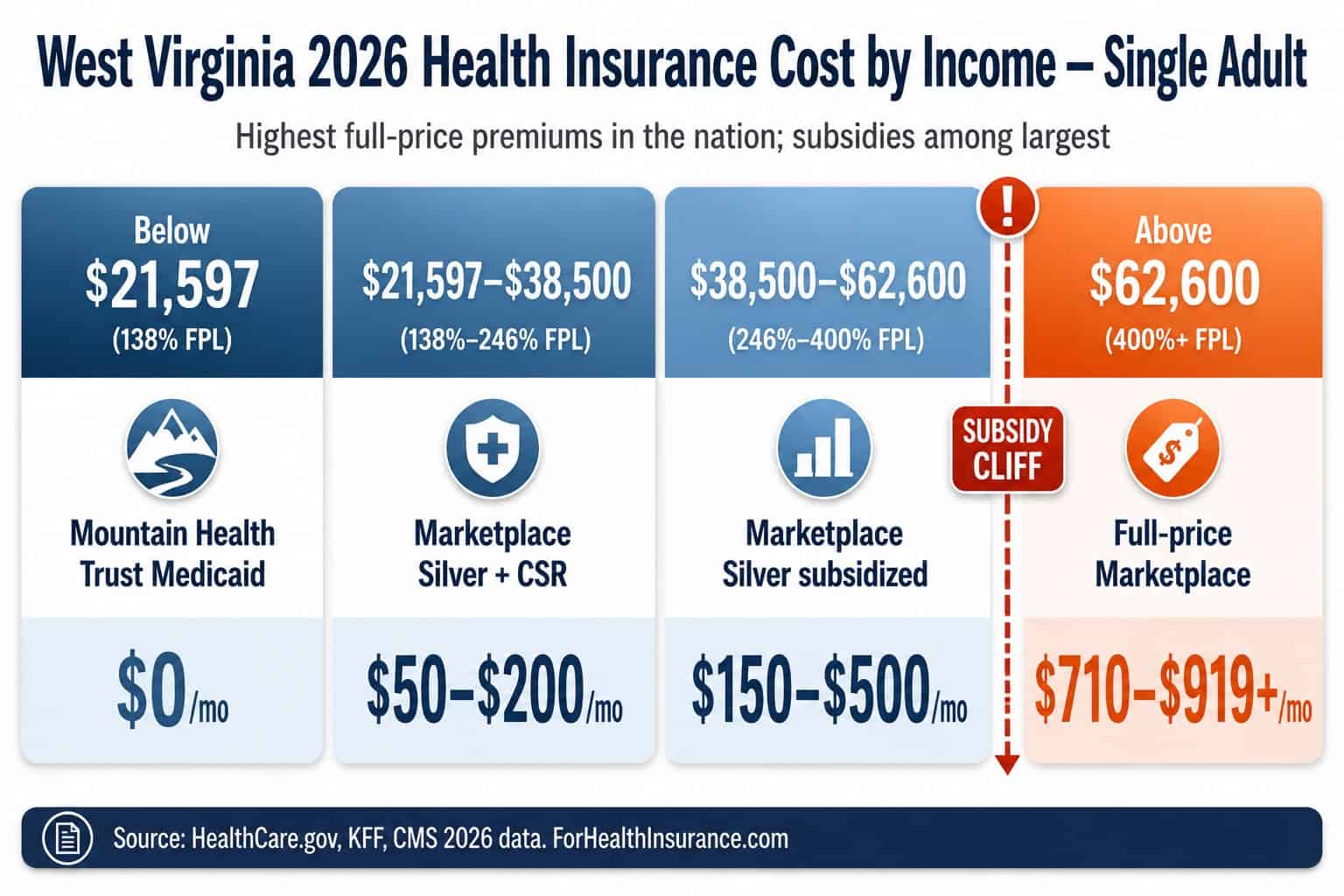
Affordable health insurance in West Virginia follows income. Below 138 percent of the federal poverty level, Mountain Health Trust Medicaid is free. Between 138 and 400 percent of FPL, HealthCare.gov Marketplace plans with Advance Premium Tax Credits typically run $0 to $200 per month for a subsidized Silver plan. Above 400 percent of FPL, the 2025 expiration of enhanced credits returned the subsidy cliff — full-price West Virginia Marketplace plans are the most expensive in the country.
The federal poverty level sets the income thresholds for affordable health insurance West Virginia residents can access. In 2026 it is $15,650 for a single adult and $32,150 for a family of four in the contiguous United States (Alaska and Hawaii use higher figures). West Virginia’s income cutoffs for each coverage path follow these thresholds: Mountain Health Trust covers up to 138 percent of FPL (about $21,597 for one person); WVCHIP covers children up to approximately 300 percent of FPL (about $96,450 for a family of four); premium tax credits phase in at 100 percent of FPL and phase out at 400 percent ($62,600 for one person). Residents between 100 and 138 percent of FPL may choose between Mountain Health Trust Medicaid and a subsidized Marketplace plan — both are available at this income band, and Medicaid is typically the lower-cost option.
West Virginia has no state individual mandate penalty. The federal mandate penalty has been $0 since 2019. This means West Virginians face no tax consequence for going uninsured — but uninsured West Virginians bear full liability for any medical costs, and the state’s rural hospital landscape includes many critical-access hospitals where a single emergency visit without coverage can result in bills of $10,000 to $50,000 or more. The economic protection that affordable health insurance West Virginia residents carry is real even without a legal mandate. For the full overview of all West Virginia health insurance options, see the state pillar page.
Mountain Health Trust: Free Medicaid Coverage for West Virginians Below 138% FPL
Mountain Health Trust is West Virginia’s Medicaid managed care program — the largest source of free affordable health insurance West Virginia residents can access. It covers approximately 87 percent of the state’s Medicaid membership through four MCOs: Aetna Better Health, The Health Plan, UniCare Health Plan of West Virginia, and Highmark Health Options. Single adults earning below $21,597 and families of four below $44,367 typically qualify. WVCHIP covers children up to approximately 300 percent of FPL.
West Virginia expanded Medicaid under the ACA in 2014, opening Mountain Health Trust eligibility to most adults regardless of family status, disability, or employment status. Before expansion, non-disabled adults without dependent children were generally ineligible for Medicaid in West Virginia; expansion changed that. As of recent data, Mountain Health Trust total enrollment has run between approximately 400,000 and 440,000 covered lives — roughly one in four West Virginia residents. West Virginia’s Medicaid expansion is among the most impactful in the country given the state’s poverty rate and rural healthcare access challenges.
Mountain Health Trust 2026 income limits
Single adult: up to $21,597/year (138% FPL). Household of 2: up to $29,160/year. Household of 3: up to $36,777/year. Family of 4: up to $44,367/year. Income is counted as modified adjusted gross income (MAGI) per federal Medicaid rules — most income counts, but some sources like child support received, veterans benefits, and certain SSI payments are excluded. Apply through the West Virginia DHHR or HealthCare.gov; coverage is retroactive to the date of application in most cases.
WVCHIP (children, up to ~300% FPL)
WVCHIP — West Virginia’s Children’s Health Insurance Program — was integrated into Mountain Health Trust in January 2021. WVCHIP covers uninsured children in families that earn too much for traditional Medicaid but cannot afford private coverage. Eligibility extends to approximately 300 percent of FPL (roughly $96,450 for a family of four in 2026). WVCHIP coverage costs range from $0 to a small monthly premium depending on family income. Children enrolled in WVCHIP receive the same benefits as Mountain Health Trust Medicaid including preventive care, dental, vision, and behavioral health services.
Mountain Health Promise (behavioral health)
Mountain Health Promise is West Virginia’s separate 1915(b) behavioral health managed care waiver for Medicaid enrollees needing mental health and substance use disorder services. West Virginia’s Section 1115 SUD demonstration waiver — “Evolving West Virginia Medicaid’s Behavioral Health Continuum of Care,” renewed January 2025 through December 2029 — allows the state to cover SUD treatment in Institutions for Mental Disease that standard Medicaid would not fund. For West Virginia residents with behavioral health needs, Mountain Health Trust plus Mountain Health Promise provides the most comprehensive affordable coverage available in the state.
How to apply for Mountain Health Trust
Apply through HealthCare.gov (which screens for Medicaid eligibility automatically) or directly through the West Virginia Department of Health and Human Resources Bureau for Medical Services at dhhr.wv.gov. Applications can also be filed in person at a local DHHR office across the state. Approved applicants choose from four MCOs: Aetna Better Health, The Health Plan, UniCare Health Plan of West Virginia, or Highmark Health Options. Enrollment is year-round — there is no open enrollment window for Mountain Health Trust. Medicaid eligibility is detailed at Medicaid.gov.
Marketplace Subsidies: How Much Can West Virginians Save in 2026?
West Virginia’s Advance Premium Tax Credits are among the largest in the country because the benchmark Silver plan premiums are the highest. A 40-year-old single adult in Charleston earning $35,000 (approximately 224 percent of FPL) typically pays roughly $100 to $170 per month for a Silver plan after subsidies, against a full-price benchmark of about $710 to $919. West Virginians earning below 250 percent of FPL also qualify for cost-sharing reductions on Silver plans that lower deductibles and out-of-pocket costs.
The Advance Premium Tax Credit — the core of affordable health insurance West Virginia Marketplace savings — is calculated as the difference between the benchmark Silver plan premium in your rating area and a required contribution percentage of your household income. In 2026, required contribution percentages range from roughly 2 percent of income at 100 percent of FPL to 9.6 percent of income at 400 percent of FPL. Because West Virginia’s benchmark Silver premium runs $709–$919 per month depending on age and rating area — far above the $497 national average — the subsidy is correspondingly large at every eligible income level. According to KFF marketplace benchmark data, West Virginia’s average benchmark premium is consistently the highest or near-highest in the nation. Subsidy amounts increase with age because the benchmark premium increases with age — a 60-year-old at the same income as a 30-year-old gets a larger subsidy because their benchmark plan costs more.
| WV Household Scenario (2026) | Full-Price Silver/mo | Est. Subsidy/mo | Net Monthly Cost |
|---|---|---|---|
| Single adult, 30, $25,000/yr (~160% FPL), Charleston | ~$560 | ~$510 | ~$50 |
| Single adult, 40, $35,000/yr (~224% FPL), Morgantown | ~$710 | ~$580 | ~$130 |
| Single adult, 55, $45,000/yr (~288% FPL), Huntington | ~$1,050 | ~$800 | ~$250 |
| Couple (2 adults, 50/52), $55,000/yr (~230% FPL), Parkersburg | ~$1,900 | ~$1,550 | ~$350 |
| Family of 4, $60,000/yr (~187% FPL), Kanawha County | ~$2,400 | ~$2,160 | ~$240 |
| Single adult, 40, $65,000/yr (~416% FPL) — above cliff | ~$710 | $0 | ~$710 |
Cost-sharing reductions (CSRs) are a key component of affordable health insurance West Virginia Silver plans offer to households between 100 and 250 percent of FPL. CSRs reduce the Silver plan’s deductible, out-of-pocket maximum, and copays — they are structurally embedded in the Silver plan design and cannot be applied to Bronze, Gold, or Platinum tiers. In 2025, approximately 39 percent of West Virginia Marketplace enrollees selected plans with CSR benefits, according to CMS enrollment data. A Huntington household of two earning $42,000 (about 188 percent of FPL) on a Silver CSR plan might see deductibles of $900 to $1,200 rather than the full $4,000 to $5,500 Silver deductible — a substantial out-of-pocket protection on top of the premium reduction.
Find Affordable Health Insurance in West Virginia
A licensed West Virginia agent screens for Mountain Health Trust and WVCHIP eligibility, calculates your exact 2026 subsidy and CSR benefits, and compares Highmark and CareSource plans for your household. Free, no obligation — find affordable health insurance West Virginia residents can actually use.
The 2026 West Virginia Subsidy Cliff and Who It Hits Hardest
The 2026 West Virginia subsidy cliff — where Advance Premium Tax Credits cut off at 400 percent of the federal poverty level — is more painful than in any other state because West Virginia’s full-price premiums are the highest. A single adult just above the cliff at 401 percent of FPL pays the full $710-to-$919 monthly benchmark Silver; the same adult at 399 percent pays roughly 9.6 percent of income after subsidies.
The cliff returned in 2026 after the American Rescue Plan and Inflation Reduction Act’s enhanced premium tax credit provisions expired at the end of 2025. From 2021 through 2025, those enhancements had temporarily eliminated the 400 percent FPL cutoff — capping benchmark Silver contributions at 8.5 percent of income for all income levels. With the cap gone, households at or above 400 percent of FPL lost eligibility for any APTC. In West Virginia, with benchmark Silver premiums near $919 per month, the cliff translates to thousands of dollars of additional annual premium cost for households near the threshold — the largest per-household impact of any state.
Who the West Virginia subsidy cliff hits hardest in 2026
The households most affected by losing affordable health insurance West Virginia subsidies at the cliff are: pre-retirement adults aged 55 to 64 earning $60,000 to $90,000 who are not yet eligible for Medicare and not covered by an employer plan; self-employed West Virginians in energy, healthcare, construction, and consulting whose incomes cross the 400 percent threshold; and couples with combined income above $83,000. A 62-year-old in Morgantown earning $70,000 who was paying roughly $500 per month for a Silver plan in 2025 with enhanced credits may be paying the full $1,200-plus monthly rate in 2026 — an annual increase of $8,400 or more. For these households, exploring off-exchange coverage options and HSA-eligible Bronze plans may lower the effective cost compared to full-price Marketplace Silver.
Every West Virginia Coverage Path: 2026 Monthly Cost Comparison
Every affordable health insurance West Virginia path — from free Mountain Health Trust to full-price Marketplace — carries a different monthly cost depending on income, age, and household. The table below shows realistic 2026 monthly costs across all major West Virginia coverage paths, using current benchmark data from HealthCare.gov, PEIA, and KFF.
| Coverage Path | Who Qualifies | Typical Monthly Cost (2026) | Key Feature |
|---|---|---|---|
| Mountain Health Trust (Medicaid) | Income ≤138% FPL | $0 | Free, year-round enrollment |
| WVCHIP (children) | Children, family income ≤~300% FPL | $0–$35/mo | Dental + vision included |
| Marketplace Silver + CSR (Highmark or CareSource) | 138%–250% FPL | $50–$200/mo after APTC + CSR | Lowest out-of-pocket costs |
| Marketplace Silver subsidized | 250%–400% FPL | $150–$500/mo after APTC | ACA essential benefits |
| Marketplace Bronze subsidized | 138%–400% FPL | $0–$150/mo after APTC | Lowest premium, higher deductible |
| Marketplace full-price (Silver) | Above 400% FPL, no subsidy | $680–$919+/mo | Highest in the nation |
| PEIA Plans A–D | WV state employees, teachers, retirees | $50–$430/mo (employee share) | Public employee benefit |
| Employer-sponsored (private) | W-2 employees with employer offer | $110–$300/mo (employee share) | Pre-tax payroll deduction |
For West Virginians above the subsidy cliff seeking affordable health insurance in West Virginia, the main options are employer-sponsored coverage (if available), PEIA (if employed by the state, a county school system, or a PEIA-eligible entity), or off-exchange individual coverage outside HealthCare.gov. Off-exchange plans do not offer APTC but may price slightly below the Marketplace equivalent — and an HSA-eligible Bronze plan paired with a Health Savings Account can reduce effective costs further through pre-tax contributions. For most West Virginians who qualify for any subsidy, the West Virginia Marketplace remains the most cost-effective path; the subsidy’s size in West Virginia makes HealthCare.gov enrollment almost always the right financial decision below the cliff.
Frequently Asked Questions
Common questions about affordable health insurance in West Virginia cover how to access free Medicaid through Mountain Health Trust, what the cheapest HealthCare.gov plan costs with subsidies, whether West Virginia has a coverage penalty, Mountain Health Trust income limits, and what the 2026 subsidy cliff means for West Virginians near the 400 percent FPL threshold.
How do I get free health insurance in West Virginia?
Free health insurance in West Virginia is available through Mountain Health Trust — the state’s Medicaid managed care program — for residents at or below 138 percent of the federal poverty level (approximately $21,597 for a single adult and $44,367 for a family of four in 2026). WVCHIP provides free or very low-cost coverage for children in families earning up to approximately 300 percent of FPL. Apply through the West Virginia Department of Health and Human Resources or through HealthCare.gov — the portal screens for Medicaid eligibility before showing affordable health insurance West Virginia Marketplace options. Mountain Health Trust enrollment is year-round with no open enrollment window.
What is the cheapest health insurance available in West Virginia?
The cheapest health insurance option in West Virginia depends on income. Mountain Health Trust Medicaid is $0 for income-eligible residents at or below 138 percent of FPL. For West Virginians above 138 percent FPL who qualify for premium tax credits, a subsidized CareSource Bronze plan on HealthCare.gov is typically the lowest monthly premium option — often $0 to $50 per month for a single adult earning around $25,000 in 2026. Without subsidies, West Virginia has the highest full-price Marketplace premiums in the country — benchmark Silver runs approximately $919 per month — making subsidy eligibility verification the essential first step for any West Virginian shopping for affordable coverage.
Does West Virginia have a health insurance penalty for going uninsured?
No. West Virginia does not have a state individual mandate penalty for going uninsured. The federal individual mandate penalty has been $0 since 2019. West Virginia is one of the majority of states that has not enacted its own coverage requirement — unlike California, Massachusetts, New Jersey, Rhode Island, Vermont, and Washington DC, which have active state mandate penalties. West Virginia residents who go without qualifying health insurance face no tax penalty at either the state or federal level, though they remain fully liable for any medical costs incurred while uninsured.
Who qualifies for Mountain Health Trust Medicaid in West Virginia?
West Virginia residents qualify for Mountain Health Trust Medicaid in 2026 if their household income is at or below 138 percent of the federal poverty level — approximately $21,597 for a single adult, $29,160 for a household of two, and $44,367 for a family of four. West Virginia expanded Medicaid under the ACA in 2014, opening eligibility to most adults regardless of family status or disability. Additional requirements include West Virginia residency, U.S. citizenship or eligible immigration status, and not being enrolled in Medicare. Mountain Health Trust covers approximately 87 percent of West Virginia’s Medicaid membership through four Managed Care Organizations.
What is the West Virginia subsidy cliff and who does it affect?
The West Virginia subsidy cliff is the income threshold at 400 percent of the federal poverty level (approximately $62,160 for a single adult and $128,600 for a family of four in 2026) where federal Advance Premium Tax Credits cut off entirely. West Virginia’s subsidy cliff is particularly damaging because the state has the highest Marketplace premiums in the country — a single adult at 401 percent of FPL pays the full $919-per-month benchmark Silver premium with no subsidy, while the same adult at 399 percent of FPL pays roughly 9.6 percent of income. The cliff became sharper in 2026 after enhanced premium tax credits that had temporarily eliminated it expired at the end of 2025.
Get Affordable West Virginia Health Insurance
A licensed West Virginia agent checks Mountain Health Trust eligibility, calculates your exact 2026 subsidy and CSR benefits, and compares Highmark and CareSource plans — covering every affordable health insurance West Virginia residents can access. Free, no obligation.
Free affordable health insurance West Virginia comparison covers Mountain Health Trust, WVCHIP, subsidized Marketplace, and PEIA in one call.
More on West Virginia Health Insurance
Complete state guide — Marketplace, PEIA, Mountain Health Trust, and employer coverage.
West Virginia MarketplaceHealthCare.gov enrollment, Highmark vs CareSource, 2026 subsidies, and open enrollment.
West Virginia Small Business Health InsuranceGroup plans, ICHRA, SHOP, and tax credit options for WV employers.
PPO Health Insurance PlansOff-exchange PPO plans for West Virginians who need national network access.
HealthCare.gov (Official)Enroll in a West Virginia Marketplace plan or check Mountain Health Trust eligibility.
WV Bureau for Medical ServicesMountain Health Trust enrollment, MCO selection, and WVCHIP applications.
Broker Disclosure
ForHealthInsurance.com is an independent health insurance agency serving West Virginia residents. We are not affiliated with any carrier or government agency. We help you compare plans and enroll in coverage that meets your needs at no extra cost to you.