Is Dental Insurance Worth It? Running the Actual Numbers
Dental coverage sits in an awkward spot. The premium is small enough that it rarely gets scrutinised, and the benefit is capped low enough that it rarely covers a big year. That combination makes the question harder to answer than it looks.
This page works through it with real figures for 2026: what preventive and major care costs without coverage, how the annual maximum caps the benefit, which households come out ahead, which do not, and what the alternatives actually offer.

What are you trying to figure out?
What Dental Care Costs Without Coverage
A routine exam with cleaning and X-rays averages about $203 nationally. Restorative work climbs quickly from there: roughly $226 for a composite filling, $300 for an extraction, $1,100 for a root canal, $1,369 for a crown. Those numbers are what make dental insurance worth considering for most households.
Those averages come from a national cost study covering all 50 states and the District of Columbia, published in CareCredit’s dental procedure cost tables. Regional variation is wide — the same exam ranges from about $50 to $350 depending on where you live.
The pattern matters more than any single figure. Preventive care is cheap and fully covered; major work is expensive and only half covered. Whether dental insurance is worth the premium therefore depends far less on the premium than on which of those two columns your year lands in.
The Preventive Math Alone
Two preventive visits a year cost roughly $400 out of pocket at the national average. Most plans cover preventive care in full with no deductible and no waiting period. If the annual premium sits below about $400, the plan has already paid for itself before any restorative work enters the picture.
A household paying $32 a month spends $384 a year in premium. Two exams with cleanings and X-rays for one person would cost about $406 without coverage. On preventive care alone the plan is roughly break-even — and everything it pays toward a filling, crown, or root canal is upside.
This is the strongest and simplest argument for coverage, and it is why the question of whether dental insurance is worth it usually resolves in favour of yes for anyone who actually attends twice a year. The weakness in the argument is that it assumes attendance.
What the Data Says About Coverage and Care
Coverage changes behaviour, not just billing. CDC figures show 75 percent of adults aged 18 to 64 with dental insurance had a dental visit in the past year, against 47.8 percent of those without. Roughly one in five adults aged 20 to 64 has at least one untreated cavity.
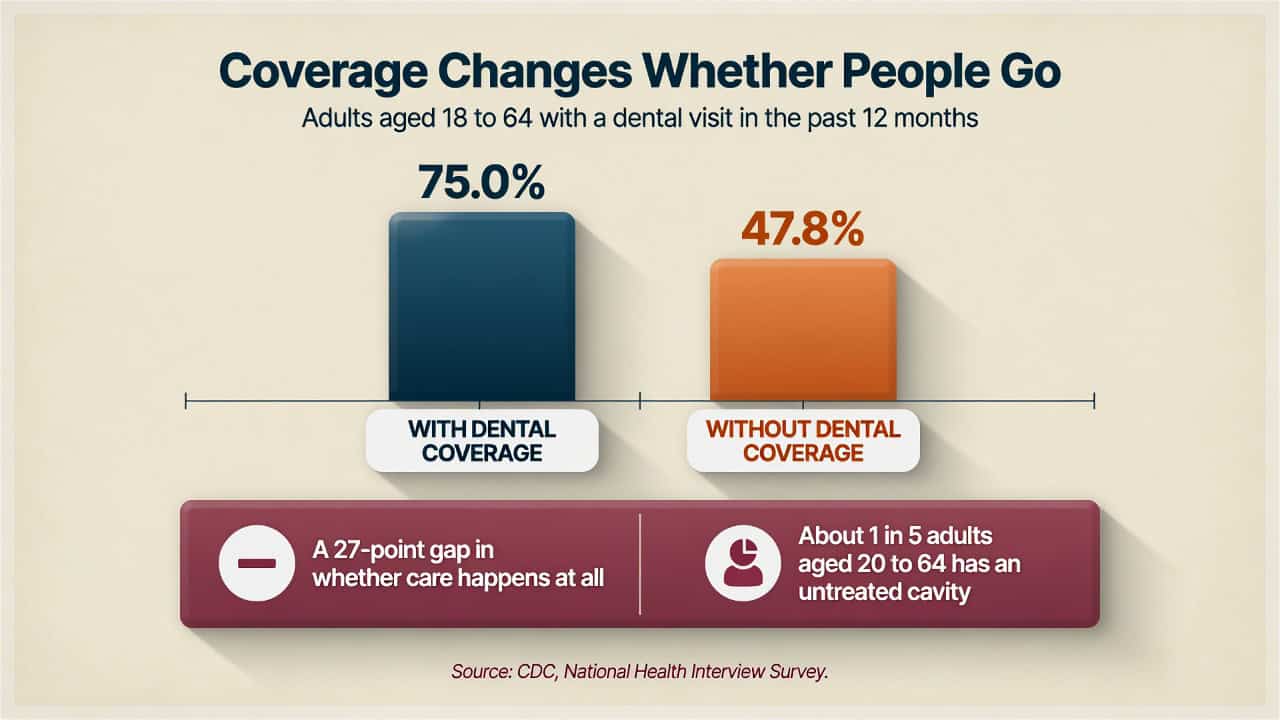
The CDC’s oral and dental health statistics track dental visit rates each year. The gap is not proof that coverage causes attendance — people who buy dental plans are already more inclined to go. But a 27-point difference is large, and the CDC’s cavity statistics show what goes untreated in the meantime. For households that would otherwise defer care, that behavioural nudge is a real part of whether dental insurance is worth buying.
See What Coverage Costs in Your Area
Premiums vary by ZIP code and plan design. Run a quote to see real numbers, or talk the options through with a licensed agent.
The Annual Maximum Caps the Upside
Dental plans limit what the insurer pays each year, commonly $1,000 to $2,500 per person. This runs opposite to a medical out-of-pocket maximum, which limits what the patient pays. A root canal and crown on one tooth can approach $2,469 before coverage, enough to exhaust a modest maximum on a single problem.
This is the single most common misunderstanding in dental coverage, and it is where the case for a plan is weakest. Someone facing extensive treatment — several crowns, an implant, full dentures — will hit the ceiling and pay the balance regardless of how good the plan looked on paper.
The counterintuitive part
Dental insurance is worth the most to people with modest, predictable needs and worth proportionally less to those facing the largest bills. That is the reverse of how most insurance behaves.
Two plan features soften it. Some plans roll unused maximum into the following year, and some exclude preventive visits from counting toward the cap at all. Both meaningfully raise the ceiling without raising the premium, and neither is obvious from a quote summary.
Who Comes Out Ahead
Dental insurance is worth it most clearly for households that attend twice yearly, have children, or anticipate a filling or crown. It pays off least for people who rarely go, and for those facing treatment far beyond the annual maximum where the cap limits the benefit early.
Clearly worth it
You attend preventive visits reliably, you have children needing regular care, or you know a crown or filling is coming. Preventive coverage alone approaches break-even.
Probably worth it
You have not been in a while and suspect work is needed. Waiting periods apply to major services, so buying ahead of the need rather than after it matters.
Marginal
You genuinely never go, have no known issues, and would not attend even with coverage. The premium buys optionality you may not use.
Limited benefit
You face a large treatment plan — multiple crowns, implants, full dentures. The annual maximum caps the payout well below the bill.
Alternatives Worth Considering
Dental savings plans charge an annual fee for discounted fees at participating dentists. There is no annual maximum, no waiting period, and no claim forms — but no reimbursement either. You pay every bill, at a reduced rate. Practice membership plans work the same way within one office.
These suit the two groups insurance serves least well: people who need immediate major work and cannot wait out a waiting period, and people whose treatment plan far exceeds any annual maximum. A 20 percent discount on a $12,000 plan beats a $1,500 cap.
They suit almost everyone else less well. There is no risk transfer at all — an unexpected root canal still lands entirely on you, just cheaper. For predictable, moderate needs, the question of whether dental insurance is worth it generally still resolves toward the insurance.
Not the same product
Savings plans are not insurance and are not regulated as insurance. Compare them on what you would actually pay for the specific care you expect, not on the headline discount percentage. Unreimbursed dental costs paid out of pocket — whether from a savings plan, a high annual-maximum overage, or no coverage at all — may be deductible as an itemized medical expense above 7.5% of adjusted gross income; see IRS Publication 502 for what qualifies.
If coverage comes through work
Employer-sponsored dental changes the calculation considerably, because the employer usually funds part or all of the employee premium. At that point the question of whether dental insurance is worth it is largely settled by the subsidy.
Frequently Asked Questions About Whether Dental Insurance Is Worth It
Is dental insurance worth it if I only get cleanings?
Often yes, but narrowly. Two preventive visits a year cost roughly $400 out of pocket at the national average of $203 per exam, cleaning and X-rays. If the annual premium is below that, the plan pays for itself on preventive care alone.
What is the annual maximum and why does it matter?
It caps what the plan pays per person per year, commonly $1,000 to $2,500. Unlike a medical out-of-pocket maximum, which limits what you pay, the dental maximum limits what the insurer pays. Everything beyond it is yours.
Does having dental insurance change whether people actually go?
Substantially. CDC data shows 75 percent of adults aged 18 to 64 with dental coverage had a dental visit in the past year, compared with 47.8 percent of those without it.
How much do major dental procedures cost without insurance?
National averages run about $226 for a composite filling, $300 for an extraction, $1,100 for a root canal, $1,369 for a crown, and $1,953 for dentures. A single root canal and crown together can exceed a typical annual maximum.
Who does dental insurance not pay off for?
People who rarely visit a dentist and have no anticipated work, and people facing very large treatment plans where the annual maximum caps the benefit early. In the second case the plan still helps, but far less than the premium might suggest.
Are there alternatives to dental insurance?
Dental savings plans offer discounted fees rather than insurance, with no annual maximum and no waiting periods, but you pay every bill yourself. In-house membership plans from individual practices work similarly. Neither reimburses claims.
Related Coverage Resources
How dental plans work — what’s covered, plan types, and annual maximums.
Dental Insurance With No Waiting PeriodHow waiting periods work, which plans skip them, and when they get waived.
Major Dental ServicesWhat insurance pays toward crowns, root canals, dentures and implants.
Orthodontic InsuranceWhat plans pay toward braces, and why the lifetime cap decides it.
Small Business Dental InsuranceGroup dental, what it costs per employee, and how to set it up.
Small Business Health InsuranceThe full employer guide to medical coverage, costs, eligibility and enrollment.
Compare Dental Plans and Decide for Yourself
The answer depends on premium, annual maximum, and waiting periods. Run a quote to see the actual numbers, or call to talk it through.
Broker Disclosure
ForHealthInsurance.com is an independent health insurance agency serving small businesses nationwide. We are not affiliated with any carrier or government agency. We help you compare plans and enroll in coverage that meets your needs at no extra cost to you.