Dental Insurance With No Waiting Period: What to Know Before You Buy
Most people search for this after a dentist has quoted them for work they were not expecting. The instinct is right — coverage bought today usually will not pay for a crown next week — but the picture is more workable than it first appears.
This page explains what waiting periods are in 2026 and why they exist, how long each service category typically waits, which plans skip them and what that costs, the circumstances in which a carrier will waive one, and what to do if the work genuinely cannot wait.

Where are you in this?
What a Waiting Period Actually Is
A waiting period is time after coverage starts during which the plan will not pay for certain categories of care. It is not a pre-existing condition exclusion and it is not permanent. Once it elapses, those services are covered normally. Dental insurance waiting periods apply by service tier rather than by person.
The reason they exist is straightforward. Unlike most medical needs, dental problems announce themselves in advance — a dentist tells you a crown is needed, and you have time to shop. Without waiting periods, plans would attract mainly people with immediate large claims, and premiums would rise for everyone. Waiting periods are the main lever keeping dental premiums low.
They are also more porous than people assume. A meaningful share of plans have none, group coverage frequently skips them, and carriers waive them in defined circumstances. Finding dental insurance with no waiting period is a matter of knowing which levers exist rather than hunting for a rare product.
How Long Each Service Category Waits
Preventive care is almost always available immediately. Basic work such as fillings and extractions commonly waits three to six months. Major work — crowns, root canals, bridges, dentures — commonly waits six to twelve months. Orthodontia often waits twelve months or longer and carries a separate lifetime maximum.
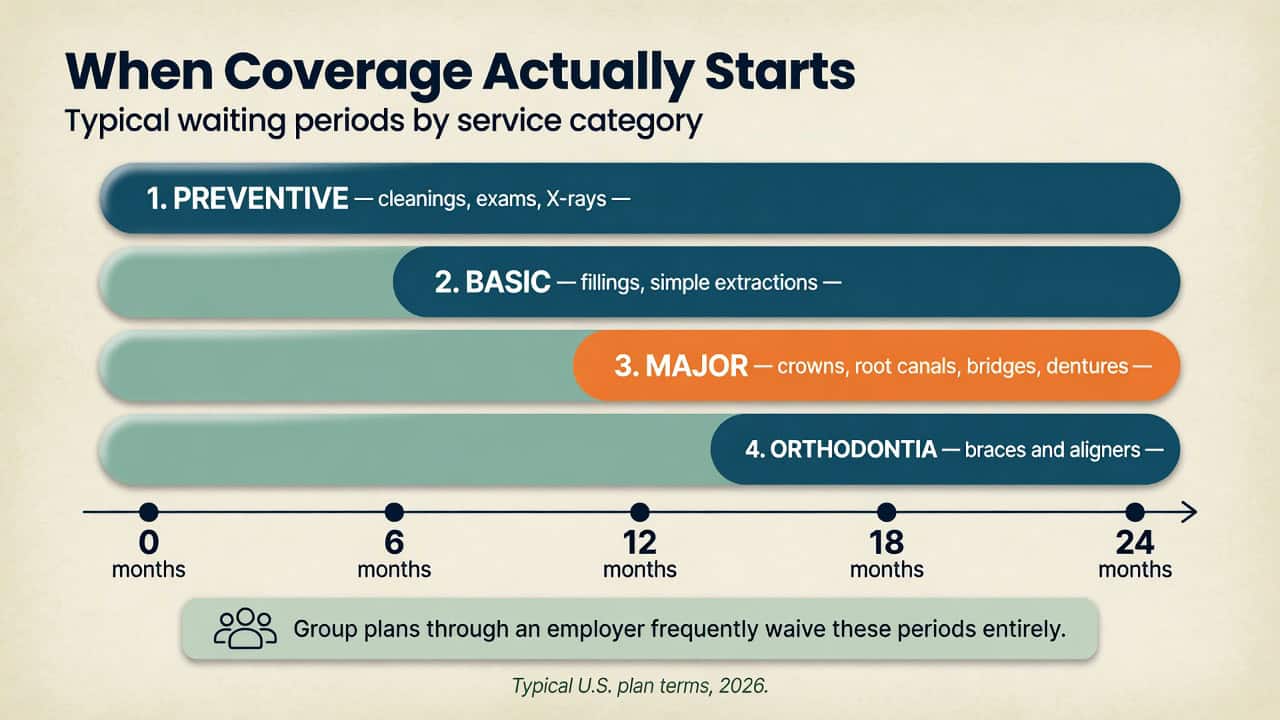
Those 2026 norms mean buying coverage the week before a crown rarely helps, while buying it a year before a predictable need works well. Anyone who has been told they will eventually need work — but not urgently — is in the best possible position to buy dental insurance before the waiting period matters.
Plans With No Waiting Period and What They Cost
Dental insurance with no waiting period exists, but the concession appears somewhere else. Expect a higher monthly premium, a reduced first-year annual maximum, a narrower network, or lower coinsurance on major work during year one. Very few plans remove the waiting period without adjusting something.
Higher premium
The most common trade. The plan prices in the risk of immediate claims, so the monthly cost sits above comparable plans that make you wait.
Reduced first-year maximum
Coverage starts immediately but the annual cap is lower in year one — sometimes half the standard figure — then rises afterwards.
Lower first-year coinsurance
Major work is covered from day one but at a smaller share, perhaps 25 percent rather than 50 percent, until the first year elapses.
The missing tooth clause
Separate from waiting periods and it does not expire. It excludes replacing teeth already missing when the policy began.
Read past the headline
A plan advertising dental insurance with no waiting period can still decline a claim under a missing tooth clause, a frequency limit, or a first-year maximum. The waiting period is one of several timing rules, not the only one.
Compare Plans and Their Start Dates
Waiting periods vary by plan and by carrier. Run a quote to see what is available in your area, or call to talk through the timing.
When a Waiting Period Gets Waived
Three routes account for most waivers. Proof of at least twelve months of prior continuous dental coverage is the most common. Group plans through an employer frequently have no waiting periods at all. And carriers often waive them for a group’s initial enrollment window when a business first sets up coverage.
The prior-coverage route is underused simply because people do not think to mention it. If you had dental insurance through a previous job and the gap since has been short, say so during the application. Carriers ask for a certificate of prior coverage or an explanation of benefits, not extensive documentation.
Employer coverage is the cleaner answer where it exists. Group dental typically skips waiting periods because the enrolled population is not self-selected, and Bureau of Labor Statistics benefits data shows how much more common employer dental access is at larger firms — everyone in the group joins, not only those with immediate needs. That is the same reason group plans price lower than comparable individual dental insurance with no waiting period.
Worth asking directly
Waiting periods are negotiable more often than published plan documents suggest, particularly for group business. It costs nothing to ask a licensed agent whether a carrier will waive one for your situation.
If the Work Cannot Wait
When treatment is needed within weeks, compare a no-waiting-period plan against a dental savings plan. Savings plans provide discounted fees immediately, with no waiting period and no annual maximum, but they reimburse nothing — every bill is yours at a reduced rate.
The comparison usually turns on the size of the treatment plan. Insurance caps what it pays, commonly at $1,000 to $2,500 a year, so a large course of treatment exhausts the benefit quickly. A percentage discount applied to the whole bill can be worth more than a capped reimbursement when the total is high.
An insurance plan covering major work at 50 percent with a $1,500 annual maximum pays $1,500. A savings plan discounting fees by 20 percent saves $1,800 and has no cap. For smaller work — a single $1,369 crown — the insurance pays roughly $685 against a savings plan’s $274.
Deferring care has its own cost, which is the argument against simply waiting. CDC figures show roughly one in five adults aged 20 to 64 has at least one untreated cavity, and untreated decay does not stay small. The CDC’s cavity statistics track how common that is.
Comparing Plans on Timing
Four questions settle it. How long is the wait on basic and on major work separately? Is the first-year annual maximum reduced? Does a missing tooth clause apply? And will the carrier waive the wait for prior coverage? Two plans at similar premiums can differ on all four.
Where to verify plan terms
Policy language is filed with state regulators, and state insurance departments handle complaints about how terms are applied. The NAIC maintains the directory of state insurance departments where those filings and complaint records can be checked.
Frequently Asked Questions About Dental Insurance Waiting Periods
What is a dental insurance waiting period?
A stretch of time after coverage begins during which the plan will not pay for certain services. Preventive care is usually available immediately. Basic work commonly waits three to six months and major work six to twelve months.
Does any dental insurance have no waiting period at all?
Yes. Some individual plans waive waiting periods entirely, and most group plans through an employer have none. Plans without waiting periods typically carry a higher premium, a lower first-year annual maximum, or both.
Why do dental plans have waiting periods?
To prevent people from buying a plan, claiming an expensive procedure immediately, and cancelling. Because dental needs are often known in advance, waiting periods are the main tool insurers use to keep premiums low for everyone else.
Can a dental waiting period be waived?
Often yes. Proof of at least twelve months of prior continuous dental coverage is the most common route. Group plans through an employer also frequently waive them, and some carriers waive them during a group’s initial enrollment.
What is a missing tooth clause?
A provision excluding replacement of teeth that were already missing before the policy started. It is separate from a waiting period and does not expire, so a plan with no waiting period can still decline to cover a bridge or implant for a long-missing tooth.
What if I need major dental work right now?
Compare a no-waiting-period plan against a dental savings plan. Savings plans give discounted fees immediately with no annual maximum, which can beat insurance when the treatment plan is large or the work cannot wait.
Related Coverage Resources
How dental plans work — what’s covered, plan types, and annual maximums.
Is Dental Insurance Worth It?The cost math on premiums, annual maximums, and what care actually costs.
Major Dental ServicesWhat insurance pays toward crowns, root canals, dentures and implants.
Orthodontic InsuranceWhat plans pay toward braces, and why the lifetime cap decides it.
Small Business Dental InsuranceGroup dental, what it costs per employee, and how to set it up.
What Health Coverage Costs Per Employee2026 medical premium benchmarks and what drives a quote.
Find Dental Insurance With No Waiting Period
Availability and terms depend on your ZIP code. Run a quote to see what starts when, or call to talk through the timing with a licensed agent.
Broker Disclosure
ForHealthInsurance.com is an independent health insurance agency serving small businesses nationwide. We are not affiliated with any carrier or government agency. We help you compare plans and enroll in coverage that meets your needs at no extra cost to you.