Orthodontic Insurance: What Plans Really Pay Toward Braces
Orthodontic coverage looks generous on a benefits summary and behaves quite differently in practice. The headline figure is usually 50 percent, but a separate lifetime cap sits behind it, and that cap does most of the work in deciding what a family actually pays.
This page covers how the benefit is structured in 2026, what each type of treatment costs at national averages, why the lifetime maximum matters far more than the percentage, how child and adult coverage differ, and how families typically fund the balance.

What are you trying to work out?
How the Benefit Is Structured
Orthodontic insurance is a separate benefit inside a dental plan, not part of the standard coverage tiers. Many plans exclude it entirely or sell it as a rider. Where included, it typically pays 50 percent of treatment up to a lifetime maximum of roughly $1,000 to $3,000, after a waiting period of twelve months or more.
Three things make orthodontic insurance behave unlike the rest of a dental plan. The cap is lifetime rather than annual, so it never resets. Benefits are usually paid out gradually across the course of treatment rather than up front. And eligibility is frequently restricted by age in a way no other dental benefit is.
Employer-sponsored plans include orthodontic benefits more often than individual ones, a pattern visible in Bureau of Labor Statistics benefits data on dental access by firm size. The first step is therefore checking whether the benefit exists at all. A plan can be excellent on preventive and major work and carry no orthodontic insurance whatsoever, and nothing on the summary page necessarily makes that obvious.
What Treatment Costs
National averages for comprehensive treatment run about $5,108 for clear aligners, $5,834 for ceramic braces, and $6,343 for metal braces. Clear aligners being the least expensive option surprises most people. Costs vary substantially by state and by how complex the case is.
Those averages come from a national cost study covering all 50 states and the District of Columbia, published in FAIR Health Consumer’s dental cost estimator data. The gap between the third and fourth columns is the entire point of the next section.
The Lifetime Maximum Does the Real Work
A plan advertising 50 percent orthodontic coverage on $6,343 metal braces would suggest $3,172 in benefit. A typical $1,750 lifetime maximum pays $1,750 instead — closer to 28 percent. The cap, not the percentage, determines what orthodontic insurance is worth on a full course of treatment.
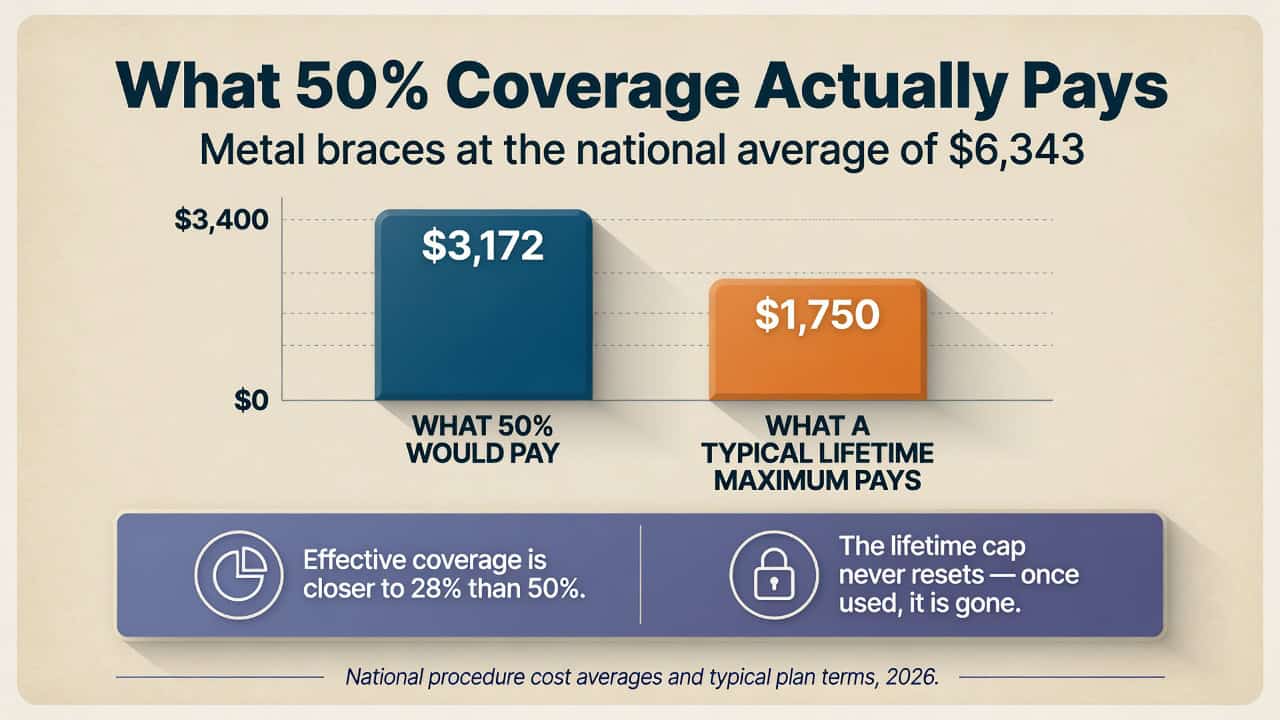
The lifetime nature of the orthodontic insurance cap is what catches families out. An annual maximum on ordinary dental work resets every January. The orthodontic maximum does not — it is one allowance per person, ever, under that plan. A child who uses it at thirteen has none remaining if a second phase of treatment is recommended later.
Two children, two caps
The lifetime maximum applies per person, not per family, so a second child has their own allowance. But it also means a plan covering three children carries three separate caps, and total household orthodontic exposure scales accordingly.
Compare Orthodontic Benefits Before Treatment Starts
Coverage, caps and waiting periods vary widely between plans. Run a quote to compare them, or call to talk through the options with a licensed agent.
Children Compared With Adults
Coverage for dependent children is common; adult coverage is not. Many plans limit orthodontic insurance to dependents under 19, and where adult benefits exist they are often narrower. Roughly one in five orthodontic patients is now an adult, so the restriction affects a substantial group.
Dependent children
The standard case. Coverage at around 50 percent up to the lifetime maximum, usually with a twelve-month waiting period and an age cutoff commonly set at 19.
Adults
Frequently excluded outright. Where covered, the same lifetime cap applies but eligibility rules and waiting periods can be stricter.
Treatment already underway
Most plans will not pay toward treatment that began before coverage started. Banding date, not billing date, is usually what the carrier looks at.
Two parents with coverage
Coordination of benefits may allow a second plan to pay toward the balance. Worth asking both carriers before assuming a single cap is the limit.
Braces Compared With Clear Aligners
Most plans treat clear aligners as orthodontic treatment under the same percentage and the same lifetime maximum as braces. A minority exclude them or restrict them by age. Since aligners average $5,108 against $6,343 for metal braces, the same cap covers proportionally more of an aligner case.
By 2026 the assumption that aligners cost more is largely outdated for comparable cases. Where a case is straightforward, aligner treatment often prices below metal braces, and the plan benefit goes further against the smaller total. Complex cases remain the domain of fixed appliances, and pricing there can invert.
What matters for orthodontic insurance purposes is the plan’s own language. Ask specifically whether clear aligners are covered as orthodontic treatment, at the same percentage, under the same lifetime maximum, and whether any age restriction applies to them separately.
Funding the Balance
Coverage rarely reaches half the total, so most families combine benefits with something else. Orthodontic practices routinely offer interest-free monthly payment plans across the treatment period, and HSA or FSA funds can be used for the uncovered portion because orthodontia qualifies as a medical expense.
The tax-advantaged route is the most commonly overlooked. Orthodontic treatment appears on the IRS list of qualifying medical and dental expenses, so pre-tax HSA or FSA dollars can cover the balance. For a household in a mid bracket, that is a meaningful discount on money already committed.
Orthodontic insurance with a $1,750 lifetime maximum pays $1,750, leaving $4,593. Spread across 24 months of treatment that is about $191 monthly, and if paid from an FSA the pre-tax funding reduces the effective cost further.
Timing matters more than usual
Because waiting periods on orthodontic insurance commonly run twelve months or longer, coverage taken out when a dentist first mentions future treatment will typically be usable by the time an orthodontist recommends starting. Coverage taken out after the consultation frequently will not.
Frequently Asked Questions About Orthodontic Insurance
Does dental insurance cover braces?
Only if the plan includes an orthodontic benefit, and many do not. Where it exists, coverage is commonly 50 percent of treatment up to a lifetime maximum of roughly $1,000 to $3,000. Coverage is far more common for children than adults.
What is an orthodontic lifetime maximum?
The total a plan will ever pay toward orthodontic treatment for one person. It is separate from the annual maximum and it never resets. Once used, there is no further orthodontic coverage for that person under that plan.
How much do braces cost?
National averages for comprehensive treatment run about $5,108 for clear aligners, $5,834 for ceramic braces, and $6,343 for metal braces. Costs vary widely by state and by case complexity.
Is Invisalign covered the same as braces?
Usually, where orthodontic coverage exists at all. Most plans treat clear aligners as orthodontic treatment under the same percentage and the same lifetime maximum, though some exclude them or limit the benefit to patients under 19.
Do plans cover adult braces?
Less often than for children. Many plans limit orthodontic benefits to dependents under 19, and adult coverage where offered is frequently narrower. Adults are roughly one in five orthodontic patients, so it is worth checking rather than assuming.
Can HSA or FSA funds pay for braces?
Yes. Orthodontic treatment is a qualifying medical expense under IRS rules, so HSA and FSA funds can be used for the portion insurance does not cover. Keep the treatment plan and receipts for records.
Related Coverage Resources
How dental plans work — what’s covered, plan types, and annual maximums.
Is Dental Insurance Worth It?The cost math on premiums, annual maximums, and what care actually costs.
Dental Insurance With No Waiting PeriodHow waiting periods work, which plans skip them, and when they get waived.
Major Dental ServicesWhat insurance pays toward crowns, root canals, dentures and implants.
Small Business Dental InsuranceGroup dental, what it costs per employee, and how to set it up.
Small Business Health InsuranceThe full employer guide to medical coverage, costs, eligibility and enrollment.
Find a Plan With Orthodontic Coverage
Not every dental plan includes an orthodontic benefit. Run a quote to see which do in your area, or call a licensed agent to check the terms.
Broker Disclosure
ForHealthInsurance.com is an independent health insurance agency serving small businesses nationwide. We are not affiliated with any carrier or government agency. We help you compare plans and enroll in coverage that meets your needs at no extra cost to you.