Dental Insurance: How Coverage and Cost Work in 2026
Dental coverage runs on rules that look nothing like medical. It pays the most for the cheapest care, caps what the insurer will spend rather than what you will, and often makes you wait months before it pays for anything substantial.
None of that is hidden, but very little of it appears on a 2026 quote summary. This guide sets out the whole structure — what gets covered and at what share, what plans cost, how the plan types differ, where the annual maximum bites, how waiting periods work, and what happens with braces.

Where would you like to start?
What Gets Covered, and at What Share
Almost every plan follows a 100-80-50 structure. Preventive care — two cleanings, exams and X-rays a year — is covered in full. Basic work such as fillings runs around 80 percent. Major work such as crowns, root canals and dentures runs around 50 percent. Orthodontia, where included, sits outside this entirely.
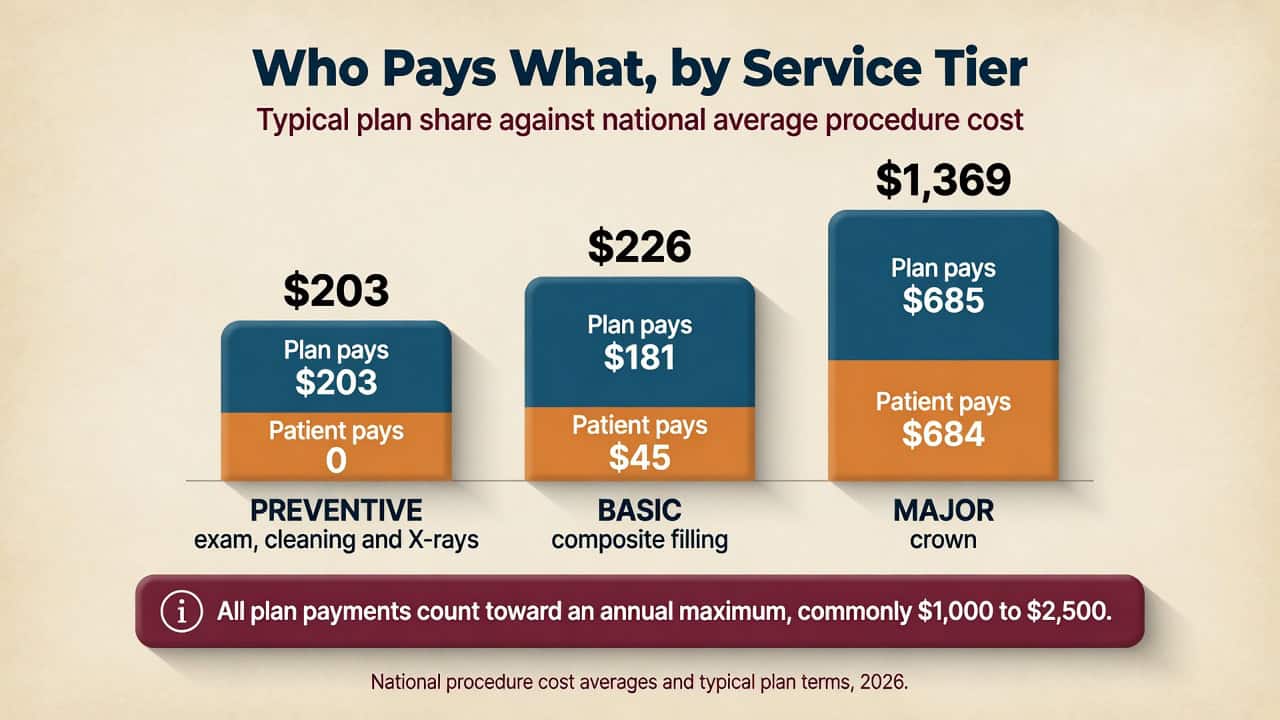
The inversion is deliberate. Insurers cover preventive care fully because it is cheap and it prevents expensive problems later. The American Dental Association notes that people with dental benefits are more than twice as likely to visit a dentist, and the CDC’s oral and dental health statistics put past-year dental visits at 65.5 percent of adults.
The boundary between tiers is not standardised. A simple extraction is usually basic at around 80 percent, while surgical removal of an impacted tooth is usually major at around 50 percent. Deep cleaning falls either side depending on the carrier. Two plans can classify the same procedure differently, which changes the bill by hundreds of dollars on identical treatment.
Frequency limits apply on top of the percentages
Most plans cover two cleanings per twelve months, bitewing X-rays once a year, and a full series of X-rays once every three to five years. A third cleaning in a year is generally paid entirely by the patient even though cleanings are nominally covered in full.
Where the structure disappoints is major work, and that is covered in detail on the major dental services page.
What Dental Insurance Costs
Individual premiums commonly run a few tens of dollars a month, and they have been remarkably stable — dental premiums have risen less than 1 percent a year for eight consecutive years. For comparison, employer medical coverage averaged $9,325 for single coverage in 2025, roughly $777 a month.
Deductibles are small by medical standards
Commonly $25 to $100 per person, and preventive care typically sits outside the deductible entirely. That combination is why the break-even calculation usually turns on preventive visits alone: two exams with cleanings and X-rays average about $406 a year at $203 each.
National averages give a reference point for the care itself: about $203 for an exam with cleaning and X-rays, $226 for a composite filling, $1,100 for a root canal and $1,369 for a crown, according to FAIR Health Consumer’s dental cost estimator data covering all 50 states. Regional variation is wide, with the same routine visit ranging from roughly $50 to $350 depending on location.
Whether that adds up for a given household is worked through on the is dental insurance worth it page, which runs the numbers in both directions.
Plan Types: DPPO, DHMO and Indemnity
Dental PPO plans dominate, holding more than 80 percent of the market. They let you see any dentist and pay less in network. Dental HMO plans require a network dentist but typically carry no annual maximum and no deductible. Indemnity plans reimburse a set amount and are now rare.
The choice usually comes down to one question: are the dentists your household already uses in the network. Dental loyalty runs deep, and a plan that forces a switch produces more dissatisfaction than the premium saving justifies. The American Dental Association’s summary of benefit trends tracks the continued shift toward PPO designs.
The Annual Maximum
Every plan caps what the insurer will pay per person per year, commonly $1,000 to $2,500. This is the feature most often misunderstood, because it works opposite to medical coverage: a medical out-of-pocket maximum protects the patient, while a dental annual maximum protects the insurer.
The practical consequence is that dental insurance is worth most to people with modest, predictable needs and least to those facing the largest bills. A root canal and crown on a single tooth average $2,469 combined — enough to exhaust a mid-range maximum on one problem. Whatever the plan doesn’t cover on a large bill may be deductible as an itemized medical expense above 7.5% of adjusted gross income; see IRS Publication 502 for what qualifies.
Dentures at the national average of $1,953 pay $977 at 50 percent, leaving $523 of a $1,500 annual maximum for the rest of the year. A crown needed later that year would normally draw $685 more at 50 percent, but only $523 of the cap remains — the plan pays $523 and the patient covers $846 of the $1,369 crown, well above the $685 the headline percentage alone would suggest.
Two features worth asking about
Some plans roll unused annual maximum into the following year, and some exclude preventive visits from counting toward the cap. Both raise the effective ceiling without raising the premium, and neither appears on a typical quote summary.
Compare Dental Plans in Your Area
Premiums, annual maximums and waiting periods vary by plan and ZIP code. Run a quote to see the options, or talk them through with a licensed agent.
Waiting Periods
Preventive care is almost always available immediately. Basic work commonly waits three to six months, major work six to twelve months, and orthodontia twelve months or longer. Group plans through an employer frequently have no waiting periods, and carriers often waive them with proof of prior coverage.
Waiting periods exist because dental needs are usually known in advance. Without them, plans would attract mainly people with immediate large claims. They are also more negotiable than published documents suggest — twelve months of prior continuous coverage is the most common route to a waiver.
The full picture, including which plans skip them and what that costs, sits on the dental insurance with no waiting period page.
Orthodontic Coverage
Orthodontia is a separate benefit that many plans exclude entirely. Where included, it commonly pays 50 percent up to a lifetime maximum of roughly $1,000 to $3,000 — a cap that never resets. Against metal braces averaging $6,343, effective coverage is closer to 28 percent than 50 percent.
Adult coverage is considerably less common than coverage for dependent children, with many plans setting an age cutoff at 19. Since roughly one in five orthodontic patients is now an adult, that restriction affects a large group. Details are on the orthodontic insurance page.
Individual Coverage Compared With Employer Plans
Employer dental is generally better and cheaper, because the enrolled group is not self-selected. About 43 percent of private industry workers had access to dental benefits in 2024, but only 27 percent at businesses with 50 or fewer employees, against 59 percent at firms with 100 or more.
Through an employer
Usually no waiting periods, lower premium, and often partial employer funding. The clear first choice where it is offered.
Individual plans
Available to anyone, but expect waiting periods on basic and major work and a premium reflecting self-selected enrolment.
Small business owners
Group dental is written for as few as two enrolled employees and costs a fraction of medical, making it the cheapest benefit to add.
Savings plans
Not insurance. Discounted fees with no cap and no waiting period, but no reimbursement — useful for large or urgent treatment.
The access gap at smaller employers is documented in Bureau of Labor Statistics benefits data, and what setting up a group plan involves is covered on the small business dental insurance page.
How to Compare Plans
Premium is the least useful number on a quote. Five things matter more: the annual maximum, waiting periods on basic and major work separately, whether orthodontia is included and at what lifetime cap, the network, and whether a missing tooth clause applies.
Frequency limits, coordination of benefits where two plans cover the same person, and whether the plan pays a percentage of the dentist’s fee or of a lower scheduled allowance all shift the real figure further. A plan paying 50 percent of a scheduled allowance rather than 50 percent of the actual charge can leave a materially larger balance on the same crown.
Two plans at nearly identical premiums can differ by more than a thousand dollars across a year on those five points alone. Checking the network against the dentists a household already uses is the single most predictive step, because it determines whether the plan gets used at all.
Before enrolling
Ask for a pre-treatment estimate if work is already planned, confirm which category each expected procedure falls into, and check whether preventive visits count toward the annual maximum. Those three questions resolve most of the surprises that follow a dental claim.
Frequently Asked Questions About Dental Insurance
What does dental insurance actually cover?
Nearly all plans follow a 100-80-50 structure: preventive care such as cleanings and exams covered in full, basic work such as fillings at around 80 percent, and major work such as crowns and root canals at around 50 percent, all subject to an annual maximum.
How much does dental insurance cost?
Individual premiums commonly run a few tens of dollars per month. Dental premiums have risen less than 1 percent a year for eight consecutive years, well below general inflation and far below medical, which averaged $9,325 for single coverage in 2025.
What is an annual maximum?
The most a plan will pay toward one person’s care in a plan year, commonly $1,000 to $2,500. It works opposite to a medical out-of-pocket maximum: it caps what the insurer pays, not what the patient pays.
What is the difference between a DPPO and a DHMO?
A dental PPO lets you see any dentist and pays less out of network. A dental HMO requires a network dentist but typically has no annual maximum and no deductible. PPO designs hold more than 80 percent of the market.
How long are dental waiting periods?
Preventive care is usually available immediately. Basic work commonly waits three to six months and major work six to twelve months. Group plans through an employer frequently have no waiting periods at all.
Does dental insurance cover braces?
Only where the plan includes an orthodontic benefit, which many do not. Where it exists, coverage is commonly 50 percent up to a separate lifetime maximum of roughly $1,000 to $3,000 that never resets.
Explore Dental Coverage in Detail
The cost math on premiums, annual maximums, and what care actually costs.
Dental Insurance With No Waiting PeriodHow waiting periods work, which plans skip them, and when they get waived.
Major Dental ServicesWhat insurance pays toward crowns, root canals, dentures and implants.
Orthodontic InsuranceWhat plans pay toward braces, and why the lifetime cap decides it.
Small Business Dental InsuranceGroup dental, what it costs per employee, and how to set it up.
Small Business Health InsuranceThe full employer guide to medical coverage, costs, eligibility and enrollment.
Find Dental Coverage That Fits
Plans differ far more below the premium line than above it. Run a quote to compare the terms that matter, or call a licensed agent.
Broker Disclosure
ForHealthInsurance.com is an independent health insurance agency serving small businesses nationwide. We are not affiliated with any carrier or government agency. We help you compare plans and enroll in coverage that meets your needs at no extra cost to you.