Alaska Health Insurance Marketplace: How to Enroll for 2026
Most people who enroll through the Alaska health insurance marketplace pay far less than the sticker price for coverage. That matters more in Alaska than almost anywhere else — unsubsidized premiums here are the highest in the country, and the federal subsidies that flow through HealthCare.gov are what bring them in line with what residents of other states pay.

This guide walks through how the Alaska marketplace works in 2026, the deadlines that apply, the two carriers selling plans this year, and the enrollment paths that are unique to Alaska Natives and rural village residents. For a broader look at all coverage options in the state, see the Alaska health insurance overview.
What are you looking for?
Only Two Carriers Sell on the Alaska Marketplace in 2026
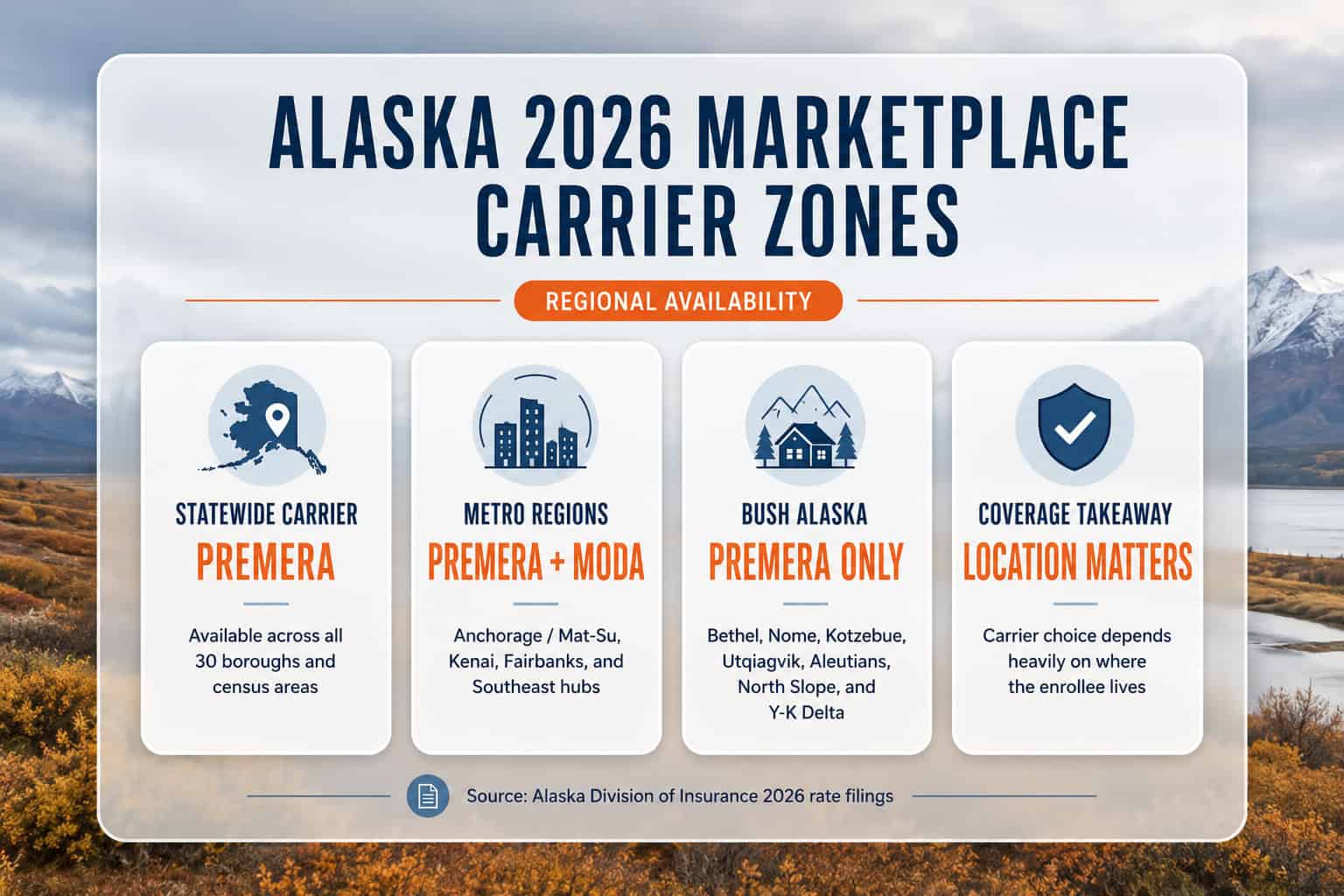
Just two carriers sell on the Alaska health insurance marketplace for 2026: Premera Blue Cross Blue Shield of Alaska and Moda Health. Premera covers all 30 Alaska boroughs and census areas, including every village and Bush community. Moda covers Anchorage, Mat-Su, Kenai Peninsula, Fairbanks North Star, and Southeast Alaska — roughly 75% of the state population, but zero rural coverage. Bronze, Silver, and Gold tiers are offered. Platinum is not sold in Alaska.
This two-carrier duopoly is the single most important fact about shopping the Alaska marketplace. In states like California or New York, marketplace shoppers compare eight or eleven carriers — networks, prices, and provider directories vary widely. In Alaska, the comparison is binary in most of the state and single-carrier in rural areas. Premera filed a 3.4% rate decrease for 2026 plans in its Alaska Division of Insurance rate filing, the first decrease in several years and a rare bright spot in a market that has seen Aetna, UnitedHealthcare, and Assurant all exit since 2017.
Premera Blue Cross Blue Shield of Alaska
- Coverage: Statewide — every borough and census area
- Network: Legacy Network — the largest provider network in Alaska, including Providence (Anchorage), Alaska Regional, Fairbanks Memorial, Bartlett Regional (Juneau)
- 2026 rate change: 3.4% decrease
- Only option in: Nome, Bethel, Kotzebue, Utqiagvik, Cordova, Dillingham, the Aleutian Islands, and most of Bush Alaska
- Tribal coordination: Contracted with the Alaska Native Tribal Health Consortium and most regional tribal health corporations
Moda Health
- Coverage: Anchorage, Mat-Su Valley, Kenai Peninsula, Fairbanks North Star, Southeast Alaska
- Network: Moda Select (renamed from Pioneer for 2026), plus Aetna PPO for out-of-state care
- 2026 rate change: Varies by service area
- Not available in: Bush Alaska, rural villages, or any area outside the named service regions
- Key advantage: Aetna national PPO access for residents who travel frequently or have family in the Lower 48
Where both carriers operate, Premera and Moda are close on premium for Silver and Gold tiers but Moda is often cheaper on Bronze in the Anchorage area. Network matters more than price for most Alaska shoppers — confirm any current providers are in-network before selecting, because switching carriers mid-year is not permitted outside a qualifying life event. For a full breakdown of the lowest-cost Bronze and Catastrophic options, see cheap health insurance in Alaska.
Alaska Has the Highest Marketplace Subsidies in the United States
Alaska enrollees receive the largest average federal subsidies in the country — averaging roughly $758 per month in 2024 according to CMS marketplace enrollment data. That subsidy size is a direct response to Alaska’s premium environment: a single 40-year-old in Anchorage pays around $740/month for a benchmark Silver plan before subsidies, compared to roughly $410 for the same person in Atlanta. Subsidies close most of that gap.
About 85% of Alaska marketplace enrollees received a premium tax credit in the most recent enrollment year — among the highest take-up rates in the nation. The reason is straightforward: Alaska’s median household income (~$89,300) sits above the U.S. median, but the state’s high benchmark Silver premium means even households at 300% or 350% of the federal poverty guidelines published by ASPE qualify for meaningful subsidies. In lower-premium states, those same households would be unsubsidized.
Why Alaska premiums are the highest in the U.S.
Four factors drive Alaska’s premium environment: only two carriers compete for individual enrollment (vs. eight to twelve in most states), the 733,000-resident population is spread across an area 2.4 times the size of Texas, healthcare delivery requires medevac air transport for many serious cases (Anchorage is the referral center for the entire state), and the cost of care is structurally higher because nearly every supply, drug, and specialist must be flown in. Federal subsidies absorb most of this premium gap for eligible enrollees.
Year-Round Marketplace Enrollment for Alaska Natives and American Indians
Alaska Natives and American Indians can enroll in or change Alaska health insurance marketplace plans any month of the year — no qualifying life event required. This is a federal protection under the Affordable Care Act that applies in every state, but it carries unusual weight in Alaska, where Alaska Native and American Indian residents make up roughly 16% of the population — the highest share in the country.
Tribal members also have access to zero-premium marketplace plans at any income level when they receive care primarily through Indian Health Service, tribal health, or urban Indian organization (I/T/U) providers. Eligible AN/AI members enrolled in marketplace plans also face zero cost-sharing — no deductibles, no copays, no coinsurance — for any covered service. The Alaska Native Tribal Health Consortium operates more than 250 village clinics, regional hospitals, and the Alaska Native Medical Center in Anchorage that coordinate directly with both Premera and Moda for AN/AI members.
Maria works seasonally for a commercial salmon operation in Bristol Bay. Her income varies year to year — about $42,000 in 2025, projected $38,000 in 2026. As an enrolled tribal member, she does not need to wait for Open Enrollment. She called 800-318-2596 in May to switch from a Premera Silver plan to a zero-cost-sharing Premera plan after a change in her care pattern (she now uses the Yukon-Kuskokwim Health Corporation regional hospital in Bethel for most care). Her new plan starts June 1 — outside any Open Enrollment window, with no qualifying life event needed.
Documents AN/AI applicants need
Tribal enrollment card or letter from a federally recognized tribe, Certificate of Indian Blood (CIB) issued by the Bureau of Indian Affairs, tribal census documents, or a letter from Indian Health Service. Any one of these establishes AN/AI status for year-round enrollment and zero-cost-sharing eligibility.
2026 Enrollment Deadlines and the Permanent 2027 Change
Open Enrollment for 2026 Alaska marketplace coverage ran November 1, 2025 through January 15, 2026. Residents who enrolled by December 15 got January 1 coverage; enrollments December 16 through January 15 took effect February 1. Starting with the 2027 plan year, the federal deadline moves permanently to December 15 — eliminating the January grace period. Alaska Natives, American Indians, and anyone with a qualifying life event can still enroll outside Open Enrollment.
Important: 2027 deadline change is permanent
Starting with 2027 plan enrollment, federal rules end Open Enrollment on December 15 — one month earlier than in prior years. Alaska residents who historically enrolled in early January will need to move their planning forward by four to six weeks. The change does not affect Alaska Native and American Indian year-round enrollment or any Special Enrollment Period.
See Real Alaska Marketplace Prices for Your Situation
Premera and Moda premiums vary by zip code, and subsidy amounts depend on income and household size. Enter your information to see actual plan pricing and tax credits applied.
Special Enrollment Periods That Are More Common in Alaska
Alaska residents who miss Open Enrollment can still enroll through a Special Enrollment Period if they experience a qualifying life event within the past 60 days. Several SEPs are triggered more often in Alaska than in other states — seasonal employment changes, relocation between villages and Anchorage for medical care, loss of seasonal employer coverage at the end of fishing or tourism seasons, and gaining lawful presence status are all routine SEP triggers in Alaska’s labor market.
Loss of Job-Based Coverage
Common in Alaska after the end of the commercial fishing season (Bristol Bay salmon, Bering Sea pollock), seasonal tourism work (Denali, Skagway, Ketchikan), or oil/gas project completion on the North Slope. Coverage loss from voluntary cancellation does not trigger an SEP — only involuntary loss qualifies.
Permanent Move
Relocating to Alaska from another state, moving between Alaska coverage areas (e.g., from Bethel to Anchorage so a different carrier becomes available), or returning to Alaska after time outside the state. Temporary moves for medical treatment do not qualify.
Household Changes
Marriage, birth, adoption, foster placement, divorce, or death of a covered family member. Each event opens a 60-day SEP window for any household member who needs new or different coverage.
Income or Eligibility Change
Becoming eligible for or losing Medicaid or Denali KidCare (Alaska’s CHIP), gaining citizenship or lawful presence, leaving incarceration, or AmeriCorps service ending. Income changes that affect subsidy amount do not require waiting for Open Enrollment to update your plan.
Enrollment Friction Unique to Alaska
Alaska’s marketplace enrollment process runs on the same HealthCare.gov platform every other federally-facilitated marketplace state uses, but the on-the-ground friction is different. Slow or absent broadband in rural villages, the absence of any HealthCare.gov in-person Assister office north of Fairbanks, mail delivery delays for paper documents in Bush Alaska, and language access for Yup’ik, Iñupiaq, and other Indigenous speakers all shape how Alaska residents actually complete an application.
Free enrollment assistance from a licensed Alaska agent is available at no cost to the consumer — agent commissions are paid by the carrier and do not affect the premium. The agent has access to the same plans, subsidies, and pricing the applicant would see on HealthCare.gov directly, plus knowledge of carrier-specific network details that matter most in Alaska’s two-carrier market.
Documents Alaska Applicants Need
Having documents ready before starting the Alaska marketplace application speeds up enrollment and reduces the chance of an income or identity verification follow-up. The federal application asks for the same baseline documents in every state, plus a few that come up more often in Alaska — tribal enrollment for AN/AI members, Permanent Fund Dividend records as income proof for some applicants, and proof of physical address for Bush residents who use P.O. Box mail.
Income Verification
- Most recent federal tax return (Form 1040)
- W-2 forms from all employers (including seasonal)
- Pay stubs from the last 30 days
- Self-employment income records (Schedule C, 1099-NEC)
- Alaska Permanent Fund Dividend (PFD) confirmation letter, if applicable
- Unemployment compensation statements
Identity & Household
- Social Security numbers for all household members
- Birthdates for all household members
- Legal names as they appear on tax returns
- Immigration documents (if applicable)
- Permanent Alaska address — physical, not P.O. Box, when possible
Current Coverage
- Existing insurance policy details
- Employer coverage offer letter (if applicable)
- COBRA continuation notice (if applicable)
- Medicaid or Denali KidCare termination notice (if applicable)
Alaska Native / American Indian
- Tribal enrollment card or letter
- Certificate of Indian Blood (CIB)
- Tribal census document
- Letter from Indian Health Service or a regional tribal health corporation
Frequently Asked Questions
How do I enroll in the Alaska health insurance marketplace?
Enroll online at HealthCare.gov during Open Enrollment (November 1 through January 15), by phone at 800-318-2596 (24/7, 150+ languages), or by working with a licensed Alaska agent at no extra cost. Have income documents, Social Security numbers for household members, and any tribal enrollment documents ready. Phone enrollment is the most reliable option for Bush Alaska residents with limited broadband.
What is the 2026 deadline for the Alaska marketplace?
For 2026 coverage, Open Enrollment ran November 1, 2025 through January 15, 2026. Enrollments by December 15 started January 1; enrollments December 16 through January 15 started February 1. The 2027 plan year permanently ends Open Enrollment on December 15 — one month earlier than 2026.
Which carriers sell on the Alaska marketplace for 2026?
Two carriers: Premera Blue Cross Blue Shield of Alaska (statewide — the only option in Bush Alaska) and Moda Health (Anchorage, Mat-Su, Kenai Peninsula, Fairbanks North Star, and Southeast Alaska only). Both offer Bronze, Silver, and Gold tiers. Platinum plans are not sold in Alaska.
Can Alaska Natives and American Indians enroll any time of year?
Yes. Federally recognized tribal members can enroll in or change marketplace plans any month of the year with no qualifying life event required. Tribal members enrolled in marketplace plans also face zero cost-sharing for covered services when receiving care through Indian Health Service, tribal, or urban Indian organization providers. Tribal enrollment documentation is required.
Why are Alaska marketplace premiums so high?
Alaska has the highest unsubsidized marketplace premiums in the country. The drivers are limited carrier competition (only two carriers vs. eight to twelve in most states), a small population of 733,000 spread across an area 2.4 times the size of Texas, high healthcare delivery costs including medevac transport, and structurally higher costs because supplies and specialists must be flown in. Federal subsidies offset most of this gap for the 85% of enrollees who qualify, with average subsidies around $758 per month — the highest in the U.S.
Is the Alaska marketplace the same as Obamacare or HealthCare.gov?
Yes — the Alaska health insurance marketplace is the federal HealthCare.gov platform applied to Alaska. Alaska does not run its own state-based exchange. All Affordable Care Act consumer protections apply, including coverage for pre-existing conditions, essential health benefits, and out-of-pocket maximums.
What if I live in a rural village without reliable internet?
Phone enrollment is the most reliable path. Call HealthCare.gov at 800-318-2596 — the line is open 24/7 and operators can complete the entire application by voice. Many regional tribal health corporations also employ certified application counselors who can assist village residents remotely or during travel to hub communities. Paper applications are still accepted but mail delays of 2 to 4 weeks are typical for Bush addresses.
Alaska Health Insurance Resources
Complete 2026 overview — Premera plans, Health First Alaska Medicaid, and subsidy eligibility
Best Alaska Health Plans 2026Premera plan-by-plan comparison with 2026 premium benchmarks by region
Affordable Coverage in AlaskaHow Alaska’s nation-leading $758/month average subsidy reduces premiums for most enrollees
Cheap Health Insurance in AlaskaLowest-cost 2026 Alaska plans — Bronze premiums, catastrophic options, and ways to cut monthly costs
Compare Alaska Marketplace Plans With Expert Help
Alaska’s two-carrier marketplace and the country’s highest subsidies make plan selection more consequential here than in most states. A licensed Alaska agent confirms tax credit eligibility, compares Premera and Moda networks for your providers, and completes HealthCare.gov enrollment at no cost.
Broker Disclosure
ForHealthInsurance.com is an independent health insurance agency serving Alaska residents. We are not affiliated with any carrier or government agency. We help you compare plans and enroll in coverage that meets your needs at no extra cost to you.