Georgia Health Insurance Marketplace 2026: Plans, Subsidies & Enrollment
The georgia health insurance marketplace is where Georgia residents compare and enroll in ACA-compliant coverage when employer insurance, Medicaid, or Medicare is not available. More than 1.3 million Georgians enrolled through the marketplace in 2025 , a state record, according to CMS 2025 Open Enrollment data. For 2025 and 2026, Georgia operates as a State-based Exchange (SBE) , operating its own marketplace platform under the Georgia Access 1332 waiver. Licensed brokers enroll consumers directly through Georgia Access-connected platforms, keeping the same subsidized plans and Advance Premium Tax Credits.

What brings you here today?
Enroll through Georgia Access
Get a free quote and enroll with a licensed Georgia broker
Get a quote →Do I qualify for subsidies?
Check APTC eligibility and how credits reduce your premium
Check eligibility ↓Georgia’s Health Insurance Marketplace in 2026
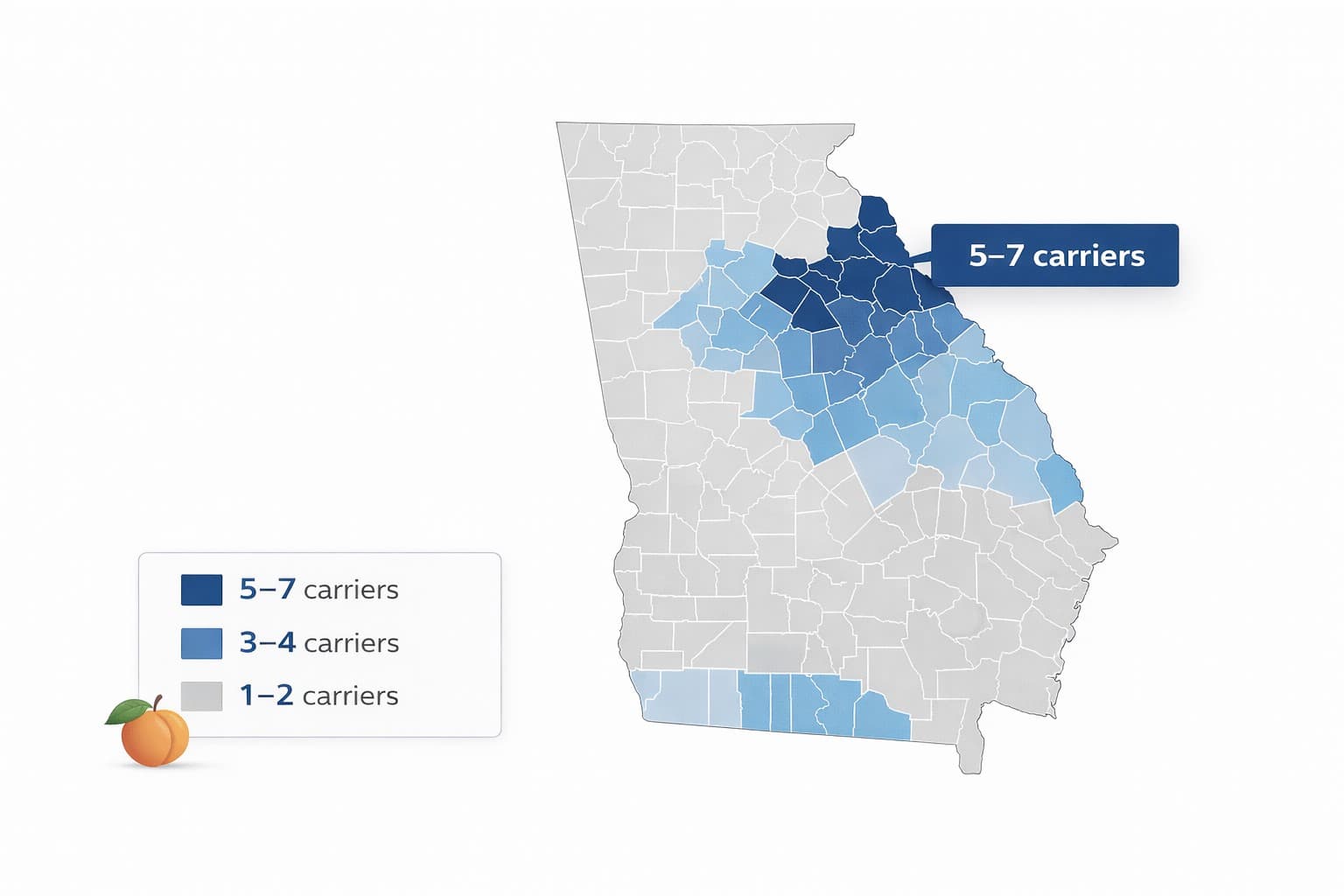
Georgia operates as a State-based Exchange under the Georgia Access program, a 1332 state waiver that allows licensed brokers to process ACA applications and subsidy determinations without directing consumers to HealthCare.gov. Seven carriers competed statewide in 2026. Atlanta-area counties including Fulton, DeKalb, and Gwinnett had five to seven options, while rural South Georgia counties typically had one or two, with Ambetter from Peach State Health Management as the dominant carrier throughout.
Georgia is one of more than 30 states using the federal marketplace rather than operating its own exchange. More than 1.3 million Georgians enrolled through the marketplace in 2025, a state record according to CMS 2025 Open Enrollment data. The Georgia Department of Insurance oversees rate filings, while federal CMS administers subsidies and eligibility. Residents qualifying for APTC , typically those earning $15,060–$60,240 per year as a single adult, typically save the most by enrolling in marketplace-connected plans. Those above the subsidy threshold sometimes find greater value in off-exchange plans, including PPO options unavailable through HealthCare.gov.
Georgia Access: What Makes Georgia’s Exchange Unique
Georgia Access is Georgia’s federally approved 1332 innovation waiver, launched in 2023. It allows consumers to complete ACA enrollment , including income verification and subsidy calculation, through licensed brokers and approved Enhanced Direct Enrollment platforms without visiting HealthCare.gov. The plans, premiums, and APTC amounts are identical. Georgia Access changes the enrollment pathway, not the coverage or the financial assistance available.
Under Georgia Access, participating brokers submit applications through approved enrollment platforms that communicate directly with federal eligibility systems. The result is identical subsidy-eligible coverage . In 2025, APTC averaged approximately $430 per month, though credits are smaller in 2026 after ARP enhancements expired. with guidance from a licensed agent who knows which carriers serve specific counties and which networks include Emory Healthcare, Northside Hospital, and WellStar Health System.
Georgia Access also creates a direct pathway for consumers considering off-exchange PPO plans. Some off-exchange Anthem BCBS of Georgia PPO plans are available through Georgia Access-connected enrollment platforms. Georgians near or above the subsidy threshold should compare Georgia PPO plans before completing enrollment.
Who Can Enroll in the Georgia Marketplace
Any Georgia resident who is a U.S. citizen or lawfully present immigrant, not incarcerated, and lacking affordable employer-sponsored coverage is eligible to enroll in the georgia health insurance marketplace. Subsidies are available for individuals earning roughly $15,060–$60,240 per year as a single adult. Georgia has no state individual mandate, so there is no penalty for going uninsured , but marketplace plans eliminate the financial exposure of unprotected medical costs.
Georgia’s 12.9% uninsured rate , the highest in the Southeast, reflects how many residents fall outside employer coverage: self-employed contractors, gig workers, early retirees, part-time workers, and adults aging off a parent’s plan at 26. Those earning below ~$15,060 per year should first check Georgia Pathways to Coverage eligibility before pursuing a marketplace plan. The enrollment process follows four steps:
Confirm Medicaid status
Georgia’s Pathways to Coverage program covers adults earning under ~$15,060 per year (100% FPL) who complete 80 hours per month of qualifying work or education activity. Those below 100% FPL who don’t qualify for Pathways fall into Georgia’s coverage gap , an estimated 200,000–300,000 residents, and cannot receive marketplace APTC subsidies. A licensed broker can assess Pathways eligibility before recommending a marketplace plan.
Check employer coverage affordability
If your employer’s single coverage costs less than ~9.02% of household income, you’re generally ineligible for APTC. A broker can confirm whether your employer plan bars subsidy eligibility.
Gather income documentation
Subsidies are based on projected MAGI. Collect pay stubs, a prior-year return, or self-employment records. Income fluctuations , common for Georgia contractors and seasonal workers, require careful projection to avoid tax reconciliation surprises.
Select an enrollment pathway
Enroll through a licensed Georgia broker via Georgia Access, or at HealthCare.gov directly. Both pathways access identical plans at identical subsidized prices. Georgia Access broker enrollment adds county-specific carrier guidance at no cost; broker compensation is paid by the carrier, not the consumer.
Get Help Enrolling Through Georgia Access
Licensed agents serve all Georgia counties through the Georgia Access enrollment framework , at no cost to enrollees.
Open Enrollment Dates and Special Enrollment Periods
Open enrollment on the georgia health insurance marketplace runs from November 1 through January 15 each year. Plans purchased by December 15 start January 1. Plans purchased between December 16 and January 15 start February 1. Outside open enrollment, a qualifying life event triggers a 60-day Special Enrollment Period. Georgia imposes no state individual mandate, so there is no tax penalty for missing enrollment , but going without coverage leaves Georgians exposed to unprotected medical costs.
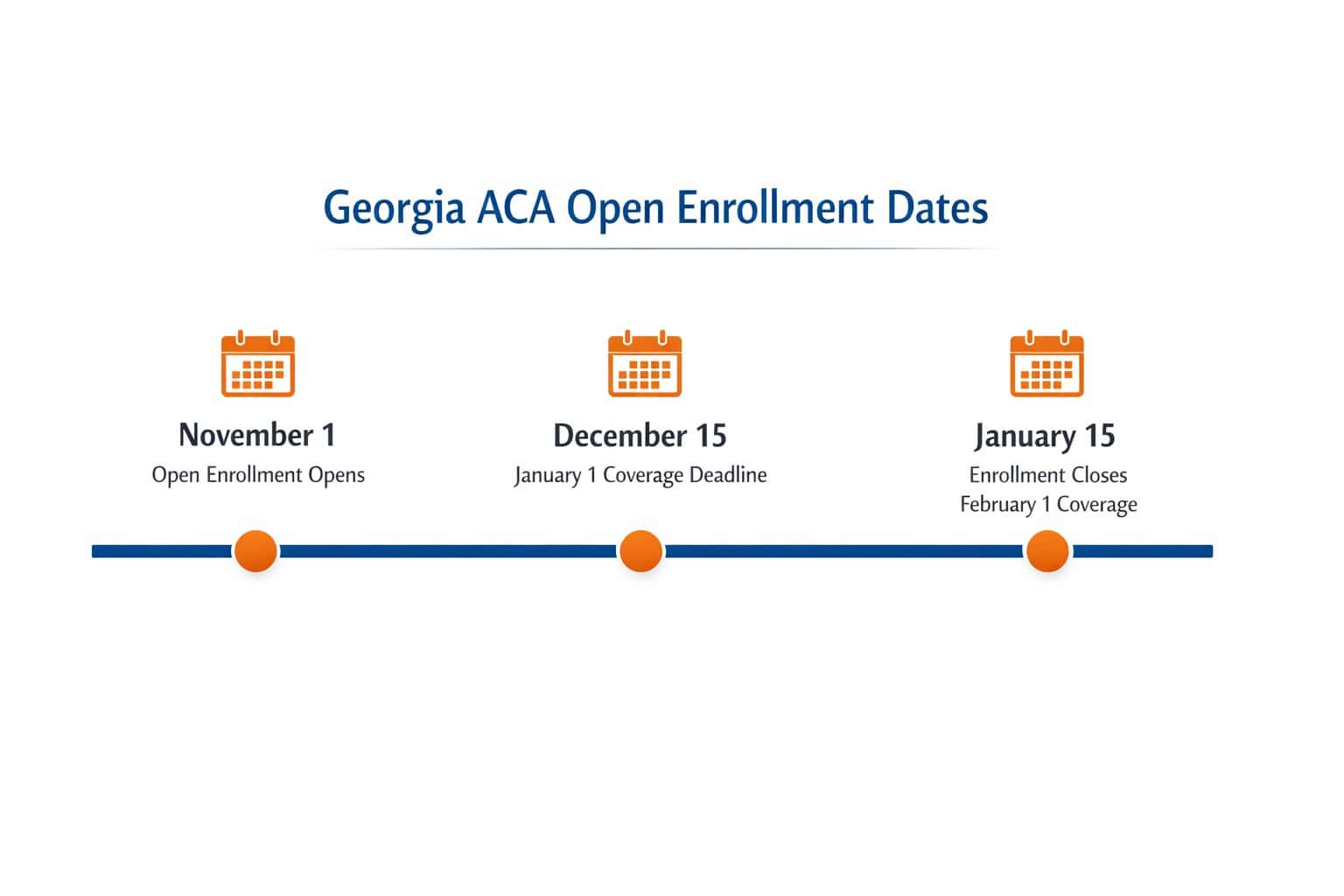
Open enrollment runs November 1 through January 15. Enroll by December 15 for January 1 coverage, or by January 15 for February 1 coverage. A qualifying life event such as loss of employer coverage, a move to a new Georgia county, marriage, or birth of a child triggers a 60-day Special Enrollment Period at any time during the year.
Without a qualifying life event, enrollment is closed until November 1. Gap options include Georgia Pathways to Coverage (if income falls below ~$15,060 and the 80-hour monthly work-activity requirement is met), short-term plans (Georgia permits plans up to 364 days with two renewals , among the most permissive short-term rules in the country), or COBRA from a prior employer plan. A licensed broker can assess which option fits the household.
Carriers on the Georgia Marketplace
Seven carriers offered plans on the georgia health insurance marketplace in 2026. Ambetter from Peach State Health Management holds the largest market share statewide and is the sole carrier in many rural South Georgia counties. Residents in Atlanta-area counties , including Fulton, DeKalb, Gwinnett, and Cobb, can typically choose from five to seven competing carriers, including Kaiser Permanente, Oscar Health, and Aetna.
Ambetter from Peach State Health Management
Georgia-specific brand for Centene Corporation. Broadest statewide footprint; the only marketplace carrier in many rural South Georgia counties including Clinch, Echols, and Charlton. Bronze plans start near $340–$380 per month (age 40, pre-subsidy). EPO network; no out-of-network benefits except emergencies.
Aetna
One of two carriers offering PPO plans on Georgia’s exchange. Available primarily in Atlanta-metro counties. Aetna PPO plans allow out-of-network care at higher cost-sharing , the primary on-exchange option for Georgians who want broad provider flexibility.
Oscar Health
EPO plans in the Atlanta metro market, primarily Fulton and DeKalb counties. Known for telehealth integration, a concierge doctor program, and transparent pricing tools. Not available in rural Georgia counties.
Kaiser Permanente
Integrated care model using Kaiser’s own hospitals and physicians. Available in the Atlanta metro , specifically Fulton, DeKalb, and Gwinnett counties. Rated highly for member satisfaction and care coordination. Not available outside the metro area.
Cigna
PPO plans in select Georgia counties. On-exchange availability varies ; confirm Cigna participation for your county before comparing. Cigna’s PPO network includes broad national provider access, a strong fit for frequent travelers or consumers seeing out-of-state specialists.
Anthem Blue Cross Blue Shield of Georgia
BCBS of Georgia offers PPO plans primarily through off-exchange direct enrollment. For consumers seeking access to Northside Hospital, WellStar Health System, or Emory Healthcare on a PPO basis, compare Georgia PPO plans alongside on-exchange options.
How Subsidies Work on the Georgia Exchange
Georgians who enroll and earn between 100% and 400% FPL , approximately $15,060 to $60,240 for a single adult, may receive Advance Premium Tax Credits (APTC). Georgia health insurance marketplace enrollees averaged approximately $430 per month in APTC in 2025. Note: ARP-enhanced subsidies expired December 31, 2025 ; credits are smaller in 2026 and the 400% FPL cliff has returned.
Example: Darius, 38, Macon, Georgia
Darius is an independent contractor projecting $36,000 in annual income , roughly 239% FPL. Under 2026 standard ACA rules, his APTC caps his benchmark Silver contribution at approximately 6–8% of income, reducing his monthly premium from ~$498 to around $230–$250. He selects an Ambetter Silver EPO covering Bibb County providers. His $3,500 deductible stays manageable, and the subsidized premium fits within his monthly budget.
| Income Range (Single Adult, 2026) | % of FPL | Max % of Income for Benchmark Silver |
|---|---|---|
| $15,060 – $22,590 | 100–150% | 0–2% |
| $22,590 – $30,120 | 150–200% | 2–6% |
| $30,120 – $45,180 | 200–300% | 6–8% |
| $45,180 – $60,240 | 300–400% | up to 8.5% (standard ACA) |
| Above $60,240 | 400%+ | No subsidy (subsidy cliff returned in 2026) |
Georgians above 400% FPL receive no subsidy and often find better value in off-exchange plans, particularly PPO plans with broader hospital access. Compare off-exchange Georgia PPO plans if income exceeds the threshold. Call 888-215-4045 for a county-specific subsidy estimate from a licensed Georgia broker.
Frequently Asked Questions About the Georgia Health Insurance Marketplace
Does Georgia have its own health insurance marketplace?
Georgia operates as a State-based Exchange (SBE) for 2025/2026 under the Georgia Access 1332 waiver. Licensed brokers process full ACA applications directly , including subsidy determinations, without consumers using HealthCare.gov. Plans and APTC amounts are identical.
What is Georgia Access and how does it work?
Georgia Access is Georgia’s 1332 waiver allowing brokers to submit marketplace applications directly to federal eligibility systems, bypassing HealthCare.gov. Subsidies, plans, and coverage terms are identical. It makes broker-assisted enrollment more efficient across Georgia’s 159 counties.
When is open enrollment on the Georgia health insurance marketplace?
Open enrollment runs November 1 through January 15. Enroll by December 15 for January 1 coverage; by January 15 for February 1 coverage. Outside open enrollment, a qualifying life event triggers a 60-day Special Enrollment Period. Georgia has no state individual mandate, so there is no tax penalty for missing enrollment , but going uninsured leaves medical costs unprotected.
Which carriers are on the Georgia marketplace in 2026?
Seven carriers in 2026: Ambetter, Aetna, Oscar Health, Kaiser Permanente, Cigna, Anthem BCBS of Georgia, and Alliant Health Plans. Ambetter is the only option in many rural South Georgia counties. Atlanta-area counties (Fulton, DeKalb, Gwinnett, Cobb) typically have five to seven carriers. Verify your county before comparing premiums.
Can I get premium subsidies on the Georgia marketplace?
Yes, if household income falls between 100% and 400% FPL , approximately $15,060 to $60,240 for a single adult in 2026. Georgia health insurance marketplace enrollees averaged approximately $430 per month in APTC in 2025. ARP-enhanced subsidies expired at end of 2025 ; 2026 credits are smaller and capped at 400% FPL. Those above 400% FPL (~$60,240/year) receive no subsidy and should compare off-exchange PPO plans.
What if I miss open enrollment in Georgia?
Without a qualifying life event, marketplace enrollment is closed until November 1. Gap options include Georgia Pathways to Coverage (if income is below ~$15,060 and work-activity requirements can be met), short-term health plans (Georgia permits plans up to 364 days with two renewals), or COBRA from a prior employer plan. A licensed broker can assess which option fits your situation while you wait for open enrollment to reopen.
Georgia Health Insurance Guides
All 2026 Georgia coverage options: marketplace, Medicaid, PPO, and short-term.
Georgia PPO Health InsuranceOn- and off-exchange PPO plans by county: Aetna, Cigna, and BCBS of Georgia.
Best Health Insurance in GeorgiaTop Georgia carriers compared by coverage need, region, and budget.
Individual Health Insurance GeorgiaPlans for self-employed workers, contractors, and individuals buying their own coverage.
Affordable Health Insurance GeorgiaMaximize APTC subsidies and CSR reductions to lower your Georgia monthly premium.
Short-Term Health Insurance GeorgiaGeorgia permits plans up to 364 days. Costs, gaps, and when short-term makes sense.
Small Business Health Insurance in GeorgiaSHOP marketplace and group plans for Georgia employers.
Compare PPO Health Insurance PlansBrowse PPO options nationwide, with no referrals required.
Compare Georgia Marketplace Plans for 2026
Find the best plan on the georgia health insurance marketplace for your county and income. Licensed agents in all 159 Georgia counties at no cost.
Broker Disclosure
ForHealthInsurance.com is an independent health insurance agency serving Georgia residents. We are not affiliated with any carrier or government agency. We help you compare plans and enroll in coverage that meets your needs at no extra cost to you.