Individual Health Insurance Arizona: Private Plans and PPO Options for 2026
Individual health insurance in Arizona covers anyone purchasing their own coverage outside of an employer group plan — including self-employed workers, early retirees, freelancers, and anyone between jobs. For 2026, Arizona’s individual market looks fundamentally different than it did a year ago. The marketplace is now 100% HMO after Banner|Aetna exited and BCBSAZ dropped all PPO products, which means anyone searching for private health insurance in Arizona with PPO flexibility must look beyond HealthCare.gov.
This guide explains the key differences between on-exchange and off-exchange individual plans, compares HMO and PPO coverage structures, and breaks down what Arizona residents need to know about buying personal health insurance in 2026. For a broader overview of all coverage pathways in the state, see the Arizona health insurance guide.

What brings you here today?
Who Needs Individual Health Insurance in Arizona
Individual health insurance in Arizona is designed for anyone who does not have access to employer-sponsored group coverage, Medicare, or Medicaid (AHCCCS). According to U.S. Census data, approximately 10% of Arizona’s working-age population purchases individual coverage. The most common situations that lead to buying private health insurance in Arizona fall into distinct categories, each with different plan selection priorities.
Self-Employed & Freelancers
Arizona has a large self-employed workforce, particularly in the Phoenix and Tucson metro areas. Without employer coverage, individual marketplace or off-exchange plans are the primary option. Self-employed individuals can deduct health insurance premiums on their federal taxes, reducing the net cost of coverage.
Early Retirees (Under 65)
Arizonans who retire before Medicare eligibility at 65 need to bridge the coverage gap. Individual plans — either marketplace HMO with subsidies or off-exchange PPO for provider continuity — fill this gap. Income during early retirement often falls into subsidy-eligible range, making marketplace options financially attractive.
Between Jobs or COBRA Transition
Job loss triggers a 60-day Special Enrollment Period for marketplace coverage. COBRA continuation from a former employer is typically more expensive than an individual marketplace plan with subsidies. Comparing COBRA to individual health insurance plans in Arizona often reveals significant savings.
Part-Time or Gig Workers
Workers without full-time benefits — including rideshare drivers, contract workers, and part-time employees — make up a growing share of Arizona’s individual market. Income variability affects subsidy eligibility, making mid-year income projections important for accurate marketplace pricing.
Aging Off a Parent’s Plan
The ACA allows dependent coverage until age 26. After that, young adults must find individual coverage. Arizona’s marketplace offers budget-friendly Bronze and Expanded Bronze plans suited to younger, healthier enrollees who want catastrophic protection at lower monthly costs.
Employer Plan Is Too Expensive
Some employer plans carry high employee contribution costs, particularly for family coverage. If the employee-only premium exceeds 8.39% of household income for 2026, the coverage is considered unaffordable under the ACA, and the household may qualify for marketplace subsidies on individual health insurance plans in Arizona.
On-Exchange vs. Off-Exchange Individual Plans
The single most important decision when buying individual health insurance in Arizona for 2026 is whether to purchase on-exchange through HealthCare.gov or off-exchange directly from a carrier. On-exchange plans are the only pathway to premium tax credits, but they are limited to HMO products in Arizona. Off-exchange plans include PPO options with broader provider access but require paying full premium without subsidies. The right choice depends on income, provider preferences, and how much flexibility matters.
For subsidy-eligible households, on-exchange plans are almost always the better financial choice — even with HMO restrictions. A household earning $55,000 might pay $300 per month for a Silver HMO after subsidies versus $720 for an off-exchange Silver PPO at full price. The trade-off is provider access: the HMO requires referrals and limits care to in-network providers, while the PPO allows direct specialist visits and out-of-network coverage. For full enrollment details, see the Arizona marketplace enrollment guide.
HMO vs. PPO: What Arizona Residents Need to Know
Understanding the structural differences between HMO, PPO, EPO, and POS plans is essential for anyone buying individual health insurance in Arizona for 2026. With the marketplace offering only HMO plans, this is no longer an abstract comparison — it determines whether a resident shops on-exchange or off-exchange, which directly affects cost and provider access. Private health insurance plans in Arizona come in multiple formats, but availability depends on the purchasing channel.
HMO (Health Maintenance Organization)
How It Works: Select a primary care physician (PCP) who coordinates all care. Referrals required to see specialists. All care must be in-network except emergencies.
Pros: Lower premiums, predictable copays, coordinated care approach, simpler billing.
Cons: No out-of-network coverage, referral delays for specialist access, restricted to one network’s providers.
AZ 2026: All seven marketplace carriers offer HMO only. Available on-exchange with subsidies.
PPO (Preferred Provider Organization)
How It Works: Choose any doctor or specialist without referrals. In-network providers cost less, but out-of-network care is covered at a higher cost-sharing level.
Pros: No referrals needed, out-of-network coverage, broader provider choice, specialist access without gatekeeping.
Cons: Higher premiums, more complex cost-sharing (separate in-network/out-of-network deductibles), no subsidy eligibility in Arizona for 2026.
AZ 2026: Available only off-exchange. No PPO plans on HealthCare.gov for Arizona.
EPO (Exclusive Provider Organization)
How It Works: Similar to PPO for in-network care (no referrals needed), but no out-of-network coverage except emergencies. A middle ground between HMO and PPO.
Pros: No referrals, typically lower premiums than PPO, simpler in-network structure.
Cons: Zero out-of-network coverage, less common in Arizona’s individual market for 2026.
AZ 2026: Limited availability. Check with a licensed agent for current EPO options in Arizona.
POS (Point of Service)
How It Works: Hybrid of HMO and PPO. Requires a PCP to coordinate care like an HMO, but allows out-of-network visits at higher cost like a PPO. Referrals typically required for specialists.
Pros: Out-of-network flexibility with HMO-style cost coordination, often lower premiums than PPO.
Cons: PCP referral requirement adds steps, out-of-network care can be expensive, member responsible for filing out-of-network claims.
AZ 2026: Not available in Arizona’s individual market. POS plans appear in employer group coverage and Medicare Advantage (HMO-POS) in Arizona, but not on-exchange or off-exchange individual plans. Residents seeking out-of-network flexibility should compare off-exchange PPO options.
Compare Arizona Individual Health Insurance Plans
Not sure whether an on-exchange HMO or off-exchange PPO is the better fit? Get a side-by-side comparison of both options based on your ZIP code, income, and preferred doctors — at no cost.
How Much Does Individual Health Insurance Cost in Arizona
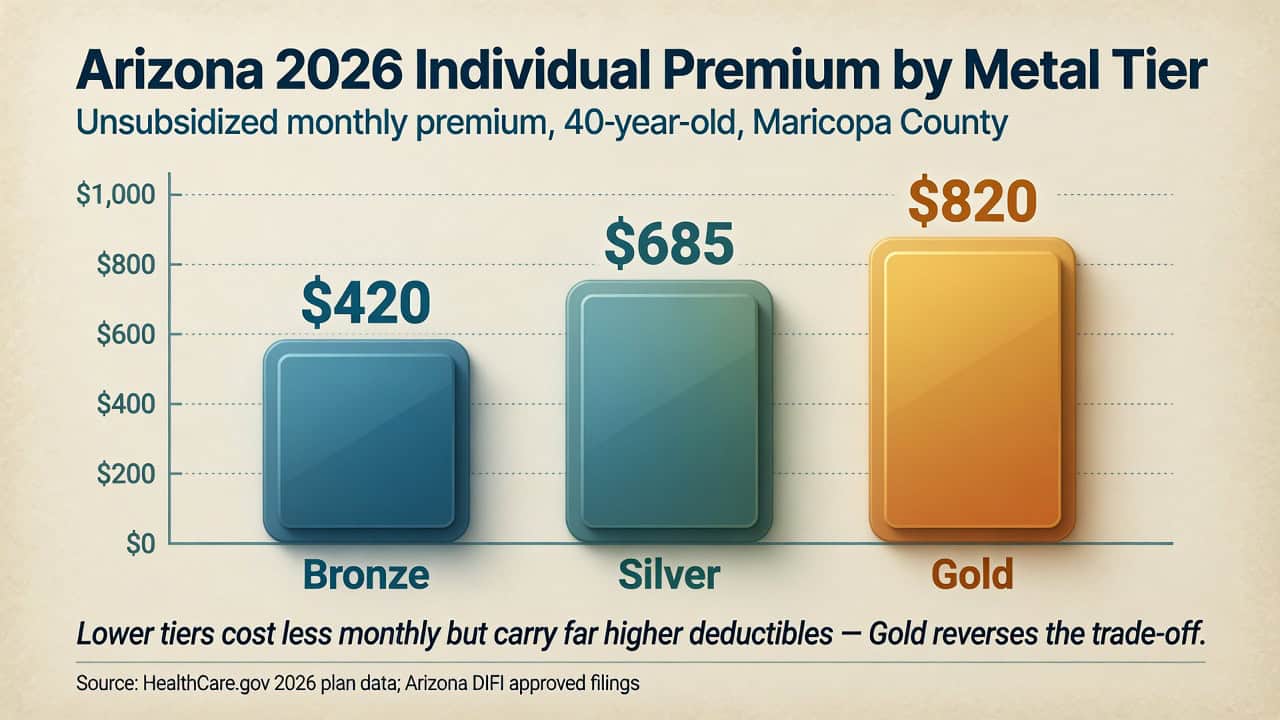
Individual health insurance costs in Arizona vary widely based on age, county, metal tier, and subsidy eligibility. According to CMS marketplace plan data, a 40-year-old in Maricopa County pays approximately $685 per month for an unsubsidized Silver HMO plan — a 29% increase over 2025 rates. After premium tax credits, eligible households pay significantly less, with many subsidized enrollees paying between $100 and $300 monthly.
Silver-tier plans offer a unique advantage for lower-income households: cost-sharing reductions (CSRs) that lower deductibles and copays for enrollees earning up to 250% of the Federal Poverty Level. A Silver plan with CSR can have an effective deductible as low as $500 — dramatically better than the standard $5,000+ deductible. This benefit only applies to Silver on-exchange plans, not off-exchange PPOs. For strategies to manage Arizona’s 2026 premium increases, see affordable health insurance in Arizona.
Rachel, age 35, is a freelance graphic designer in Tucson earning $42,000 annually (approximately 280% FPL). She visits a specialist twice per year and takes one monthly prescription. On a Silver HMO through the marketplace, her subsidized premium is $210 per month with a $2,500 deductible (CSR-enhanced). An off-exchange Silver PPO costs $690 per month with a $4,500 deductible and no subsidy. Even though the PPO gives her direct specialist access, the marketplace HMO saves her over $5,760 annually in premiums alone — plus $2,000 in deductible exposure. For Rachel, individual health insurance in Arizona through the marketplace is the clear financial winner.
Private Health Insurance vs. Marketplace Coverage in Arizona
Arizona residents searching for private health insurance often want to understand how it differs from marketplace coverage. In practice, the term “private health insurance” in Arizona refers to any plan purchased from a commercial insurance carrier — whether through HealthCare.gov or directly. All individual marketplace plans are private insurance sold by private companies. The meaningful distinction for 2026 is between subsidized marketplace plans (all HMO) and unsubsidized off-exchange plans (HMO or PPO available).
Marketplace = Private Insurance + Subsidies
Plans on HealthCare.gov are sold by the same private carriers — Ambetter, BCBSAZ, Cigna, Oscar, UnitedHealthcare, and others. The marketplace simply acts as a shopping platform that applies subsidies. Private health insurance in Arizona purchased through the marketplace is identical to the carrier’s direct product, with premium tax credits reducing the monthly cost for eligible households.
Off-Exchange = Same Carriers, More Plan Types
Purchasing individual health insurance plans in Arizona directly from a carrier (off-exchange) provides access to the same carriers plus additional plan types — including PPO options not available on the marketplace for 2026. The trade-off is no subsidy eligibility. Households above 400% FPL who do not qualify for subsidies may find comparable pricing off-exchange with added PPO benefits.
Short-Term Plans: Limited Coverage
Arizona permits short-term health insurance plans lasting up to 36 months. These plans have lower premiums but do not cover pre-existing conditions, may exclude essential health benefits, and do not count as ACA-compliant coverage. Short-term plans are not a substitute for comprehensive individual health insurance in Arizona for most residents.
Health Sharing Ministries
Health sharing plans are not insurance and are not regulated by the Arizona Department of Insurance. Members share medical costs according to the organization’s guidelines, but there are no legal guarantees of payment. These programs are not recommended as a primary replacement for private health insurance in Arizona.
AHCCCS (Arizona Medicaid)
Arizona residents earning below 138% of the Federal Poverty Level (approximately $21,597 for an individual in 2026) qualify for AHCCCS, Arizona’s Medicaid program. AHCCCS is not private health insurance — it is a government program with its own provider networks and eligibility rules. Marketplace applicants are automatically screened for AHCCCS eligibility.
COBRA Continuation
Former employees can continue employer coverage through COBRA for up to 18 months, but at full premium cost plus a 2% administrative fee. COBRA is often significantly more expensive than individual health insurance plans in Arizona purchased through the marketplace with subsidies. A side-by-side cost comparison with a licensed agent can reveal whether switching makes financial sense.
How to Buy Individual Health Insurance in Arizona
Purchasing individual health insurance in Arizona follows a straightforward process regardless of whether buying through the marketplace or off-exchange. The key decision — on-exchange versus off-exchange — should be made before starting the enrollment process, since it determines which platform to use and whether subsidies apply. A licensed agent can help with either pathway at no cost.
Determine Subsidy Eligibility
Estimate household income for the year. If it falls between 100% and 400% of the Federal Poverty Level ($15,650 to $62,600 for a single person in 2026), marketplace subsidies likely apply and the on-exchange route makes financial sense. Income above 400% FPL means no subsidy — making off-exchange PPO options worth comparing.
Check Provider Networks
If specific doctors or hospitals are priorities, check each carrier’s provider directory before selecting a plan. With all marketplace plans now HMO, provider networks are narrower than PPO plans from previous years. Confirm that preferred physicians are in-network for any plan under consideration. For carrier network details, see the best health insurance in Arizona comparison.
Compare Total Annual Cost
Add 12 months of premiums to expected out-of-pocket costs based on typical healthcare usage. A lower-premium Bronze plan with a $9,100 deductible costs more over the year than a higher-premium Gold plan with a $2,000 deductible if regular specialist visits or prescriptions are expected.
Enroll Through the Appropriate Channel
For marketplace plans: enroll through HealthCare.gov during Open Enrollment (November 1 through January 15) or during a Special Enrollment Period. For off-exchange plans: contact the carrier directly or work with a licensed agent, with enrollment available year-round from most carriers.
Frequently Asked Questions
These questions address the most common concerns Arizona residents have when shopping for individual and private health insurance plans for 2026.
What is individual health insurance in Arizona?
Individual health insurance in Arizona is coverage purchased by a single person or family outside of an employer group plan. It includes plans available through the HealthCare.gov marketplace (all HMO for 2026) and off-exchange plans purchased directly from carriers (HMO or PPO). Both options are private insurance sold by commercial carriers.
Is there a difference between private and marketplace health insurance in Arizona?
All marketplace plans are private health insurance sold by commercial carriers. The marketplace is simply a platform that enables subsidy eligibility. The practical difference for 2026 is that marketplace plans in Arizona are HMO-only, while off-exchange private plans include PPO options. Coverage benefits and carrier networks may differ between on-exchange and off-exchange versions of the same carrier’s plans.
Can I get a PPO individual plan in Arizona for 2026?
Yes, but only off-exchange. The Arizona marketplace is 100% HMO for 2026 after Banner|Aetna exited and BCBSAZ dropped all PPO products. Off-exchange PPO plans are available directly from carriers or through a licensed agent, but they are not subsidy-eligible.
How much does individual health insurance cost in Arizona?
A 40-year-old in Maricopa County pays approximately $685 per month for an unsubsidized Silver HMO plan. After premium tax credits, many subsidized enrollees pay $100 to $300 per month. Bronze plans start around $420 monthly before subsidies. Off-exchange PPO plans vary but often run $500 to $900+ per month depending on age, tier, and carrier.
Does Arizona have a penalty for not having health insurance?
No. Arizona does not have a state individual mandate and does not impose any penalty for going without coverage. However, being uninsured means paying all medical costs out of pocket, and a single emergency room visit can exceed $5,000 without insurance.
Can I buy individual health insurance outside of Open Enrollment?
Marketplace enrollment requires Open Enrollment (November 1 through January 15) or a qualifying life event that triggers a Special Enrollment Period. Off-exchange individual plans are available year-round from most carriers, with no enrollment window restrictions. A licensed agent can process both marketplace and off-exchange enrollments.
Related Arizona Coverage Guides
Explore Arizona’s coverage landscape — from marketplace enrollment to carrier comparisons and subsidy strategies.
Complete guide to all coverage options in Arizona for 2026.
Best Plans ComparedCarrier reviews, ratings, and network comparisons.
Marketplace Enrollment GuideStep-by-step enrollment, deadlines, and carrier details.
Affordable Coverage OptionsSubsidy strategies, cost breakdowns, and savings tips.
Find a Broker in ArizonaFree enrollment help from licensed professionals.
Small Business CoverageGroup plans, SHOP marketplace, and employer options.
Find the Right Individual Health Insurance in Arizona
Get a personalized comparison of marketplace HMO plans and off-exchange PPO options based on your ZIP code, income, and healthcare needs — completely free.
Broker Disclosure
ForHealthInsurance.com is an independent health insurance agency serving Arizona residents. We are not affiliated with any carrier or government agency. We help you compare plans and enroll in coverage that meets your needs at no extra cost to you.