Individual Health Insurance in Virginia 2026 Guide
Individual health insurance in Virginia covers Virginians who don’t get coverage through an employer — self-employed professionals, freelancers, 1099 contractors, early retirees, students aging off a parent plan, and family members not covered by a household member’s group plan. Virginia residents shop for individual coverage through Marketplace.Virginia.gov, the state-based exchange that replaced HealthCare.gov for plan year 2024. Eight carriers offer 2026 individual plans, with Northern Virginia (MSA 10) the only region carrying all eight — reflecting the dense federal contractor and self-employed professional population in the DC metro region. About 86% of Virginia marketplace enrollees still qualify for subsidies in 2026 despite enhanced federal credits expiring at the end of 2025. This guide covers self-employed enrollment, family coverage, NoVA federal contractor options, That flexibility shapes the individual health insurance Virginia buyers rely on.

What brings you here today?
Self-Employed Health Insurance in Virginia
Self-employed Virginians, 1099 freelancers, and independent contractors enroll in individual health insurance through Marketplace.Virginia.gov. Self-employment income is reported as expected household income on the application, which calculates Advance Premium Tax Credit and cost-sharing reductions in real time. About 86% of Virginia marketplace enrollees qualify for subsidies in 2026. Self-employed Virginians can also deduct premiums above-the-line on their federal tax return through the self-employed health insurance deduction.
The self-employed health insurance deduction is one of the most valuable tax provisions for Virginia 1099 workers buying coverage on Marketplace.Virginia.gov. Self-employed individuals can deduct 100% of their health insurance premiums (covering themselves, their spouse, and dependents) on Form 1040 Schedule 1 — reducing adjusted gross income before federal tax calculation. The deduction applies whether the policy is bought through Marketplace.Virginia.gov or off-exchange. There is one limitation: the deduction cannot exceed the net earnings from self-employment, and the self-employed individual cannot be eligible for any other employer-sponsored health plan (including a spouse’s plan).
Income reporting matters significantly for Virginia self-employed shoppers. The Marketplace calculates subsidies based on Modified Adjusted Gross Income (MAGI), which for self-employed Virginians includes business income net of allowable deductions. Underestimating income on the application can result in clawback of subsidies at tax time; overestimating can result in paying more than necessary during the plan year (with a refund at tax filing). Self-employed Virginians with variable income should update Marketplace.Virginia.gov mid-year if their income changes substantially — the platform recalculates subsidies in real time based on updated figures.
Northern Virginia Federal Contractors and 1099 Workers
Northern Virginia federal contractors who are 1099 independent contractors, or who work for small contractors not offering group coverage, typically buy individual coverage on Marketplace.Virginia.gov. Northern Virginia (MSA 10) has the most carrier choice in Virginia — eight carriers compete in NoVA, including CareFirst BlueChoice (the DC-metro Blue Cross BlueShield licensee unique to MSA 10) for integrated DC + Maryland + Northern Virginia network access.
Federal contractors in Northern Virginia split into three coverage situations. First, 1099 independent contractors and consultants who shop Marketplace.Virginia.gov for individual coverage — typically choosing CareFirst BlueChoice if they need DC-metro network access, or Anthem HealthKeepers, Cigna, or Kaiser if they primarily work and seek care in Virginia. Second, W-2 employees of larger federal contractors (Booz Allen, Leidos, SAIC, MITRE, etc.) who receive group health coverage as a benefit and don’t shop the marketplace. Third, employees of smaller federal contractors who don’t offer group coverage and end up on Marketplace.Virginia.gov, sometimes with employer ICHRA reimbursement (covered on our Virginia Small Business page).
CareFirst BlueChoice is the standout NoVA option for federal contractors. Available in MSA 10 only — Arlington, Alexandria, Fairfax, Loudoun, Prince William, and surrounding counties — CareFirst is the regional Blue Cross BlueShield licensee for DC + Maryland + Northern Virginia. Federal workers who travel for assignments, have family members in DC or Maryland, or consult across the National Capital region typically prefer CareFirst’s BlueCard reciprocity over Virginia-only HMO networks. CareFirst’s 2026 approved rate change was +18.2%, slightly below Virginia’s statewide average of 21.6%. About 7, NoVA leads individual health insurance Virginia enrollment.
Family Health Insurance and Dependent Coverage
Family health insurance in Virginia covers a household — typically the policyholder, spouse, and dependent children up to age 26 — on a single Marketplace.Virginia.gov plan. Premium costs scale with the number and ages of covered individuals. Subsidies are calculated based on total household income across all enrolled members. The household out-of-pocket maximum applies to the family combined, generally making a family plan more cost-effective than separate individual policies.
Dependent children stay on a Virginia parent’s plan up to age 26 — a federal ACA protection that applies regardless of student status, marital status, or whether the child lives with the parent. Children enrolled in a parent’s marketplace plan who lose eligibility at age 26 typically qualify for a Special Enrollment Period to enroll in their own marketplace plan, with subsidies calculated based on their own household income (which is often lower than the parent’s, qualifying the child for Subsidies lower individual health insurance Virginia costs sharply.
Virginia families with children under 19 should also screen for FAMIS — Virginia’s Children’s Health Insurance Program. FAMIS covers about 183,526 Virginia children at $0 premium for families with incomes typically up to 200% of the federal poverty level. Marketplace.Virginia.gov screens for FAMIS automatically as part of the same application. A family at 250% of FPL might find that the parents qualify for Marketplace Silver subsidies while the children separately qualify for FAMIS — a split-coverage scenario that the Marketplace handles seamlessly within one application.
Get a Virginia Individual Coverage Quote
Self-employed in Virginia? A licensed Virginia agent runs your expected 1099 income through Marketplace.Virginia.gov, folds in the self-employed deduction, and checks whether Inova, Sentara, HCA Virginia, or CareFirst’s DC-metro network covers your doctors before you enroll. One call covers all eight carriers. Free, no obligation.
Individual Health Insurance Costs in Virginia for 2026
Full-price individual Silver-tier marketplace premiums for a 40-year-old non-smoker run roughly $490 to $760 per month before subsidies depending on Virginia MSA, with Northern Virginia at the high end ($720 to $760) and Bristol at the low end ($490 to $540). After Advance Premium Tax Credits, typical after-subsidy Silver costs drop to $80 to $280 per month. Premiums also scale with age.
| Age | Silver Full-Price (NoVA) | Silver Full-Price (Bristol) | Typical After APTC |
|---|---|---|---|
| 27 years old | $540–$580/mo | $370–$410/mo | $70–$180/mo |
| 30 years old | $580–$620/mo | $400–$440/mo | $75–$190/mo |
| 40 years old | $720–$760/mo | $490–$540/mo | $80–$280/mo |
| 50 years old | $980–$1,030/mo | $680–$740/mo | $120–$380/mo |
| 60 years old | $1,720–$1,820/mo | $1,180–$1,300/mo | $150–$510/mo |
Pricing varies substantially across Virginia’s 12 MSAs. Northern Virginia (MSA 10) is consistently the most expensive — reflecting higher Inova Health System and HCA Virginia hospital reimbursement rates and the dense DC-metro provider market. Hampton Roads (MSA 9), Richmond (MSA 7), and Roanoke (MSA 8) sit in the middle range. Far southwest Virginia (MSA 5 — Bristol) and Lynchburg (MSA 12) are the cheapest. For self-employed Virginians who could relocate within the state, choosing a less expensive MSA can change after-subsidy premiums by $30–$100 per month Pricing varies across individual health insurance Virginia plans.
Special Enrollment Period Triggers in Virginia
Outside Virginia’s November 1 to January 30 open enrollment window, Virginia residents can buy individual marketplace coverage only through a Special Enrollment Period. Common SEP triggers include losing other coverage, getting married, having a baby, becoming a U.S. citizen, or moving to a different Virginia county. SEPs typically allow 60 days to enroll from the qualifying event date. Cardinal Care Medicaid and FAMIS enrollment is open year-round with no SEP required.
Loss of other coverage
The most common SEP trigger. Includes job loss with employer coverage termination, COBRA expiration, loss of Cardinal Care or FAMIS eligibility, divorce that ends coverage on a spouse’s plan, aging off a parent’s plan at 26, and certain student plan terminations. Loss of voluntary plans (e.g., voluntarily dropping COBRA) does NOT qualify. Documentation typically required: termination letter from prior insurer, COBRA election notice, Such events open individual health insurance Virginia enrollment midyear.
Marriage, divorce, or new dependent
Getting married triggers an SEP for both spouses to enroll on Marketplace.Virginia.gov individually or jointly. Divorce ending dependent coverage triggers an SEP for the affected spouse and any children losing coverage. Having a baby, adopting a child, or gaining a foster child also triggers an SEP — coverage can be backdated to the date of birth or adoption. Documentation: marriage certificate, divorce decree, birth certificate, or adoption paperwork.
Move to a new Virginia county or state
Moving to Virginia from another state triggers an SEP, as does moving to a different Virginia county that changes available carriers or pricing region. The move must be permanent and require a change of residence — temporary moves for vacation, work travel, or college (in some cases) do not qualify. Documentation: lease agreement, mortgage statement, utility bill, or driver’s license update.
Income change or citizenship status
Becoming a U.S. citizen, gaining qualifying immigration status, or experiencing an income change that newly qualifies you for subsidies (or moves you out of the Cardinal Care eligibility range) can trigger an SEP. Income changes that simply increase or decrease subsidy amounts do not require an SEP — those are handled by updating your existing Marketplace.Virginia.gov account. Documentation: naturalization certificate, immigration documentation, or tax return showing income change.
SEPs typically allow 60 days from the qualifying event date to enroll. Some SEPs (like loss of coverage) allow 60 days before AND after the event for forward-planning. Coverage effective dates depend on when enrollment is completed — generally the first of the month following enrollment, though some triggers (birth, adoption) allow retroactive coverage to the event date. The Virginia Health Benefit Exchange’s Marketplace Help Center at 888-687-1501 It clarifies individual health insurance Virginia timing rules.
Off-Exchange Private Health Insurance in Virginia
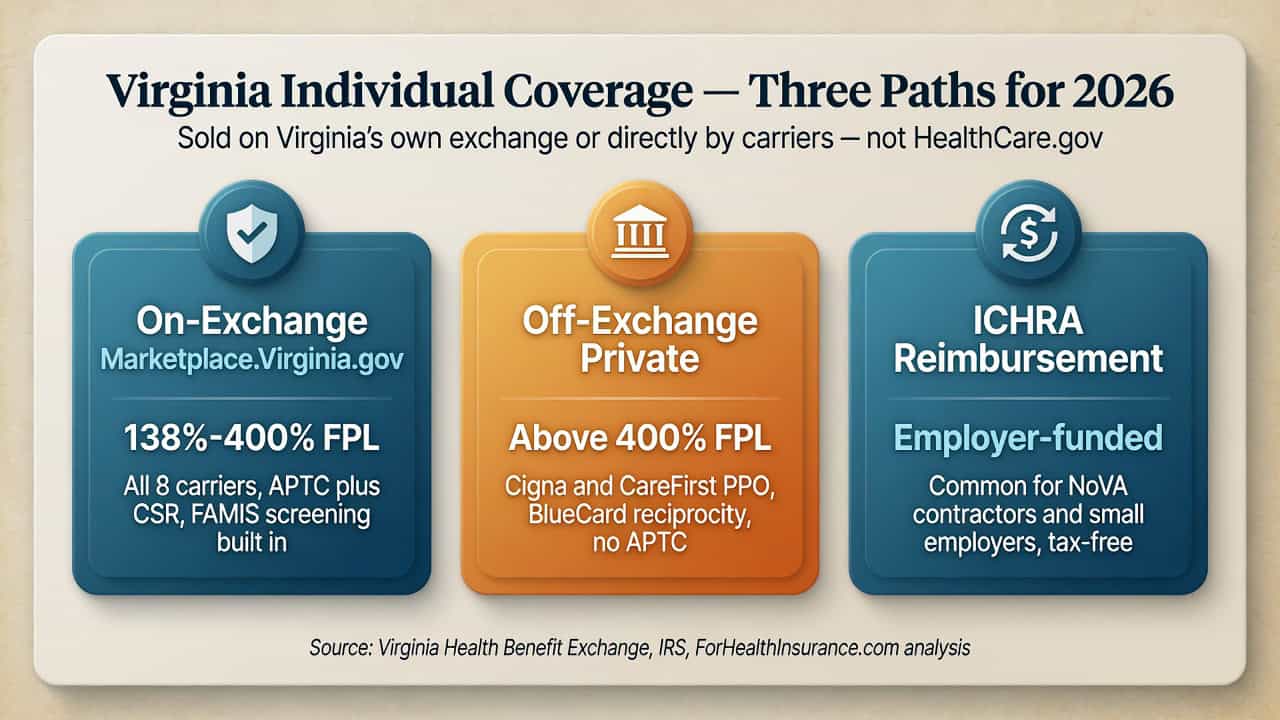
Off-exchange individual health insurance in Virginia is sold directly by carriers (Anthem, Cigna, CareFirst, others) without going through Marketplace.Virginia.gov, and is not eligible for Advance Premium Tax Credits or cost-sharing reductions, so the enrollee pays the full premium. It is sold year-round, not limited to open enrollment. For Virginians above 400% of FPL, off-exchange PPO plans often deliver better network value at comparable cost.
The trade-off between marketplace and off-exchange is straightforward. Marketplace.Virginia.gov plans qualify for subsidies and cost-sharing reductions but are predominantly HMOs with restricted networks. Off-exchange plans can include PPO and EPO products with broader networks (national reciprocity, out-of-network access) but charge full premium. For a self-employed Virginian earning $120,000 (above 400% FPL for a single adult), the marketplace and off-exchange premium costs are often comparable — but off-exchange may deliver a better network at the same cost. For a self-employed Virginian earning $50,000, the marketplace subsidy makes Marketplace.Virginia.gov coverage substantially cheaper than any off-exchange option.
Off-exchange enrollment is also useful outside open enrollment. Without an SEP-qualifying event, marketplace enrollment is closed between February 1 and October 31. Off-exchange carriers may sell new policies year-round, though many require waiting periods or limit enrollment to qualifying life events similar to marketplace SEPs. For carrier-by-carrier comparison of Virginia PPO availability — including which 2026 marketplace and off-exchange carriers offer PPO products — see our Best Health Insurance in Virginia guide.
Frequently Asked Questions
Common questions about individual health insurance in Virginia cover self-employed enrollment through Marketplace.Virginia.gov, Northern Virginia federal contractor coverage, the difference between individual and family plans, Special Enrollment Periods outside open enrollment, average costs across Virginia’s 12 MSAs, and how off-exchange private coverage differs from marketplace plans.
How do I get individual health insurance in Virginia if I’m self-employed?
Self-employed Virginians, freelancers, and independent contractors enroll in individual health insurance through Marketplace.Virginia.gov — Virginia’s state-based exchange that replaced HealthCare.gov for plan year 2024. Self-employment income is reported as expected household income on the Marketplace application, which calculates your Advance Premium Tax Credit and any cost-sharing reductions in real time. About 86% of Virginia marketplace enrollees qualify for premium subsidies. Self-employment health insurance premiums are also deductible above-the-line on your federal tax return through the self-employed health insurance deduction, That deduction helps self-employed individual health insurance Virginia buyers.
Can a federal contractor in Northern Virginia get individual health insurance?
Yes — Northern Virginia federal contractors who are 1099 independent contractors or who work for small contractors not offering group coverage typically buy individual coverage on Marketplace.Virginia.gov. Northern Virginia (MSA 10) has the most carrier choice in Virginia with eight carriers competing — including CareFirst BlueChoice, the DC-metro Blue Cross BlueShield licensee that offers integrated DC + Maryland + Northern Virginia network coverage. Federal contractors employed by larger contracting firms typically receive group health coverage as a W-2 benefit and would not need individual marketplace coverage, though some choose marketplace coverage if their employer Affordability tests govern individual health insurance Virginia eligibility.
What is the difference between individual and family health insurance in Virginia?
In Virginia, individual health insurance covers one person, while family health insurance covers a household — typically the policyholder, spouse, and dependent children up to age 26. Both are sold through Marketplace.Virginia.gov as the same underlying plans; the difference is which household members are added to the policy at enrollment. Premium costs scale with the number of covered individuals and their ages. Subsidies are calculated based on total household income across all enrolled members. A family plan is generally more cost-effective than separate individual policies for spouses and children because the household out-of-pocket maximum applies to the whole family combined.
When can I buy individual health insurance in Virginia outside open enrollment?
Outside the November 1 to January 30 open enrollment window, Virginians can buy individual health insurance through Marketplace.Virginia.gov only if they qualify for a Special Enrollment Period (SEP). Common SEP triggers include losing other coverage (job loss, COBRA expiration, loss of dependent status, divorce), getting married, having a baby or adopting, becoming a U.S. citizen or qualifying immigrant, moving to a different Virginia county or to Virginia from another state, and certain income changes that newly qualify you for subsidies. SEPs typically allow 60 days to enroll from the qualifying event date. Cardinal Care Medicaid and FAMIS enrollment is open year-round with no SEP required.
What is the average cost of individual health insurance in Virginia?
Full-price individual Silver-tier marketplace premiums for a 40-year-old non-smoker in Virginia run roughly $490–$760 per month before subsidies depending on Metropolitan Statistical Area, with Northern Virginia (MSA 10) at the high end and far southwest Virginia (MSA 5 — Bristol) at the low end. After Advance Premium Tax Credits, typical after-subsidy costs drop to $80–$280 per month for subsidized Silver plans. About 86% of Virginia marketplace enrollees still qualify for subsidies in 2026 even after enhanced federal credits expired at the end of 2025. Premium costs also vary by age — a 50-year-old typically pays roughly 1.4 times what a 40-year-old pays for the same plan.
What is private health insurance in Virginia and how is it different from marketplace coverage?
Private health insurance in Virginia includes both Marketplace.Virginia.gov coverage (where Anthem HealthKeepers, Sentara Health Plans, Cigna, Kaiser, CareFirst BlueChoice, and others sell ACA-compliant plans) and off-exchange private coverage sold directly by carriers without going through the state marketplace. Off-exchange plans are not eligible for Advance Premium Tax Credits or cost-sharing reductions but may offer broader networks (especially PPO products) at the same or higher full-price premium. For Virginians above 400% of FPL who don’t qualify for marketplace subsidies anyway, off-exchange PPO plans often deliver better network value at comparable cost. Off-exchange coverage is also sold year-round, not limited to the open enrollment window.
Compare 2026 Virginia Individual Coverage
From a NoVA federal contractor to a Richmond freelancer, a licensed Virginia agent weighs subsidized Marketplace.Virginia.gov plans against off-exchange private PPO and any employer ICHRA, then points you to the lowest-total-cost individual path for 2026. Free, no obligation.
Virginia individual coverage help — covers all situations in one call.
Related Virginia Health Insurance Resources
The complete pillar guide to Virginia health insurance for 2026.
Virginia Health Insurance MarketplaceMarketplace.Virginia.gov enrollment, January 30 deadline, and subsidies.
Best Health Insurance in VirginiaAll 8 carriers compared head-to-head on cost, network, and MSA.
Affordable Virginia Health InsuranceCardinal Care, FAMIS, subsidies, and the 21.6% rate increase explained.
Cover Virginia (Cardinal Care / FAMIS)Year-round Medicaid and FAMIS eligibility screening for income-qualifying Virginians.
Virginia Small Business Health InsuranceGroup plans, SHOP, ICHRA, and QSEHRA for Virginia employers.
Virginia’s Insurance Marketplace (Official)Virginia’s official marketplace enrollment portal for 2026 plans.
IRS Self-Employed Health Insurance DeductionFederal guidance on the self-employed health insurance tax deduction.
Broker Disclosure
ForHealthInsurance.com is an independent health insurance agency serving Virginia residents. We are not affiliated with any carrier or government agency. We help you compare plans and enroll in coverage that meets your needs at no extra cost to you.