Maryland Health Insurance: 2026 Plans, Costs & Enrollment Guide
Maryland residents purchase health insurance through Maryland Health Connection — the state’s own marketplace at MarylandHealthConnection.gov — where five carriers offer individual and family plans for 2026. For 2026, Maryland expanded its state-funded Premium Assistance program from young adults only to all enrollees with income up to 400% FPL, helping approximately 177,000 residents offset the loss of federal enhanced subsidies. This guide covers how the marketplace works, what plans cost, which carriers serve your area, and how to enroll.

What are you looking for?
How Much Does Health Insurance Cost in Maryland?
Maryland health insurance costs for 2026 depend on carrier selection, metal tier, and whether you qualify for federal and state subsidies. Approximately 80% of Maryland Health Connection applicants receive financial help. The lowest Silver plan for a 40-year-old in the Baltimore metro area is approximately $302/month (UHC/Optimum Choice) before subsidies, per approved rates from the Maryland Insurance Administration.
| Carrier | Network Type | Silver Premium (Age 40, Baltimore) | 2026 Approved Rate Change |
|---|---|---|---|
| Optimum Choice (UHC) | HMO | ~$302/month | +11.4% |
| Kaiser Permanente | HMO | ~$319/month | +9.2% |
| CareFirst BlueChoice | HMO | ~$355/month | +9.7% |
| Wellpoint Maryland | HMO | ~$397/month | +8.1% |
| CareFirst GHMSI/CFMI | PPO | ~$510/month | +15.9% |
The overall approved average rate increase for Maryland’s individual market is 13.4% for 2026, down from the 17.1% carriers initially requested. Maryland’s state reinsurance program — established in 2019 — continues to keep unsubsidized premiums lower than they would otherwise be by helping carriers pay for their costliest members. For most subsidized enrollees, the rate increase does not translate directly into higher out-of-pocket costs because subsidy amounts adjust annually to match the benchmark Silver plan. The Affordable Health Insurance in Maryland guide covers all cost-saving strategies.
Maryland Health Insurance Carriers for 2026
Five carriers offer individual plans through Maryland Health Connection for 2026, including two CareFirst entities — CareFirst BlueChoice (HMO) and CareFirst GHMSI/CFMI (the only PPO on the exchange). CareFirst is the dominant carrier in Maryland, covering nearly 60% of all state residents. Kaiser Permanente serves the Baltimore–Washington corridor with a closed-network HMO model. Aetna exited the Maryland marketplace for 2026, displacing approximately 5,000 enrollees.
Carrier availability varies by county. The Baltimore metro area and Montgomery/Prince George’s counties typically have access to all five carriers. Rural counties on the Eastern Shore and in western Maryland may have three to four options. CareFirst BlueChoice offers the broadest network access in the state — including the national Blue Cross Blue Shield provider network for out-of-area emergencies. Kaiser Permanente is limited to its own facilities in the Baltimore and Washington, D.C., metropolitan areas — ideal for residents already in the Kaiser system but restrictive for those who need providers outside Kaiser facilities.
CareFirst GHMSI/CFMI is the only PPO option on Maryland Health Connection — offering out-of-network coverage at higher cost-sharing. The PPO Silver premium of $510/month (age 40, Baltimore) is significantly higher than the HMO alternatives, but it provides the flexibility to see specialists without referrals and to access out-of-network providers. The Best Health Insurance in Maryland guide profiles each carrier’s network and regional strengths.
Compare Maryland Health Insurance Plans
See which carriers serve your county, check subsidy eligibility including Maryland Premium Assistance, and compare 2026 plan costs from five carriers.
Subsidies & Maryland Premium Assistance
Maryland health insurance enrollees benefit from a dual-subsidy system for 2026: federal advance premium tax credits (available in all states) plus the state-funded Maryland Premium Assistance program — expanded for 2026 from young adults only (ages 18–37) to all Maryland Health Connection enrollees with income up to 400% FPL (~$62,600/individual). Approximately 177,000 enrollees are receiving state-funded subsidies in early 2026, up from about 65,000 in 2025.
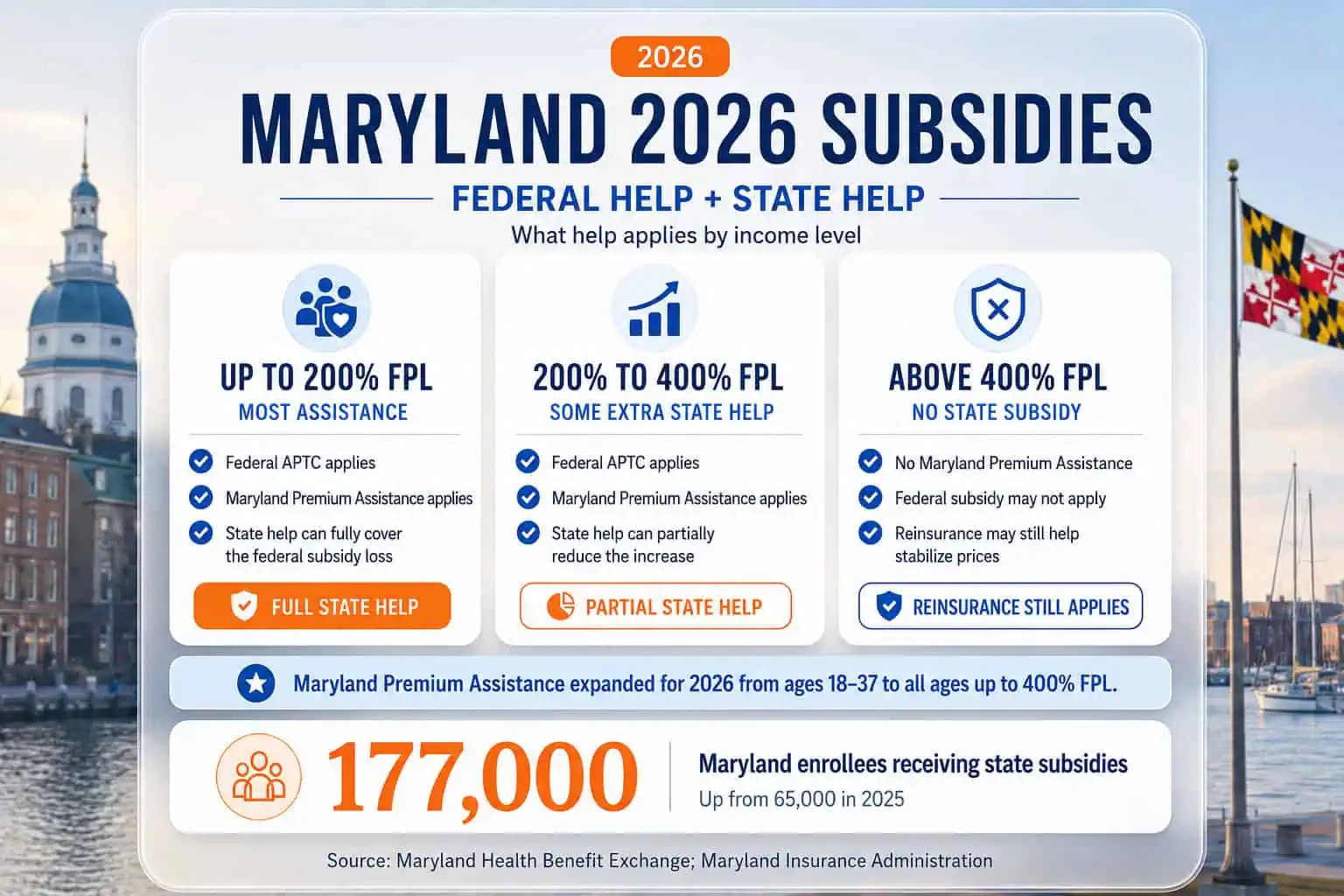
Maryland Health Connection clarified that the state-funded Maryland Premium Assistance program fully covers the loss of federal enhanced subsidies for enrollees with income up to 200% FPL (~$30,120/individual), and partially covers it for enrollees with income up to 400% FPL. This makes Maryland one of approximately ten states offering state-funded subsidies in addition to federal assistance — and one of the most aggressive in expanding eligibility for 2026 to offset the federal subsidy expiration. Federal premium tax credits continue to follow the rules the Centers for Medicare & Medicaid Services sets for every state exchange.
Maryland also maintains a state reinsurance program, established by the General Assembly in 2019, which reduces unsubsidized premiums by helping carriers pay for their highest-cost members. The reinsurance program — combined with the new Premium Assistance expansion — contributed to keeping approved 2026 rates lower than what carriers initially requested (13.4% approved vs. 17.1% requested). The Affordable Health Insurance in Maryland guide covers both subsidy programs in detail.
2026 subsidy changes: Federal enhanced premium tax credits expired at the end of 2025. Maryland responded with the expanded Premium Assistance program, but middle-income enrollees (200%–400% FPL) may still see some premium increases. A 30-year-old earning $39,125/year could see monthly premiums nearly double compared to 2025 if they do not qualify for full state subsidy offset. Check the Get an Estimate tool at MarylandHealthConnection.gov for your specific 2026 subsidy amount.
How to Enroll in Maryland Health Insurance
Maryland health insurance enrollment happens through Maryland Health Connection at MarylandHealthConnection.gov — not HealthCare.gov. Open enrollment for 2026 ran November 1, 2025, through January 15, 2026, with a December 15 deadline for January 1 coverage. Maryland also offers a unique Easy Enrollment program that connects residents with health coverage through their state income tax return.
Create an account at MarylandHealthConnection.gov
Visit MarylandHealthConnection.gov or call 1-855-642-8572 for phone assistance. The application determines eligibility for Medicaid, Maryland Premium Assistance, standard APTC, and unsubsidized marketplace plans through a single form. In-person help is available through Health Care Access Maryland navigators statewide.
Complete the application with income and household data
Provide household size, estimated 2026 income, Social Security numbers, and immigration documents if applicable. Maryland Health Connection uses this to determine your subsidy amount — including the new Maryland Premium Assistance for enrollees up to 400% FPL. The Get an Estimate tool provides a quick preview before completing the full application.
Compare plans — including Value Plans
Maryland Health Connection offers certified “Value Plans” with lower out-of-pocket costs for frequently-used services like primary care and prescriptions. Compare carrier networks, formularies, and total annual cost (premium + deductible + copays) across all five carriers available in your county. Value Plans make common service costs clearer and more consistent across carriers.
Select a plan and make your first payment
Choose your plan and pay the first month’s premium to activate coverage. Outside of open enrollment, qualifying life events (job loss, marriage, childbirth, moving) trigger a 60-day special enrollment period. Maryland’s Easy Enrollment program can also connect uninsured residents with coverage through their state income tax return filing.
Easy Enrollment: Maryland’s Easy Enrollment program allows residents to check a box on their state income tax return to share information with Maryland Health Connection. If you appear eligible for free or low-cost coverage, the exchange follows up to help you enroll. This unique pathway has helped thousands of previously uninsured Maryland residents connect with coverage without completing a separate application.
Other Health Coverage Options in Maryland
Beyond Maryland Health Connection plans, Maryland residents can access employer-sponsored group coverage, off-exchange individual plans from the same five carriers, Medicaid for incomes up to 138% FPL (~$21,384/individual), and MCHP (Maryland Children’s Health Program) for children in families with higher incomes. Maryland does not have a state individual mandate — there is no penalty for going uninsured, unlike Massachusetts and a few other states.
Off-exchange individual plans in Maryland are available from the same carriers at the same base rates — but subsidies (both federal APTC and Maryland Premium Assistance) are only available through Maryland Health Connection. For small businesses, the Maryland Health Connection small group portal offers coverage from CareFirst, Kaiser, UnitedHealthcare, and Aetna (small group market). The Small Business Health Insurance in Maryland guide covers employer group options. The Individual Health Insurance in Maryland guide covers self-employed and off-exchange options.
Frequently Asked Questions About Maryland Health Insurance
Answers to common questions about Maryland health insurance for 2026 — including how Maryland Health Connection works, the new state Premium Assistance program, carrier options, enrollment deadlines, and how subsidies affect the cost of coverage.
Is Maryland Health Connection the same as HealthCare.gov?
No. Maryland operates its own state-based marketplace at MarylandHealthConnection.gov. Maryland residents do not use HealthCare.gov for individual coverage. Maryland Health Connection has its own application, enrollment deadlines, and the Maryland Premium Assistance state subsidy program that is not available in HealthCare.gov states. Call 1-855-642-8572 for enrollment assistance.
What is Maryland Premium Assistance?
Maryland Premium Assistance is a state-funded subsidy program expanded for 2026 from young adults only (ages 18–37) to all Maryland Health Connection enrollees with household income up to 400% FPL (~$62,600/individual). The program layers state subsidies on top of federal APTC to reduce monthly premiums. Approximately 177,000 enrollees are receiving state subsidies in early 2026, up from 65,000 in 2025. The amount depends on income, family size, and zip code.
How many carriers are on Maryland Health Connection for 2026?
Five carriers offer individual plans through Maryland Health Connection for 2026: CareFirst BlueChoice (HMO), CareFirst GHMSI/CFMI (PPO — the only PPO on the exchange), Kaiser Permanente (HMO), Optimum Choice/UnitedHealthcare (HMO), and Wellpoint Maryland (HMO). Aetna exited the Maryland marketplace for 2026, displacing approximately 5,000 enrollees who needed to select replacement coverage.
Does Maryland require health insurance?
No. Maryland does not have a state individual mandate or tax penalty for going without health insurance. The federal individual mandate penalty was eliminated in 2019. Maryland residents can choose whether to purchase coverage without facing a state-level fine. However, approximately 80% of Maryland Health Connection applicants qualify for financial help that makes coverage significantly more affordable than paying out of pocket for medical care.
What is Easy Enrollment in Maryland?
Easy Enrollment is a Maryland-specific program that allows residents to check a box on their state income tax return to share information with Maryland Health Connection. If the exchange determines you may qualify for free or low-cost health coverage, it follows up with enrollment assistance. This unique pathway has helped thousands of previously uninsured Maryland residents connect with Medicaid or subsidized marketplace plans without completing a separate application process.
When is open enrollment for Maryland health insurance?
Open enrollment for 2026 coverage through Maryland Health Connection ran November 1, 2025, through January 15, 2026. The deadline for January 1 coverage was December 15. Outside of open enrollment, qualifying life events — including job loss, marriage, childbirth, and moving to a new Maryland county — trigger a 60-day special enrollment period. The Easy Enrollment program provides an additional pathway through state tax return filing.
Maryland Health Insurance Resources
Explore related guides for Maryland Health Connection enrollment, affordable coverage and state subsidies, carrier comparisons, individual and small business plans, and nationwide PPO options.
How to enroll, deadlines, and qualifying life events.
Affordable Coverage & SubsidiesPremium Assistance, Medicaid, and low-cost plan options.
Best Plans & CarriersCareFirst, Kaiser, and UHC ranked and compared.
Individual & Private PlansCoverage options for individuals and families in Maryland.
Small Business Group PlansGroup coverage options for Maryland employers.
Nationwide PPO PlansFlexibility for specialists and out-of-network care.
Find the Right Maryland Health Insurance Plan
Compare plans from five carriers on Maryland Health Connection, check state and federal subsidy eligibility, and see 2026 pricing for your household.
Broker Disclosure
ForHealthInsurance.com is an independent health insurance agency serving Maryland residents. We are not affiliated with any carrier or government agency. We help you compare plans and enroll in coverage that meets your needs at no extra cost to you.