Nebraska Health Insurance: 2026 Plans, Carriers & Costs
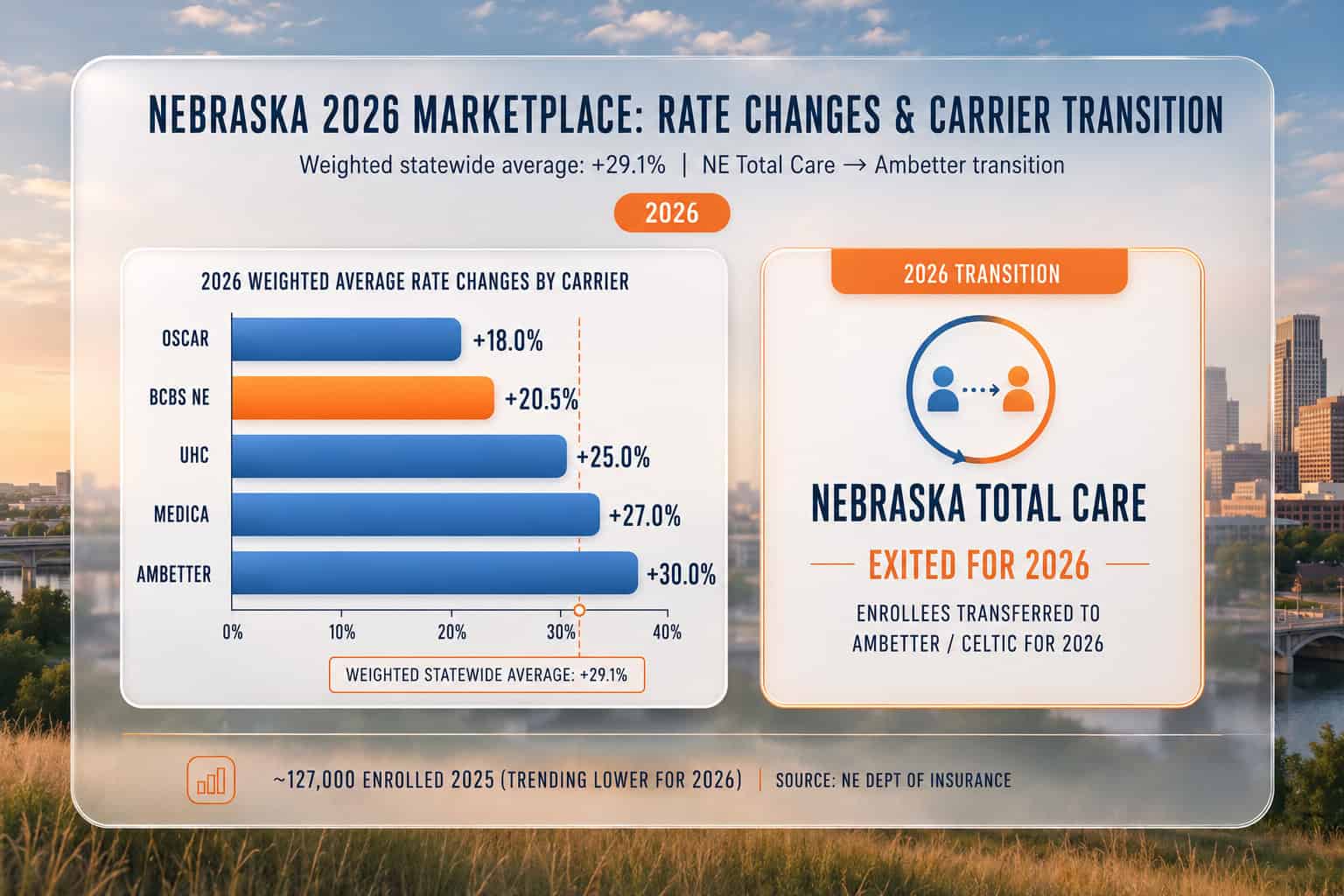
Health insurance in Nebraska for 2026 sits at a crossroads shaped by two forces pulling in opposite directions. On the supply side, five marketplace carriers now compete on HealthCare.gov — BCBS of Nebraska, Medica, Ambetter (which absorbed Nebraska Total Care’s departing enrollees), Oscar, and UnitedHealthcare — giving most Nebraskans three to five options depending on their county and rating area. On the cost side, the weighted average rate increase of +29.1% is among the steepest nationally, driven by BCBS NE’s +20.5% hike on its 22,300-member book and the compounding effect of enhanced subsidy expiration on the risk pool. Meanwhile, Heritage Health — Nebraska’s Medicaid managed care system covering approximately 333,000 residents — faces a new chapter as Medicaid work requirements begin May 1, 2026 for expansion adults. Approximately 127,000 Nebraskans enrolled in marketplace coverage for 2025, with enrollment trending lower for 2026. This guide covers carriers, costs, Medicaid eligibility, the subsidy shift, and how to navigate the most complex enrollment year since Medicaid expansion took effect in October 2020.

What brings you to Nebraska coverage today?
Five Carriers Competing From Omaha to Scottsbluff
Nebraska health insurance for 2026 comes from five carriers on HealthCare.gov. BCBS of Nebraska dominates with 22,300 enrollees and a dual EPO/PPO product structure. Medica offers CHI Health network plans and competitive mid-tier pricing. Ambetter (Celtic) absorbed Nebraska Total Care’s departing enrollees for 2026. Oscar Health sells the cheapest plans in Lincoln. UnitedHealthcare rounds out the field in select areas. Carrier availability varies across Nebraska’s four rating areas.
| Carrier | 2026 Rate Change | Enrollees (est.) | Key Strength |
|---|---|---|---|
| Blue Cross Blue Shield of NE | +20.5% | ~22,300 (largest) | EPO + PPO dual structure; broadest statewide network |
| Medica | ~25–30% | ~15,000 | CHI Health network plans; competitive Silver pricing |
| Ambetter (Celtic) | ~30% | ~8,000+ | Absorbed NE Total Care enrollees; affordable Bronze |
| Oscar Health | Varies | ~1,585 | Cheapest in Lincoln; tech-forward app; EPO plans |
| UnitedHealthcare | ~25% | ~3,300 | National brand; strong pharmacy benefit; select areas |
BCBS of Nebraska’s dual product line deserves particular attention. Its EPO (Exclusive Provider Organization) plans are the most affordable — Bronze EPO starts at approximately $662/month for a 40-year-old — while PPO plans add out-of-network flexibility for $115–$234 more per month. The EPO network includes Nebraska Medicine (UNMC), Methodist Health, and most major Omaha and Lincoln providers. The PPO extends nationwide through the BlueCard program. For Nebraskans who need CHI Health (the state’s Catholic health system with hospitals across Omaha, Lincoln, Grand Island, and Kearney), Medica’s CHI-affiliated plans provide direct network access. Which carrier is the best Nebraska health insurance pick comes down to three questions: do your providers sit in BCBS NE’s broad EPO network (Nebraska Medicine, Methodist) or in CHI Health (Creighton, Bergan Mercy, Good Samaritan), where Medica’s CHI plans fit best; do you need nationwide out-of-state access, which only BCBS NE’s PPO with BlueCard delivers; and are you in Lincoln, where Oscar undercuts everyone on Silver? Verify your doctors are in-network first, then compare after-subsidy pricing. Regional best-value picks for Omaha, Lincoln, Grand Island/Kearney, and the Panhandle appear later on this page.
What Nebraskans Pay in 2026 — The 29% Surge
Nebraska health insurance premiums for a 40-year-old Silver plan average approximately $870–$930/month before subsidies, depending on the carrier and EPO versus PPO selection. The weighted average rate increase of +29.1% reflects both rising medical costs and the anticipated exit of healthier enrollees after enhanced subsidy expiration. After premium tax credits, most subsidized enrollees still pay significantly less — but the subsidy cliff returned, eliminating help above 400% FPL.
The cost picture splits sharply by income. In 2025, the majority of Nebraska marketplace enrollees — 59% of whom earned under $37,651 — paid well below sticker price. For 2026, those below 400% FPL still receive credits capping the benchmark Silver as a percentage of income, but credits are less generous than under enhanced subsidies. An Omaha single adult earning $62,000 (just above 400% FPL) now pays the full BCBS NE Silver EPO premium of approximately $872/month — $10,464/year with no help. At $60,240, the same person qualifies for credits reducing that to roughly $425/month. Premium tax credits reconcile at tax time via IRS Form 8962. The NE affordable coverage guide details subsidy optimization strategies.
2026 Nebraska Health Insurance Quotes by Carrier
Representative full-price (pre-subsidy) monthly premiums for a 40-year-old non-smoker shopping Nebraska health insurance in 2026. An actual Nebraska health insurance quote depends on age, rating area, tobacco use, and household size — and most enrollees pay far less after premium tax credits.
| Carrier / Plan Type | 40yo Bronze | 40yo Silver | Network Highlight |
|---|---|---|---|
| Oscar EPO (Lincoln) | ~$580/mo | ~$751/mo | Cheapest in Lincoln; tech-forward app |
| Ambetter EPO (Celtic) | ~$630/mo | ~$820/mo | Absorbed NE Total Care; competitive Bronze |
| Medica CHI EPO | ~$670/mo | ~$870/mo | Direct CHI Health network access |
| BCBS NE EPO | ~$662/mo | ~$872/mo | Nebraska Medicine, Methodist; broadest in-state |
| UHC EPO | ~$680/mo | ~$880/mo | Lowest Silver deductible (~$4,000) |
| BCBS NE PPO | ~$777/mo | ~$990/mo | Nationwide BlueCard out-of-state access |
Age is the single biggest driver of an unsubsidized premium — the same Silver plan roughly quadruples between 21 and 60, which is why early retirees aged 55–64 lean hardest on premium tax credits. Representative 2026 Silver quotes by age:
| Age | BCBS NE EPO Silver | Oscar Silver (Lincoln) | BCBS NE PPO Silver |
|---|---|---|---|
| 21 | ~$480/mo | ~$415/mo | ~$545/mo |
| 30 | ~$695/mo | ~$600/mo | ~$790/mo |
| 40 | ~$872/mo | ~$751/mo | ~$990/mo |
| 50 | ~$1,220/mo | ~$1,050/mo | ~$1,385/mo |
| 60 | ~$1,850/mo | ~$1,600/mo | ~$2,100/mo |
Sticker price tells only half the story. What Nebraskans actually pay after subsidies looks very different — these two scenarios show the gap:
Example — Lincoln Family of 4, $72,000 Income: A Lincoln family of four (two adults ages 38 and 40, two children) earning $72,000/year sits at approximately 220% FPL. An Oscar Silver family plan quotes approximately $2,250/month full premium. Estimated premium tax credit: roughly $1,780/month. Net cost: about $470/month for coverage with Bryan Health access in Lincoln. Cost-sharing reductions apply at this income, reducing the family deductible, and the children may qualify for Nebraska Medicaid/CHIP under the 218% FPL threshold.
Example — Kearney Small Business Owner, Age 52, $56,000 Income: A 52-year-old Kearney business owner earning $56,000/year (about 370% FPL) selects Medica CHI Silver at approximately $1,100/month full price for direct CHI Health Good Samaritan network access. Estimated premium tax credit: roughly $690/month. Net premium: about $410/month, with a network that includes Good Samaritan Hospital in Kearney and CHI facilities across central Nebraska. The self-employed deduction saves an additional $1,180 at the 22% bracket.
Compare Nebraska Coverage for Your County
See 2026 plans from all five carriers — BCBS NE, Medica, Ambetter, Oscar, and UHC. Check subsidy eligibility and after-subsidy pricing from a licensed enrollment assistant at no cost — serving Omaha, Lincoln, Grand Island, Kearney, North Platte, Scottsbluff, and rural Nebraska.
Individual & Self-Employed Coverage From Omaha to the Panhandle
Individual Nebraska health insurance covers residents without employer benefits — the roughly 127,000 marketplace enrollees plus off-exchange buyers. Omaha’s finance sector produces independent consultants and between-jobs buyers; Lincoln’s university ecosystem adds freelancers and researchers; and corn, cattle, and ranch operators across central and western Nebraska buy individual plans because farm operations rarely offer group coverage. Self-employed Nebraskans can deduct 100% of premiums, stacking with subsidies for combined savings of 25–40% below sticker price.
Self-employed residents are the largest individual Nebraska health insurance segment. Without employer coverage, sole proprietors, Lincoln tech freelancers, and Kearney business owners buy through HealthCare.gov. Businesses that do offer coverage have separate options — the NE small business coverage guide covers group plans, SHOP, and ICHRA for Nebraska employers. Because the self-employed deduction and the premium tax credit both hinge on modified adjusted gross income, accurate MAGI projection is what prevents a year-end clawback — and it is where a licensed agent earns their keep at no cost to you.
Example — Omaha Independent Financial Advisor, Age 42, $72,000 MAGI: A self-employed Omaha financial advisor earning $72,000 MAGI sits just above the subsidy cliff at 400% FPL. Without subsidies, BCBS NE Silver EPO runs $872/month ($10,464/year). The self-employed deduction saves about $2,511 at the 24% bracket. If the advisor reduces MAGI below $60,240 through an HSA contribution ($4,150) and a traditional IRA ($7,000), marketplace subsidies unlock — potentially cutting the net premium to roughly $420/month. Combined with the deduction on the remaining premium, effective annual cost drops from $10,464 to about $3,800.
The EPO-versus-PPO decision shapes every individual Nebraska health insurance purchase. All five carriers offer EPO-style plans (in-network only); only BCBS NE offers a PPO with nationwide BlueCard access, at $115–$234 more per month. For Panhandle residents who see Denver specialists, Omaha consultants who travel to Chicago or Kansas City, and retirees who winter in warmer states, the PPO premium buys out-of-state flexibility that EPO plans cannot match. Understanding how a PPO health insurance plan works nationwide helps Nebraskans weigh that extra premium against their travel and provider needs. Nebraska early retirees aged 55–64 pay the highest premiums by age — a 60-year-old pays roughly 3x a 21-year-old — but benefit most from subsidies when retirement income is managed strategically.
Choosing the Right Metal Tier in NE’s Five-Carrier Market
Marketplace plans come in four metal tiers plus catastrophic. For subsidized Nebraskans under 250% FPL, Silver with cost-sharing reductions delivers the best combined value — deductibles can drop from $5,000+ to under $1,000 at no extra premium. Above 250% FPL with minimal healthcare needs, Bronze minimizes monthly spend; UHC Silver carries the lowest average deductible (~$4,000) for those who expect frequent care. The NE affordable coverage guide walks through subsidy optimization in more depth.
Heritage Health Medicaid: Voter-Approved, Now With Work Requirements
Nebraska expanded Medicaid in October 2020 through the Heritage Health Adult program — the result of Initiative 427, a voter-approved ballot measure in 2018. Adults ages 19–64 with income up to 138% FPL (approximately $20,782 single or $42,780 family of four) qualify. Total Medicaid and CHIP enrollment stands at approximately 333,000, with roughly 70,000 in the expansion adult group. Starting May 1, 2026, Nebraska will begin enforcing Medicaid work requirements for expansion adults.
Heritage Health combines physical health, behavioral health, dental, and pharmacy into a single managed care system — a more comprehensive integration than most state Medicaid programs. Children qualify with household income up to 218% FPL. Pregnant women qualify up to 199% FPL with 12 months postpartum coverage. Enrollment is year-round through ACCESSNebraska online, by phone at 1-855-632-7633, or at a local DHHS office. The HealthCare.gov application screens for Medicaid automatically — adults under 138% FPL are transferred to Nebraska DHHS. During the pandemic unwinding, approximately 24,000 people transitioned from Nebraska Medicaid to marketplace plans.
Medicaid work requirements starting May 1, 2026: Nebraska DHHS will begin enforcing work requirements of 80 hours/month (work, school, apprenticeship, community service, or meeting a minimum income threshold) for Heritage Health Adult members. Many exemptions apply — parents of children under 13, caregivers of disabled individuals, and those with medical hardships may qualify. Current members will be checked at renewal; those with eligibility periods ending on or after July 31, 2026 are the first group. Additional federal guidance is expected, and rules may evolve. Contact Nebraska DHHS or a local Navigator for current details.
Enrolling in NE Coverage: Dates and the Shorter 2027 Window
Nebraska health insurance enrollment runs through HealthCare.gov. Open Enrollment for 2026 ran November 1, 2025 through January 15, 2026. For 2027, the window shortens to November 1 – December 15, 2026 — six weeks instead of ten. Outside these windows, a Qualifying Life Event triggers a 60-day Special Enrollment Period. Heritage Health Medicaid accepts applications year-round through ACCESSNebraska. Insurance Commissioner Eric Dunning oversees rate approvals and consumer protections.
Nebraska’s marketplace enrollment has been volatile — peaking during enhanced subsidies and the Medicaid unwinding (24,000 transitioned from Medicaid to marketplace) and now declining as subsidies expire. For Nebraska farmers with variable crop income, Omaha small business owners, Lincoln freelancers, and Panhandle ranchers, the marketplace remains the primary individual coverage path. Enroll Nebraska navigators provide free enrollment assistance statewide, and licensed agents access all five carriers at no cost. The HealthCare.gov call center at 1-800-318-2596 operates 24/7.
Omaha to the Panhandle: Coverage Across Nebraska’s Four Rating Areas
Nebraska health insurance carrier availability varies across four rating areas. Omaha (the largest metro at approximately 490,000) typically has all five carriers competing. Lincoln (approximately 290,000) has Oscar as the cheapest option at $681/month Silver. Grand Island, Kearney, and central Nebraska have three to four carriers. The Panhandle (Scottsbluff, North Platte) has the fewest options. BCBS NE is the only carrier with statewide EPO and PPO products.
The provider landscape shapes carrier choice. Nebraska Medicine — the academic medical center affiliated with the University of Nebraska Medical Center (UNMC) in Omaha — anchors the state’s most advanced care. CHI Health operates hospitals across Omaha, Lincoln, Grand Island, and Kearney as the Catholic health system. Methodist Health System serves Omaha. Bryan Health anchors Lincoln. Regional West Medical Center serves the Panhandle from Scottsbluff. BCBS NE’s EPO and PPO networks include most major systems; Medica’s CHI Health plans provide targeted CHI access. The Nebraska Department of Insurance under Commissioner Eric Dunning publishes consumer resources and approved rate filings.
Best value in Omaha
Four to five carriers competing. BCBS NE EPO has the cheapest Silver, with Nebraska Medicine (UNMC) and Methodist in-network. Medica CHI plans cover Creighton, Immanuel, and Bergan Mercy. UHC has the lowest-deductible Silver; Ambetter is competitive on Bronze.
Best value in Lincoln
Oscar is the cheapest Silver at ~$751/month — about $121 less than BCBS NE EPO — with a tech-forward app and virtual care. Bryan Health is Lincoln’s anchor hospital, so verify Oscar includes Bryan. BCBS NE and Medica are also available; CHI St. Elizabeth is accessible through Medica CHI plans.
Best value in Grand Island / Kearney
Three to four carriers. CHI Health is the anchor system — Medica CHI plans provide direct network access to Good Samaritan in Kearney and CHI Grand Island. BCBS NE EPO covers both CHI and Kearney Regional. This agricultural region has significant self-employed marketplace demand.
Best value in the Panhandle
The fewest carrier options. Regional West Medical Center in Scottsbluff is the primary facility. BCBS NE PPO is essential for residents who need specialty care in Denver or Billings — BlueCard provides in-network rates out of state, a gap that EPO-only carriers cannot fill.
Common Questions From Nebraska Residents
How much does Nebraska health insurance cost in 2026?
A 40-year-old Silver EPO averages approximately $870/month before subsidies. BCBS NE PPO Silver runs $990+. Oscar is cheapest in Lincoln at $681/month. The statewide weighted average rate increase is +29.1%. After premium tax credits, most subsidized enrollees pay significantly less. The subsidy cliff returned — no help above 400% FPL. BCBS NE EPO is the most affordable product line from the state’s dominant carrier.
Which carriers sell health insurance in Nebraska for 2026?
Five carriers: BCBS of Nebraska (largest, EPO + PPO dual structure), Medica (CHI Health network plans), Ambetter/Celtic (absorbed Nebraska Total Care enrollees), Oscar Health (cheapest in Lincoln, tech-forward), and UnitedHealthcare (select areas, strong pharmacy benefit). Nebraska Total Care exited for 2026. Carrier availability varies across four rating areas.
Which carrier is the best health insurance in Nebraska?
There is no single best carrier — it depends on your providers, region, and whether you need out-of-state access. BCBS NE is the only carrier with statewide EPO and PPO, and its PPO’s nationwide BlueCard suits Panhandle residents and travelers. Medica’s CHI Health plans fit users of Creighton, Bergan Mercy, or Good Samaritan in Kearney. Oscar is cheapest in Lincoln. Verify your doctors are in-network first, then compare after-subsidy pricing.
Can self-employed Nebraskans deduct health insurance premiums?
Yes. Self-employed Nebraskans — Omaha consultants, Lincoln freelancers, and corn and cattle operators — can deduct 100% of premiums as an adjustment to gross income through the self-employed health insurance deduction. It stacks with marketplace premium tax credits for combined savings of roughly 25–40% below sticker price. Accurate MAGI projection matters, since income drives both the subsidy and the deduction.
Did Nebraska expand Medicaid?
Yes — in October 2020 via the Heritage Health Adult program, following voter approval of Initiative 427 in November 2018. Adults 19–64 with income up to 138% FPL qualify. Children qualify to 218% FPL. Pregnant women to 199% FPL. Total Medicaid/CHIP enrollment is approximately 333,000. Work requirements for expansion adults begin May 1, 2026 — 80 hours/month with many exemptions.
What are the new Medicaid work requirements?
Starting May 1, 2026, Heritage Health Adult members must complete 80 hours/month of work, school, apprenticeship, community service, or meet a minimum income threshold. Exemptions apply for parents of children under 13, caregivers of disabled individuals, people with medical hardships, and other qualifying circumstances. Current members will be checked at renewal starting with eligibility periods ending July 31, 2026 or later.
What happened to Nebraska Total Care?
Nebraska Total Care exited the individual marketplace for 2026. Enrollees were transferred to similar plans offered by Ambetter Health (Celtic). Those who preferred a different carrier could select one during Open Enrollment. If you were auto-transferred and your doctors are not in Ambetter’s network, you may qualify for a Special Enrollment Period to switch carriers.
When does Open Enrollment end for Nebraska?
Open Enrollment for 2026 ran November 1, 2025 through January 15, 2026. For 2027, the window shortens to November 1 – December 15, 2026 — six weeks instead of ten. Heritage Health Medicaid allows year-round enrollment. Qualifying Life Events trigger 60-day Special Enrollment Periods. Enroll Nebraska navigators and licensed agents provide free enrollment help.
What is the difference between BCBS NE EPO and PPO plans?
BCBS NE EPO plans are cheaper — Bronze EPO starts at approximately $662/month for a 40-year-old — but restrict coverage to in-network providers within Nebraska. PPO plans cost $115–$234 more per month but add nationwide out-of-network access through the BlueCard program. Both include Nebraska Medicine (UNMC) and Methodist. Choose EPO if your care stays in-state; PPO if you need out-of-state specialist access.
Related Nebraska Health Insurance Resources
Go deeper on any part of the Nebraska cluster — marketplace enrollment, low-cost coverage, temporary plans, and national PPO networks.
How HealthCare.gov works for Nebraskans, the Nebraska Total Care transition, and Open Enrollment timing.
Affordable Nebraska CoverageHeritage Health Medicaid, premium tax credits, and the lowest-cost paths to NE coverage.
Short-Term Nebraska CoverageTemporary plans for gaps between jobs, and when a marketplace SEP is the better choice.
Find Your 2026 Nebraska Coverage
Compare all five carriers, check Heritage Health Medicaid eligibility, and get after-subsidy pricing from a licensed enrollment assistant. Free, no cost — serving Omaha, Lincoln, Grand Island, Kearney, the Panhandle, and every NE county.
Broker Disclosure
ForHealthInsurance.com is an independent health insurance agency serving Nebraska residents. We are not affiliated with any carrier or government agency. We help you compare plans and enroll in coverage that meets your needs at no extra cost to you.