Individual Health Insurance in Ohio 2026: Self-Employed and Private Plans
Individual health insurance Ohio residents buy on their own — separate from any employer plan — covers a specific group of buyers. Self-employed Ohioans, 1099 contractors, freelancers, gig workers, early retirees too young for Medicare, between-jobs Ohioans, and anyone whose employer plan is unaffordable all share one structural reality: they navigate HealthCare.gov themselves without an HR department behind them. About 463,086 Ohioans enrolled through HealthCare.gov for 2026 coverage, with the largest cohort being self-employed and 1099 individuals. This individual health insurance Ohio guide walks through how the marketplace works for buyers without employer benefits — including MAGI calculation rules for self-employed Ohioans, the Schedule 1 premium deduction, and the carrier choices that matter most for individual buyers in Ohio.

What brings you here today?
What Is Individual Health Insurance in Ohio?
Individual health insurance Ohio residents purchase on their own is coverage bought directly through HealthCare.gov or off-exchange — without an employer contributing toward the premium. It serves Ohioans not eligible for Medicare, not covered by a job, not covered by a spouse’s plan, and earning above the Ohio Medicaid threshold of 138% FPL. About 463,086 Ohioans had individual marketplace coverage for 2026, with most receiving premium tax credits despite the end of enhanced subsidies.
The term “individual health insurance” specifically means coverage you buy yourself, separate from any group plan. It also includes family coverage when you’re the policyholder — a self-employed Ohioan covering a spouse and children buys an individual plan even though the household has multiple covered lives. The defining feature is that no employer is splitting the premium with you, so you pay the full cost minus any federal premium tax credit you qualify for.
For 2026, Ohio’s individual market is the federal HealthCare.gov marketplace plus off-exchange options. Self-employed Ohioans, freelancers, and gig workers make up the largest single demographic on the exchange, followed by early retirees, between-jobs Ohioans, and people whose employer plans were determined unaffordable under ACA rules. The “individual market” in Ohio is essentially HealthCare.gov for most buyers — with 11 marketplace carriers participating in 2026, down from 13 in 2025 after two carriers exited at year-end.
Individual ≠ unsubsidized
“Individual” refers to who buys the plan, not whether subsidies apply. Most individual health insurance Ohio buyers qualify for substantial premium tax credits — over 90% of Ohio marketplace enrollees received APTC averaging $500/month in 2025 (smaller for 2026 after enhanced subsidies expired). Off-exchange individual plans never qualify for federal subsidies, even when they’re identical to on-exchange plans. The choice between on-exchange and off-exchange individual coverage is essentially the choice between subsidized and full-price.
Who Buys Individual Health Insurance in Ohio?
Six groups make up most individual health insurance Ohio buyers: self-employed Ohioans and 1099 contractors, gig workers (rideshare, delivery, short-term rentals), freelancers and creative professionals, early retirees ages 55–64, between-jobs Ohioans, and dependents aging off a parent’s plan at 26. Each group has slightly different MAGI calculation, subsidy estimation, and timing considerations. Self-employed Ohioans alone account for over a quarter of farmers and ranchers nationwide who use the marketplace.
Self-employed and 1099 contractors
The largest individual health insurance Ohio buyer group. Schedule C net profit (after legitimate business deductions) becomes the MAGI starting point. The health insurance premium itself can be deducted as a business expense.
- Use prior-year Schedule C as estimate baseline
- Deduct premium on Schedule 1, Line 17
- Quarterly estimated taxes affect MAGI
Gig workers
Rideshare, delivery, and short-term rental hosts in Columbus, Cleveland, Cincinnati, and other Ohio metros. Income reported on 1099-NEC or 1099-K. Variable monthly earnings make MAGI estimation harder but not different in process.
- 1099-K threshold dropped to $600 in 2024
- Mileage deduction is large for rideshare
- Update estimate mid-year if income shifts
Freelancers and creatives
Designers, writers, consultants, photographers — many work for clients across multiple states. Ohio residency determines which state’s marketplace applies (Ohio’s federal HealthCare.gov), regardless of where clients are located.
- Multiple 1099s combine into one MAGI
- Home office deduction reduces MAGI
- Retirement contributions reduce MAGI further
Early retirees (ages 55–64)
Ohioans who retired before Medicare eligibility at 65. Premiums for this age group are roughly 3× younger-adult premiums under ACA age-rating rules. Withdrawing from retirement accounts increases MAGI.
- Roth withdrawals don’t count toward MAGI
- Traditional 401(k)/IRA withdrawals do
- Strategic withdrawal timing matters for subsidies
Between-jobs Ohioans
Job loss is a qualifying life event triggering a 60-day Special Enrollment Period. COBRA continuation is usually more expensive than a marketplace plan — most Ohioans save money by switching to HealthCare.gov instead.
- SEP starts on coverage-loss date
- Documentation: termination letter required
- COBRA premiums lose the employer subsidy
Dependents aging off at 26
Ohioans turning 26 must leave a parent’s plan. The qualifying life event triggers a 60-day SEP. Most Ohioans in this group qualify for substantial subsidies because of relatively low post-college income.
- Coverage ends end of birthday month
- SEP runs 60 days from that date
- Often pairs with first job’s HR transition
How Is Individual Ohio Health Insurance Priced?
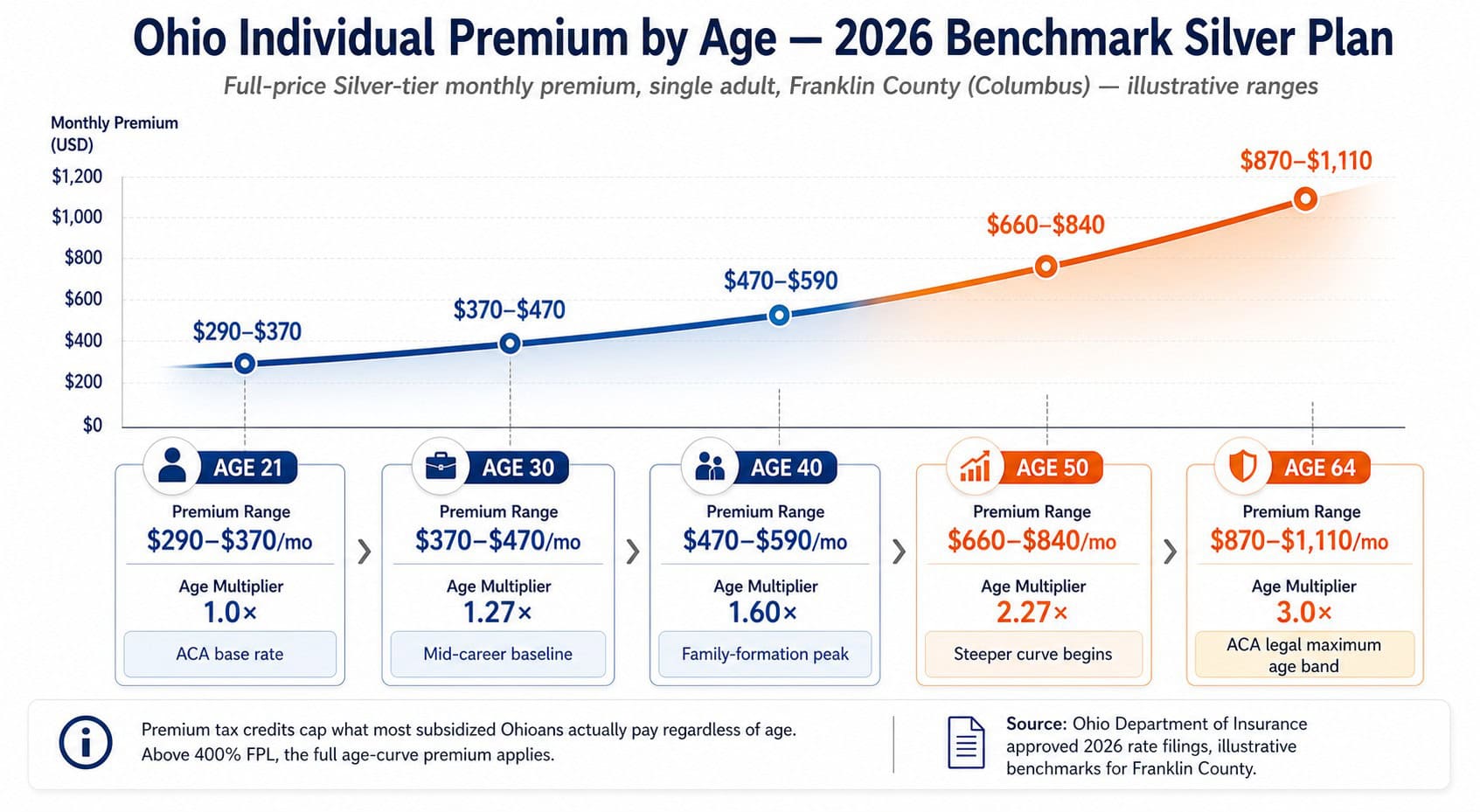
Individual health insurance Ohio premiums depend on six factors: age, county of residence, tobacco use, family size, plan metal tier, and carrier. Age is the single largest driver — under ACA rules, the oldest applicants pay roughly 3× the youngest-adult rate. All 11 Ohio marketplace carriers price using the same age curve, with carrier-specific differences in absolute dollars. County matters because each Ohio county has a different benchmark Silver plan that anchors subsidy calculations.
Age-rating in Ohio follows the federal default. A 21-year-old pays the base rate (1.0×). Premiums increase modestly through age 49, then steeply from age 50 onward. A 64-year-old in Ohio pays roughly 3× what a 21-year-old pays for the same plan. This is why early retirees ages 55–64 face the largest individual market premiums in the state — and why they benefit most from any subsidy that reduces those premiums. Ohio’s lack of a state reinsurance program (unlike Maryland, Pennsylvania, or New Jersey) means full-price premiums run higher than peer states for above-400% FPL Ohioans.
County matters because each Ohio county has a slightly different “second-lowest-cost Silver plan” used to calculate subsidies. A Cuyahoga County (Cleveland) resident and a rural Mahoning County resident at the same income may receive different subsidy amounts because their county benchmarks differ. Tobacco use can add up to 50% to premiums under federal ACA rules, though Ohio carriers typically apply smaller tobacco surcharges than the legal maximum.
Estimating MAGI as a Self-Employed Ohioan
Modified Adjusted Gross Income (MAGI) determines individual health insurance Ohio subsidy eligibility. For self-employed Ohioans, MAGI starts with Schedule C net profit, then subtracts self-employment tax deduction, retirement contributions, and the self-employed health insurance deduction itself. Estimating MAGI accurately is the most consequential financial step in the application — under HR 1, the entire excess subsidy must be repaid at tax time if you underestimate, with no repayment cap protection.
The MAGI calculation for a self-employed Ohioan starts with gross 1099 income, subtracts business expenses to arrive at Schedule C net profit, then adjusts down for several deductions. Half of self-employment tax is deductible. Contributions to a SEP-IRA, Solo 401(k), or traditional IRA reduce MAGI further. The premium itself becomes deductible once you have a plan, creating a small circular calculation that the HealthCare.gov prescreener handles automatically.
For Ohioans with variable income — gig workers, seasonal contractors, commission-based salespeople — the recommended approach is to estimate using the prior year’s actual numbers as a starting point, then update HealthCare.gov mid-year if income tracks substantially differently. Reporting changes within 30 days of a significant income shift is the rule, though most Ohioans only check once or twice a year unless something major changes.
Repayment caps were eliminated in 2026
Before 2026, even substantial subsidy underestimates resulted in capped repayments at tax time — typically $300 to $2,800 maximum, depending on income and household size. HR 1 (the One Big Beautiful Bill Act) eliminated those caps. For 2026 and beyond, the entire excess subsidy must be repaid if you underestimate your income. Self-employed Ohioans with variable income should err toward overestimating slightly rather than under, especially if a strong client month or unexpected payment could push annual income above 400% of the federal poverty level.
Individual Plans for Ohio Early Retirees (Ages 55–64)
Early retirees face the highest individual premiums in Ohio because of ACA age-rating rules but also have the most strategic flexibility on income. By managing which retirement accounts you draw from — Roth versus Traditional, taxable brokerage versus tax-deferred — you can control your MAGI and qualify for substantially larger HealthCare.gov subsidies than you might otherwise. Since enhanced subsidies expired, this strategy matters more than ever for Ohio early retirees.
The strategic distinction is between MAGI-counted income and MAGI-excluded income. Roth IRA and Roth 401(k) qualified withdrawals don’t count toward MAGI. Traditional 401(k) and IRA withdrawals do. Long-term capital gains are MAGI-counted but at a lower marginal cost than ordinary income. Cash from a taxable brokerage’s basis isn’t taxable and doesn’t increase MAGI. For Ohio early retirees with diversified accounts, sequencing withdrawals from the right buckets can keep MAGI low enough to qualify for substantial premium tax credits.
The 400% FPL cliff returned for 2026, making this strategy even more important. Ohio early retirees whose annual MAGI exceeds $62,600 single or $84,600 for a couple lose subsidy eligibility entirely. A retired couple drawing $80,000/year from Traditional IRAs would lose all subsidy access. The same couple drawing $50,000 from Roth IRAs and $30,000 from a taxable brokerage’s basis (returning principal, not capital gains) would have MAGI under the cliff and retain full subsidy access — saving thousands of dollars annually on premiums.
Real-world example: Ohio early retiree couple in Columbus, ages 60 and 58
A Columbus couple ages 60 and 58 who retired early would face combined full-price benchmark Silver premiums of roughly $1,500–$1,800 per month under 2026 rates. By withdrawing $70,000 from a Roth IRA (MAGI-excluded) and $30,000 from a Traditional IRA (MAGI-counted), they keep MAGI at $30,000 — about 197% of the 2026 federal poverty level for a couple. That MAGI level qualifies them for both an Advance Premium Tax Credit and Cost-Sharing Reductions, dropping their net Silver-plan premium to roughly $180–$250 per month combined.
Get a Personalized Individual Plan Quote
A licensed Ohio agent can run your MAGI estimate, identify the carriers that include your existing doctors, calculate your 2026 premium tax credit, and produce a side-by-side comparison across metal tiers — at no cost and no obligation. The full review takes about 20 minutes by phone or video call.
Compare 2026 individual Ohio plans matched to your situation, at no charge.
Individual Coverage After Losing Employer Insurance in Ohio
Losing job-based health insurance triggers a 60-day Special Enrollment Period in Ohio’s HealthCare.gov marketplace, allowing you to switch to an individual plan outside the standard November 1–December 15, 2026 open enrollment window. For most Ohioans, an on-exchange marketplace plan is meaningfully cheaper than COBRA continuation because COBRA loses the employer’s premium subsidy entirely — the former employee pays the full group rate plus a 2% administrative fee.
The 60-day SEP starts on the coverage-loss date, not the date you find out about it. Documentation is required: a termination letter from the former employer, the date coverage ends on the employer plan, and confirmation that no other coverage applies. HealthCare.gov generally accepts these documents through the application portal, but enrolling earlier in the 60-day window prevents gaps in coverage.
The cost comparison usually favors marketplace coverage. A typical Ohio employer pays 70–80% of a single employee’s premium and 60–70% of a family premium. When you elect COBRA, the employee pays 100% of the original group premium plus a 2% admin fee. For an Ohioan whose employer was paying $550/month toward a $700 individual premium, the COBRA cost is roughly $714/month versus a marketplace Silver plan for the same person likely running $150–$350/month after premium tax credits. The exception: COBRA may be the better choice if you’re deep into a year-long deductible already and switching plans would reset out-of-pocket spending to zero.
| Coverage Option | Typical Monthly Cost | When It Makes Sense |
|---|---|---|
| COBRA continuation | $600–$2,100 (full group rate + 2%) | Mid-year and already met deductible |
| HealthCare.gov (subsidized) | $0–$520 (depending on income) | Most Ohioans below 400% FPL |
| HealthCare.gov (full price) | $470–$1,110 by age | Above 400% FPL, no tax credit |
| Spouse’s employer plan | Varies by spouse’s employer | If qualifying life event allows enrollment |
| Short-term plan (off-exchange) | $80–$300 | Brief gap, not for ongoing care |
| Off-exchange PPO (working) | $380–$720 | Above 400% FPL with active employment |
How to Buy Individual Health Insurance in Ohio
Buying individual health insurance Ohio residents can rely on takes four steps: estimate your 2026 MAGI accurately, run the HealthCare.gov prescreener, compare plans by total annual cost across all 11 Ohio carriers, and enroll before the relevant deadline. The full process typically takes 30–60 minutes when documents are ready, and free help is available from licensed brokers and certified navigators in multiple languages.
Step 1: Estimate MAGI
For self-employed Ohioans, start with prior-year Schedule C and adjust for expected 2026 changes. For W-2 transitions, use the new annualized income. HealthCare.gov’s prescreener walks through MAGI inputs.
Step 2: Run the prescreener
HealthCare.gov’s prescreener returns your subsidy estimate, Ohio Medicaid eligibility, and CSR eligibility before you commit to creating a full account. Takes about five minutes.
Step 3: Compare plans
Filter by carrier, network, and metal tier. Verify your doctors are in-network before committing. Compare total annual cost (premium × 12 + expected out-of-pocket), not just monthly premium.
Step 4: Enroll on time
Open enrollment for 2027 coverage runs November 1–December 15, 2026 — shorter than 2026’s window. SEP windows are 60 days from a qualifying life event. Coverage starts January 1, 2027.
Optional: Use a broker
Licensed Ohio brokers help at no cost — broker fees are built into plan pricing whether used or not. Brokers provide ongoing support after enrollment for claims questions and SEP changes.
Optional: Use a navigator
Federally funded certified navigators offer free enrollment help, particularly useful for non-English speakers or first-time buyers. Available across major Ohio metros.
The most expensive mistake first-time individual buyers make is buying off-exchange directly from a carrier. The same plan from the same carrier never qualifies for a federal premium tax credit when sold off-exchange. For the 90%+ of Ohioans who qualify for a subsidy, this single mistake costs an average of $500 per month — roughly $6,000 per year — for an identical plan. Always start with the on-exchange prescreener before considering an off-exchange option. The HealthCare.gov individual health insurance glossary explains the federal definitions Ohio’s marketplace follows. The IRS Schedule C overview covers the deductions that reduce MAGI for self-employed Ohioans, and the KFF explainer on ACA subsidies walks through the premium tax credit math by income tier.
Self-Employed Ohio Health Insurance: Tax Deduction and Strategy
Self-employed Ohioans benefit from a powerful tax deduction: 100% of health insurance premiums are deductible on Schedule 1, Line 17 of the federal 1040. The deduction reduces both federal income tax and Ohio state income tax. For a self-employed Ohioan in the 22% federal bracket paying $7,200 annually for health insurance, the deduction saves about $1,584 in federal tax plus $250 in Ohio state tax — reducing the after-tax cost of coverage by roughly 26%.
The Schedule 1 deduction applies to premiums for the policyholder, spouse, dependents, and any non-dependent children up to age 27. The deduction is limited to your business net profit, so it can’t create a loss. Importantly, the deduction reduces both income tax and self-employment tax for the policyholder, and reducing AGI through the deduction may also reduce MAGI for subsidy purposes — creating a small circular calculation that HealthCare.gov handles automatically. Self-employed Ohioans should not separately deduct premiums on Schedule A; the Schedule 1 deduction is the correct mechanism.
The HSA-eligible plan combination is particularly strong for self-employed Ohioans wanting tax-advantaged healthcare savings. An HSA-eligible Bronze plan paired with maximum HSA contributions ($4,400 single or $8,750 family for 2026) creates three layers of tax savings: the premium is deductible on Schedule 1, the HSA contribution is deductible separately, and HSA earnings grow tax-free for qualified medical expenses. For a self-employed Ohioan in the 22% federal bracket maxing out an HSA on top of premium deduction, the combined annual tax savings can exceed $2,500 — meaningfully reducing the effective cost of comprehensive coverage.
Frequently Asked Questions
Common questions about individual health insurance Ohio buyers face cover the difference between individual and group coverage, how self-employed Ohioans deduct premiums, what happens when a spouse loses coverage, COBRA versus marketplace timing, and how Ohio’s federal-exchange structure affects buyer experience compared to neighboring states with state-based exchanges. Answers below reflect 2026 plan year rules and HR 1 changes effective for 2026 and later.
What’s the difference between individual and group health insurance in Ohio?
Group health insurance is sponsored by an employer, union, or association — multiple covered lives are pooled and the employer typically pays a portion of the premium. Individual health insurance Ohio residents buy on their own includes no employer contribution; you pay the full premium minus any federal premium tax credit. Both types must cover the same essential health benefits under ACA rules, but premium structure and selection process differ. Family coverage purchased by a self-employed parent counts as individual insurance because no employer is contributing.
Can self-employed Ohioans deduct health insurance premiums on taxes?
Yes. Self-employed Ohioans can deduct 100% of their health insurance premiums on Schedule 1, Line 17 of the federal 1040 — including premiums for the policyholder, spouse, dependents, and any non-dependent children up to age 27. The deduction is limited to your business net profit, so it can’t create a loss. Importantly, the deduction reduces both income tax and self-employment tax for the policyholder, and reducing AGI through the deduction may also reduce MAGI for subsidy purposes. The Ohio state income tax also benefits from the federal deduction since Ohio uses federal AGI as a starting point.
What’s “private health insurance” in Ohio — is it the same as individual?
Private health insurance Ohio residents buy through HealthCare.gov is essentially the same thing as individual health insurance Ohio offers — both terms refer to coverage purchased outside an employer’s group plan. “Private” sometimes specifically means off-exchange (without subsidies) versus on-exchange marketplace coverage, but most Ohioans use the terms interchangeably. The plans themselves come from the same 11 private carriers regardless of which channel sells them: Anthem, Medical Mutual, Buckeye/Ambetter, CareSource, Molina, Oscar, UnitedHealthcare, AmeriHealth Caritas, Antidote, and others.
How does Ohio income work if my earnings vary month to month?
HealthCare.gov uses annual MAGI, not monthly income, for subsidy calculations. For Ohioans with variable income — gig workers, seasonal contractors, commission-based salespeople — the recommended approach is to estimate annual MAGI based on the prior year and update if reality tracks substantially differently. Report changes within 30 days of any major income shift (a new contract, a paid-off project, a job loss). Year-end reconciliation on tax forms 8962 corrects any over- or under-estimate, but as of 2026, repayment caps were eliminated, so substantial underestimates can lead to large tax-time bills.
Can I keep my doctor when I switch from employer coverage to individual?
Often yes, but verify before enrolling. Anthem Blue Cross Blue Shield’s individual plans use a similar (though not identical) network to its group plans, so many Anthem-network providers stay in-network through the transition. Medical Mutual of Ohio also overlaps its individual and group networks. The most reliable way to check is to pull each carrier’s individual-plan provider directory by your doctor’s name and NPI, then call the doctor’s office to confirm they accept that specific plan. The HealthCare.gov plan-finder lets you filter plans by carrier so you can compare networks before choosing.
Is COBRA cheaper than an individual marketplace plan in Ohio?
Almost never. COBRA continuation requires the former employee to pay 100% of the original group premium plus a 2% administrative fee — without the employer subsidy that previously covered 60–80% of that premium. For most Ohioans, an on-exchange HealthCare.gov plan with subsidies costs less than COBRA continuation, often substantially less. The exception is mid-year situations where you’ve already met a large deductible on the employer plan; switching plans would reset out-of-pocket spending to zero, which can be more expensive than COBRA over the rest of the year. A licensed Ohio agent can run the comparison for your specific situation.
Find Your Individual Health Insurance Match in Ohio
Free help is available to estimate your 2026 MAGI, identify carriers that cover your existing doctors, calculate your premium tax credit, and produce a side-by-side total annual cost comparison — at no cost and no obligation. Self-employed Ohioans, freelancers, and early retirees can all benefit from a 20-minute review by phone or video call.
Compare 2026 individual Ohio plans matched to your situation.
Related Ohio Health Insurance Resources
How HealthCare.gov works for Ohio shoppers — plans, subsidies, and 2026 enrollment.
Best Ohio Health Insurance PlansCompare top Ohio carriers by network, customer satisfaction, and total cost.
Affordable Ohio Health InsuranceLower your monthly cost with subsidies, Medicaid, and lowest-premium plan strategies.
Ohio Health Insurance QuotesFree side-by-side comparison of 2026 Ohio marketplace plans by zip code.
Ohio Small Business Health InsuranceGroup plans, ICHRA, QSEHRA, and SHOP options for Ohio employers with 1-50 employees.
Ohio Health Insurance GuideComplete state pillar guide to coverage options, costs, and carriers in Ohio.
Broker Disclosure
ForHealthInsurance.com is an independent health insurance agency serving Ohio residents. We are not affiliated with any carrier or government agency. We help you compare plans and enroll in coverage that meets your needs at no extra cost to you.