Oregon Health Insurance 2026: OHP, Bridge & Marketplace
Oregon health insurance in 2026 runs on a three-tier structure that no other state combines in quite the same way: the Oregon Health Plan (OHP) for residents up to 138 percent of the federal poverty level, the new OHP Bridge program for the 138-to-200 percent band, and a subsidized marketplace above that. Oregon was the first state in the nation to launch a Basic Health Program under the Affordable Care Act, opening OHP Bridge in July 2024. For 2026, regulators finalized a weighted average individual-market rate increase of just 9.7 percent — well under the national average above 25 percent — but most enrollees still saw net premiums jump after enhanced federal premium tax credits expired at the end of 2025. This guide covers the coverage stack, all six marketplace carriers, the 2026 cost picture, subsidies, and every way Oregon residents can enroll.

Oregon’s Three-Tier Coverage Stack: OHP, OHP Bridge, and the Marketplace
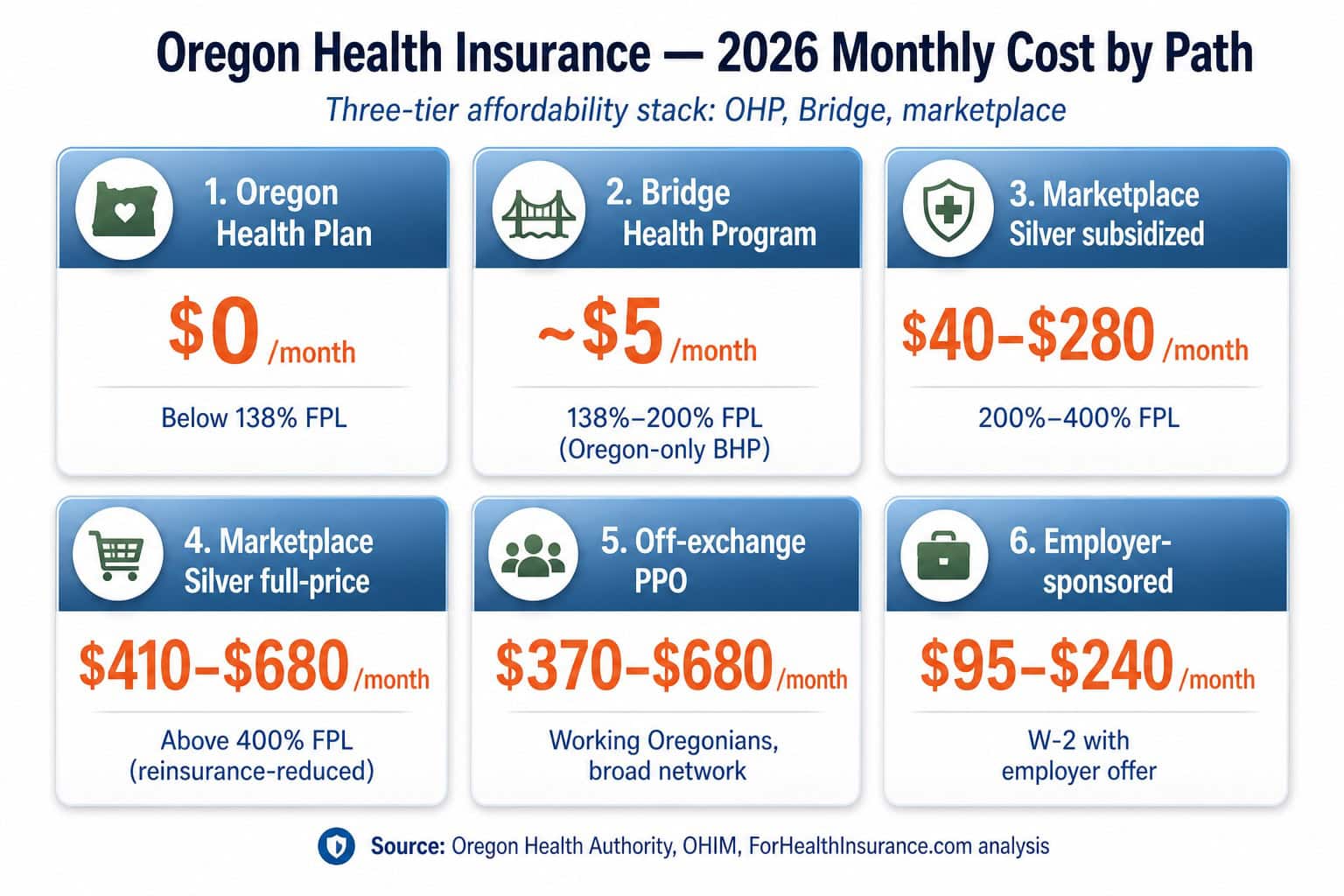
Oregon health insurance is organized into three income tiers that fit together with almost no gap. The Oregon Health Plan covers residents up to 138 percent of poverty at no cost. OHP Bridge covers the 138-to-200 percent band, also at no cost. The subsidized marketplace covers everyone above 200 percent. This layered design is why Oregon has one of the lowest uninsured rates in the country.
| Coverage Tier | Income Range (2026) | Monthly Cost |
|---|---|---|
| Oregon Health Plan (OHP) | Up to 138% FPL (~$21,597 single) | $0 |
| OHP Bridge (Basic Health Program) | 138%–200% FPL (~$31,300 single) | $0 |
| Subsidized marketplace | 200%–400% FPL | Sliding scale after tax credit |
| Unsubsidized marketplace | Above 400% FPL | Full premium (no federal credit for 2026) |
The middle tier is what sets Oregon apart. When Oregon opened OHP Bridge in July 2024, it became the first state to launch a Basic Health Program in years and the first to do so under the current ACA framework, joining only Minnesota and New York among states using the Section 1331 option. Adults earning between roughly $21,600 and $31,300 as a single filer — a band that in most states lands in subsidized marketplace coverage with real monthly premiums — instead get zero-premium coverage through the same Coordinated Care Organizations that run regular OHP. That removes the affordability cliff that low-income marketplace shoppers face elsewhere.
The Oregon Health Insurance Marketplace for 2026
Oregon residents shopping for individual coverage do so at OregonHealthCare.gov, the state-based marketplace that runs on the federal HealthCare.gov enrollment platform. About 126,000 Oregonians held marketplace plans as of mid-2025, and roughly 60 percent of them received a premium subsidy for 2026. The state controls plan certification and outreach while relying on the federal system to process enrollments.
| Feature | Oregon Marketplace |
|---|---|
| Marketplace type | State-based exchange on the federal platform (SBE-FP) |
| Enrollment site | OregonHealthCare.gov (HealthCare.gov backend) |
| 2026 Open Enrollment | Nov 1, 2025 – Jan 15, 2026 |
| Carriers for 2026 | 6 (5 statewide + Kaiser in 11 counties) |
| Reinsurance program | 1332 waiver active since 2018 |
| Marketplace enrollment | ~126,000 (mid-2025) |
Oregon’s current marketplace structure grew out of a costly false start. Cover Oregon, the fully state-run exchange the state launched in 2013, never produced a working enrollment website and was dismantled in 2015. Rather than build a second exchange from scratch, Oregon adopted the federal platform while keeping state authority over the rest of the marketplace. A separate piece of that history still pays off today: Oregon’s 1332 reinsurance waiver, in place since 2018, reimburses carriers for high-cost claims and holds full-price premiums materially below where they would otherwise sit — a key reason the 2026 gross rate increase came in under 10 percent.
Oregon Health Insurance Carriers for 2026
The Oregon marketplace fields six carriers for 2026, four of them headquartered in the state — an unusually local lineup. Five carriers offer plans in every county, and Kaiser Permanente Northwest adds an 11-county footprint anchored in the Portland metro. Every Oregon county therefore has at least five carriers to compare, one of the most competitive marketplaces in the West.
Moda Health
Oregon-HQ · StatewidePortland-based carrier with deep Oregon roots and one of the broadest provider networks in the state. A common choice for residents who want statewide reach and access to large Oregon health systems.
Regence BlueCross BlueShield of Oregon
Oregon-HQ · StatewideThe Oregon Blue Cross Blue Shield licensee, with a large statewide network and strong recognition across both the Willamette Valley and rural counties. Approved 2026 increases landed in the low double digits.
Providence Health Plan
Oregon-HQ · StatewideCarrier tied to the Providence health system, strong in the Portland metro and Willamette Valley. Note that Providence has announced it will leave the individual marketplace for 2027, so 2026 enrollees should plan to re-shop next fall.
PacificSource
Oregon-HQ · StatewideSpringfield-based nonprofit with a strong Central and Southern Oregon presence and the lowest approved 2026 increase at 3.9 percent. Like Providence, PacificSource has announced an individual-market exit for 2027.
Kaiser Permanente Northwest
11 CountiesIntegrated HMO model dominant in the Portland metro and surrounding counties, pairing coverage with Kaiser-owned clinics and hospitals. Approved the highest 2026 increase at 12.9 percent.
BridgeSpan Health
StatewideRegence-affiliated carrier offering statewide marketplace plans, giving shoppers a sixth option alongside the larger Oregon names in most rating areas.
How Much Does Oregon Health Insurance Cost in 2026?
Oregon health insurance costs in 2026 depend on which tier of the coverage stack a household lands in. OHP and OHP Bridge cost nothing. Marketplace premiums rose a finalized 9.7 percent on average before subsidies, with approved carrier changes from 3.9 percent at PacificSource to 12.9 percent at Kaiser. What a household actually pays then depends on its income and federal tax credit.
| Household | Full Premium (Silver) | After Subsidy (if eligible) |
|---|---|---|
| Single adult under 138% FPL | $0 — OHP | $0 |
| Single adult 138%–200% FPL | $0 — OHP Bridge | $0 |
| 40-year-old single (250% FPL) | $470–$640/mo | $140–$300/mo |
| 60-year-old single (350% FPL) | $1,000–$1,380/mo | $330–$760/mo |
| Household above 400% FPL | $520–$1,400/mo by age | No federal credit for 2026 |
The 2026 cost story for Oregon is really two stories. The gross rate increase was modest because the 1332 reinsurance waiver suppresses full-price premiums. The net increase for many households was steep because enhanced federal premium tax credits expired at the end of 2025, returning subsidy rules to their pre-2021 form. State regulators warned that some enrollees who lost subsidy eligibility would see net increases of 300 to 400 percent, concentrated among older buyers and households above 400 percent of poverty.
Compare Oregon Plans for 2026 With Expert Help
Oregon’s coverage stack and the 2026 subsidy changes make it easy to land in the wrong tier or miss free OHP Bridge eligibility by a few hundred dollars of income. A licensed Oregon agent screens OHP and Bridge eligibility, compares all six marketplace carriers, and completes enrollment at no cost.
Get a Quote Call 888-215-4045Oregon Subsidies and the End of Enhanced Tax Credits
About 60 percent of Oregon’s roughly 126,000 marketplace enrollees relied on a premium tax credit in 2026, so the December 2025 expiration of the enhanced federal credits reshaped affordability across the state. The credits reverted to their pre-2021 form: eligibility now runs only from 100 to 400 percent of poverty, and households above 400 percent receive no federal credit at all.
Under the pre-2021 rules now back in force, the share of income a household is expected to pay toward a benchmark Silver plan rises across every income band, and the hard cliff at 400 percent of poverty returns. For Oregon, two cushions soften the blow that buyers in other states feel more sharply. OHP Bridge captures the 138-to-200 percent band entirely, so the lowest-income marketplace shoppers elsewhere are simply not in Oregon’s marketplace risk pool. And the 1332 reinsurance waiver keeps the underlying Silver benchmark lower, which means each remaining tax credit stretches further. A licensed agent can model the exact after-credit premium for a household before open enrollment closes.
The Oregon Health Plan (OHP) and OHP Bridge
The Oregon Health Plan is the state’s Medicaid program, and it covers a large share of Oregonians at no cost. Both OHP and OHP Bridge are delivered through 16 regional Coordinated Care Organizations — local networks that manage physical, behavioral, and dental care under one budget. A single application screens for both programs plus marketplace subsidies at once.
| Program | Income Limit (2026) | Who It Covers |
|---|---|---|
| OHP Plus (adults) | Up to 138% FPL | Adults 19–64 |
| OHP (children) | Up to 305% FPL | Kids under 19 |
| OHP Bridge | 138%–200% FPL | Adults under 65 |
| Delivery system | 16 CCOs statewide | All OHP and Bridge members |
Oregon Coverage Rules You Won’t Find in Most States
Oregon health insurance carries several state protections that go beyond the federal floor, and a few matter more in 2026 than ever because federal rules changed. State law continues to require coverage that federal rules no longer mandate, which means an Oregon plan can include benefits a similar plan in another state would drop.
- Gender-affirming care: Oregon law requires marketplace plans to cover gender-affirming care, even though federal rules stopped requiring it as an essential health benefit starting in 2026.
- Reproductive health: Oregon’s Reproductive Health Equity Act requires most plans to cover a broad set of reproductive and preventive services with no cost sharing.
- Continuity through CCOs: OHP and OHP Bridge members keep a single Coordinated Care Organization across physical, dental, and behavioral health, rather than juggling separate networks.
- Five-carrier minimum: Every Oregon county has had at least five marketplace carriers, a level of choice many rural markets in other states lack.
When and How to Enroll in Oregon Health Insurance
Open enrollment for 2026 Oregon marketplace coverage ran from November 1, 2025 through January 15, 2026. Outside that window, a qualifying life event opens a Special Enrollment Period. OHP and OHP Bridge accept applications year-round, so income-eligible residents never have to wait for an enrollment window.
| Enrollment Path | When Available | Coverage Start |
|---|---|---|
| Standard open enrollment | Nov 1 – Jan 15 annually | Jan 1 or Feb 1 by selection date |
| OHP / OHP Bridge | Year-round | Often first of the next month |
| Loss of job-based coverage | 60 days before or after loss | First of month after selection |
| Marriage, birth, or adoption | 60 days after event | Event date or first of next month |
| Move into Oregon | 60 days after move | First of month after selection |
Households that took no action could keep a 2024 marketplace plan through 2026 by allowing auto-enrollment, but any change in income, address, or family size had to be reported — and those updates are exactly what can move someone into OHP Bridge or shift a subsidy. Federal rule changes also shorten the standard open enrollment window beginning with the 2027 plan year, so Oregon residents should expect an earlier deadline next fall.
How to Choose Oregon Coverage for Your Situation
The right Oregon health insurance choice starts with household income relative to the coverage stack, then layers in geography and how the household uses care. These five profiles cover most situations Oregon shoppers encounter.
Frequently Asked Questions
What is OHP Bridge and who qualifies?
OHP Bridge is Oregon’s Basic Health Program, which the state launched in July 2024 as the first new Basic Health Program in the nation under ACA Section 1331. It covers adults under age 65 whose household income falls between 138 percent and 200 percent of the federal poverty level — the band that sits just above regular Oregon Health Plan eligibility. OHP Bridge carries no monthly premium, no copays, and no deductible, and it is administered through the same Coordinated Care Organizations that run the rest of the Oregon Health Plan.
How much did Oregon health insurance go up for 2026?
The Oregon Division of Financial Regulation finalized a weighted average individual-market rate increase of 9.7 percent for 2026, with approved changes ranging from 3.9 percent at PacificSource to 12.9 percent at Kaiser. That gross increase was under 10 percent — well below the national average of more than 25 percent — because Oregon’s 1332 reinsurance waiver holds down full-price premiums. The much larger change for most households came from the expiration of enhanced federal premium tax credits at the end of 2025, which raised net premiums far more than the underlying rate filing.
Which carriers offer Oregon health insurance for 2026?
Six carriers participate in the Oregon marketplace for 2026. Five offer plans statewide: Moda Health, Regence BlueCross BlueShield of Oregon, Providence Health Plan, PacificSource, and BridgeSpan. Kaiser Permanente Northwest offers plans in 11 counties. Four of those carriers are headquartered in Oregon, which is unusual among states. Every Oregon county has at least five carriers to choose from. Note that Providence and PacificSource have announced they will exit the individual marketplace for 2027.
Does Oregon use HealthCare.gov or its own marketplace?
Oregon operates a state-based marketplace that uses the federal HealthCare.gov enrollment platform, a structure known as a state-based exchange on the federal platform. Residents shop and apply at OregonHealthCare.gov, which routes them to the HealthCare.gov backend for enrollment. Oregon took this hybrid route after Cover Oregon, the fully state-run exchange launched in 2013, failed at the technology level and was dismantled in 2015. The state retains control over plan certification, outreach, and consumer assistance while relying on the federal enrollment system.
Who can get free health coverage in Oregon?
Oregon residents earning up to 138 percent of the federal poverty level generally qualify for the Oregon Health Plan, the state’s Medicaid program, which carries no premium. Adults between 138 percent and 200 percent of poverty qualify for OHP Bridge, which also has no premium, no copays, and no deductible. Both programs are delivered through 16 regional Coordinated Care Organizations. A single application at OregonHealthCare.gov screens for OHP, OHP Bridge, and marketplace subsidies at the same time and routes the applicant to the right program.
When is open enrollment for Oregon health insurance?
Open enrollment for 2026 Oregon marketplace coverage ran from November 1, 2025 through January 15, 2026. Outside that window, residents need a qualifying life event — such as losing job-based coverage, marriage, birth, adoption, or a move into Oregon — to enroll through a Special Enrollment Period. The Oregon Health Plan and OHP Bridge have no enrollment window and accept applications year-round, so income-eligible residents can apply at any time.
Related Oregon Health Insurance Resources
Explore the rest of the Oregon cluster: marketplace enrollment, the six-carrier comparison, costs and affordability, plan types and tiers, individual and self-employed coverage, and small business group plans.
Step-by-step enrollment through OregonHealthCare.gov and the federal platform.
Best Oregon Health PlansCarrier ratings and 2026 comparisons across all six Oregon insurers.
Oregon Costs & AffordabilityPremium ranges, the subsidy cliff, and after-credit affordability for 2026.
Oregon Plans & TiersBronze, Silver, Gold, and Platinum plus HMO, PPO, and EPO types in Oregon.
Individual Oregon CoverageSelf-employed and individual market options, MAGI, and Bridge eligibility.
Oregon Small Business CoverageGroup plans, the tax credit, and 2026 small-group options for employers.
Enroll in Oregon Health Insurance for 2026
OHP, OHP Bridge, and the six-carrier marketplace give most Oregon households a coverage path. ForHealthInsurance.com runs the eligibility checks, compares every Oregon carrier, and completes enrollment at no extra cost.
Get a Quote Call 888-215-4045Broker Disclosure
ForHealthInsurance.com is an independent health insurance agency serving Oregon residents. We are not affiliated with any carrier or government agency. We help you compare plans and enroll in coverage that meets your needs at no extra cost to you.