Vermont Health Insurance 2026: Plans, Carriers and Costs
This guide explains how Vermont health insurance works in 2026 — which carriers sell plans, what the state’s unique rating rules mean for premiums, and how to find coverage that fits your situation. Vermont’s market works differently than every neighboring state, and understanding those differences helps you make a faster, more informed decision.

What brings you here today?
What Makes Vermont’s Health Insurance Market Different
Vermont and New York are the only two U.S. states that prohibit age rating — a 25-year-old and a 64-year-old pay the same premium for the same plan. Only two carriers sell individual coverage statewide: Blue Cross Blue Shield of Vermont and MVP Health Care. The Green Mountain Care Board reviews and approves every rate filing, and the entire state is a single pricing region.
Most ACA states allow insurers to charge older enrollees up to three times what they charge younger ones. Vermont does not. Under 8 V.S.A. § 4080a and 33 V.S.A. § 1811, demographic rating — including age and gender — is prohibited on individual and small group plans. The same plan costs the same monthly premium for any adult enrollee, before subsidies are applied.
This rule changes how shopping works. In other states, a young adult might find a $250 bronze plan and a 60-year-old finds the same plan at $750. In Vermont, both pay the same sticker price. Subsidies still vary by income, but the underlying premium does not move with age.
The carrier landscape is equally simple. Two carriers, two network types: MVP Health Care sells HMO plans across the state, and Blue Cross Blue Shield of Vermont sells EPO plans. There is no individual PPO market in Vermont in 2026. Comparison shopping means choosing between two carriers and two network structures — not the dozens of options buyers face in larger state markets.
Geography matters less here than anywhere else. Vermont is a single rating area for federal purposes (Rating Area 1), which means premiums do not vary county-to-county the way they do in most states. A plan in Burlington’s Chittenden County costs the same as the identical plan in Brattleboro’s Windham County.
The Two Carriers: BCBSVT and MVP Health Care
Blue Cross Blue Shield of Vermont sells EPO plans — the state’s only EPO carrier on the 2026 exchange. MVP Health Care sells HMO plans statewide. Both received perfect 5-of-5 quality ratings from the Centers for Medicare and Medicaid Services for the 2026 plan year, so the choice between them comes down to network type and price, not reputation.
Blue Cross Blue Shield of Vermont (BCBSVT)
BCBSVT is a Vermont-domiciled nonprofit insurer, the only Blue Cross Blue Shield member operating exclusively in the state. Every BCBSVT individual plan on Vermont Health Connect uses an EPO network — Exclusive Provider Organization — which removes the referral requirement that HMO members must meet before seeing a specialist. The trade-off is cost: BCBSVT Silver-tier plans average $191 more per month than MVP’s Silver HMO.
BCBSVT historically anchored the southern Vermont and Rutland markets, and its provider network includes Rutland Regional Medical Center and Southwestern Vermont Medical Center in Bennington. In August 2025, the Department of Financial Regulation placed BCBSVT under enhanced supervision after the Green Mountain Care Board cited solvency concerns during the 2026 rate review.
MVP Health Care
MVP Health Plan, Inc. is a nonprofit insurer domiciled in New York that sells individual and small group plans in Vermont through Vermont Health Connect. Every MVP individual plan is an HMO — primary care physician required, referrals needed for specialists, in-network care only except in emergencies. MVP’s HMO network is strongest in Chittenden County and the Burlington metro, where the University of Vermont Medical Center is the dominant in-network hospital.
MVP plans run lower than BCBSVT across every metal tier. Every Bronze plan in MVP’s 2026 lineup qualifies for a Health Savings Account, including CDHP options. As of February 2025, MVP reported 9,312 policyholders and 12,790 effectuated enrollees in Vermont’s individual market.
Side-by-Side: 2026 Plan Year
| Factor | BCBSVT | MVP Health Care |
|---|---|---|
| Network type | EPO (no referrals required) | HMO (PCP referrals required) |
| 2026 individual rate change (GMCB approved) | +9.6% | +1.3% |
| Silver-tier monthly premium (typical) | ~$191 higher than MVP | Lower; benchmark |
| Bronze HSA-eligible plans | 2 of 5 (CDHPs only) | All Bronze plans |
| CMS quality rating (2026 plan year) | 5 of 5 | 5 of 5 |
| Out-of-state network access | BlueCard PPO program | In-network only except emergencies |
Need help comparing BCBSVT and MVP for 2026?
Licensed agents help you compare both Vermont carriers and find a plan that fits your providers and budget. No fee to you.
Vermont Health Connect: How to Enroll
Vermont Health Connect (healthconnect.vermont.gov) is the state-based marketplace administered by the Department of Vermont Health Access. Open enrollment for 2026 coverage runs November 1, 2025 through January 15, 2026. Vermonters who qualify for premium tax credits must enroll through Vermont Health Connect to receive them — plans purchased directly from BCBSVT or MVP off-exchange do not qualify for federal subsidies.
The Plan Comparison Tool at healthconnect.vermont.gov lets you enter your household size and income to see your 2026 premiums and subsidy eligibility before applying. Plan data goes live each year on October 15, ahead of the November 1 enrollment start.
Key 2026 Open Enrollment Dates
| Date | What Happens |
|---|---|
| October 15, 2025 | 2026 Plan Comparison Tool goes live |
| November 1, 2025 | Open enrollment begins |
| December 15, 2025 | Deadline for January 1, 2026 coverage start |
| January 15, 2026 | Open enrollment ends; last day to enroll for 2026 |
| February 1, 2026 | Coverage start for enrollments completed Dec 16 – Jan 15 |
Outside Open Enrollment
If you miss the January 15 deadline, you can still enroll through a Special Enrollment Period after a qualifying life event — losing job-based coverage, getting married, having a baby, moving into or within Vermont, or aging off a parent’s plan at 26. Vermont’s Office of the Health Care Advocate (1-800-917-7787) is a free state-funded resource that helps Vermonters navigate enrollment and resolve disputes with carriers.
Auto-renewal note: Most Vermont Health Connect customers are auto-enrolled in the same plan for 2026 they had in 2025. If your 2025 plan offered worse value for 2026, Vermont Health Connect may auto-enroll you in a different plan with better cost sharing or lower premiums. Read your renewal notice carefully — the state mails them in early October.
2026 Approved Rate Changes from the Green Mountain Care Board
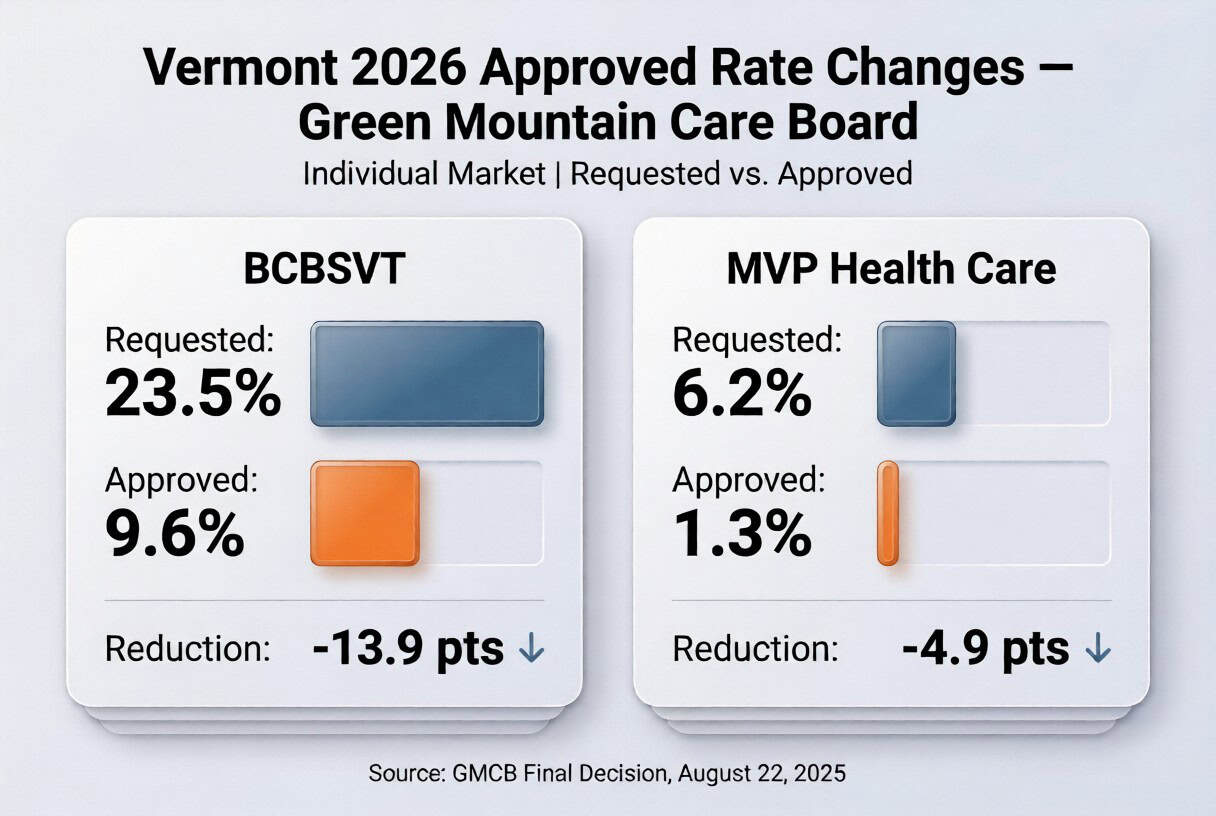
The Green Mountain Care Board approved a 9.6% individual market increase for BCBSVT (down from 23.5% requested) and 1.3% for MVP (down from 6.2% requested) on August 22, 2025. These were among the lowest approved rate increases in the country for 2026. The weighted average across both carriers dropped from a 17.4% request to a 6.7% approval.
Vermont is the only state with an independent 5-member board that reviews every carrier’s rate filing before it can take effect. The Green Mountain Care Board was created in 2011 and combines actuarial analysis, public testimony, and statutory affordability criteria to approve, modify, or reject proposed rates. The 2025 GMCB Annual Report describes the 2026 individual market decisions as “some of the lowest approved rates in the country.”
2026 Individual Market Rate Decisions
| Carrier & Market | Requested | GMCB Approved | Reduction |
|---|---|---|---|
| BCBSVT Individual | +23.5% | +9.6% | -13.9 pts |
| BCBSVT Small Group | +13.5% | +4.4% | -9.1 pts |
| MVP Individual | +6.2% | +1.3% | -4.9 pts |
| MVP Small Group | +7.5% | +2.5% | -5.0 pts |
Despite low approved increases, Vermont still carries the highest individual market sticker prices in the country. The 2025 GMCB Annual Report cites the expiration of enhanced federal premium tax credits as the principal upward pressure on 2026 premiums, with rate filings reflecting an anticipated deterioration of the risk pool as some enrollees drop coverage.
Coverage Options Beyond Vermont Health Connect
Vermonters with household income below 138% of the Federal Poverty Level qualify for Green Mountain Care, the state’s Medicaid program. Children up to 312% FPL and pregnant women qualify for Dr. Dynasaur, Vermont’s CHIP program. Both accept enrollment year-round. Short-term plans are available but limited to 3 months with no renewals — among the strictest short-term regimes in the United States.
Green Mountain Care (Medicaid)
Green Mountain Care is Vermont’s Medicaid program, run by the Department of Vermont Health Access. Adults qualify with household incomes up to 138% FPL — approximately $20,783 for a single adult or $43,056 for a family of four in 2026. Enrollment is open year-round, not limited to the November-to-January window. HealthCare.gov explains how the Medicaid expansion rules under the Affordable Care Act apply.
Dr. Dynasaur (CHIP)
Dr. Dynasaur is Vermont’s Children’s Health Insurance Program. It covers children up to age 19 in households earning up to 312% FPL — approximately $97,344 for a family of four in 2026 — and pregnant women regardless of immigration status. Dr. Dynasaur has no monthly premium for most families and covers preventive care, hospitalization, prescriptions, dental, and vision.
Short-Term Limited Duration Plans
Short-term health insurance is sold in Vermont but heavily restricted. State law caps short-term plans at a maximum 3-month term with no renewals — meaning the same insurer cannot reissue the same plan after expiration. The National Federation of Independent Business has noted Vermont’s 3-month cap among the strictest in the country. Most Vermonters who lose coverage between jobs use a Special Enrollment Period on Vermont Health Connect rather than short-term coverage.
How Subsidies Work in Vermont
Vermont enrollees receive federal Advance Premium Tax Credits (APTC) based on household income relative to the Federal Poverty Level — see the full breakdown in the affordable Vermont health insurance guide. On top of federal APTC, Vermont layers two state-funded supplements: Vermont Premium Assistance (VPA) and state Cost-Sharing Reduction (CSR). Enhanced federal APTC expired at the end of 2025, so 2026 marks a return to original ACA subsidy levels.
Federal subsidies under the original Affordable Care Act formula are available to households with income between 100% and 400% FPL. The enhanced subsidies created by the American Rescue Plan and extended under the Inflation Reduction Act expired December 31, 2025. For 2026, Vermonters with household income over 400% FPL no longer qualify for federal premium tax credits at all. Households under 400% FPL still receive APTC, but at lower amounts than in 2024 or 2025.
APTC repayment changes for 2026: Starting with the 2026 tax year, there is no longer a cap on how much excess APTC a household must repay to the IRS if income ends up higher than estimated. Update your household income at Vermont Health Connect during open enrollment, and report income changes throughout the year to avoid surprise tax bills.
Vermont Premium Assistance (VPA)
VPA is a state-funded supplemental subsidy that stacks on top of federal APTC for qualifying Vermont households. It reduces the monthly premium further than federal subsidies alone, particularly for households between 138% and 300% FPL. VPA is automatic for eligible enrollees — there is no separate application; Vermont Health Connect applies it when the application is processed.
State Cost-Sharing Reduction (CSR)
Vermont also funds a state CSR program that reduces deductibles, copayments, and coinsurance for enrollees in Silver-tier plans. State CSR stacks on top of the federal CSR program for eligible households, lowering out-of-pocket costs at the point of care. Both VPA and state CSR are available only to enrollees who buy through Vermont Health Connect — not through direct off-exchange purchases.
How Vermont Compares to Other States
Vermont has the smallest individual market carrier roster of any New England state, no age rating, no county-level price variation, and a state regulator that approves every rate filing. Premiums are the highest in the country at the sticker level, but state subsidies and recent GMCB rate reductions narrow the gap for subsidized enrollees. Most cross-border care happens at Dartmouth-Hitchcock in New Hampshire.
Scenario: 40-year-old Vermonter earning $45,000
A 40-year-old single adult living in Burlington, Vermont, earning $45,000/year (about 290% FPL for a single person) shops for 2026 coverage on Vermont Health Connect. She compares the lowest-cost MVP Silver HMO at roughly $850/month sticker price against a comparable BCBSVT Silver EPO at roughly $1,040/month. After federal APTC plus VPA, her net MVP Silver premium falls to approximately $290/month. The BCBSVT EPO at $480/month net buys her referral-free specialist access, useful if she sees out-of-network providers regularly.
Vermont’s neighbors operate very differently. New Hampshire has 5 carriers and age rating. Massachusetts has 12 carriers and the country’s first state-level individual mandate. New York shares Vermont’s no-age-rating rule but has dozens of carriers, regional pricing zones, and the largest state-based marketplace in the U.S. The University of Vermont Medical Center (Burlington) and Dartmouth-Hitchcock Medical Center (Lebanon, NH) are the two dominant tertiary care institutions Vermonters use; both BCBSVT and MVP cover Dartmouth-Hitchcock through specific network arrangements.
Ready to compare 2026 Vermont plans?
Talk to a licensed agent who knows the BCBSVT and MVP networks, what subsidies apply to your household, and how Vermont Premium Assistance stacks on top.
Related Vermont Health Insurance Resources
Frequently Asked Questions
How many health insurance carriers sell individual plans in Vermont?
Two. Blue Cross Blue Shield of Vermont (BCBSVT) and MVP Health Care are the only carriers offering individual market plans through Vermont Health Connect for 2026. BCBSVT sells EPO plans and MVP sells HMO plans.
Does age affect health insurance premiums in Vermont?
No. Vermont is one of only two states (with New York) that prohibits age rating on individual and small group plans. A 25-year-old and a 64-year-old pay the same premium for the same plan, before subsidies.
When is open enrollment for Vermont Health Connect in 2026?
November 1, 2025 through January 15, 2026. Coverage starts January 1, 2026 for enrollments completed by December 15, 2025, and February 1, 2026 for enrollments completed between December 16 and January 15.
What is the Green Mountain Care Board and how does it affect rates?
The Green Mountain Care Board (GMCB) is an independent 5-member board that reviews and approves every individual and small group rate filing in Vermont. For 2026, GMCB approved a 9.6% increase for BCBSVT individual plans (down from 23.5% requested) and 1.3% for MVP (down from 6.2%).
What is Green Mountain Care and Dr. Dynasaur?
Green Mountain Care is Vermont’s Medicaid program, covering adults up to 138% of the Federal Poverty Level. Dr. Dynasaur is Vermont’s CHIP program, covering children up to 312% FPL and pregnant women. Both programs accept enrollment year-round, not only during open enrollment.
Are short-term health insurance plans available in Vermont?
Yes, but Vermont caps short-term plans at 3 months with no renewals — one of the strictest short-term regimes in the United States. Most Vermonters needing coverage between jobs or life events use a Special Enrollment Period through Vermont Health Connect instead.
Get a free Vermont health insurance quote
No fee to use a broker. Compare BCBSVT and MVP side by side with help that knows both networks.
Broker Disclosure
ForHealthInsurance.com is an independent health insurance agency serving Vermont residents. We are not affiliated with any carrier or government agency. We help you compare plans and enroll in coverage that meets your needs at no extra cost to you.