Wyoming Health Insurance 2026: Plans, Costs & Carriers
Health insurance in Wyoming in 2026 operates in one of the most concentrated individual markets in the country — just two carriers offer marketplace plans statewide, after Mountain Health CO-OP exited entirely at the end of 2025, displacing approximately 9,600 Wyoming enrollees who were auto-transitioned to Blue Cross Blue Shield of Wyoming. Wyoming health insurance premiums are among the highest in the nation: BCBSWY’s Silver PPO runs approximately $1,070 per month for a 40-year-old at full price, and the weighted average marketplace rate increase for 2026 reached 25.9 percent. Wyoming is also one of ten states that have not expanded Medicaid under the ACA — creating a genuine coverage gap for an estimated 9,000 to 11,000 Wyoming adults below the federal poverty level who qualify for neither Medicaid nor marketplace subsidies. Wyoming uses HealthCare.gov for marketplace enrollment, has no state individual mandate penalty, and has no effective state rate review program — rates are reviewed directly by CMS. This guide covers every Wyoming health insurance option for 2026: the two-carrier marketplace, the Medicaid coverage gap and who it affects, subsidy eligibility, Wyoming Medicaid for those who qualify, small business coverage, short-term plans, and how to enroll in Wyoming.

What brings you here today?
Do I qualify for Wyoming Medicaid?
Wyoming’s coverage gap and Medicaid eligibility explained
Check eligibility ↓Wyoming Health Insurance Coverage Options at a Glance
Wyoming health insurance in 2026 comes from four primary sources: the HealthCare.gov marketplace (two carriers — BCBSWY and UHC), Wyoming Medicaid (narrowly available; no ACA expansion), employer-sponsored group coverage, and off-exchange individual plans. Wyoming does not have a state-based marketplace or effective state rate review program. About 41,545 Wyoming residents enrolled in marketplace plans for 2026.
Wyoming Medicaid (Very Limited)
Wyoming has not expanded Medicaid under the ACA, remaining one of ten non-expansion states. Wyoming Medicaid (administered through the Wyoming Department of Health and Department of Family Services) covers only narrowly defined groups: children under 19 up to 205 percent of FPL through Kid Care CHIP, pregnant women up to 159 percent of FPL, parents with dependent children only up to 47 percent of FPL, and disabled or elderly residents. Non-disabled childless adults are essentially ineligible regardless of income.
- No ACA expansion — 10 non-expansion states remain
- ~9,000-11,000 adults in coverage gap
- Parents: up to 47% FPL only
- Kid Care CHIP: children to 205% FPL
Wyoming Marketplace (BCBSWY + UHC)
Wyoming’s marketplace operates through HealthCare.gov with two statewide carriers for 2026: Blue Cross Blue Shield of Wyoming (PPO plans, lowest premiums) and UnitedHealthcare (EPO plans). Mountain Health CO-OP exited entirely after 2025, displacing approximately 9,600 Wyoming enrollees who were auto-enrolled in comparable BCBSWY plans. Premium tax credits are available for households between 100 and 400 percent of FPL. Wyoming is one of three states with no effective state rate review — CMS reviews rates directly.
- BCBSWY: PPO, statewide, lowest WY premiums
- UHC: EPO, statewide, higher premiums
- Mountain Health CO-OP: exited 2025
- +25.9% weighted avg rate increase 2026
Employer-Sponsored Coverage
Most insured Wyoming residents under 65 receive coverage through an employer group plan. Wyoming’s major employers include energy companies (Occidental Petroleum, ExxonMobil operations, coal producers in the Powder River Basin), the State of Wyoming (state employee group plans through the Wyoming Department of Administration), University of Wyoming in Laramie, and healthcare systems including Wyoming Medical Center in Casper and Cheyenne Regional Medical Center. Group plans typically offer broader networks and lower employee cost-sharing than marketplace plans.
- Largest WY employers offer group coverage
- State of Wyoming employee group plans
- UW Laramie faculty and staff coverage
- Pre-tax payroll deduction
Short-Term Health Plans
Short-term health insurance in Wyoming is limited to the federal maximum of 4 months initial term plus 1-month renewal under the 2024 federal rule. Short-term plans are not ACA-compliant, exclude pre-existing conditions, and do not count as minimum essential coverage. They are appropriate only for genuine coverage gaps — between jobs, waiting for employer benefits to begin, or similar transitional situations. For Wyoming residents who qualify for marketplace subsidies, a subsidized marketplace plan almost always produces better value than short-term coverage.
- Federal 4+1 month maximum
- Pre-existing conditions excluded
- Not ACA-compliant coverage
- For genuine short gaps only
Medicare in Wyoming
Wyoming residents eligible for Medicare at 65 have access to Medicare Advantage plans and Medicare Supplement (Medigap) policies. Wyoming’s Medicare Advantage market is smaller than most states given the rural population, but BCBSWY, UnitedHealthcare, and others offer Medicare Advantage plans in the state. Wyoming residents in rural counties — Sublette, Lincoln, Crook, Weston, and others — may have very limited Medicare Advantage plan availability and often rely on Original Medicare plus a Medigap policy for the most flexible provider access statewide.
- BCBSWY and UHC offer Medicare Advantage
- Rural counties: limited MA availability
- Original Medicare + Medigap often best for WY
- Wyoming SHIP: free counseling available
Individual Off-Exchange Plans
Wyoming residents can purchase ACA-compliant plans directly from BCBSWY or UnitedHealthcare off the HealthCare.gov marketplace. Off-exchange plans offer the same ACA benefits as marketplace plans but cannot receive premium tax credits — they are appropriate only for Wyoming residents above 400 percent of FPL who want to shop outside the marketplace, or those who prefer direct carrier enrollment. BCBSWY also offers off-exchange PPO plans. Most Wyoming residents who qualify for any subsidy should enroll through HealthCare.gov to capture premium tax credit eligibility.
- BCBSWY and UHC sell off-exchange
- No premium tax credits off-exchange
- Same ACA essential benefits required
- For above-400% FPL residents only
Wyoming Medicaid and the Coverage Gap
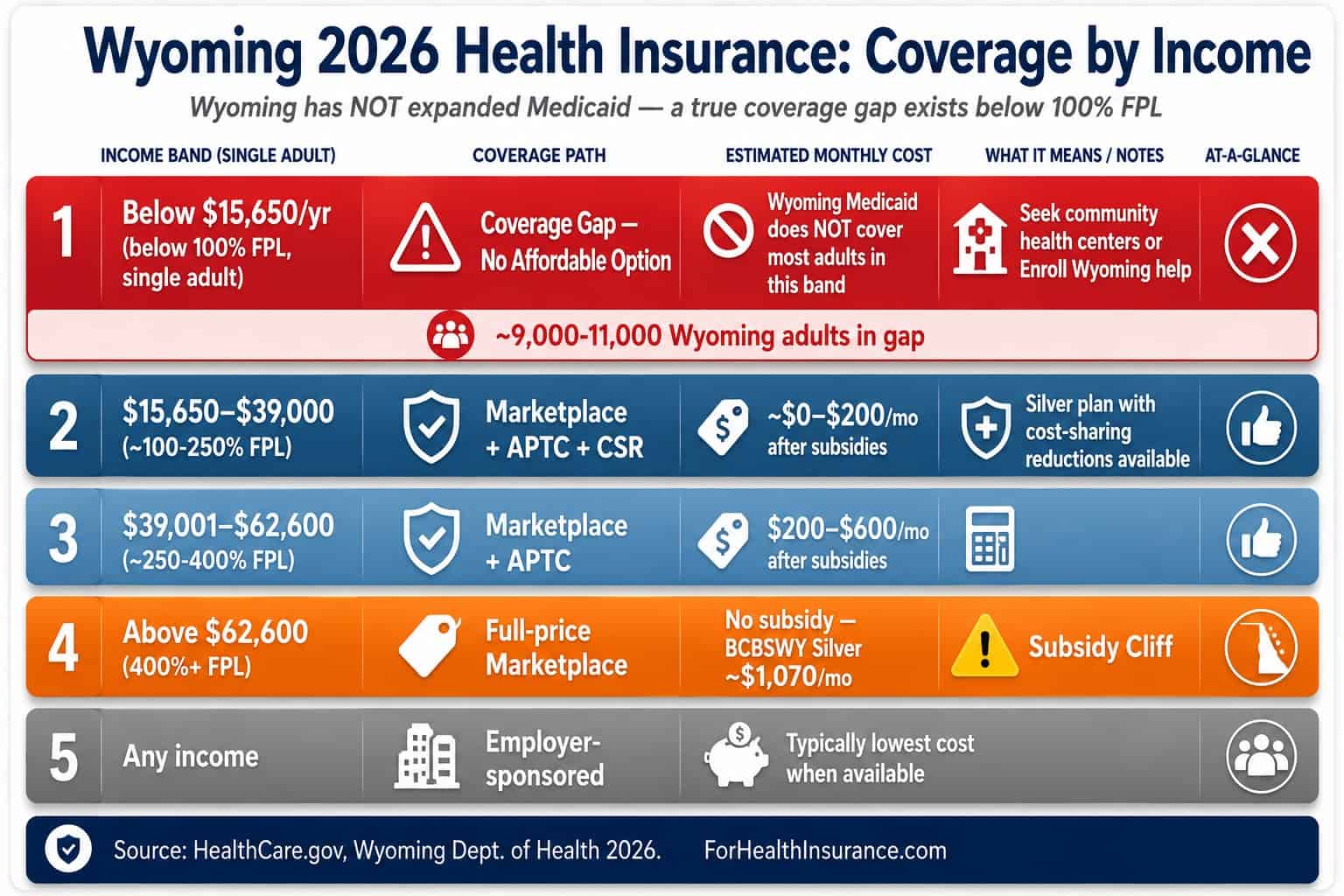
Wyoming is one of ten states that have not expanded Medicaid, leaving an estimated 9,000 to 11,000 Wyoming adults in a true coverage gap with no affordable insurance option. Adults below 100 percent of FPL ($15,650 for a single adult in 2026) cannot access marketplace subsidies, and most do not qualify for Wyoming Medicaid. Kid Care CHIP covers children to 205 percent of FPL. Wyoming parents with dependents qualify for Medicaid only up to 47 percent of FPL.
Wyoming’s Medicaid non-expansion status has been debated in the state legislature repeatedly since the ACA passed — and rejected each time. In the 2022 budget session, expansion legislation failed to get a House floor hearing. In 2023, another bill died in committee. Wyoming’s conservative legislature has consistently opposed expansion despite the federal government covering 90 percent of expansion costs, and despite projections by the Wyoming Department of Health that expansion would provide coverage to approximately 19,000 Wyoming residents at a net state cost of approximately $22 million every two years. The Wyoming Department of Health (health.wyo.gov) administers Medicaid; applications go through the Department of Family Services at dfsweb.wyo.gov or by calling 1-800-251-1269.
Wyoming’s true coverage gap — approximately 9,000-11,000 adults
Wyoming adults in the coverage gap earn below 100 percent of the federal poverty level (approximately $15,650 for a single adult in 2026) and have no affordable health insurance option: they earn too little to qualify for marketplace premium tax credits (which require income of at least 100 percent of FPL), and too much or lack the family status to qualify for Wyoming Medicaid. This group includes low-wage service workers in Jackson, Rock Springs, and Gillette; agricultural laborers; part-time workers; and early retirees. Community health centers — which charge on a sliding-fee scale regardless of insurance status — are the primary alternative. Enroll Wyoming (enrollwyo.org, 307-996-4797) provides free help exploring limited options.
Wyoming residents who do qualify for Medicaid apply through the Wyoming Department of Family Services, online at dfsweb.wyo.gov, or in person at local DFS county offices statewide. Kid Care CHIP — Wyoming’s Children’s Health Insurance Program — covers children in families earning up to approximately 205 percent of FPL (about $65,600 for a family of four in 2026). Pregnant women qualify for Wyoming Medicaid up to 159 percent of FPL, with 12-month postpartum coverage after delivery. Disabled and elderly Wyoming residents have separate eligibility pathways with different income and asset tests. Processing for standard applications takes up to 45 days; disability-related applications may take up to 90 days.
Wyoming Health Insurance Marketplace: BCBSWY vs UnitedHealthcare
Wyoming’s health insurance marketplace on HealthCare.gov offers plans from exactly two carriers for 2026: Blue Cross Blue Shield of Wyoming and UnitedHealthcare. BCBSWY’s PPO plans are the only PPO option in Wyoming and carry lower premiums than UHC. UHC’s EPO plans require strict in-network use outside emergencies but may provide access to a different provider network. About 41,545 Wyoming residents enrolled for 2026, down from prior years as enhanced subsidies expired.
BCBSWY is Wyoming’s dominant marketplace carrier — it is the only carrier that has offered ACA marketplace plans continuously since 2014, and it offers the only PPO plans in Wyoming. BCBSWY’s PPO structure allows Wyoming members to use any provider nationwide who accepts their insurance, with higher cost-sharing for out-of-network care. This flexibility is particularly valuable for Wyoming residents who live near state borders — near South Dakota in the east, Colorado in the south, Idaho and Montana in the northwest — or who travel to larger metropolitan areas for specialty care in Denver, Salt Lake City, or Billings. BCBSWY is a not-for-profit, purpose-driven insurer headquartered in Cheyenne and licensed by the Wyoming Insurance Department. As of May 2026, new CEO Kris Urbanek leads BCBSWY following the retirement of longtime CEO Diane Gore.
UnitedHealthcare entered the Wyoming marketplace for 2025 and continues for 2026 with EPO plans. UHC’s EPO structure covers only in-network providers (outside of emergency care) — a meaningful limitation in Wyoming’s rural landscape where provider networks can be thin in counties far from Casper, Cheyenne, Laramie, and Gillette. However, UHC’s national network can be an advantage for Wyoming residents who receive specialty care at large academic medical centers in Denver or Salt Lake City that may be in UHC’s national network even if not contracted for Wyoming PPO purposes. Verify your specific providers in UHC’s EPO network directory before enrolling.
Mountain Health CO-OP exit: what former members need to know
Mountain Health CO-OP covered approximately 9,600 Wyoming residents in 2025 before exiting the Wyoming market at the end of 2025. Former Mountain Health members who took no action during open enrollment were auto-enrolled by BCBSWY in a comparable plan per CMS auto-enrollment rules. If you were a Mountain Health member, verify your current BCBSWY plan through HealthCare.gov or by calling BCBSWY directly — confirm the network covers your existing providers, confirm your premium and deductible, and verify your subsidy amount has been updated to reflect the new plan’s premium.
Get a 2026 Wyoming Health Insurance Quote
A licensed Wyoming agent compares BCBSWY PPO and UnitedHealthcare EPO plans side by side with your exact subsidy applied, verifies your providers are in-network, and confirms your best option across Wyoming’s two-carrier marketplace. Free, no obligation for Wyoming residents.
How Much Does Wyoming Health Insurance Cost in 2026?
Wyoming health insurance premiums are among the highest in the country at full price. BCBSWY’s Silver PPO costs approximately $1,070 per month for a 40-year-old in 2026 — and unusually, BCBSWY’s Gold PPO at approximately $980 per month is cheaper than its Silver plan. Most Wyoming marketplace enrollees qualify for federal premium tax credits that substantially reduce these premiums. A single Wyoming adult earning $35,000 typically pays far below the full sticker price after subsidies.
| 2026 Wyoming Plan (40-yr-old) | Carrier | Type | Monthly Premium |
|---|---|---|---|
| Gold PPO | BCBSWY | PPO | ~$980/mo |
| Silver PPO | BCBSWY | PPO | ~$1,070/mo |
| Bronze PPO (HSA-eligible) | BCBSWY | PPO | ~$700–$800/mo |
| Silver EPO | UnitedHealthcare | EPO | Higher than BCBSWY |
| Bronze EPO | UnitedHealthcare | EPO | Higher than BCBSWY Bronze |
Wyoming’s unusual Gold-cheaper-than-Silver pricing reflects how BCBSWY has structured its 2026 rate filings. In most states, premiums increase from Bronze to Silver to Gold as actuarial value rises. In Wyoming, BCBSWY’s Gold plan is priced approximately $90 per month lower than its Silver plan for a 40-year-old — making Gold a compelling choice for Wyoming residents above the cost-sharing reduction threshold (250 percent of FPL) who expect moderate health utilization. For Wyoming residents between 100 and 250 percent of FPL who qualify for cost-sharing reductions, the Silver plan remains the right choice — Silver CSR plans dramatically reduce deductibles and out-of-pocket maximums in ways the Gold plan does not replicate. For the complete Wyoming affordability analysis, including subsidy examples by income and the 2026 subsidy cliff, see the affordable Wyoming health insurance guide.
Individual and Self-Employed Health Insurance in Wyoming
Individual health insurance in Wyoming for self-employed residents — ranchers, energy contractors, consultants, outfitters, and sole proprietors — runs through Wyoming marketplace plans from BCBSWY or UHC. Subsidy eligibility is based on net Schedule C income after business deductions. The IRS above-the-line self-employed health insurance deduction lowers MAGI and can significantly increase marketplace subsidy eligibility for Wyoming’s large self-employed agricultural and energy sectors.
Wyoming has a large self-employed and independent-contractor workforce concentrated in energy (Wamsutter, Pinedale, Gillette, Casper), ranching (across Carbon, Goshen, Platte, and Laramie counties), outfitting and tourism (Jackson Hole, Cody, Sheridan), and professional services. Self-employed Wyoming residents who file Schedule C can deduct health insurance premiums as an above-the-line adjustment on Form 1040, reducing modified adjusted gross income and potentially shifting them into higher subsidy eligibility. A Wyoming ranch operator earning $75,000 gross who deducts $12,000 of health insurance premiums reduces MAGI to $63,000 — just above the 400 percent FPL cliff for a single adult. Careful income planning around the 400 percent FPL threshold ($62,600 for a single adult in 2026) is especially valuable in Wyoming given the extreme premium differential between subsidized and full-price coverage. Wyoming’s agricultural economy and the state’s lack of a state income tax also create unique planning considerations for ranch operators and energy contractors whose income varies significantly year to year.
Small Business Health Insurance in Wyoming
Small business health insurance in Wyoming is available through BCBSWY and UnitedHealthcare group plans, the SHOP marketplace for tax credit eligibility, or ICHRA and QSEHRA arrangements. Wyoming employers with fewer than 50 full-time-equivalent employees have no ACA mandate to offer coverage. Wyoming’s dominant private employers in energy, agriculture, tourism, and healthcare rely on group coverage as a recruiting tool in a competitive labor market for skilled workers.
BCBSWY dominates Wyoming’s small group market as the state’s largest commercial insurer with the broadest provider network — for affordability analysis see the affordable Wyoming health insurance guide — across Wyoming’s rural hospital landscape — Wyoming Medical Center in Casper, Cheyenne Regional Medical Center, St. John’s Medical Center in Jackson, Memorial Hospital of Sweetwater County in Rock Springs, Campbell County Health in Gillette, and critical-access hospitals across the state’s 23 counties. UnitedHealthcare also offers small group products in Wyoming. The SHOP Marketplace through HealthCare.gov is available to Wyoming employers with 1 to 50 FTEs and provides access to the Small Business Health Care Tax Credit — worth up to 50 percent of employer premium contributions for businesses with fewer than 25 FTEs paying average wages below $62,000. Wyoming’s energy sector employers — which typically pay well above this average wage threshold — rarely qualify for the SHOP credit but may benefit from ICHRA arrangements that provide flexible, employee-directed coverage across Wyoming’s diverse geography.
How to Get Health Insurance in Wyoming
Getting Wyoming health insurance follows four steps: check Wyoming Medicaid and Kid Care CHIP eligibility first (if income is below 100 percent of FPL, be aware of the coverage gap); enroll through HealthCare.gov for marketplace coverage if income is above 100 percent of FPL; compare BCBSWY PPO and UHC EPO plans with your subsidy applied; and verify your providers are in-network before selecting. Enroll Wyoming provides free enrollment help statewide.
Wyoming residents who earn below 100 percent of FPL — and those in the coverage gap — should first contact Enroll Wyoming (enrollwyo.org, 307-996-4797) — the nonprofit provides free assistance and can help explore community health center options, charity care programs, and any limited Medicaid pathways that may apply. Wyoming Medicaid applications go through the Department of Family Services; the online portal is at dfsweb.wyo.gov. Wyoming residents who earn above 100 percent of FPL and do not have affordable employer coverage should enroll through HealthCare.gov, which auto-screens for Wyoming Medicaid eligibility before presenting marketplace plan options. A licensed Wyoming insurance agent can compare BCBSWY and UHC plans side by side, calculate the exact premium tax credit, and verify providers at no cost to the consumer — broker compensation is paid by the carrier. Open enrollment for 2027 coverage runs November 1 through December 15, 2026, under the federal shortened window.
Frequently Asked Questions
Common questions about Wyoming health insurance cover 2026 premium costs, whether Wyoming expanded Medicaid, which two carriers participate in the marketplace, when open enrollment runs, whether Wyoming has a coverage penalty, and what the Medicaid coverage gap means for low-income Wyoming adults who have no affordable insurance option.
How much does health insurance cost in Wyoming in 2026?
Wyoming has among the most expensive individual health insurance premiums in the country. Blue Cross Blue Shield of Wyoming’s Silver PPO plan runs approximately $1,070 per month for a 40-year-old at full price in 2026, and the Gold PPO plan costs approximately $980 per month — unusually, Gold is cheaper than Silver in Wyoming. UnitedHealthcare’s EPO plans are priced higher than BCBSWY. The weighted average rate increase for 2026 was 25.9 percent. Most Wyoming marketplace enrollees qualify for federal premium tax credits that offset a substantial portion of these premiums — a single adult earning $35,000 per year typically pays far less than the full sticker price after subsidy.
Did Wyoming expand Medicaid under the ACA?
No. Wyoming is one of ten states that have not expanded Medicaid under the Affordable Care Act as of 2026. Wyoming’s legislature has rejected Medicaid expansion repeatedly. This creates a genuine coverage gap: adults earning below 100 percent of the federal poverty level (approximately $15,650 for a single adult) do not qualify for Wyoming Medicaid unless they have dependent children (and even then only up to 47 percent of FPL) or qualify on disability or age grounds. They also do not qualify for marketplace premium tax credits, which require income of at least 100 percent of FPL. An estimated 9,000 to 11,000 Wyoming adults fall into this gap with no affordable coverage option.
Which carriers sell health insurance in Wyoming for 2026?
Two carriers offer 2026 Wyoming marketplace plans through HealthCare.gov: Blue Cross Blue Shield of Wyoming (BCBSWY) and UnitedHealthcare. Mountain Health CO-OP, which covered approximately 9,600 Wyoming residents in 2025, exited the Wyoming market entirely at the end of 2025 — former Mountain Health members were auto-enrolled in a comparable BCBSWY plan. BCBSWY offers the only PPO plans in Wyoming across Bronze, Silver, and Gold tiers. UnitedHealthcare offers EPO plans. Both carriers serve the full state.
When is open enrollment for Wyoming health insurance?
Open enrollment for 2026 Wyoming marketplace coverage ran November 1, 2025 through January 15, 2026 — that window is now closed. Open enrollment for 2027 coverage runs November 1 through December 15, 2026, under the federal rule change shortening the window. Outside open enrollment, Wyoming residents can enroll only through a Special Enrollment Period triggered by a qualifying life event such as job loss, marriage, birth, or relocation. Wyoming Medicaid enrollment is open year-round for those who qualify — apply through the Wyoming Department of Health or the Department of Family Services.
Does Wyoming have a penalty for not having health insurance?
No. Wyoming does not have a state individual mandate penalty for going uninsured, and the federal individual mandate penalty has been $0 since 2019. Wyoming residents who go without qualifying health insurance face no tax penalty at the state or federal level. Wyoming is among the majority of states that have not enacted their own coverage requirement. However, uninsured Wyoming residents are fully liable for medical costs — in Wyoming’s rural hospital landscape, a single emergency or hospitalization at Wyoming Medical Center in Casper, Cheyenne Regional Medical Center, or another major Wyoming facility can easily exceed $20,000 to $100,000.
What is the Wyoming Medicaid coverage gap?
The Wyoming Medicaid coverage gap affects an estimated 9,000 to 11,000 Wyoming adults who earn below 100 percent of the federal poverty level (approximately $15,650 for a single adult in 2026) but do not qualify for Wyoming Medicaid. Wyoming has not expanded Medicaid, so non-disabled childless adults are essentially ineligible for Medicaid regardless of income. Adults in this gap also cannot receive marketplace premium tax credits — which require income of at least 100 percent of FPL. Enroll Wyoming (enrollwyo.org, 307-996-4797) can help residents in the gap explore limited coverage options including community health centers and other resources.
Compare Wyoming Health Insurance Options
A licensed Wyoming agent compares BCBSWY PPO and UnitedHealthcare EPO plans with your exact subsidy applied, screens for Wyoming Medicaid and Kid Care CHIP eligibility, and confirms your providers before enrollment. Free, no obligation for Wyoming residents statewide.
Free Wyoming coverage comparison — marketplace, Medicaid, employer, and short-term in one call.
More on Wyoming Health Insurance
HealthCare.gov enrollment, BCBSWY vs UHC comparison, subsidies, and open enrollment dates.
Affordable Wyoming Health InsuranceCoverage gap, subsidy eligibility, CSR Silver plans, and the 2026 subsidy cliff for WY residents.
PPO Health Insurance PlansNational PPO options — BCBSWY is Wyoming’s only marketplace PPO for 2026.
HealthCare.gov (Official)Enroll in Wyoming marketplace coverage or check Medicaid eligibility.
Enroll WyomingFree Wyoming enrollment assistance — navigators statewide, 307-996-4797.
Wyoming Medicaid (Official)Wyoming Department of Health Medicaid program — eligibility and application information.
Wyoming Marketplace Enrollment GuideStep-by-step HealthCare.gov enrollment, BCBSWY vs UHC comparison, and 2026 subsidy calculation.
Affordable Wyoming Health InsuranceCoverage gap explained, CSR Silver plans, subsidy examples, and the 2026 subsidy cliff.
Broker Disclosure
ForHealthInsurance.com is an independent health insurance agency serving Wyoming residents. We are not affiliated with any carrier or government agency. We help you compare plans and enroll in coverage that meets your needs at no extra cost to you.