Maine Health Insurance Marketplace: CoverME.gov Enrollment Guide for 2026
CoverME.gov is Maine’s state-based health insurance marketplace, where residents can compare plans from four carriers, check subsidy eligibility, and enroll in coverage. This guide walks through how the marketplace works, what changed for 2026, and how to get the most out of Maine’s Clear Choice standardized plan designs when shopping for coverage.

What do you need help with?
What Is CoverME.gov and How Does It Work?
CoverME.gov is Maine’s official state-based health insurance marketplace, operated by the Department of Health and Human Services’ Office of the Health Insurance Marketplace (OHIM). Launched as a fully state-run platform in 2022, CoverME.gov is where Maine residents compare and purchase ACA-compliant health plans from four private carriers, apply for premium tax credits and cost-sharing reductions, and determine eligibility for MaineCare. During the 2026 open enrollment period, 58,523 Mainers selected plans through the platform.
Maine transitioned from the federal HealthCare.gov platform to its own state-based marketplace over several years — operating on the federal platform from 2014 to 2020, shifting to a hybrid federal-state model for the 2021 plan year, and fully launching CoverME.gov for the 2022 plan year. Running its own marketplace allows Maine to customize outreach, extend enrollment assistance, and capture federal administrative funding that previously went to Washington. The Office of the Health Insurance Marketplace oversees the platform, while a licensed agent can guide you through plan selection, subsidy verification, and enrollment at no cost to you.
Unlike HealthCare.gov states where plan designs vary widely between carriers, Maine requires most marketplace plans to follow Clear Choice standardized designs — meaning the deductible, copays, and out-of-pocket maximum are identical across carriers at the same metal tier. This makes the Maine health insurance marketplace simpler to navigate than most: once you choose a metal tier, the main decision is which carrier’s provider network best covers your doctors and hospitals.
Plans Available on the Maine Health Insurance Marketplace
The Maine health insurance marketplace offers plans across five coverage levels: Catastrophic (limited to adults under 30 or those with a hardship exemption), Bronze, Silver, Gold, and Platinum. Four carriers participate in CoverME.gov for 2026 — Anthem Health Plans of Maine, Harvard Pilgrim Health Care, Community Health Options, and Mending. Anthem, Harvard Pilgrim, and CHO are available statewide, while Mending covers 10 of Maine’s 16 counties.
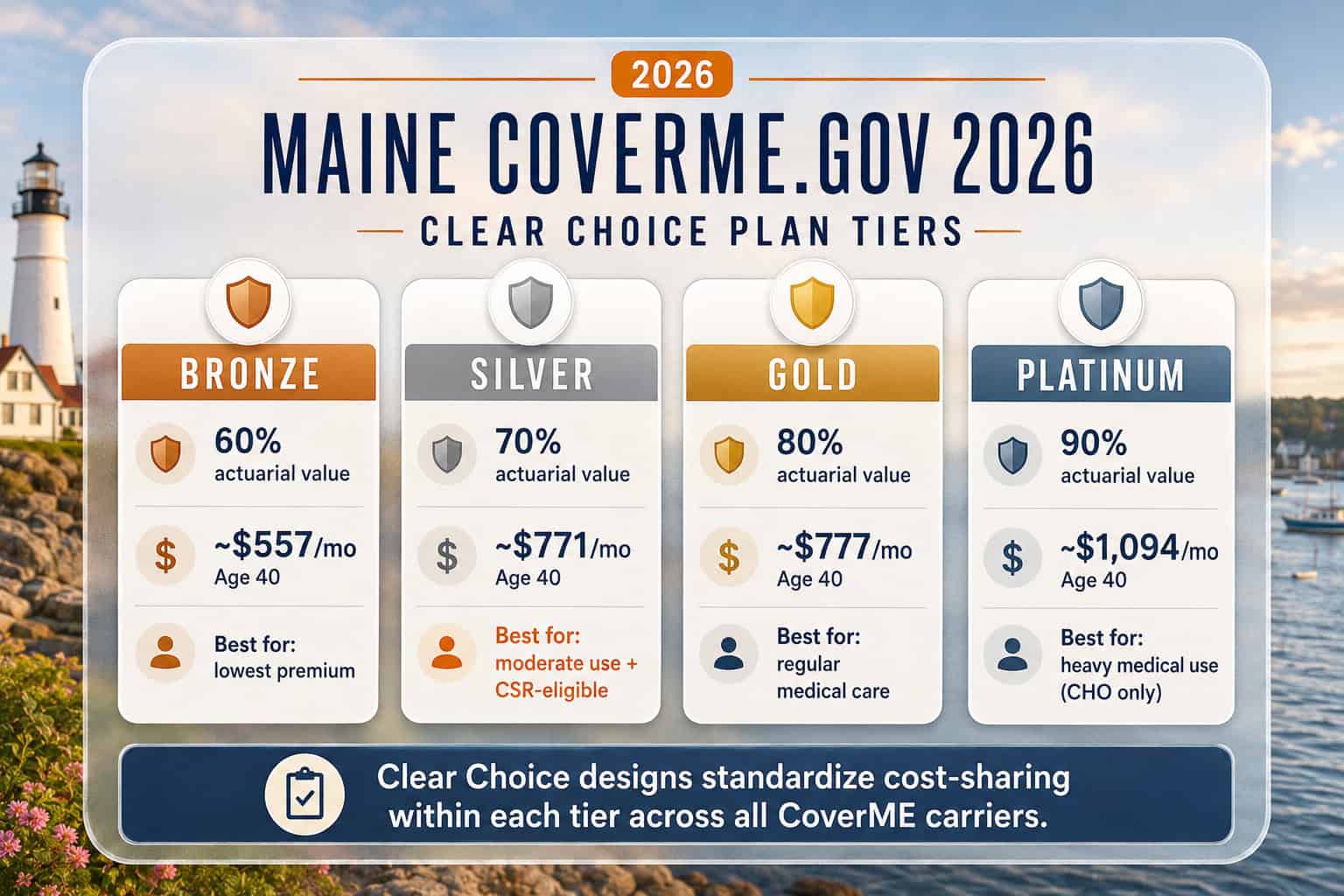
The Clear Choice standardized plan designs, established by the Maine Bureau of Insurance under Rule 851, are what set the Maine health insurance marketplace apart from most states. Within a given metal tier, all carriers must offer the same deductible, copay structure, and out-of-pocket maximum. This means a Silver plan from Anthem and a Silver plan from Harvard Pilgrim cover the same percentage of costs with the same cost-sharing schedule — the differences are premium price and provider network only. For consumers accustomed to sifting through dozens of plan variations in other states, Maine’s approach dramatically simplifies the comparison process.
Community Health Options is the sole carrier offering Platinum plans on CoverME.gov — making CHO the only marketplace option for residents who want 90% actuarial value coverage. CHO is also one of just three ACA-created CO-OPs still operating anywhere in the country, offering a member-governed alternative to the larger national carriers. The Maine carrier comparison guide breaks down network differences, customer satisfaction, and pricing between all four marketplace carriers.
Short-term health insurance is not sold in Maine
Some Maine residents searching for marketplace alternatives ask about short-term, limited-duration health plans. Maine technically allows these products, but no carriers currently sell them in the state as of 2026 — confirmed by the Maine Bureau of Insurance. The marketplace alternatives for someone who missed open enrollment are a special enrollment period on CoverME.gov tied to a qualifying life event (job loss, marriage, birth, move, loss of other coverage), MaineCare for income-eligible residents, or COBRA continuation through a former employer.
For Maine residents who want plan quotes before enrolling, CoverME.gov offers a Window Shopping tool that returns estimated premiums and subsidy amounts based on age, household income, and county — no account required. The marketplace pricing engine is the authoritative source for Maine health insurance marketplace quotes; private quote sites pull from the same underlying carrier rates but may not show all Clear Choice plans or accurately reflect subsidy eligibility.
How to Enroll on CoverME.gov
Enrollment on the Maine health insurance marketplace follows a four-step process: create an account on CoverME.gov, complete an application with income and household information, compare plans using the Plan Comparison Tool, and select a plan and pay the first premium. Open enrollment for 2026 coverage ran from November 1, 2025 through January 15, 2026. Plans selected by December 15 started January 1; plans selected by January 15 started February 1.
Create your CoverME.gov account
Visit CoverME.gov and create an account with your email address. You’ll need Social Security numbers for all household members being covered, immigration documentation if applicable, employer information, and estimated 2026 income for your household. CoverME.gov added mobile password reset functionality for the 2026 enrollment period and requires 14-character passwords for security.
Complete your application
The application determines your eligibility for three things: marketplace plans, premium tax credits, and MaineCare. If your income falls below 138% FPL (approximately $21,597 for an individual), you’ll be directed to MaineCare. If you earn between 100% and 400% FPL ($15,060–$60,240 for an individual), you’ll see your estimated monthly subsidy. The system also checks cost-sharing reduction eligibility for Silver plans.
Compare plans with the Plan Comparison Tool
CoverME’s Plan Comparison Tool filters available plans by your county, shows after-subsidy premiums, and lets you check if your doctors and medications are covered. Because of Clear Choice standardized designs, plans at the same metal tier share identical cost-sharing — so the comparison focuses on carrier network and premium price. In counties where all four carriers operate, you may see 15–20 plan options across tiers.
Select your plan and pay the first premium
After selecting a plan, pay your first month’s premium to activate coverage. Coverage effective dates depend on when you enroll — during open enrollment, December 15 is the deadline for January 1 coverage. For new Harvard Pilgrim enrollees, first payment is made through their unique Payment Portal link. CoverME.gov now sends automated SMS notifications when notices are posted to your account.
Compare CoverME.gov Plans for Your County
See after-subsidy prices from Anthem, Harvard Pilgrim, CHO, and Mending. Check which plans cover your doctors and find the best value for your situation.
Financial Assistance on the Maine Marketplace
Premium tax credits and cost-sharing reductions are available to CoverME.gov enrollees based on household income. In 2026, 75% of marketplace enrollees receive Advance Premium Tax Credits averaging $772 per month — reducing the average net premium to $178. Cost-sharing reductions, which lower deductibles and copays on Silver plans, are available to households earning between 100% and 250% of the Federal Poverty Level.
The financial assistance landscape shifted significantly for 2026 after Enhanced Premium Tax Credits expired at the end of 2025. These enhanced credits, in place since 2021, had expanded subsidy eligibility to higher-income households and capped premiums at 8.5% of income regardless of earnings. Without them, households above 400% FPL ($60,240 for an individual) no longer receive any subsidy — and those between 300% and 400% FPL see reduced assistance. During the 2026 open enrollment, more than 3,000 previously subsidized CoverME enrollees discovered they no longer qualified for any tax credits under the new rules.
For those who still qualify, premium tax credits work the same way: CoverME.gov calculates your expected premium contribution based on income as a percentage of FPL, and the credit covers the difference between that amount and the cost of the second-lowest-cost Silver plan (the “benchmark plan”) in your county. An individual in Kennebec County earning $30,000 (approximately 199% FPL) would pay roughly 6% of income — about $150/month — toward the benchmark Silver plan, with the credit covering the rest. The affordable coverage guide includes detailed subsidy tables by income bracket.
| Household Income (Individual) | % of FPL (2026) | Premium Tax Credit | Cost-Sharing Reductions |
|---|---|---|---|
| Under $21,597 | Under 138% | MaineCare eligible — no marketplace subsidy | N/A (MaineCare) |
| $21,597–$30,120 | 138%–200% | Yes — largest credits, net premium ~$50–$150/month | Yes — Silver plans have reduced deductibles and copays |
| $30,120–$45,180 | 200%–300% | Yes — moderate credits | Yes (200–250% FPL) / No (250–300%) |
| $45,180–$60,240 | 300%–400% | Yes — reduced credits | No |
| Over $60,240 | Over 400% | No — full price (EPTC expired) | No |
Bronze plan shift in 2026
With reduced subsidies, nearly half of subsidized CoverME enrollees chose Bronze plans for 2026 — a significant shift from prior years when most selected Silver or Gold. Bronze plans have the lowest premiums but the highest deductibles ($7,000–$9,200). If your income qualifies for cost-sharing reductions (under 250% FPL), a Silver plan may actually cost less overall because CSRs dramatically reduce your deductible and copays.
Special Enrollment Periods on CoverME.gov
Outside of open enrollment, Maine residents can enroll on CoverME.gov through a special enrollment period (SEP) triggered by a qualifying life event. Common qualifying events include losing other health coverage, getting married, having a baby, moving to a new county, or losing MaineCare eligibility. Maine is one of a small number of states where pregnancy itself — not just the birth — qualifies as a special enrollment event, allowing expectant mothers to enroll as soon as pregnancy is confirmed.
Special enrollment periods typically last 60 days from the date of the qualifying life event. For Maine residents transitioning off MaineCare — a common pattern for seasonal workers in industries like lobster fishing, tourism, and blueberry harvesting whose income fluctuates throughout the year — CoverME.gov offers a dedicated “Recently Lost MaineCare” SEP accessible directly from the enrollment portal. This pathway has become increasingly important as MaineCare’s post-pandemic redetermination process continues to move people between Medicaid and marketplace coverage.
Native Americans enrolled in or eligible for Indian Health Service coverage can enroll in or change CoverME.gov plans at any time — there is no enrollment period restriction. This is a federal provision that applies across all states but is particularly relevant in Maine, which has significant Wabanaki communities including the Penobscot Nation, Passamaquoddy Tribe, Maliseet Nation, and Micmac Nation.
Example: Seasonal Worker in Hancock County
A 42-year-old restaurant worker in Hancock County earns approximately $16,000 during the off-season (October–April) and $38,000 during the summer tourist season (May–September). During the low-income months, she qualifies for MaineCare. When summer income pushes her above the 138% FPL threshold, she loses MaineCare eligibility and transitions to a subsidized Anthem Silver plan on CoverME.gov through the MaineCare loss SEP — paying roughly $130/month after a tax credit of approximately $640/month. This annual transition between MaineCare and marketplace coverage is a pattern that CoverME.gov is specifically designed to handle.
What Changed on the Maine Marketplace for 2026
The 2026 plan year brought several significant changes to the Maine health insurance marketplace: a weighted average premium increase of 23.9%, the expiration of Enhanced Premium Tax Credits, a reduction in MGARA reinsurance coverage from 75% to 60% of eligible claims, Mending’s expansion into six new counties, and stricter CMS enrollment verification rules. Total enrollment dropped 9.5% to 58,523 — the lowest since CoverME launched as a state-based marketplace.
The premium increases vary by carrier. Anthem’s individual market rates increased approximately 20.3%, Harvard Pilgrim approximately 21.5%, Community Health Options 21.2% (after initially requesting nearly 30%), and Mending 32.2%. These increases reflect rising healthcare costs — Northern Light Health projects 30% higher costs over three years — combined with the MGARA reinsurance program covering a smaller share of high-cost claims (60% versus 75% in 2024–2025) and actuarial adjustments for expected risk pool deterioration as healthier enrollees leave the market.
For unsubsidized enrollees, premiums rose approximately 33% on average. More than 8,000 consumers canceled CoverME coverage during the 2026 enrollment period, with about a third citing affordability. The full enrollment impact may not appear until later in 2026 — consumers receiving subsidies who fall behind on premium payments have a three-month grace period before carriers can terminate coverage.
Upcoming enrollment change
A new federal rule will shorten the open enrollment period starting in fall 2026. Beginning with the 2027 plan year, open enrollment will no longer extend past December 31 — all plan selections must be made by that date, and all plans will take effect January 1. The current January 15 deadline with February 1 coverage start will no longer be available.
Frequently Asked Questions About the Maine Health Insurance Marketplace
What is CoverME.gov?
CoverME.gov is Maine’s official state-based health insurance marketplace, operated by the Department of Health and Human Services. It launched as a fully state-run platform for the 2022 plan year after transitioning from the federal HealthCare.gov platform. Maine residents use CoverME.gov to compare health plans from four private carriers, apply for premium tax credits and cost-sharing reductions, and check MaineCare eligibility.
When can I enroll on the Maine marketplace?
Open enrollment for 2026 coverage ran from November 1, 2025 through January 15, 2026. Outside of open enrollment, you need a qualifying life event to trigger a 60-day special enrollment period — such as losing other coverage, getting married, having a baby, or moving. Maine also recognizes pregnancy as a qualifying event, allowing enrollment as soon as pregnancy is confirmed. Starting with the 2027 plan year, a new federal rule will end open enrollment on December 31 instead of January 15.
What are Clear Choice plans on CoverME.gov?
Clear Choice plans are Maine’s standardized plan designs, required by the Bureau of Insurance under Rule 851. Within each metal tier (Bronze, Silver, Gold, Platinum), all carriers must offer the same deductible, copay structure, and out-of-pocket maximum. This means the only meaningful differences between carriers at the same tier are premium price and provider network — simplifying comparison shopping significantly compared to states without standardized designs.
How many carriers are on the Maine marketplace?
Four carriers offer plans through CoverME.gov for 2026: Anthem Health Plans of Maine, Harvard Pilgrim Health Care, Community Health Options (CHO), and Mending (formerly Taro Health). Anthem, Harvard Pilgrim, and CHO are available in all 16 Maine counties. Mending expanded to 10 counties for 2026 — including Androscoggin, Cumberland, Franklin, Kennebec, Knox, Lincoln, Oxford, Sagadahoc, Waldo, and York. CHO is the only carrier offering Platinum plans.
Can I still get subsidies on CoverME.gov in 2026?
Yes — 75% of CoverME.gov enrollees receive premium tax credits in 2026, averaging $772 per month. However, Enhanced Premium Tax Credits expired at the end of 2025, which means households above 400% FPL (over $60,240 for an individual) no longer qualify for any subsidy, and some previously eligible households receive smaller credits. Cost-sharing reductions that lower deductibles and copays on Silver plans remain available for incomes between 100% and 250% FPL.
What if I lose MaineCare coverage?
If you lose MaineCare eligibility due to income changes, you qualify for a special enrollment period on CoverME.gov. Log in to your CoverME account and select “Recently Lost MaineCare” from the special enrollment period options. You typically have 60 days from the date of MaineCare termination to enroll in a marketplace plan. Depending on your income, you may qualify for premium tax credits to reduce your monthly costs.
More Maine Health Insurance Guides
CoverME.gov is one part of Maine’s coverage landscape. These guides cover the statewide overview, low-cost and subsidy options, small business and group plans, and nationwide PPO coverage for residents who travel or work across state lines.
Plans, carriers, costs, and enrollment across the Pine Tree State.
Low-Cost Coverage & Subsidy OptionsSubsidies, cost-sharing reductions, and strategies to cut premiums.
Small Business & Group Plans in MaineGroup coverage, SHOP tax credits, and ICHRA options for employers.
Nationwide PPO Health InsuranceOut-of-network flexibility and broader provider access nationwide.
Find Your Plan on CoverME.gov
Compare marketplace plans from all four Maine carriers, check subsidy eligibility, and get enrollment help at no cost.
Broker Disclosure
ForHealthInsurance.com is an independent health insurance agency serving Maine residents. We are not affiliated with any carrier or government agency. We help you compare plans and enroll in coverage that meets your needs at no extra cost to you.